Contents — find the section you need
Background and reading guide
Background Units used in specifications, such as voltage, current, distance and time.
Fundamentals · Explanations of principles, structure and trade-offs.
An ultrasonic sensor emits an ultrasonic pulse — a high-frequency sound wave above the range of human hearing — and computes distance to a target from the time it takes for the pulse's reflection to return. In principle, it's the acoustic counterpart to LiDAR: where LiDAR measures the round-trip time of light, an ultrasonic sensor measures the round-trip time of sound. Its most common application is embedding several units around a vehicle's front, rear, and corners for obstacle detection while parking (parking sensors, clearance sonar) — but the principle traces back to research into bat biology, and its practical origin traces back to submarine detection in the First World War.
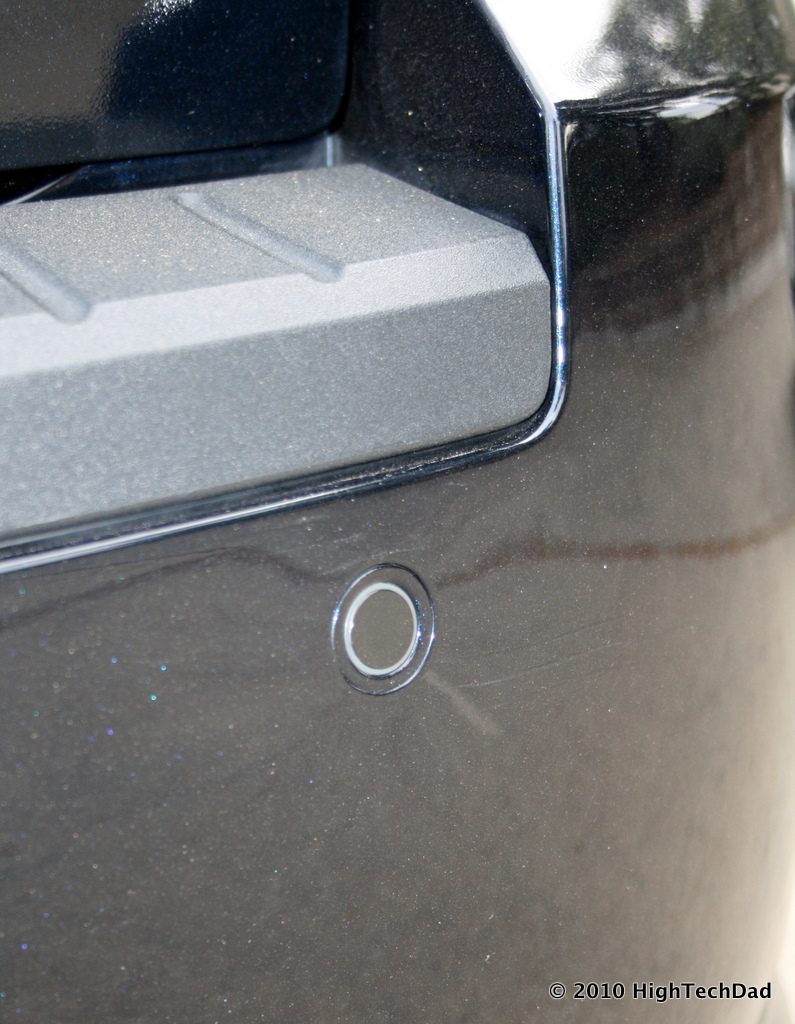 Ford Flex rear parking sensor
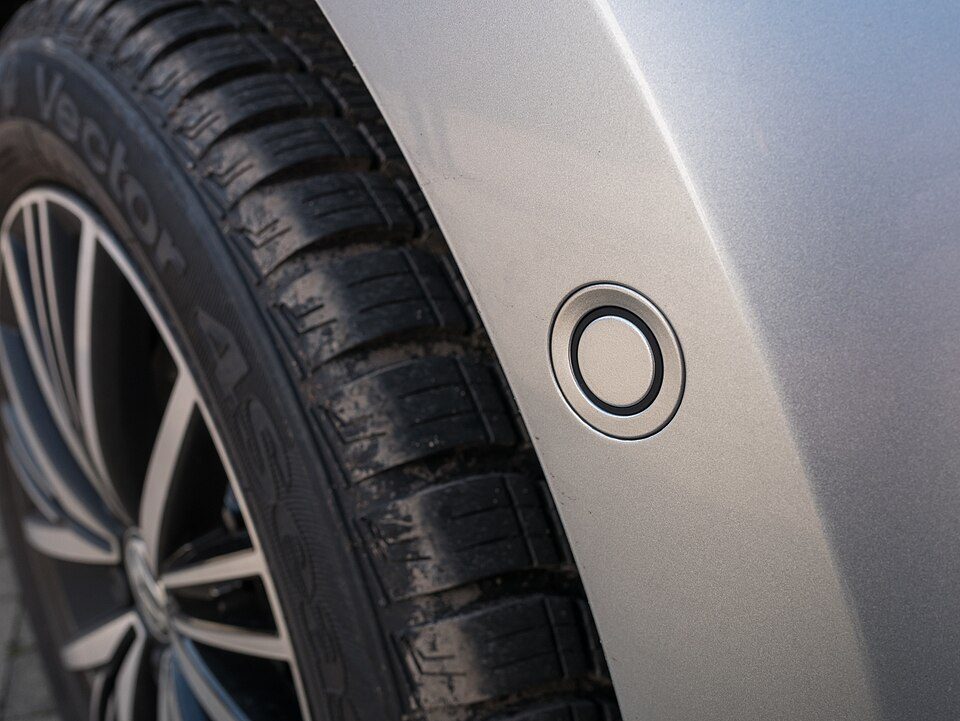 VW Golf VII side parking sensor
Images: Ford Flex rear parking sensor (Michael Sheehan, CC BY 2.0) / VW Golf VII side parking sensor (Basotxerri, CC BY-SA 4.0), Wikimedia Commons.


Principle: time-of-flight ranging, corrected for the temperature dependence of the speed of sound
An ultrasonic sensor vibrates a piezoelectric element to emit an ultrasonic pulse, then picks up the reflection off a target using the same piezoelectric element (or a separate receiving element). Distance d to the target is computed from the time-of-flight t — the interval between emitting the pulse and receiving its reflection — and the speed of sound v.
Dividing by two to account for the round trip is the same as LiDAR's time-of-flight ranging, but ultrasonic sensors carry a distinctive caveat: the speed of sound v itself changes with air temperature. The speed of sound in dry air can be approximated by:
where T is the air temperature in Celsius. Because the speed of sound shifts by roughly 0.6 m/s for every 1°C change in temperature, a product that operates across a wide temperature range — say -40 to 85°C, as is typical in automotive applications — will accumulate non-negligible ranging error if it computes distance without temperature correction. High-precision ultrasonic sensors measure ambient temperature in real time using a built-in temperature sensor and correct the speed of sound with this formula before computing distance.

Image: Principle diagram of bat echolocation (Marek M, based on originals by Shung, José Augusto, Rugby471, and JASC's WebDraw, CC BY-SA 3.0), Wikimedia Commons. An emitted sound wave (E) reflects off prey (B) as R, and the round-trip time of that reflection yields the distance (d) — a principle fundamentally identical to an engineered ultrasonic sensor's time-of-flight ranging.

Characteristics: strong against exactly what trips up optical sensors
An ultrasonic sensor's single greatest strength is that it can reliably detect the very targets that give optical sensors (cameras, LiDAR) the most trouble. A pane of transparent glass is hard for an optical sensor to detect, but sound reflects off glass just fine, so an ultrasonic sensor picks it up without issue. Likewise, a black object that absorbs light and is hard for a camera to recognize has no effect at all on an ultrasonic reflection. Stable operation at night or in fog is another strength it shares with radar. On the other hand, its effective range is short — tens of centimeters to a few meters — making it unsuitable for detecting fast-moving objects or distant obstacles. Given this "short-range specialist, all-weather, strong against glass and black objects" profile, an ultrasonic sensor is rarely a replacement for other sensors; it more often plays a complementary role specialized for close-range detection.
History: from bat biology research to First World War sonar
The principle of ultrasonic echolocation was discovered, surprisingly, not by engineers but by biologists studying bats. In 1794, Italian biologist Lazzaro Spallanzani demonstrated that blindfolded bats could still avoid obstacles in flight without relying on vision — considered the first scientific discovery of bats' echolocation ability. In 1876, British scientist Francis Galton invented the adjustable ultrasonic-generating "Galton whistle," which he used to study the range of frequencies audible to humans and other animals.
The trigger for its engineering application came, ironically, from the 1912 sinking of the Titanic. A few months after the Titanic sank following its collision with an iceberg, British scientist Lewis Richardson filed a patent for a device that would detect underwater icebergs using sound waves. Then, once the First World War broke out, French physicist Paul Langevin worked with Russian engineer Constantin Chilowski to develop, between 1915 and 1918, a device that used piezoelectric quartz crystals to transmit and receive ultrasonic pulses and detect submerged submarines out to ranges of up to 1,300 meters. This was the world's first practical active sonar — meaning a technology for artificially reproducing bat echolocation came to fruition, ironically enough, as a military technology for detecting enemy submarines. The technology later found further application in depth sounding and in medical ultrasound diagnostics.
Comparing key products by spec
| Product | Application | Object presence detection | Measurement range (min-max) | Frequency |
|---|---|---|---|---|
| Bosch Ultrasonic Sensor Gen 6.0 | Automotive (parking assist) | 6cm | 15cm-2.5m | 43-60kHz (variable) |
| Bosch Ultrasonic Sensor Gen 6.1 | Automotive (parking assist) | 6cm | 15cm-4.5m | 43-60kHz (variable) |
| Bosch Ultrasonic Sensor Gen 6.5 | Automotive (parking assist, automatic parking) | 3cm | 15cm-5.5m | 43-60kHz (variable) |
| Murata MA40S4S/MA40S4R | Robotics, industrial | — | 20cm-4m | 40kHz fixed, 80° directivity |
| MaxBotix LV-MaxSonar-EZ1 (MB1010) | Robotics, human detection | Effectively no dead zone (detects objects up to and touching the sensor face) | 15cm-6.45m | 42kHz, 20Hz read rate |
Bosch's Generation 6 ultrasonic sensor line is sold not just for obstacle detection while parking or maneuvering, but as the sensing basis for automatic braking and automatic parking features. Across generations, maximum measurement range has grown from 2.5m (Gen 6.0) to 4.5m (Gen 6.1) to 5.5m (Gen 6.5), while object-presence detection — the ability to sense an object's presence at very close range — has, conversely, tightened from 6cm to 3cm, reflecting a design intent to differentiate characteristics by application rather than simply chase higher performance across the board. Minimum measurement range stays fixed at 15cm across every generation — anything closer than that remains an inherent detection limit, a "dead zone." Bosch supplies this line to multiple automakers, including BMW, GM, Daimler, Volkswagen, Honda, Mazda, and Subaru.
Outside the automotive space, Japan's Murata sells the fixed-40kHz MA40S4S (transmitter) / MA40S4R (receiver) pair, which has become a staple in robotics and industrial sensing. Its 80-degree directivity and 20cm-4m detection range are a rough baseline for the standard spec of a general-purpose ultrasonic sensor used everywhere from Arduino/Raspberry Pi hobbyist robots to industrial equipment. The US-based MaxBotix's LV-MaxSonar-EZ1 (MB1010) markets itself as having "effectively no dead zone," able to detect a target even right up against the sensor face. That trait makes it valuable as a proximity sensor for robots that need to work right up against a wall or obstacle.
A real-world example: Toyota's Intelligent Clearance Sonar (ICS) — eight sensors to curb pedal misapplication
A real-world example of combining multiple ultrasonic sensors is Toyota's "Intelligent Clearance Sonar" (ICS). It uses four ultrasonic sensors each at the front and rear — eight in total — to detect surrounding obstacles, and triggers collision-mitigating braking when the driver mistakenly presses the accelerator instead of the brake at low speed. An enhancement was announced in November 2014, and starting with the 2015 Alphard, Vellfire, and subsequently the Prius, both the number of sensors and the detection range were increased, alongside improvements to the control software. According to a Toyota survey of accidents occurring between January 2015 and June 2016, vehicles equipped with ICS saw pedal-misapplication accidents fall by roughly 70% and reversing-related accidents fall by roughly 40%. Because it uses sound waves, ICS's ability to reliably detect a glass surface — like the front wall of a convenience store — is exactly what makes this use case work.
What Bats Can Teach the Next Generation of Micro-Robot Navigation
Research inspired by bat echolocation is still active well over a century later. An arXiv paper published around 2026, "Saranga: MilliWatt Ultrasound for Navigation in Visually Degraded Environments on Palm-Sized Aerial Robots," proposes an ultrasonic navigation system drawing only a few milliwatts of power for palm-sized micro aerial robots. It's motivated by the observation that mainstream sensors — cameras, event cameras, radar, LiDAR — all degrade in "visually degraded environments": direct sunlight, darkness, snow, glass, fog, dust. Sound-based navigation, by contrast, keeps functioning in exactly these conditions. In a related vein, a study called "BatDeck," published around 2024, reports an ultra-low-power obstacle-avoidance approach for nano-drones that uses only a single forward-facing ultrasonic sensor and, lacking any information about an obstacle's direction, achieves avoidance through random turning. It's a striking picture: in an era of robotics dominated by cameras and LiDAR, the classical principle of echolocation that bats have used for tens of millions of years is being reevaluated as a solution to thoroughly modern constraints — power budget and robustness to adverse environments.
A more everyday example: household robot vacuums sometimes use ultrasound for their "cliff detection" (fall-prevention) sensors too. Many products use infrared or PSD (position-sensitive detector) sensors instead, but ultrasonic-based variants also serve the role of detecting a drop-off like a stair edge to prevent the robot from falling. It's a good illustration of how the "short-range, low-cost, all-weather" profile of ultrasonic sensing has spread across a wide range of consumer devices — from automotive parking assistance to the safety mechanisms of household robots.
Parameters that determine performance
- Measurement range (maximum distance): As with the Bosch Gen 6.0-6.5 line, a range of a few meters is enough for basic parking assistance, but a longer range becomes advantageous when the sensor is meant to serve as the basis for automatic parking or automatic braking. The steady growth in maximum measurement range across generations reflects exactly this need
- Object-presence detection (very-close-range sensing) and dead zone: In scenarios that demand precise detection right up against a target — the final phase of backing into a tight space, for instance — a smaller value here (3cm on the Bosch Gen 6.5) is an advantage. Some products, like the MaxBotix LV-MaxSonar-EZ1, market "effectively no dead zone," which becomes a decisive trait for applications like a robot approaching right up against a wall
- Whether temperature correction is applied: Because the speed of sound shifts with air temperature (roughly 0.6 m/s per °C), whether a product corrects for this using a built-in temperature sensor has a direct impact on ranging accuracy for anything operating across a wide temperature range — outdoor and automotive applications especially
- Robustness against transparent and black objects: For applications that must reliably detect targets optical sensors struggle with — a glass wall, a black bumper — an ultrasonic sensor can be the only practical option available. Toyota ICS's ability to reliably pick up a glass surface like a convenience-store wall comes directly from this trait
- Sensor count and placement: As with Toyota ICS's eight sensors split front and rear, covering a vehicle's full perimeter requires combining multiple sensors rather than relying on one. More sensors reduce blind spots, but trade off against cost and wiring complexity
- Power consumption: As research like Saranga and BatDeck demonstrates, for battery-constrained nano-drones and small robots, an ultrasonic sensor's own power draw (on the order of milliwatts) can be a major advantage over cameras or LiDAR
- The constraint of a short effective range: Because an ultrasonic sensor's effective range tops out at a few meters, it is fundamentally unsuited to long-range applications like forward monitoring at highway speed. The standard practice is to specialize it in the limited role of close-range obstacle detection at low speed, used alongside radar and cameras
Check temperature and beam width numerically
If the measured time of flight t is 10 ms, dry air at 20°C has v=331.3+0.606\times20=343.4\,\mathrm{m/s}, giving
Using the 0°C speed of sound, 331.3\,\mathrm{m/s}, for the same time gives 1.657 m: a difference of about 6.0 cm. In an outdoor sensor exposed to morning/evening temperature swings, or near an engine bay, omitting temperature compensation can create more error than the nominal range resolution.
The other easy-to-miss detail is that the acoustic field is a fan, not a point ray. For nominal beam width \phi and target distance d, a useful estimate of lateral spread is
At d=2\,\mathrm{m} and \phi=20^\circ, this gives w\simeq0.73\,\mathrm{m}. The sensor is therefore reporting the strongest reflecting surface somewhere inside the beam, not a uniquely identified point. Bumper curvature, the road surface, and cross-talk from neighboring transducers all belong in the placement test.
Figure — Ultrasound spreads as a beam rather than a point. The fan is simplified for teaching; real directivity depends on frequency, housing, and the reflecting surface.
Does no ultrasonic echo mean clear space ahead?
An angled surface may redirect sound or an absorbent material may weaken it. No detection is not proof of no obstacle.
References
- Bosch Ultrasonic Sensors Generation 6 factsheet (Bosch official PDF)
- Bosch radar sensors (related product page for context on ultrasonic sensor positioning)
- How clearance sonar works (SOMPO Direct)
- Intelligent Clearance Sonar (ICS) overview (Netz Toyota Mie)
- Toyota's Intelligent Clearance Sonar accident-reduction results (Toyota Newsroom)
- Murata MA40S4S/MA40S4R product page (Murata official)
- MaxBotix LV-MaxSonar-EZ1 (MB1010) product page (MaxBotix official)
- The invention of sonar (Engineering and Technology History Wiki)
- Paul Langevin and the origins of submarine detection and ultrasonic technology (Physics Today)
- Saranga: MilliWatt Ultrasound for Navigation in Visually Degraded Environments on Palm-Sized Aerial Robots (arXiv:2603.24699)
Current step · 13 / 21 · Sensors & Hardware
Comments
Please log in to post a comment
No comments yet.