Contents — find the section you need
Background and reading guide
Background Units used in specifications, such as voltage, current, distance and time.
Fundamentals · Explanations of principles, structure and trade-offs.
The event camera (Dynamic Vision Sensor, DVS) is a sensor that captures light by a fundamentally different method from conventional frame-based cameras, which photograph the entire scene at fixed intervals: each pixel operates independently and asynchronously from every other, reporting only the instant its own brightness changes by more than a set amount, at microsecond-order time resolution.
Principle: each pixel independently reports only "change"
A conventional CMOS/CCD image sensor reads out all pixels simultaneously at each exposure interval and outputs the absolute brightness values as a grid-shaped frame. An event camera's pixels, by contrast, each hold the log-brightness value from the last time that pixel reported a value as a reference, and the instant the current log-brightness has changed from that reference by more than a threshold C, that single pixel alone fires an "event." The event that pixel (x, y) fires at time t is generated
the instant this condition is satisfied, and the output becomes an asynchronous sequence of 4-tuples e_k = (x_k, y_k, t_k, p_k) (coordinates, timestamp, polarity). This scheme of outputting only coordinates and a timestamp each time is called AER (Address-Event Representation), and it distinguishes brightness-increasing changes (ON) from brightness-decreasing changes (OFF) by the polarity p_k. Because the concept of a frame doesn't exist at all, nothing is output if there's no motion in the scene, and the faster the motion, the more events are fired at shorter intervals.
This scheme's two defining properties both come directly from its log-response circuit design. The first is time resolution: because each pixel makes its threshold decision independently, changes can in principle be detected on the order of microseconds — even the early DVS chip announced in 2008 (discussed below) achieved a latency of 15 microseconds. Because it isn't tied to the concept of a frame rate, the motion blur that frame-based cameras cannot avoid does not occur in principle. The second is dynamic range: because each pixel makes its threshold decision independently on a logarithmic scale, whereas conventional sensors top out around 60-70dB, capped by well capacity (the upper limit on the charge a photodiode can accumulate), event sensors exceed 100dB, and in some products reach 140dB. This is why, even in scenes with extreme differences between light and dark — a sunlit road surface and a shaded tunnel entrance existing in the same scene at once, for example — changes can still be captured continuously without blown highlights or crushed blacks.
There are broadly two families of implementation. There is "pure DVS," which only performs change detection, as in DVS128, iniVation DVXplorer, and Prophesee GenX320, and there is the hybrid approach, as in iniVation DAVIS346 and ATIS (discussed below), which adds a circuit that also measures the actual brightness value (grayscale) for just the pixels where a change was detected, on top of the change-detection circuit. The latter yields both asynchronous event output and, at a low frame rate, a conventional grayscale image at the same time, which lets it exploit the advantages of events while remaining compatible with existing image-processing pipelines — but it also inherits the constraint that a brightness value cannot be obtained from pixels with no change.
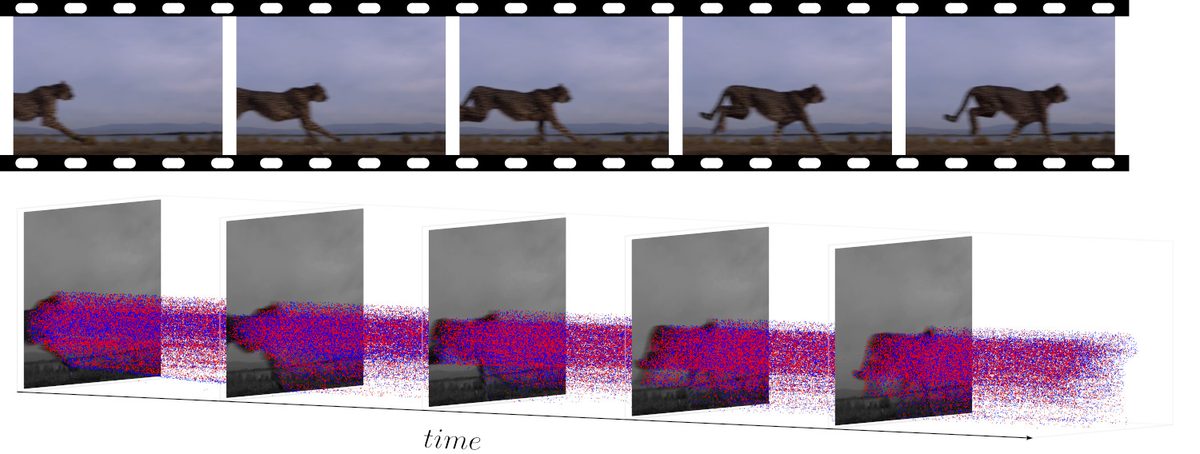 The difference between the data output by a frame-based camera (top) and an event camera (bottom) from the same scene
Image: Event camera comparison (TimoStoffregen, CC BY-SA 4.0), Wikimedia Commons.

As the comparison image above shows, where a frame-based camera outputs a "photograph of the entire scene" at fixed intervals, an event camera outputs only a sparse cluster of events scattered along the moving contours. Because a stationary background produces no data whatsoever, it can also be described as the sensor handing over data with the scene's redundancy already stripped out from the start. For its own event-based industrial vision, Prophesee states that in applications such as visual inspection on beverage carton production lines and laser-welding robots, it can measure objects moving faster than 10 meters per second at a pace of over 1,000 per second while reducing the volume of data to be processed to roughly one-hundredth compared to conventional frame-based methods — a direct consequence of the fact that the sensor never generates data for "pixels that haven't changed" in the first place.
Comparing the specs of key products
| Product | Resolution | Dynamic Range | Latency / Time Resolution | Notes |
|---|---|---|---|---|
| iniVation DVXplorer | 640×480 (VGA) | Up to 110dB | Sub-millisecond latency, 200µs time resolution | Throughput up to 165 million events/sec, built-in 6-axis IMU (gyro up to 3.2kHz), under 140mA at 5V |
| iniVation DAVIS346 | 346×260 (events), frame output at the same resolution | 120dB for event output, 55dB for frame output | 1µs time resolution and under 1ms latency for events, 40fps for frames | Hybrid design outputting change detection + grayscale frames simultaneously. Up to 12 million events/sec, 18.5µm pixel pitch |
| Sony IMX636 (Prophesee Metavision) | 1280×720 (0.92 megapixels) | Over 86dB at 5-100,000 lux, over 120dB with low-light cutoff at 0.08-100,000 lux | High-speed, low-latency response (figures are application-dependent) | Stacked sensor co-developed by Sony and Prophesee, 4.86µm pixel pitch, full-digital 16-line parallel output |
| Prophesee GenX320 | 320×320 | Over 140dB | Pixel latency under 150µs at 1000 lux | Can be reduced to 36µW in ultra-low-power mode, 6.3×6.3µm pixel, ultra-compact 3×4mm package, built-in flicker suppression and event-rate control |
| Samsung DVS-Gen4 | 1280×960 | 100dB | 150µs | 4.95µm pixel pitch, achieves both high resolution and low power consumption via in-pixel Cu-Cu bonding and a GIDL-suppression circuit |
 A Prophesee event camera evaluation kit
Image: Prophesee Event Camera Evaluation Kit (Auledas, CC BY 4.0), Wikimedia Commons.

The iniVation DVXplorer has a VGA-equivalent resolution of 640×480 and a built-in 6-axis IMU, and is a pure DVS camera widely used in robotics research. The DAVIS346 is a hybrid design housing both a change-detection circuit and grayscale frame output on a single chip: the event output itself carries a 120dB dynamic range, but the frames it can output simultaneously are limited to 55dB and 40fps — this product makes it plain that the advantages of pure DVS and compatibility with frame-based processing are in a tradeoff relationship. The Sony IMX636 combines Sony's stacked-sensor manufacturing technology with Prophesee's (discussed below) event-sensing know-how, and at 1280×720 falls into the high-resolution class for an event camera; it has also been adopted in the "uEye EVS" series that industrial camera maker IDS Imaging Development Systems announced in 2025. The GenX320 is somewhat lower-resolution at 320×320, but has an ultra-low-power mode that can cut consumption to 36µW, making it a design aimed at always-on wearable devices and edge sensing for IoT. The Samsung DVS-Gen4 has the highest pixel count at 1280×960, and its in-pixel Cu-Cu bonding (a stacking technique that directly joins copper to copper) together with a circuit design that suppresses GIDL (Gate-Induced Drain Leakage) hold down the increase in leakage current that comes with higher resolution.
Where did the electronic eye come from: from the silicon retina to the event-camera industry
1988, the silicon retina at Caltech — The direct origin of the event camera traces back to the 1988 paper "A Silicon Model of Early Visual Processing," published by Carver Mead, known as one of the fathers of the integrated circuit, together with Misha Mahowald, then a graduate student. The two actually built a "silicon retina" that mimicked the retina's early visual processing using analog CMOS circuits, and in doing so opened up the field of "neuromorphic engineering" itself — the attempt to reproduce the brain's information processing in hardware. Mead later received a lifetime achievement award in neuromorphic engineering from Caltech for this work.
2008, a fully asynchronous DVS out of ETH Zurich / University of Zurich — Patrick Lichtsteiner, Christoph Posch, and Tobi Delbrück published "A 128×128 120 dB 15 μs Latency Asynchronous Temporal Contrast Vision Sensor" in IEEE Journal of Solid-State Circuits, demonstrating a fully asynchronous sensor with 128×128 pixels, 120dB of dynamic range, and 15-microsecond latency — the prototype of what is now called "DVS." The paper is referenced widely enough to rank 4th in citations over the preceding decade in that journal, and it has since become the de facto starting point for event-camera research.
2011, ATIS combines change detection with brightness measurement — Christoph Posch moved to the Austrian Institute of Technology (AIT) and presented ATIS (Asynchronous Time-based Image Sensor), which combined a change-detection circuit with a circuit that also measures actual brightness (grayscale value) on a time basis, but only for pixels where a change was detected. ATIS achieved a dynamic range exceeding 143dB, and as a design answering the real-world application need for "not just change, but images too," it became the technical foundation for the later DAVIS and other hybrid-type products.
2014, Chronocam is founded, and two ETH/University of Zurich spinoffs — In 2014, Posch founded Chronocam together with Ryad Benosman, Bernard Gilly, and Luca Verre inside the Paris startup studio iBionext, setting out to commercialize the ATIS technology developed at AIT. Chronocam renamed itself Prophesee in 2018, alongside a $19 million Series B funding round. Meanwhile, from the University of Zurich/ETH Zurich's Institute of Neuroinformatics (INI), which had produced DVS128, four people — Tobi Delbrück, Rodney Douglas, Kynan Eng, and Sven-Erik Jacobsen — spun off iniVation in 2015, and a separate team spun off SynSense in 2017. These two companies, sharing the same institute as their common source, came back together in 2024 when SynSense acquired all of iniVation's shares. In China, Shanghai-based CelePixel was founded in 2017 by Chen Shoushun and others, and was acquired in 2019 by Will Semiconductor, the parent company of OmniVision. Then in 2020, Sony brought its stacked image-sensor manufacturing technology and Prophesee its event-sensing know-how to a joint development effort, which was productized as the IMX636 mentioned above. A niche technology out of a neuroscience lab, arriving in a little over a decade at the point of partnering with a major image-sensor maker like Sony — that is the story of this sensor so far.
A real example: the stereo event camera rig "DSEC" that drove through Zurich
Event cameras aren't yet a sensor riding on automakers' mass-production lines, but there are multi-unit examples one step before that, in research and development. The dataset DSEC (A Stereo Event Camera Dataset for Driving Scenarios), released in 2021 by ETH Zurich/University of Zurich's Robotics and Perception Group, was collected with a vehicle carrying a stereo rig of two Prophesee Gen3.1 event cameras (640×480) mounted left and right with a 60cm baseline, synchronized with two FLIR Blackfly S color frame cameras, LiDAR, and RTK-GPS, driving through multiple Swiss cities including Zurich, Thun, and Interlaken to collect over an hour of driving data. It's notable for being recorded specifically to target high-dynamic-range scenes where standard cameras tend to hit the limits of exposure control — tunnel entrances and exits, strong backlight at sunset and sunrise — and, just as with monocular setups, it's designed by taking a wide baseline in stereo too, to secure disparity accuracy out to distant ranges while also verifying whether the event-camera side can keep capturing change even in scenes where the frame camera blows out highlights or crushes blacks. As a foundation for research into how robustly self-localization algorithms like Visual-SLAM can be run in poor-lighting environments that ordinary cameras struggle with, DSEC continues to be referenced today.
Research reading faces out of footage that looks like nothing but noise, and SLAM running onboard a UAV
A face-detection dataset on event streams, out of Kazakhstan — Nazarbayev University's ISSAI (Institute of Smart Systems and Artificial Intelligence) published the paper "Faces in Event Streams (FES): An Annotated Face Dataset for Event Cameras," by Bissarinova, Rakhimzhanova, Kenzhebalin, and Varol, in the journal Sensors (Volume 24, Issue 5, article number 1409) in 2024. It's the first large-scale dataset of its kind, annotating 1.6 million faces and 5-point facial landmarks across 689 minutes of event streams, and the 12 accompanying models are reported to detect faces and facial landmarks with over 90% accuracy at mAP50. The image below is the cover image from its GitHub repository, showing multiple people's faces and outlines emerging as accumulations of events out of footage that otherwise looks like nothing but stippled noise. The very principle of the event camera — that nothing not in motion is ever recorded — produces footage of "outlines and motion only" with no photographic texture, and its potential applications in privacy-sensitive surveillance and monitoring use cases have also been pointed out.
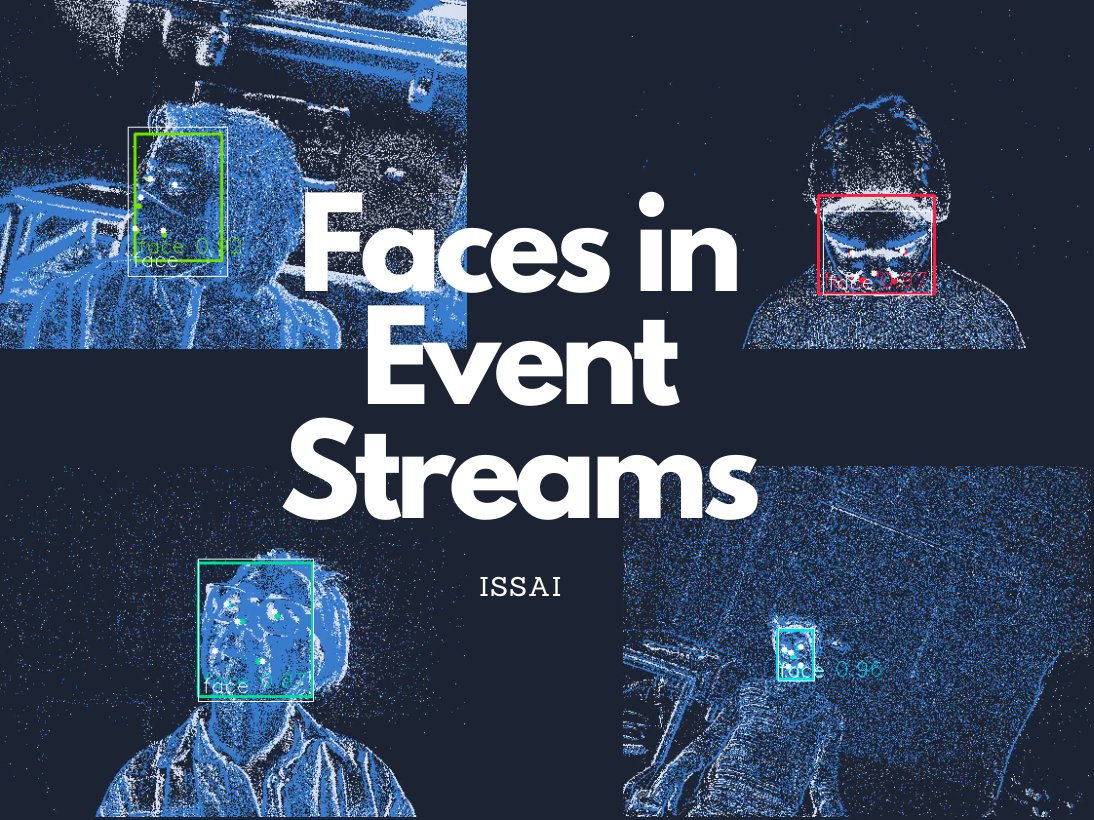 Faces and detection boxes emerging in an event stream (cover image of the FES dataset)
Image: Faces in Event Streams (Ulzhanbis, CC BY 4.0), Wikimedia Commons. GitHub cover image for the FES dataset paper by ISSAI (Nazarbayev University) (Bissarinova et al., Sensors 2024, 24(5):1409).

Stereo event SLAM running onboard a UAV, and an experiment dodging "thrown objects" — Robotics is where the event camera's low latency and high dynamic range pay off the most. The paper "AERO-VIS: Asynchronous Event-based Real-time Onboard Visual-Inertial SLAM" (arXiv:2605.07885), published just in May 2026, combines a stereo event camera with an IMU, implements a feature detector that processes the event stream while keeping it asynchronous, and reports achieving accuracy that conventional event-based SLAM could not, by actually mounting it on a UAV (unmanned aerial vehicle) and running it onboard. Separately, the Robotics and Perception Group at the University of Zurich, led by Davide Scaramuzza, reports that in an experiment with a quadrotor avoiding obstacles relying solely on a monocular event camera, it detected incoming objects with 81-97% probability within 3.5 milliseconds, and succeeded at dodging objects thrown from 3 meters away at 10 meters per second with over 90% probability. The same group also states that using event cameras could raise drone flight speeds by up to a factor of 10, and research into just how far event cameras can carry perception in speed regimes that frame-based cameras cannot in principle keep up with is ongoing.
Parameters that determine performance
- The resolution/bandwidth tradeoff: GenX320's 320×320 is a design prioritizing low power consumption for edge and wearable use, whereas Samsung DVS-Gen4's 1280×960 and Sony IMX636's 1280×720 are resolutions aimed at higher-fidelity applications. However, because an event camera generates more events the faster the motion, the higher the resolution, the more sharply the bandwidth demanded of downstream processing spikes as well — a point that differs from the conventional way of thinking about frame rate
- Dynamic range: Against GenX320's over 140dB and IMX636's over 120dB (with low-light cutoff), Samsung DVS-Gen4 is somewhat more modest at 100dB. In applications like DSEC where high-dynamic-range scenes such as tunnels and backlight are the main battleground, this figure directly determines whether it's practically usable
- Latency / time resolution: While 2008's DVS128 had already achieved 15 microseconds, the latency of GenX320 and Samsung DVS-Gen4 is said to be around 150 microseconds at 1000 lux — care is needed here, since this isn't a simple generation-over-generation improvement race but a figure determined by a tradeoff against illumination conditions and processing-circuit design policy (such as whether ultra-low power is prioritized)
- Contrast threshold: As with GenX320's rated threshold of 25%, the setting of the threshold that picks up a brightness change as an event is itself a tradeoff between noise and sensitivity. Lowering the threshold picks up even minute changes at the cost of more noise events; raising it reduces noise but misses some fast changes
- Power consumption: Against DVXplorer's under 140mA at 5V (roughly 700mW), GenX320's ultra-low-power mode is 36µW — products differing by nearly four orders of magnitude coexist within the same "event camera" category. Whether the premise is always-on wearable/IoT use or being mounted on a robot to process large volumes of events at high speed changes which product you should pick entirely
- Pure DVS or hybrid: A hybrid type like DAVIS346, which can also output grayscale frames simultaneously, has the convenience of directly reusing an existing image-recognition pipeline, but its frame output at 55dB/40fps falls short of what the event output itself is capable of. Pure DVS (DVXplorer, GenX320, and others) sacrifices compatibility with existing pipelines in exchange for drawing out the full advantage of events
How does a stationary object appear to an event camera?
Events respond to brightness changes. Without change, static appearance is not continuously refreshed as it is in conventional frames.
References
- A 128×128 120 dB 15 µs Latency Asynchronous Temporal Contrast Vision Sensor (IEEE JSSC, Lichtsteiner, Posch, Delbrück, 2008)
- Dynamic Vision Sensor Event Camera (University of Zurich Sensors Group)
- Commentary on A Silicon Model of Early Visual Processing (History of Information)
- Live demonstration: Asynchronous Time-based Image Sensor (ATIS) camera with full-custom AE processor (Posch et al.)
- Overview of Prophesee (formerly Chronocam) and the history of its founding at iBionext
- History of the iniVation spinoff (Institute of Neuroinformatics, UZH)
- SynSense's acquisition of iniVation (Greater Zurich Area)
- DVS Company Celepixel Acquired by Will Semiconductor (Image Sensors World)
- iniVation DVXplorer datasheet
- iniVation DAVIS346 datasheet
- Sony/Prophesee IMX636 product information
- IDS uEye EVS series announcement (Prophesee)
- Prophesee GenX320 product information
- Technical material on Samsung DVS-Gen4 (Samsung, CVPR2019 workshop)
- DSEC: A Stereo Event Camera Dataset for Driving Scenarios (arXiv:2103.06011)
- DSEC project page (University of Zurich)
- Faces in Event Streams (FES): An Annotated Face Dataset for Event Cameras (ISSAI)
- Faces in Event Streams paper (PMC)
- AERO-VIS: Asynchronous Event-based Real-time Onboard Visual-Inertial SLAM (arXiv:2605.07885)
- Agile Drone Flight (University of Zurich Robotics and Perception Group)
- Drone detects & avoids obstacles in milliseconds thanks to event cameras (The Robot Report)
- File:Event camera comparison.jpg (Wikimedia Commons)
- File:Prophesee Event Camera Evaluation Kit.jpg (Wikimedia Commons)
- File:Faces in Event Streams.png (Wikimedia Commons)
Current step · 14 / 21 · Sensors & Hardware
Comments
Please log in to post a comment
No comments yet.