Contents — find the section you need
Background and reading guide
Background Units used in specifications, such as voltage, current, distance and time.
Fundamentals · Explanations of principles, structure and trade-offs.
Radar (Radio Detection and Ranging) is a sensor that measures distance, bearing, and relative velocity by transmitting radio waves and receiving their reflection off a target. Relative velocity is derived from the frequency shift of the reflected wave (the Doppler effect); distance is derived from the round-trip travel time of the radio wave. Automotive applications generally use the millimeter-wave band at 76-81GHz, hence the common name "millimeter-wave radar." Where cameras and LiDAR work with light, radar works with radio waves — which is exactly why it keeps functioning comparatively reliably under the rain, fog, snow, glare, and darkness that give optical sensors so much trouble. Born out of Second World War air-defense systems, this technology has been miniaturized and driven down in cost over more than 80 years to the point of being a mass-produced automotive component.
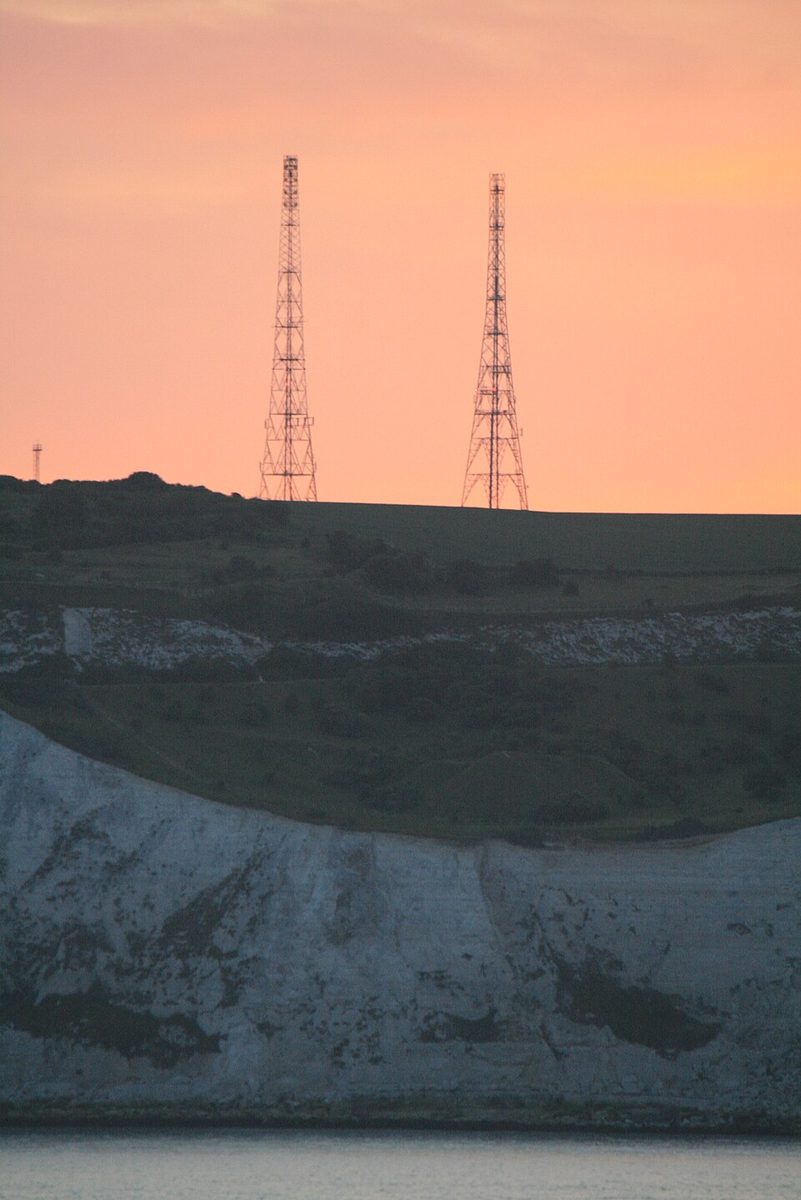 Chain Home air-defense radar towers (Swingate, Dover, UK)
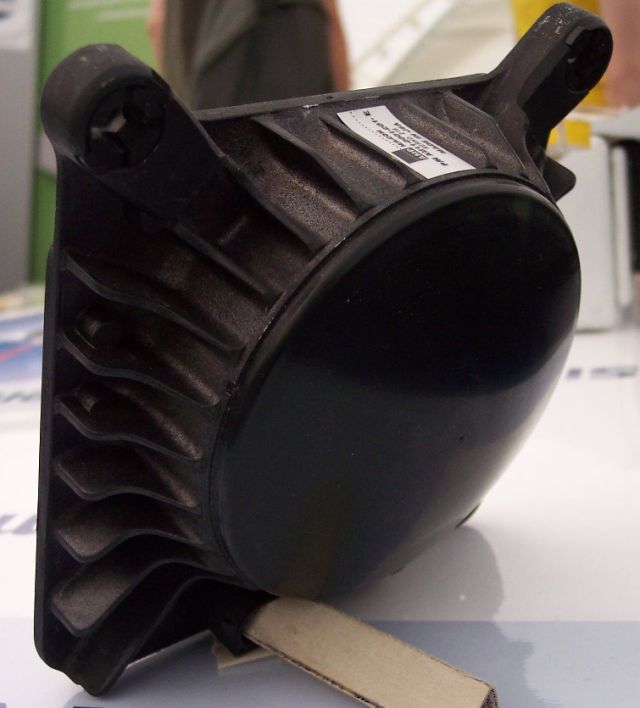 Automotive millimeter-wave radar antenna
Images: Chain Home air-defense radar towers (Jean-Etienne Minh-Duy Poirrier, CC BY-SA 2.0) / Automotive millimeter-wave radar antenna (Stahlkocher, CC BY-SA 3.0 / GFDL), Wikimedia Commons.


Principle: FMCW — deriving distance and velocity together from the beat frequency
The dominant approach in automotive millimeter-wave radar is FMCW (Frequency Modulated Continuous Wave). The transmitted signal's frequency is swept linearly over time at a constant slope (a "chirp"); mixing the received reflection with the transmitted signal produces a "beat frequency" f_b — the difference between the two.
Here B is the chirp bandwidth, T is the chirp sweep duration, c is the speed of light, R is the distance to the target, v is relative velocity, and \lambda is the radio wavelength. The first term on the right derives from the round-trip delay of the reflected wave (proportional to distance); the second term derives from the Doppler-shifted frequency component (proportional to relative velocity). A reflection off a stationary object and a reflection off a moving object each show up as a beat signal with distinctly different characteristics. By transmitting a continuous train of chirps and running each resulting beat signal through a Fast Fourier Transform (FFT), the radar can separate out and simultaneously solve for both distance and relative velocity. Range resolution is inversely proportional to the chirp bandwidth B (\Delta R = c / 2B), so a wider bandwidth translates directly into the ability to resolve two closely spaced targets as distinct objects.
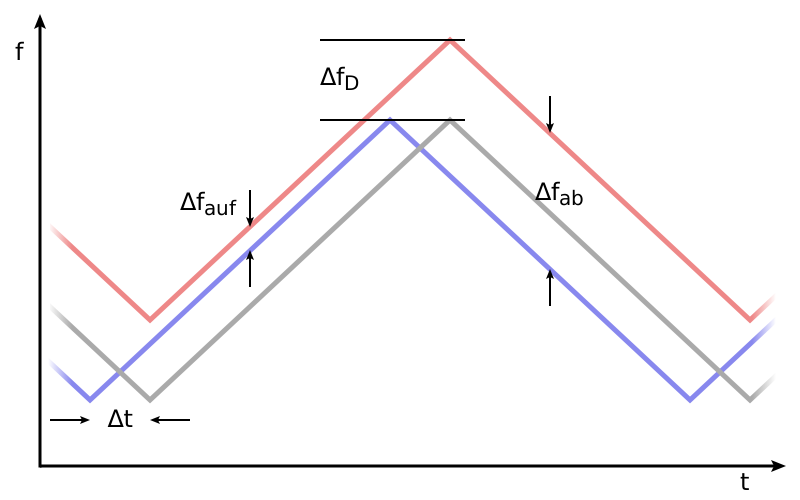
Image: Principle diagram of FMCW/Doppler radar (Rainald62, CC BY-SA 3.0), Wikimedia Commons. The blue line is the transmitted wave, the gray line is the reflection off a stationary object (delayed in time only), and the red line is the reflection off an approaching object (delayed in time, and shifted upward in frequency by the Doppler effect).

Principle: how frequency band choice tracks application
Automotive millimeter-wave radar mainly operates in the 76-81GHz band, but even within that band, the choice of sub-band tracks the application. The 76GHz band suits long-range monitoring out to roughly 100-200m ahead, with range resolution around 1-2m and a narrower field of view of roughly 20 degrees. That suits applications wanting early detection of a distant vehicle ahead at highway speed — adaptive cruise control (ACC), automatic emergency braking. The wider 77-81GHz band, by contrast, carries high enough resolution to finely separate nearby vehicles, pedestrians, and cyclists, making it useful for distinguishing multiple nearby targets during merges or right-turns at intersections. The recently emerging "4D imaging radar" is a high-resolution variant that measures elevation angle (the vertical dimension) alongside the distance, azimuth, and relative velocity that conventional radar already measured — letting it handle vertical information like road-surface bumps and overhead signage as well.
History: from air-defense system to automotive component
Radar's practical origins trace back to the Second World War. British physicist Robert Watson-Watt first demonstrated, on February 26, 1935, that an aircraft could be detected by bouncing radio waves off it — and this discovery became the foundation of Britain's home air-defense network, Chain Home. Operational from 1938, Chain Home was a large-scale network of fixed radar stations operating in the comparatively low 22-50MHz band; it grew from 18 stations at the outbreak of war to 53 by war's end. During the 1940 Battle of Britain, this early-warning capability is widely credited as a major factor letting the outnumbered RAF intercept incoming Luftwaffe raids. In the roughly 80 years since, the underlying principle — transmit a radio wave, measure its reflection — has stayed the same, but radar itself has shrunk from a massive fixed antenna tower down to a module a few centimeters across, tucked inside a vehicle's bumper.
Comparing key products by spec
| Product | Maker | Type | Range | Field of view (FOV) | Measured quantities |
|---|---|---|---|---|---|
| Continental ARS540 | Continental | 4D imaging radar | 300m | ±60° | Simultaneous distance, azimuth, elevation, and relative velocity |
| Bosch front/corner radar | Bosch | 76-77GHz and 77-81GHz bands | 300m detection range (up to 530m high-sensitivity) | Not disclosed | Distance and relative velocity (works up to 210km/h driving speed) |
| Bosch radar premium (5th gen) | Bosch | 76-77GHz and 77-81GHz bands | 300m detection range (up to 700m high-sensitivity) | Not disclosed | Distance and relative velocity (35% higher detection sensitivity vs. previous generation) |
| Aptiv FLR4+ | Aptiv | Imaging radar | 300m | Built for machine-learning-based sensor fusion | High-resolution detection for ADAS through automated-driving support |
| Arbe Phoenix (used in Tesla HW4) | Arbe | High-resolution (synthetic aperture) imaging radar | Not disclosed | Not disclosed | 76-77GHz band; reintroduced to Tesla vehicles starting 2023 |
The Continental ARS540 is a 4D imaging radar that captures targets at high resolution, including elevation information that older radars struggled with. Its 300m range and wide ±60° field of view are combined deliberately in one unit, reflecting a design philosophy of covering both long-range monitoring and a wide surrounding area with a single sensor. Bosch's front/corner radar and radar premium both support the 76-77GHz and 77-81GHz bands and share a common 300m detection range, but the sensitivity range — the distance at which high-sensitivity detection is possible — extends to 700m on the radar premium, showing how far the detection of small distant targets has been pushed forward generation over generation. Bosch and Aptiv together are reported to account for roughly 45-50% of global automotive radar revenue, and both companies field full lineups spanning short, medium, and long range along with 4D imaging radar. Aptiv's FLR4+ is an imaging radar designed from the ground up around machine-learning-based sensor fusion, and in May 2026 Volvo announced it would adopt Aptiv's next-generation high-resolution radar platform, "Gen 8," for new vehicles from 2028 onward.
The Radar Tesla Abandoned, Then Took Back
Among autonomous-driving companies, Tesla made a genuinely unusual call. In May 2021, Tesla removed radar sensors from North American Model 3 and Model Y vehicles, announcing a shift to a camera-only perception system it called "Tesla Vision." CEO Elon Musk made a first-principles argument that conflicting sensor inputs undermine safety, staking out a clear position — pursuing camera-only autonomous driving — that ran directly against industry convention. The decision surprised engineers, analysts, regulators, and customers alike, and touched off a major debate over whether cameras alone could deliver adequate safety, including for the distance and speed estimation that radar is typically relied on for. Early on, this brought real functional constraints — Autosteer's top speed was capped and following distances were increased.
But in 2023, Tesla reversed course with its next-generation autonomous-driving computer, "Hardware 4," reintroducing a radar sensor codenamed "Phoenix" to the Model S and Model X. Teardowns confirmed that this radar is based on Israeli company Arbe's "Phoenix" high-resolution synthetic-aperture radar unit. About two years after retreating to a camera-only approach, this amounted to an acknowledgment that radar's more robust ranging and velocity data under adverse weather was, in fact, still needed — a genuinely interesting real-world case where one of the industry's biggest players staked out an extreme answer to "is camera alone enough, or should radar be fused in," and then walked it back.
A real-world example: Honda SENSING 360 — five radars covering every direction
A real-world example of combining multiple radars to sense a vehicle's full surroundings is Honda's "Honda SENSING 360." It places one long-range millimeter-wave radar at the front center, plus four medium-range millimeter-wave radars at the vehicle's four corners — five radars in total — combined with a single monocular wide-view camera mounted above the front windshield, to achieve 360-degree sensing. Notably, the system deliberately varies each radar's characteristics by role: long-range monitoring ahead prioritizes reach over field of view, while side and rear near-field monitoring prioritizes a wide field of view. This is a real-world example of solving, through multi-unit placement, a trade-off — "long-range monitoring" versus "all-around coverage" — that is difficult to achieve with a single radar alone.
Parameters that determine performance
- Range: For applications wanting early detection of a distant vehicle ahead with plenty of margin to slow down — highway ACC, for instance — a long-range radar like the Continental ARS540 becomes essential
- Field of view (FOV): As with Honda SENSING 360's placement of medium-range radars at the sides and rear, applications wanting to cover a wide surrounding area during an intersection merge or turn prioritize a wide field of view. Since it's difficult for a single radar to deliver both long range and a wide field of view at once, combining multiple units tends to be the practical solution
- Range resolution and chirp bandwidth: Because FMCW's range resolution is inversely proportional to chirp bandwidth, a narrower-band 76GHz-only setup with roughly 1-2m resolution makes it easy to mistake multiple close-together targets — a cyclist and a pedestrian, say — for a single blob. Applications needing fine target discrimination, like merge assistance, benefit from the higher resolution the wider 77-81GHz band provides
- Whether elevation data is captured: Conventional radar only carries horizontal information, making it prone to misclassifying road-surface bumps or overhead signage and overpasses as "obstacles." A 4D imaging radar like the ARS540's ability to measure elevation directly reduces this class of false detection
- Robustness to adverse weather and conditions: Camera and LiDAR performance degrades substantially under rain, fog, glare, and darkness, while radar — because it uses radio waves — keeps functioning comparatively reliably. As Tesla's radar removal-and-reinstatement story shows, camera-only systems have real limits under adverse weather, and in regions with frequent bad weather or heavy nighttime driving, leaning more heavily on radar is a rational design choice
- Compatibility with machine-learning-based sensor fusion: A radar designed to feed raw point-cloud data directly into a machine-learning pipeline — like Aptiv's FLR4+ — tends to contribute more to fused-perception accuracy when combined with cameras and LiDAR. Compared with a radar that only outputs simple target-detection results, it hands the downstream perception algorithm a meaningfully different volume of usable information
Computing Bandwidth and Velocity
In an FMCW radar datasheet, check the bandwidth B and observation time, not only the maximum range. Range resolution is
With B=1\,\mathrm{GHz}, this gives \Delta R\simeq0.15\,\mathrm{m} — an ideal figure for separating two reflectors in the same direction with about 15cm of range difference. Windowing, signal-to-noise ratio, angular resolution, and target size also matter, so a catalog number is not the same as field detection accuracy.
Relative velocity comes from the Doppler frequency. For wavelength \lambda and line-of-sight relative velocity v,
At 77GHz the wavelength is about 3.9mm, so v=20\,\mathrm{m/s} (72km/h) gives f_D\simeq10.3\,\mathrm{kHz}. At an oblique angle, the radar sees only the line-of-sight component, so a bicycle crossing the lane can look like a "slow" object. For ACC and collision decisions, associating range, velocity, and angle with the same track is as important as the individual resolutions.
Are objects at equal range always indistinguishable to radar?
Angle or relative velocity can sometimes separate them. Check resolution in each dimension and the target conditions.
References
- Continental ARS540 4D imaging radar (Electronic Specifier)
- Honda SENSING 360 omnidirectional safety technology (Honda official)
- Bosch radar sensors (Bosch Mobility official)
- Automotive radar market: Bosch/Aptiv/Continental/Denso technology strategy comparison (LinkedIn)
- Aptiv's Gen 8 high-resolution radar platform adopted by Volvo (related coverage)
- Robert Watson-Watt and the invention of radar (English Wikipedia)
- The Chain Home air-defense radar network (RAF Air Defence Radar Museum)
- Tesla's radar removal and transition to Tesla Vision (Electrek)
- New "Phoenix" radar confirmed in Tesla Hardware 4 vehicles (InsideEVs)
- Tesla's shifting relationship with radar (Edge AI and Vision Alliance)
Current step · 12 / 21 · Sensors & Hardware
Comments
Please log in to post a comment
No comments yet.