Contents — find the section you need
Background and reading guide
Background No specialist background required; check the reporting period and scope of financial measures.
Industry research · Read the sources, reporting period and comparison criteria together.
Cell signal reaching wherever you happen to be relies on a massive infrastructure combining cell towers, fiber-optic networks, submarine cables, and now even satellites. NTT, KDDI, and SoftBank diverge sharply in scale, and each is betting on a different technical vision for what comes after radio.
 NTT
NTT KDDI
KDDIImage: NTT logo / KDDI logo (both public domain; trademark rights still apply separately), Wikimedia Commons. No SoftBank logo meeting Commons' copyright threshold was found, so SoftBank is covered in text only.


Company History: Three Very Different Paths Through Monopoly, Privatization, and Liberalization
The three companies' origins differ sharply. NTT traces back to a state-run telegraph service that began in 1869 (Meiji 2); the Nippon Telegraph and Telephone Public Corporation, established in 1952, ran Japan's state telecom monopoly for 115 years before it was privatized as Nippon Telegraph and Telephone Corporation (NTT) in April 1985, when the Telecommunications Business Act took effect. NTT spun off NTT Mobile Communications Network (now NTT Docomo) in 1991, and shifted to a holding-company structure in 1999, launching NTT East, NTT West, and NTT Communications as separate entities. It has continued reorganizing since — most recently making NTT Data Group a wholly owned subsidiary in 2025.
KDDI was formed by a 2000 merger of three companies with entirely separate origins: Kokusai Denshin Denwa (KDD, founded 1953, an international-telecom-only carrier), Daini Denden Kikaku (DDI, founded 1984 by Kyocera founder Kazuo Inamori as one of the "New Common Carriers" born from telecom liberalization when the public corporation was privatized), and Nippon Idou Tsushin (IDO, a mobile carrier). KDDI treats DDI's 1984 founding as its own company-founding date.
SoftBank's origin is the most different of the three. It began as Nihon SoftBank, founded in 1981 by Masayoshi Son as a PC-software distributor. It entered fixed-line telecom in 2004 by acquiring Japan Telecom (a fixed-line carrier tracing back to one of the New Common Carriers descended from the old Kokusai Digital Tsushin), then made a full-scale entry into mobile in 2006 by acquiring Vodafone's Japanese subsidiary for roughly ¥1.75 trillion, forming SoftBank Mobile. Starting as a software distributor and transforming into a carrier through M&A is what most distinguishes SoftBank from the other two, both of which descend from the old public telecom monopoly.
Comparing Company Scale: Five-Year Trend
Looking at the trend over the last five fiscal years (FY2022/3 through FY2026/3, all three companies sharing a March fiscal year-end) rather than a single snapshot makes the three companies' different growth patterns much clearer. Note that NTT's FY2026/3 revenue and operating profit figures saw a discrepancy between an earlier flash estimate and the finalized earnings report; this article uses the finalized figures (revenue ¥14.4091 trillion, operating profit ¥1.7062 trillion), cross-checked against NTT's own earnings report and multiple news sources.
| Fiscal Year | NTT (holding co., consolidated) Revenue | NTT Operating Profit | KDDI Revenue | KDDI Operating Profit | SoftBank Revenue | SoftBank Operating Profit |
|---|---|---|---|---|---|---|
| FY2022/3 | ¥12.1564 trillion | ¥1.7685 trillion | ¥5.4467 trillion | ¥1.0605 trillion | ¥5.6906 trillion | ¥965.6 billion |
| FY2023/3 | ¥13.1361 trillion | ¥1.8289 trillion | ¥5.6717 trillion | ¥1.0773 trillion | ¥5.9119 trillion | ¥1.0601 trillion |
| FY2024/3 | ¥13.3745 trillion | ¥1.9229 trillion (record) | ¥5.6997 trillion | ¥912.0 billion | ¥6.084 trillion | ¥876.1 billion |
| FY2025/3 | ¥13.7047 trillion | ¥1.6495 trillion (down) | ¥5.8355 trillion | ¥1.0874 trillion | ¥6.5443 trillion | ¥989.0 billion |
| FY2026/3 | ¥14.4091 trillion (record) | ¥1.7062 trillion | ¥6.0719 trillion | ¥1.0991 trillion | ¥7.0387 trillion | ¥1.0426 trillion (first time over ¥1 trillion) |
| Metric | NTT (holding co., consolidated) | KDDI | SoftBank |
|---|---|---|---|
| Consolidated employees (FY2026/3) | 344,196 | 73,198 | 58,432 |
| Net income (FY2026/3) | ¥1.037 trillion (+3.7% YoY) | ¥707.1 billion (+7.9% YoY) | ¥550.8 billion (+4.7% YoY) |
NTT posts by far the largest revenue of the three, but that figure belongs to a holding company spanning far more than mobile service — NTT Data (systems integration), NTT East and West (fixed-line), and a large overseas business all sit under the same umbrella, so it isn't a direct apples-to-apples comparison against KDDI and SoftBank, which are primarily mobile carriers. NTT's operating profit hit a record ¥1.9229 trillion in FY2024/3, then fell in FY2025/3 as its core integrated-ICT business (NTT Docomo) stalled, before swinging back to revenue and profit growth in FY2026/3 as its Global Solutions business (NTT Data) — boosted in part by a data-center divestiture — carried the results. KDDI posted steady, gradual revenue growth across all five years, with profit dipping only slightly in FY2024/3 before resuming its climb. SoftBank grew revenue for five consecutive years and posted the fastest growth of the three, crossing ¥7 trillion in revenue and ¥1 trillion in operating profit for the first time in FY2026/3.
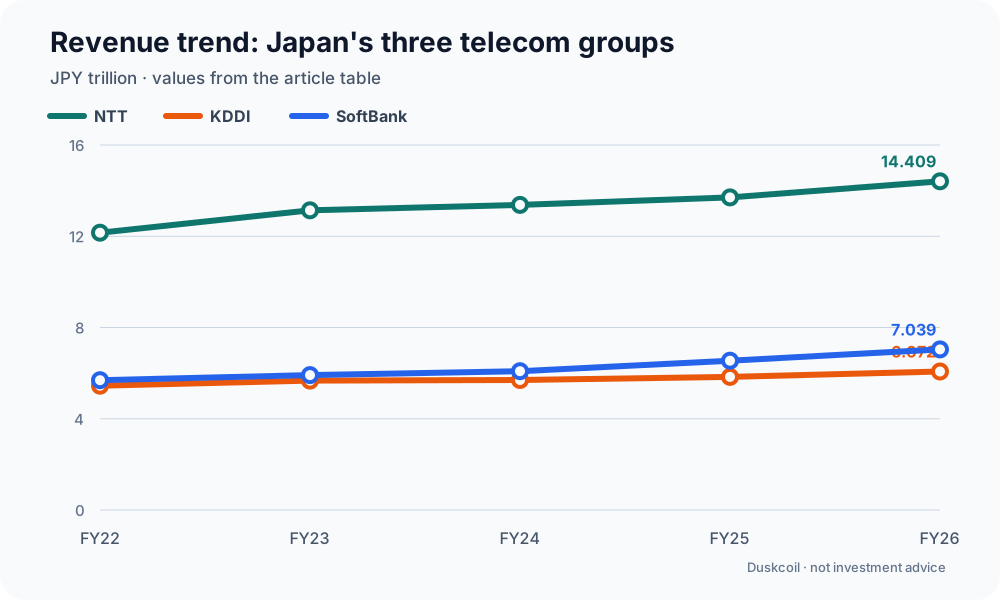
Diagram: Duskcoil. Revenue values in the article table, converted to JPY trillions. NTT is shown on a consolidated holding-company basis, so this is not a mobile-only comparison. This diagram is not investment advice.
Comparing Flagship Businesses: Mobile Subscriber Share and AI/Data-Center Investment
Comparing the three as "telecom carriers" requires looking at mobile subscriber share alongside the AI and data-center investment all three have been racing to expand in recent years.
| Item | NTT (Docomo) | KDDI (au) | SoftBank |
|---|---|---|---|
| Mobile subscribers (end of March 2026) | 93.076 million | 72.7606 million (including Okinawa Cellular) | 56.9201 million (including Y!mobile) |
| Share (of roughly 233.11 million total across 4 carriers) | Roughly 39% — the clear #1, though below a majority on its own | Roughly 31% | Roughly 24% |
| AI/data-center investment pillar | Roughly ¥8 trillion in planned growth investment over 5 years, centered on optical-electronic-fusion technology IOWN and NTT Data's data-center business | "Osaka Sakai Data Center," converted from a former Sharp LCD plant in Sakai (came online January 2026, a GPU-cloud hub for AI training and inference) | "Crystal Intelligence," a management-transformation solution built on U.S. OpenAI's enterprise AI platform "Frontier" |
NTT Docomo remains the single largest carrier by subscriber count, but it holds less than half the market on its own — combine KDDI, SoftBank, and Rakuten Mobile and their total exceeds Docomo's. What's driving revenue growth, though, is no longer voice and data service itself but the "non-telecom" segment. NTT has made data centers a growth pillar tied directly to IOWN (discussed below); KDDI converted a former Sharp LCD plant into an AI data center in under a year, an unusually fast timeline for standing up a GPU-cloud hub. SoftBank, alongside its own infrastructure investment, is racing to roll out enterprise solutions that embed generative AI into real work, centered on its partnership with U.S.-based OpenAI. The shift from a revenue model built on the subscriber base to new revenue sources in AI and data centers is a structural change all three companies share.
Three Carriers, Three Different Bets on "What Comes After Radio"
Facing the physical limits of today's radio-based communication — ceilings on speed, capacity, and power efficiency, and coverage gaps in mountains, at sea, and other "out of range" areas — each major carrier is pursuing a distinct technical strategy.
NTT has staked its future on "IOWN" (Innovative Optical and Wireless Network), a next-generation communications architecture. The idea is to replace conventional electronic-circuit-based transmission with an all-optical network, achieving high capacity, low latency, and low power consumption simultaneously — and NTT is now extending this concept into space communications as well. Optical terminals several to several dozen times faster than current ones could shift satellite links from radio to light, with applications like real-time transmission of observation data. It's a strategy built around developing core infrastructure technology in-house, aimed at long-term technical leadership.
KDDI has aggressively pursued a partnership with SpaceX's satellite service, Starlink. It's rolling out direct satellite-to-smartphone connectivity to close coverage gaps in mountainous areas and remote islands where terrestrial base stations can't reach, and is also finding new enterprise use cases for the technology. Rather than developing satellite technology from scratch in-house, KDDI's approach prioritizes fast, practical coverage expansion by partnering with the world's largest satellite operator.
SoftBank is building out a network combining "HAPS" (High Altitude Platform Station) — stratospheric aircraft that function as flying base stations — with multiple satellites. Its strategic focus is the "mobility IoT" market, connecting vehicles, construction equipment, ships, and other mobile assets, aiming for innovation centered on industrial applications rather than consumer coverage alone.
Facing the same goal of eliminating coverage gaps, the three carriers have taken clearly distinct paths: NTT pursues long-term technical leadership through in-house optical technology, KDDI prioritizes fast practical implementation through partnership with the world's largest satellite operator, and SoftBank focuses on industrial IoT applications built around HAPS and satellites.
Major Facilities & Data Centers
Carriers don't operate factories, so the map below plots each company's headquarters function alongside the major facilities at the core of its AI/data-center business. All three keep headquarters functions in central Tokyo, while spreading data centers across the greater Tokyo area, Kansai, Kyushu, and Tohoku.
Sources: facility names and locations from the official sites and news releases of NTT / NTT Docomo / NTT East / NTT Data, KDDI / KDDI Research, and SoftBank. Most addresses were confirmed to town/block level, but KDDI's Osaka Sakai Data Center (Sakai Ward) and SoftBank's Tokyo Fuchu, Osaka, Kitakyushu, and Fukushima Shirakawa data centers had only city/ward-level locations disclosed in official announcements, so those pins are plotted at ward/city-level representative points (noted here honestly). Coordinates were geocoded via OpenStreetMap Nominatim.
Strategy & Outlook: A Shift Toward "Non-Telecom" and AI Infrastructure
The shared challenge across all three companies heading into 2026 is finding growth beyond a mature domestic mobile market. Each has put AI, data centers, and non-telecom business at the center of its mid-term management plan.
NTT revised its mid-term management strategy — announced in May 2023 as "New Value Creation & Sustainability 2027 Powered by IOWN" — into "New Value Creation & Sustainability 2030 Powered by AIOWN" in May 2026. It's built around two pillars: accelerating IOWN's real-world deployment by expanding the ecosystem around optical-electronic-fusion devices, and using AI to transform its own operations — with roughly ¥8 trillion in planned investment in growth areas over five years. Making NTT Data Group a wholly owned subsidiary in 2025 was a step toward driving this growth strategy as one unified group, and the more-than-50% jump in FY2026/3 operating profit at the Global Solutions business (NTT Data) shows that capturing data-center and AI-related demand is already starting to show up in the results.
KDDI announced a new mid-term management strategy, "Power-to-Connect 2028," in May 2026, covering FY2027/3 through FY2029/3. It's built around realizing an "AI-native society" with telecom as basic infrastructure, balancing stable growth in its core telecom business (the TelecomCore segment) against double-digit growth in AI, data centers, and other growth businesses (the Growth segment), targeting 5% average annual growth in operating profit. Beyond the Osaka Sakai Data Center noted above, consolidating convenience-store chain Lawson as a subsidiary and its partnership around the Starlink Direct satellite service are also positioned as growth drivers in the non-telecom segment. Separately, Rakuten Mobile continues negotiating to end its roaming agreement with KDDI and become self-sufficient — a shift that, if it happens, could affect the competitive dynamics among all four mobile carriers.
SoftBank announced a new mid-term management plan, "Activate AI for Society," in May 2026, centering growth on four areas: AI infrastructure, AI services, finance, and media/e-commerce. Its signature initiative is "Crystal Intelligence," a management-transformation solution built on U.S. OpenAI's enterprise AI platform "Frontier" — positioned as multi-agent AI that "completes tasks on a person's behalf" rather than the answer-a-question, write-some-text role of conventional generative AI, with service to large enterprises planned to begin sometime in 2026. Building on FY2026/3 results that crossed ¥7 trillion in revenue and ¥1 trillion in operating profit for the first time, SoftBank is accelerating efforts to monetize AI across both consumer and enterprise lines.
What all three companies share is a pivot away from the mature mobile-phone market itself and toward the investment race in new growth areas — AI and data centers. NTT is approaching that race through in-house optical technology (IOWN); KDDI through rapid repurposing of existing infrastructure (the Sakai DC) plus partnerships (Starlink, Lawson); and SoftBank through its partnership with U.S.-based OpenAI — three distinct approaches to the same contest.
References
- NTT Official Site / Investor Relations
- KDDI Official Site / Newsroom (Earnings)
- SoftBank Official Site / Investor Relations
- 2026 Earnings Analysis: KDDI and SoftBank Post Growth, Docomo Declines (Japanese)
- NTT, KDDI, SoftBank, and Rakuten Mobile's Space Strategies Explained (Japanese)
- IOWN Opens the Door to Optical Space Communications: NTT's Game-Changing Ambition (Japanese)
- Nikkei xTECH: From the Public Corporation to NTT — 1985, the Year the ICT Era Began (Japanese)
- KDDI's History in One Page | KDDI Official Site (Japanese)
- Vodafone (now SoftBank)'s History | The-Shashi (Japanese)
- IRBANK: NTT (9432) financial results / IRBANK: KDDI (9433) financial results / IRBANK: SoftBank (9434) financial results
- NTT's FY2026/3 results (Global Solutions business growth, etc.) (Japanese)
- Nikkei xTECH: NTT's FY2024/3 operating profit up 5%, a record (Japanese)
- Mobile subscriber counts and share, as of May 2026 - INFRA EXPERT (Japanese)
- Will NTT, KDDI, and SoftBank's high-dividend telecom stocks turn into growth stocks? AI investment as the turning point (Japanese)
- The three secrets behind KDDI's "Osaka Sakai Data Center" - Business Insider Japan (Japanese)
- NTT Group mid-term management strategy (AIOWN 2030) (Japanese)
- KDDI mid-term management strategy "Power-to-Connect 2028" (Japanese)
- "Activate AI for Society": the next five years, SoftBank's new mid-term management plan (Japanese)
- SoftBank accelerates "Crystal Intelligence" built on OpenAI's "Frontier" (Japanese)
- NTT East headquarters access (Japanese) / KDDI Takanawa headquarters (Japanese) / SoftBank company profile (Japanese)
Current step · 17 / 21 · Corporate Research
Comments
Please log in to post a comment
No comments yet.