Contents — find the section you need
Background and reading guide
Background No specialist background required; check the reporting period and scope of financial measures.
Industry research · Read the sources, reporting period and comparison criteria together.
The JR companies were born out of the 1987 breakup and privatization of Japanese National Railways. JR East, whose network centers on greater Tokyo, and JR Central, whose core business is the Tokaido Shinkansen, diverge sharply in scale and in the direction of the next-generation rail technology each is developing. JR East is a diversified conglomerate with multiple revenue streams — conventional rail, Shinkansen, station-building real estate, and the Suica payments ecosystem — while JR Central depends overwhelmingly on a single business, the Tokaido Shinkansen, and reaps a far higher margin as a result. Both companies share the same origin as pieces split off from Japanese National Railways, but their next-generation technology bets couldn't be more different in scale or character: JR East's next-generation Shinkansen train, the "E10 series," versus JR Central's ¥11 trillion superconducting maglev, the Chuo Shinkansen.
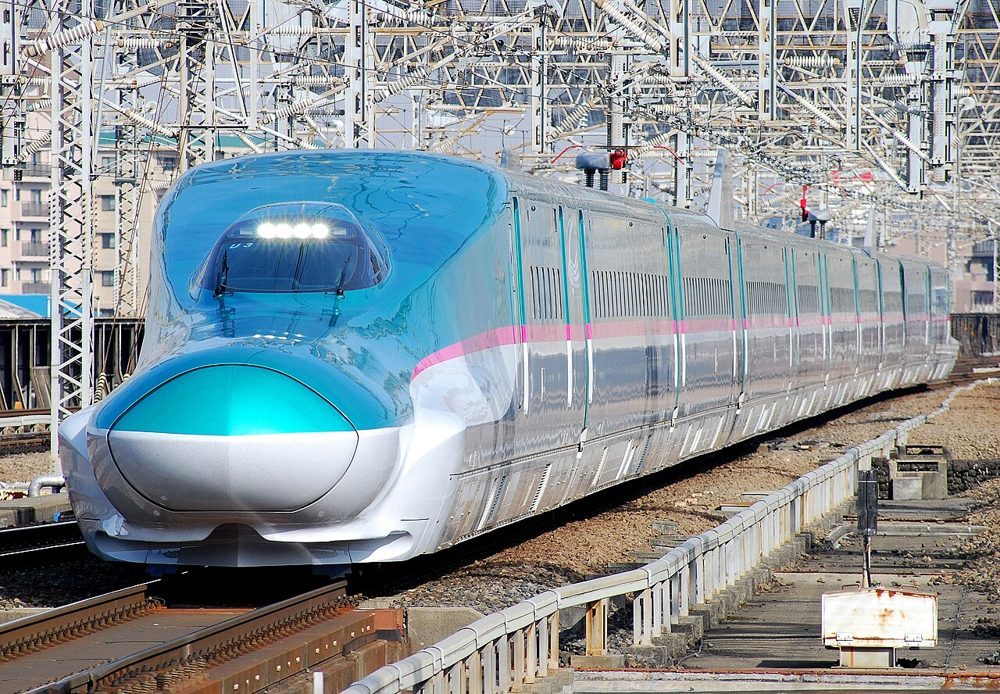 JR East
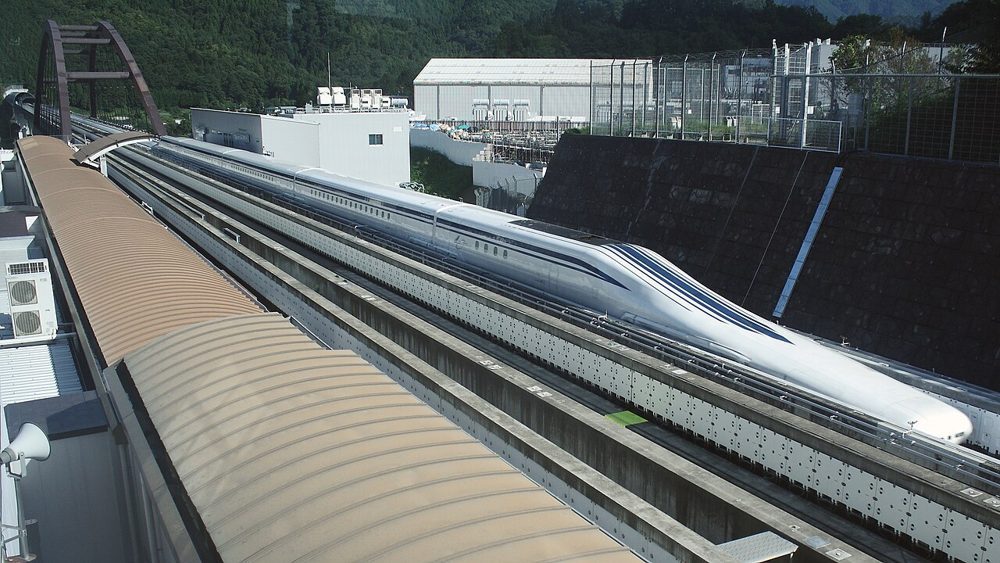 JR Central
Image: JR East E5 series Tohoku Shinkansen (CC0) / JR Central L0 series Chuo Shinkansen maglev (Saruno Hirobano, CC BY-SA 3.0), Wikimedia Commons


Company History: The Same Breakup, Opposite Business Structures
JR East and JR Central were both born on April 1, 1987, when Japanese National Railways (JNR) was broken up and privatized. JNR's reform split the company into six passenger railway companies (JR Hokkaido, JR East, JR Central, JR West, JR Shikoku, and JR Kyushu) plus one freight company (JR Freight) — seven companies in all, each starting out as a special government-funded corporation wholly owned by the state. JR East listed its stock in October 1993, and the government finished selling off its remaining shares in June 2002, completing full privatization. JR Central listed in October 1997 and completed full privatization in 2006.
Both companies started from the same point, but the character of the rail network each inherited determined its business structure from day one. JR East took over the greater Tokyo commuter network along with the wide-area Tohoku, Joetsu, and Hokuriku Shinkansen lines, and has since diversified its revenue across conventional rail, Shinkansen, station-building real estate, and Suica-related businesses. JR Central, by contrast, inherited the single biggest moneymaker from the JNR era — the Tokaido Shinkansen (Tokyo–Shin-Osaka) — and has run a business structure close to a "one-legged stool" built around it ever since its founding. This dependence on the Tokaido Shinkansen is also the source of the financial headroom that let JR Central conceive of the Chuo Shinkansen, the self-funded superconducting-maglev megaproject discussed below. JR Central began studying the commercialization of the Chuo Shinkansen maglev from the 1990s, won designation as a basic-plan line with the transport minister's approval in 2011, and broke ground on the Southern Alps Tunnel (Yamanashi Prefecture) in 2014.
Comparing Company Scale: Five-Year Trend
Both companies' fiscal years end in March. Tracking the last five fiscal years (FY2022/3 through FY2026/3), rather than a single snapshot, makes the recovery pattern from the pandemic — and the gap in profitability that followed — stand out sharply.
| Fiscal Year | JR East Revenue | JR East Operating Profit | JR Central Revenue | JR Central Operating Profit |
|---|---|---|---|---|
| FY2022/3 | ¥1.9789 trillion | -¥153.9 billion (loss) | ¥935.1 billion | ¥1.7 billion (near zero) |
| FY2023/3 | ¥2.4055 trillion | ¥140.6 billion | ¥1.4002 trillion | ¥374.5 billion |
| FY2024/3 | ¥2.7301 trillion | ¥345.2 billion | ¥1.7104 trillion | ¥607.3 billion |
| FY2025/3 | ¥2.8875 trillion | ¥376.8 billion | ¥1.8318 trillion | ¥702.7 billion |
| FY2026/3 | ¥3.0846 trillion (record for a 5th straight year) | ¥414.3 billion | ¥2.0062 trillion (topped ¥2 trillion for the first time) | ¥830.1 billion (record) |
| Metric | JR East | JR Central |
|---|---|---|
| Net profit (FY2026/3) | ¥247.8 billion | ¥552.8 billion (record) |
| Consolidated employees | 69,559 (as of April 1, 2025) | 29,569 (+425 YoY) |
| Operating margin (FY2026/3) | ~13.4% | ~41.4% |
JR East runs roughly 1.5x JR Central's scale on revenue, but JR Central posts more than twice JR East's net profit — and an operating margin over three times higher — a clear inversion of scale and profitability. Both companies took a devastating hit from the pandemic (JR East posted an operating loss and JR Central's operating profit was near zero in FY2022/3), but the speed of recovery and the margin achieved afterward diverged sharply. JR Central's high profitability traces directly to how concentrated its business is in a single line — the Shinkansen — which carries relatively light capital-expenditure, maintenance, and labor-cost burdens compared with a diversified rail operator; the flip side is a concentration risk in which the company's entire performance rides on Tokaido Shinkansen demand. JR East's diversified revenue base — conventional rail, station real estate, Suica-related businesses — trails on margin but carries far less dependence on any single business.
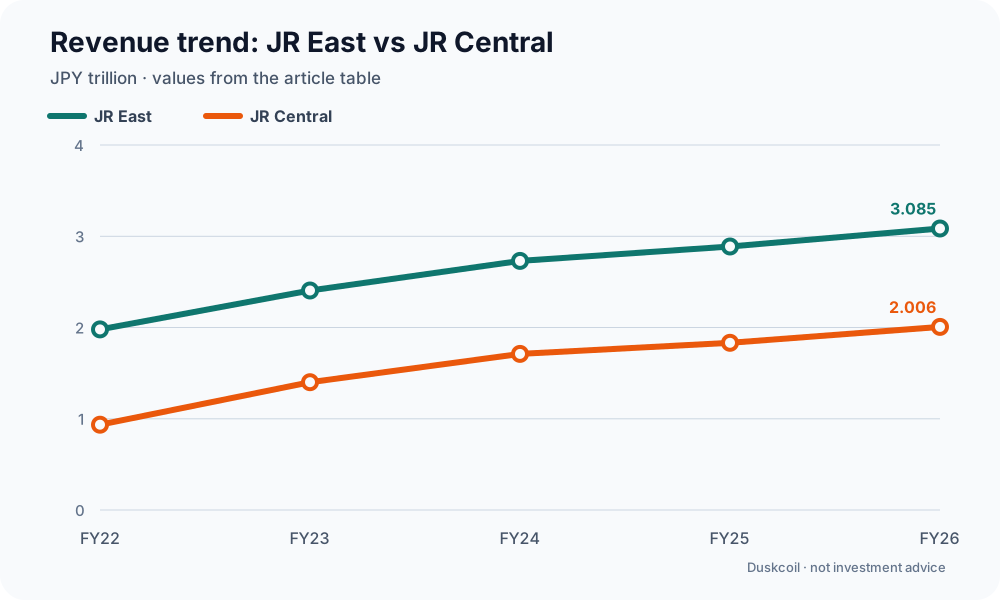
Diagram: Duskcoil. Revenue values in the article table, converted to JPY trillions. This diagram is not investment advice.
Comparing Flagship Technology and Services
Next-Generation Shinkansen Rolling Stock: E10 Series (in development) vs. N700S (current flagship)
JR East is developing the "E10 series," the next-generation successor to the E5 and E2 series that form the backbone of the Tohoku Shinkansen fleet. It holds the same top speed as the E5 series — 320 km/h — while adding safety-focused technology: an L-shaped guide mechanism to prevent derailment during an earthquake (proven on the ALFA-X high-speed test train), a new braking system that cuts stopping distance by 15% versus the E5 series, and dampers to suppress lateral sway while running. Comfort and convenience get attention too — a roomy 4-across seat layout throughout, power outlets at every seat, and a newly added door dedicated to baggage. The train is set to be completed in autumn 2027 to begin running tests, with commercial service targeted for fiscal 2030.
JR Central's current flagship, the N700S, has been in service on the Tokaido and Sanyo Shinkansen lines since July 2020 as the standard rolling stock. Built on a 4-car unit system, it can be configured not just as the standard 16-car train (capacity of roughly 1,323) but also as 12-car or 8-car formations — a flexible design. Its high starting acceleration of 2.6 km/h/s lets JR Central hold top speed to 285 km/h on the Tokaido section and 300 km/h on the Sanyo section while still running high-frequency service on a dense timetable. That looks slower on paper than the E5 series' 320 km/h top speed, but the difference reflects each line's operating characteristics: JR Central's design philosophy prioritizes acceleration-driven high-density operation over outright top speed.
| Item | JR East E10 Series (in development) | JR Central N700S (current) |
|---|---|---|
| Top speed | 320 km/h (target) | 285 km/h (Tokaido) / 300 km/h (Sanyo) |
| Commercial service start | Targeted for FY2030 | July 2020 (already in service) |
| Formation | In development (details undisclosed) | 4-car unit system; 16-car (capacity ~1,323) / 12-car / 8-car |
| Notable feature | L-shaped guide mechanism against derailment, 15% shorter braking distance, power outlets at every seat | 2.6 km/h/s starting acceleration for high-density operation; formation can flex shorter |
The Megaproject: Where the Chuo Shinkansen Stands Today
JR Central's biggest technical undertaking is the Chuo Shinkansen, a superconducting maglev (SCMaglev) line. The Shinagawa–Nagoya section was originally planned to open as early as 2027, but Shizuoka Prefecture kept opposing construction on its section of the route, citing concerns that tunnel excavation would reduce the flow of the Oi River — and in March 2024, JR Central abandoned that 2027 target. In October 2025 the company also disclosed that total construction cost was projected to roughly double from the original plan (~¥5.5 trillion) to ¥11 trillion, with roughly ¥2.3 trillion of the increase attributed to inflation and roughly ¥1.2 trillion to handling difficult excavation conditions. That figure was calculated assuming a hypothetical 2035 opening and, the company stresses, is not a commitment to that opening date.
A turning point came on July 18, 2026, when JR Central and Shizuoka Prefecture signed a "Natural Environment Conservation Agreement" — the precondition for construction to begin — bringing the long-stalled start of work in the Shizuoka section within realistic reach. In parallel, from May through June 2026 JR Central held resident briefings (open-house format) across eight cities and two towns in the Oi River basin plus Shizuoka City, working to build local understanding. As of the end of March 2026, construction outside Shizuoka was steadily progressing: roughly 90% complete on urban tunnels, roughly 85% on mountain tunnels, and roughly 85% on terminal stations — meaning that once the Shizuoka section actually breaks ground, the project overall enters its final phase. That said, tunnel excavation itself still has not started in the Shizuoka section, and the prevailing view is that the opening won't come before 2036 at the earliest.
IC Fare Cards and Payment Infrastructure: The Suica Ecosystem vs. TOICA Plus Express Reservation
Both companies issue IC fare cards, but they occupy very different positions in each company's business. JR East's Suica has grown well beyond a train ticket into a payment platform interoperable with IC cards nationwide (Kitaca, PASMO, TOICA, manaca, ICOCA, SUGOCA, nimoca, and hayakaken). In December 2024, JR East unveiled its "Suica Renaissance" vision, committing to evolve Suica over the next decade from a "device for travel and payment" into a "device for daily life." Alongside that, the company is consolidating IDs that used to be managed separately across its various services into a single "JRE ID," a rollout that began on Mobile Suica in February 2025.
JR Central's TOICA, by contrast, is an IC card focused mainly on conventional-line service in the Tokai region (Shizuoka, Aichi, Gifu, and Mie) and carries much less of the character of a broad payment platform than Suica does. What JR Central invests in instead is "Express Reservation" (EX Reservation), which lets riders book and pay for Tokaido Shinkansen reserved seats entirely online through an IC card, including an IC-linked service available via Mobile Suica. Where JR East treats the payment platform itself as a growth engine, JR Central's IC strategy is narrowly focused on improving convenience for its core Shinkansen business — a difference that mirrors, point for point, the difference in how diversified each company's overall business is.
A Difference in Technology Strategy
JR East's technology strategy centers on a composite approach that uses rail infrastructure as the starting point for tying "safety," "payments," and "real estate" together into one plane. The L-shaped guide mechanism and new braking system going into the E10 series extend the earthquake-safety push that followed the Great East Japan Earthquake, while the Suica Renaissance vision and the JRE ID consolidation aim to convert the customer touchpoints won through the rail business into a data foundation for life-services businesses broadly.
JR Central's technology strategy runs the opposite way: total focus on pushing the precision and safety of a single piece of infrastructure — the Tokaido Shinkansen — to its limit. The N700S's high-acceleration design is the optimal answer within the constraint of high-density Shinkansen operation that JR Central has worked within since its earliest trains, and the superconducting maglev represents the culmination of more than 60 years of technology investment dating back to basic research that began in 1962. The difference in the two companies' technology strategies is really a difference in management philosophy: JR East pursues risk reduction through portfolio diversification, while JR Central concentrates its technology and capital investment into its overwhelming Tokaido Shinkansen revenue base, choosing a path that funds a project on the unmatched scale of the Chuo Shinkansen mainly out of its own resources.
Development & Manufacturing Facilities
Beyond its Tokyo headquarters, JR East operates two plants run by its wholly owned rolling-stock manufacturing subsidiary J-TREC (Japan Transport Engineering Company), a research and development facility, and a General Rolling Stock Center that handles comprehensive inspection of both conventional and Shinkansen rolling stock. Beyond its Nagoya headquarters, JR Central operates the Hamamatsu Plant, which handles comprehensive inspection of Shinkansen rolling stock; its Research & Development Institute (Komaki City, Aichi), which covers technology research including the superconducting maglev; the Yamanashi maglev test line and its public exhibition facility (Tsuru City, Yamanashi); and the Tokaido Shinkansen's three major rolling-stock depots (Tokyo, Nagoya, and Osaka). The map below plots every domestic facility we could confirm (overseas facilities and ordinary conventional-line depots are out of scope).
Sources: articles on rolling-stock depots and research facilities from each company's official site, Wikipedia, and map/directory services (Mapion, NAVITIME, etc.) used to confirm addresses. Neither company publishes a single consolidated "facility list" page, so each facility's address was cross-checked against an individual source (an official news release or a railway trade publication). Coordinates were geocoded to town/block level via OpenStreetMap Nominatim.
Strategy & Outlook
Under its 2018 group management vision "Move Up! 2027," JR East has committed to shifting from "service provision centered on rail" to "value creation centered on people," positioning its life-services business and its IT/Suica business as new growth engines. The clearest embodiment of that shift is "Takanawa Gateway City," which held its neighborhood-opening ceremony in March 2025 and reached full opening in March 2026 — one of the largest redevelopment projects in Tokyo, with a total project cost of roughly ¥600 billion and a site area of roughly 9.5 hectares, comprising office space, commercial facilities, a large-scale convention center, and a culture-and-creation building. Alongside that, JR East has founded JR East Real Estate to accelerate an asset-turnover real estate business model, unveiled the "Suica Renaissance" vision to evolve Suica from a "device for travel and payment" into a "device for daily life," and is rolling out "JRE ID" to unify IDs across its various services — all signs that the central question going forward is how to convert the customer touchpoints won through the rail business into growth for non-rail businesses. FY2026/3 marked a fifth consecutive year of record revenue, but net profit growth was comparatively modest, weighed down by investment costs tied to Takanawa Gateway City along with rising labor and maintenance costs.
JR Central is holding firm to a strategy of concentrating its management resources on completing the Chuo Shinkansen megaproject. Even after disclosing in October 2025 that total construction cost would roughly double to ¥11 trillion, the company has not backed away from its principle of "completion funded by its own resources." The July 2026 Natural Environment Conservation Agreement with Shizuoka Prefecture — clearing what had been considered the single biggest obstacle, construction start in the Shizuoka section — is a major step toward pinning down an actual opening date. The company is also participating in discussions about the redevelopment around Nagoya Station through the "Meieki Grand Design Council," a body that includes the City of Nagoya, Aichi Prefecture, and Meitetsu, with an eye toward the future Chuo Shinkansen station there — but unlike Tokyo's Takanawa Gateway City, redevelopment around Nagoya Station has yet to reach a clear stage of project execution, and the uncertainty around the Chuo Shinkansen's opening date is itself one reason the surrounding urban-planning decisions remain unsettled. A debate has also emerged over whether the cost increase should be passed on through Tokaido Shinkansen fares — whether completing the Chuo Shinkansen ripples into the Tokaido Shinkansen's fare structure itself is another point to watch going forward.
The structural challenge both companies share is how to pursue inbound tourism demand and grow non-rail businesses in tandem against the long-term headwind of Japan's shrinking, aging population. JR East is spreading that risk through portfolio diversification, while JR Central is protecting its rock-solid Tokaido Shinkansen revenue base while pouring all available resources into its next growth engine, the Chuo Shinkansen — two contrasting answers to the same underlying question.
References
- JR East Official Site / Earnings Results (Japanese)
- JR Central Official Site / Chuo Shinkansen (Japanese)
- JR East Announces Next-Generation Tohoku Shinkansen "E10 Series" (Japanese)
- The Background Behind the Chuo Shinkansen's Delayed Opening (Toyo Keizai Online, Japanese)
- IRBANK: JR East (9020) financial results (Japanese) / IRBANK: JR Central (9022) financial results (Japanese)
- JR East Group Management Vision "Move Up! 2027" (Japanese)
- PR TIMES: JR East mid/long-term business growth strategy "Beyond the Border" (Japanese)
- Fashion Press: Takanawa Gateway City full opening coverage (Japanese)
- N700S Series Shinkansen — Wikipedia (Japanese)
- Nikkei: "Chuo Shinkansen total construction cost up ¥4 trillion to ¥11 trillion, Shinagawa–Nagoya opening timeline unclear" (Japanese)
- Mynavi News: "JR Central and Shizuoka Prefecture sign agreement, Shizuoka-section maglev construction to begin this year" (Japanese)
- JR Central: efforts in the Shizuoka Prefecture section (Japanese)
- J-TREC (Japan Transport Engineering Company) facility list (Japanese)
- JR Central Hamamatsu Plant — Wikipedia (Japanese)
- Yamanashi Prefectural Maglev Exhibition Center official site (Japanese)
- DBJ: "Outlook on the Impact of the Chuo Shinkansen Opening and Meieki Redevelopment on the Nagoya Area and Tokai Region" (Japanese)
Current step · 18 / 21 · Corporate Research
Comments
Please log in to post a comment
No comments yet.