Contents — find the section you need
Background and reading guide
Background No specialist background required; check the reporting period and scope of financial measures.
Industry research · Read the sources, reporting period and comparison criteria together.
Japan's "super general contractors" build the physical foundations of society itself — roads, dams, and tunnels through skyscrapers, factories, and data centers. A severe, worsening shortage of skilled labor is driving Kajima, Taisei, and Shimizu into fierce competition on automation and robotics, and the three companies diverge just as sharply on scale and on construction-robotics technology.
 Kajima
 Shimizu
Image: Kajima logo (CC BY 2.5) / Shimizu logo (public domain), Wikimedia Commons. No Taisei logo meeting Commons' copyright threshold was found, so Taisei is covered in text only.


Company History: From Edo-Era Carpenters to Some of Japan's Oldest Contractors
All three companies trace back to the Edo or Meiji era, and all three followed a similar path — starting as an individual master carpenter or a sole proprietorship before incorporating.
Shimizu is the oldest of the three. It began in 1804 (Bunka 1), when Kisuke Shimizu I, a carpenter from Etchu (present-day Toyama Prefecture), opened for business in Kanda-Kajicho, Edo (Tokyo). After taking part in rebuilding Edo Castle's western citadel in 1838 and winning contracts to build the foreign magistrate's office following Yokohama's 1858 opening to foreign trade, the company completed the Tsukiji Hotel — a lodging house for foreigners — in 1868, absorbing Western building techniques early.
Kajima traces back to 1840 (Tenpo 11), when founder Iwakichi Kajima opened a carpentry shop called "Oiwa-gumi" in Kyobashi, Edo. In 1880, the company established its head office as Kajima-gumi in Kyobashi Kobikicho, Tokyo, and entered the railway-construction boom that followed the Meiji Restoration, laying more than 2,000 km of track cumulatively and building a foothold in infrastructure construction. Kajima-gumi Co., Ltd. was established in 1930, and the company took its present name, Kajima Corporation, in 1947.
Taisei is the youngest of the three. It began in 1873 (Meiji 6), when Kihachiro Okura founded Okura-gumi Shokai. In 1887, Okura joined Eiichi Shibusawa and Denzaburo Fujita to establish the Nippon Doboku Kaisha (Japan Civil Engineering Company), regarded as Japan's first incorporated construction firm. After passing through several incarnations — Okura Doboku-gumi, then the civil engineering division of Kabushiki Kaisha Okura-gumi, among others — the company took the name Taisei Corporation in 1946. "Taisei" derives from Okura's Buddhist posthumous name, while "Kensetsu" (construction) was coined as a new Japanese word translating the English "construction" — the first time the term was adopted into a company name.
All three companies' roots lie in wooden-building carpentry, but each reached its present three-company structure through a different turning point: Shimizu's linear growth from an individual founder, Kajima's early entry into railway infrastructure construction, and Taisei's establishment of a modern joint-stock company alongside Eiichi Shibusawa and others.
Comparing Company Scale: Five-Year Trend
Looking at the trend over the last five fiscal years (FY2022/3 through FY2026/3, all three companies sharing a March fiscal year-end) rather than a single snapshot makes the three companies' different growth patterns much clearer.
| Fiscal Year | Kajima Revenue | Kajima Operating Profit | Taisei Revenue | Taisei Operating Profit | Shimizu Revenue | Shimizu Operating Profit |
|---|---|---|---|---|---|---|
| FY2022/3 | ¥2.0797 trillion | ¥123.3 billion | ¥1.5432 trillion | ¥96.0 billion | ¥1.4829 trillion | ¥45.1 billion |
| FY2023/3 | ¥2.3916 trillion | ¥123.5 billion | ¥1.6427 trillion | ¥54.7 billion | ¥1.9338 trillion | ¥54.6 billion |
| FY2024/3 | ¥2.6652 trillion | ¥136.2 billion | ¥1.7650 trillion | ¥26.5 billion | ¥2.0055 trillion | -¥24.7 billion (first-ever operating loss since listing) |
| FY2025/3 | ¥2.9118 trillion | ¥151.9 billion | ¥2.1542 trillion | ¥120.2 billion | ¥1.9443 trillion | ¥71.0 billion (back to profit) |
| FY2026/3 | ¥3.0672 trillion (record) | ¥240.8 billion (record) | ¥2.0890 trillion | ¥188.0 billion (record) | ¥2.0578 trillion | ¥118.7 billion |
| Metric | Kajima | Taisei | Shimizu |
|---|---|---|---|
| Consolidated employees (FY2026/3) | 11,437 | 10,984 | 11,434 |
| Notable | 5th consecutive year of revenue and profit growth; first Japanese contractor to top ¥3 trillion in revenue | Sharp rebound from a FY2024/3 trough; record at every profit level | First-ever operating loss (since listing) in FY2024/3, followed by two straight years of profit growth |
Kajima grew revenue and profit for five consecutive years, with revenue up roughly 1.5x and operating profit up roughly 2x from FY2022/3 to FY2026/3. Taisei's operating profit fell as low as ¥26.5 billion in FY2024/3, then rebounded 4.5x to ¥120.2 billion the following year and hit a record ¥188.0 billion in FY2026/3. Shimizu experienced the deepest trough of the three — a ¥24.7 billion operating loss in FY2024/3, its first since going public in 1961 — before swinging back to profit in FY2025/3 and posting a 67% year-over-year jump in net profit in FY2026/3. All three companies share a V-shaped recovery centered on FY2024/3, but the depth of the trough and the shape of the recovery differ; Shimizu's swing into loss and Taisei's roughly 80% drop in operating profit in particular reflect a period when neither company could fully pass rising material and labor costs through to contract prices.
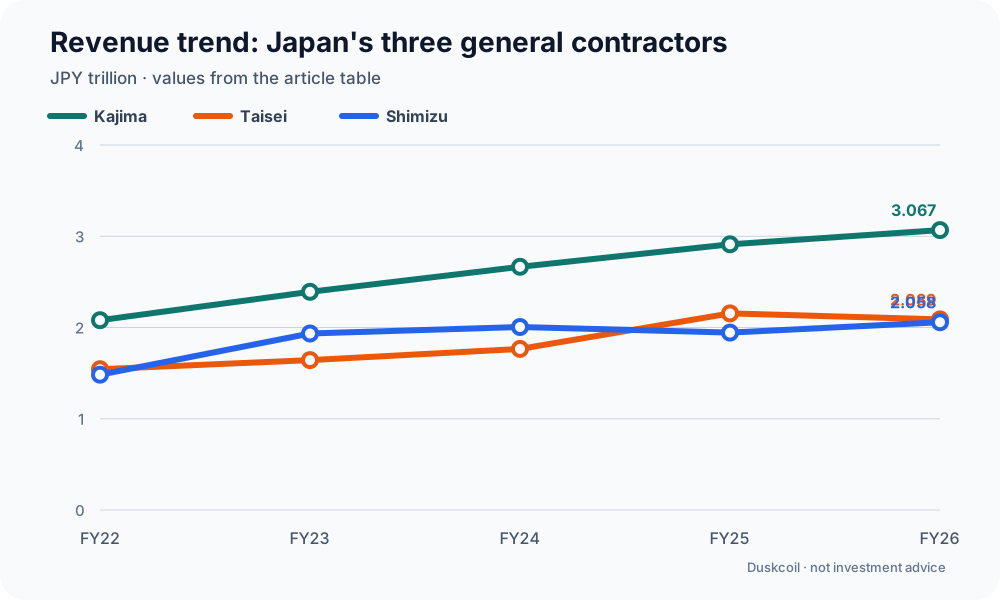
Diagram: Duskcoil. Revenue values in the article table, converted to JPY trillions. This diagram is not investment advice.
Comparing Flagship Businesses: Overseas Operations and Frontier Businesses
With Japan's domestic construction market plateauing amid population decline, all three companies are looking to different areas for growth.
| Item | Kajima | Taisei | Shimizu |
|---|---|---|---|
| Position of overseas business | Overseas affiliates' revenue reached ¥1.1143 trillion, a 38.3% share of the total — now the largest of any segment, ahead of domestic building construction | Reorganized its international branch into an "International Business Division" in April 2024 to drive localization | Has operated in roughly 60 countries since opening a Singapore office in 1974 |
| Flagship overseas projects | Los Angeles serves as its main North American base, building high-rises valued for Japanese seismic and vibration-isolation technology; in China, pharmaceutical and food plants (e.g., a Meiji Milk plant in Tianjin) | "TAISEI SQUARE HANOI" in Vietnam, the Hamad International Airport passenger terminal in Qatar, and the North-South Commuter Railway project in the Philippines | Production facilities, high-rises, hospitals, and subways mainly across Southeast Asia |
| Domestic frontier business | Surging orders for data centers (including in the U.S.); accumulating and selling real-estate development assets at home and abroad | Capturing manufacturing-linked construction demand through semiconductor fab construction (e.g., TSMC's Kumamoto plant) | A space-development office set up in 1987, elevated to a full business unit in 2018; researching lunar habitats jointly with Taiyo Kogyo and Tokyo University of Science |
All three companies are looking outside their core domestic building-and-civil-engineering business for growth, but in different directions. Kajima's overseas affiliates alone generate over ¥1 trillion in revenue — by revenue mix, it can no longer simply be called a "domestic contractor." Taisei is capturing high-value-added domestic construction like semiconductor fabs and data centers while also reinforcing its overseas business through its 2024 reorganization. Shimizu, while also active in roughly 60 countries overseas, stands apart with a business neither of the other two has: space-development research dating back to 1987, investing in the long-term frontier of lunar habitat design.
Technology Strategy: Construction Robotics and Automated Construction
Facing a worsening shortage of skilled tradespeople, Japan's major contractors have each taken a distinct approach to automation.
Kajima has built "A4CSEL" (pronounced "Quad Accel"), an automated construction system for civil-engineering work. Dump trucks hauling and dumping earth, bulldozers spreading and grading it, and vibratory rollers compacting it are all equipped with GPS, gyroscopes, laser scanners, and an onboard control PC, letting multiple machines coordinate and run the entire earthwork sequence unmanned. A human operator only needs to send a work plan — multiple machines can then run autonomously and simultaneously.
Taisei partnered with Chiba Institute of Technology to develop "T-iROBO Revar," a robot that automates rebar-tying work, one of the more labor-intensive tasks in reinforced-concrete construction, estimated to account for roughly 20% of total rebar-work labor. Beyond that, Taisei has built out the T-iROBO series to automate individual construction processes one by one: "T-iROBO Slab Finisher" for concrete floor finishing, "T-iROBO Welding" for automated on-site welding, and "T-iROBO Cleaner," an autonomous cleaning robot.
Shimizu unveiled "Shimz Smart Site" in 2018, a next-generation production system combining autonomous robots with an integrated management platform. At its core are three robot types operated by tablet instructions: "Robo-Carrier" for horizontal material transport, "Robo-Welder" for welding steel columns, and "Robo-Buddy," a multi-skill robot that handles tasks like ceiling and floor material installation. The concept goes further than individual robots — it aims to redesign the entire construction-site production system around robotics and BIM (Building Information Modeling).
Facing the same challenge of construction robotics, the three companies have taken clearly different paths: Kajima automates civil-engineering earthwork as a whole, Taisei develops individual robots for specific building-construction processes, and Shimizu is rebuilding the entire building-construction production system around robotics — a divergence that reflects each company's traditional area of strength (Kajima in civil engineering, Taisei and Shimizu in building construction).
Development & Manufacturing Facilities (Headquarters and Major Domestic Branches)
Contractors don't operate "factories" the way manufacturers do, so the map below plots each company's headquarters function alongside its major regional branch network. Branch layouts are broadly similar across all three, with each company running a nationwide network from Hokkaido to Kyushu.
Sources: branch names and addresses from Kajima's "Major Domestic Locations," Taisei's "Branches," and Shimizu's "Office List" official pages (all primary-source). All three companies operate many more branches and sales offices nationwide; this map is limited to headquarters/technical institute plus each company's major regional-block branches (8 locations per company). Coordinates were geocoded to town/block level via OpenStreetMap Nominatim.
Strategy & Outlook: Data Centers and Semiconductor Fabs as the New Main Battleground
A common thread across every major contractor's FY2026/3 results is the establishment of "selective order-taking" — accepting only projects where rising material and labor costs can be fully passed through to contract prices — which sharply improved profitability. Demand is being driven above all by large data centers for cloud and telecom operators and by semiconductor-fab-related construction, with individual projects worth hundreds of billions to over ¥100 billion not uncommon. Taisei has won construction contracts tied to TSMC's Kumamoto plant, and Kajima has seen a surge in U.S. data-center construction orders — both fields are becoming a shared main battleground for all three companies.
Kajima, under its FY2024-2026 mid-term management plan, "Strengthening the Core Further, Pioneering the Future," targets net profit attributable to owners of the parent of at least ¥130 billion in FY2026 (at least ¥150 billion by FY2030) and continued ROE above 10%. It plans to allocate roughly ¥1.2 trillion to growth investment over three years, with its overseas business (a 38.3% revenue share, noted above) and the accumulation and sale of real-estate development assets at home and abroad as the pillars of growth. Its FY2026/3 results — ¥240.8 billion in operating profit, a fifth straight year of revenue and profit growth — are tracking ahead of the pace needed to hit this plan's targets.
Taisei, under its "TAISEI VISION 2030" achievement plan and FY2024-2026 mid-term management plan, had set FY2026 targets of roughly ¥1.95 trillion in group revenue, ¥120 billion in group operating profit, ¥80 billion in net profit, and an ROE of roughly 8.5%. Taisei's actual FY2026/3 results — ¥2.089 trillion in revenue and ¥188.0 billion in operating profit — comfortably beat those targets on both revenue and profit. It had set a three-year investment envelope of ¥350 billion (including ¥125 billion for technology development and DX), with rebuilding the profitability of its domestic building-construction business as the top priority — but the profit recovery arrived faster than planned.
Shimizu, under its FY2024-2026 mid-term management plan, shortened its planning horizon from the previous five years to three, with "strengthening the management foundation for sustainable growth" as its basic policy. For its construction business (building and civil engineering), it set out to achieve "a shift to a highly profitable business structure" and "rebuild a production system that lets people take pride in making things," while its mid-term DX strategy for the same period prioritizes "building a cross-organizational DX promotion structure" and "developing DX talent." For a company that had just experienced its first-ever operating loss since listing in FY2024/3, this plan amounts to a three-year bet on rebuilding the management foundation itself — and its FY2026/3 results, with both revenue and profit up and net profit up 67% year over year, show real progress toward that goal.
What all three companies share is a two-pronged approach: shifting orders toward newly high-margin categories like data centers and semiconductor fabs, and investing in DX and automation to lift productivity. As Japan's domestic construction market itself gradually shrinks under population decline, each company is also pursuing growth outside its core business in parallel — Kajima through overseas operations, Taisei through its reorganized International Business Division, and Shimizu through the long-term frontier of space development.
References
- Kajima Official Site / Investor Relations
- Taisei Official Site / Investor Relations
- Shimizu Official Site / Investor Relations
- 2026 Overview: The Five Super General Contractors' Earnings and Outlook (Japanese)
- Kajima Civil Engineering Technology: ICT/DX (A4CSEL) (Japanese)
- T-iROBO Series | Taisei Corporation (Japanese)
- Inside Shimizu's "Shimz Smart Site" (Japanese)
- Kajima corporate history - The-Shashi (Japanese) / Taisei 150th Anniversary: 1873-1945 (Japanese) / Shimizu History | Our Heritage (Japanese)
- IRBANK: Kajima financial results / IRBANK: Taisei financial results / IRBANK: Shimizu financial results
- Kajima tops ¥3 trillion in revenue: breaking down the 38% overseas share (Japanese)
- Taisei overseas business (International Business Division) | Taisei Techsolu (Japanese)
- Shimizu lunar base business topic page (Japanese)
- Nikkei: Shimizu's space-development chief pursues the dream of lunar habitation (Japanese)
- Kajima major domestic locations (official site, Japanese)
- Taisei branches (official site, Japanese)
- Shimizu office list (official site, Japanese)
- Kajima mid-term management plan (2024-2026) (Japanese)
- Taisei "TAISEI VISION 2030" achievement plan and mid-term management plan (2024-2026) (Japanese)
- Shimizu mid-term management plan <2024-2026> (Japanese)
- BUILT: Taisei posts record profit for FY2026/3 (Japanese)
- BUILT: Kajima's 5th straight year of revenue and profit growth, revenue a record ¥3.0672 trillion (Japanese)
- BUILT: Shimizu's FY2026/3 revenue reaches ¥2.0578 trillion (Japanese)
- Nikkei: Shimizu posts its first-ever operating loss since listing, FY2024/3 (Japanese)
Current step · 19 / 21 · Corporate Research
Comments
Please log in to post a comment
No comments yet.