Contents — find the section you need
Study robot-reducer businesses by asking which joint they serve, what they supply and how much integration they provide. This comparison covers Nabtesco, Harmonic Drive Systems (HDS) and Sumitomo Heavy Industries because official sources expose different precision mechanisms and supply boundaries. Research date: 2026-09-08. It does not value shares or provide investment recommendations.
Separate components from integrated units
Buying gear components differs from buying a unit with bearings and housing. An actuator adding motor, sensors and drive electronics changes the customer's remaining design work further.
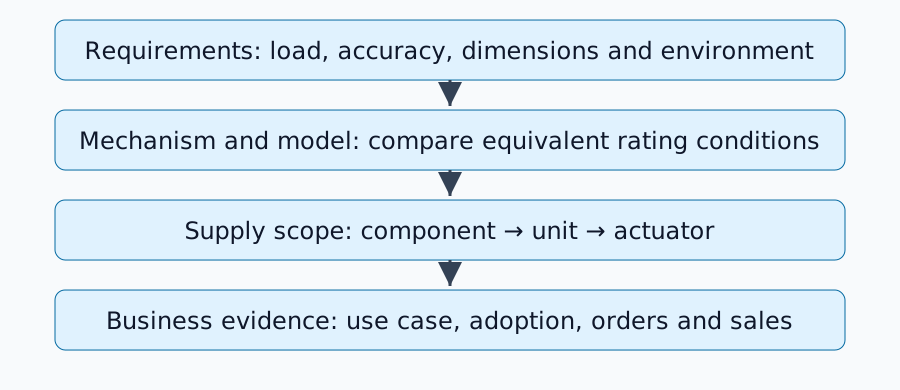
The table is a research entry point, not an exhaustive lineup or equal-performance ranking. See the reducer introduction for mechanism basics.
Put three companies on common axes
| Company | Product entry point | Supply-scope perspective | Further question |
|---|---|---|---|
| Nabtesco | Precision reduction gear RV | Components, gearheads and actuators | Which support parts, loads and dimensions are covered? |
| HDS | HarmonicDrive, precision planetary and mechatronics | Gear elements through motor/sensor integration | Are component and integrated-product sales distinguished? |
| Sumitomo Heavy Industries | Fine CYCLO precision control | Precision reducers within broader drive equipment | Can precision and general-industrial figures be separated? |
Sources are Nabtesco's product list, HDS's business model and Sumitomo's Fine CYCLO list. The questions are this article's analytical framework.
Nabtesco: connect mechanism and application range
The RV operating principle combines spur gearing with eccentric reduction. Then inspect product boundaries: model differences involve mounting, bearings and output arrangement, not only ratio.
A dated change is the RVmini and Monocrank product announcement on 2025-12-02. It establishes product expansion, not shipment volume or earnings contribution. Broader options for compact applications are an inference from the announcement, not measured adoption.
HDS: do not describe the whole company through one mechanism
The business model includes precision planetary and mechatronics products alongside strain-wave HarmonicDrive. Customers may need a controllable joint or positioning axis rather than isolated gear performance.
Our inference is that integration changes assembly/control responsibility, making component price alone insufficient for comparison. It does not guarantee higher margins: customization, materials, quality assurance and support also matter. Customer-specific adoption shares absent from public sources are not estimated here.
Sumitomo: distinguish precision uses from the broader drive business
The official Fine CYCLO page identifies robotics/automation positioning applications and lists A, C, DA and UA series. The same site also covers broader drive equipment such as gearmotors and inverters.
Whole-company or broad-segment revenue cannot be relabeled robot-joint-reducer revenue. Keep a Fine CYCLO product comparison separate from financial reporting boundaries. No equal-load lifetime or hardware comparison among these series was performed.
A worksheet for future numerical research
Before adding revenue or orders, align fiscal year, period, currency, consolidation, segment and definitions of orders versus shipments. Check whether application categories such as robotics and semiconductor equipment match. Do not rank whole-company and individual-product revenue in one column.
Separate exhibition, prototype, mass-production adoption and actual shipment claims. Market share needs a defined market and estimation method. Comparable volume data was not collected here, so no share or growth ranking is provided.
Build a use-case-specific comparison
Choose one application and list torque, speed, outer diameter, bore, output support, accuracy definition, life conditions and control interface. Return from that worksheet to product documentation rather than ranking company names first. Connect it to industrial robot company research to examine finished machines and component supply together.
Comments
Please log in to post a comment
No comments yet.