Contents — find the section you need
Background and reading guide
Background No specialist background required; check the reporting period and scope of financial measures.
Industry research · Read the sources, reporting period and comparison criteria together.
The global industrial robot market is dominated by four companies — FANUC, Yaskawa Electric, Switzerland's ABB, and Germany's KUKA — and two of the four are Japanese, one of the rare advanced-manufacturing fields where Japan holds real strength. FANUC, Japan's domestic leader, and Yaskawa Electric, one of the world's highest-volume robot shippers, chart different paths to the top in both scale and technology strategy. FANUC is also a highly profitable maker of CNC (computer numerical control) systems for machine tools, holding roughly half the world market, while Yaskawa is a world-leading maker of servo motors and inverters in its own right — both companies built their competitiveness not on the robot alone but on owning the surrounding technology that automation depends on.
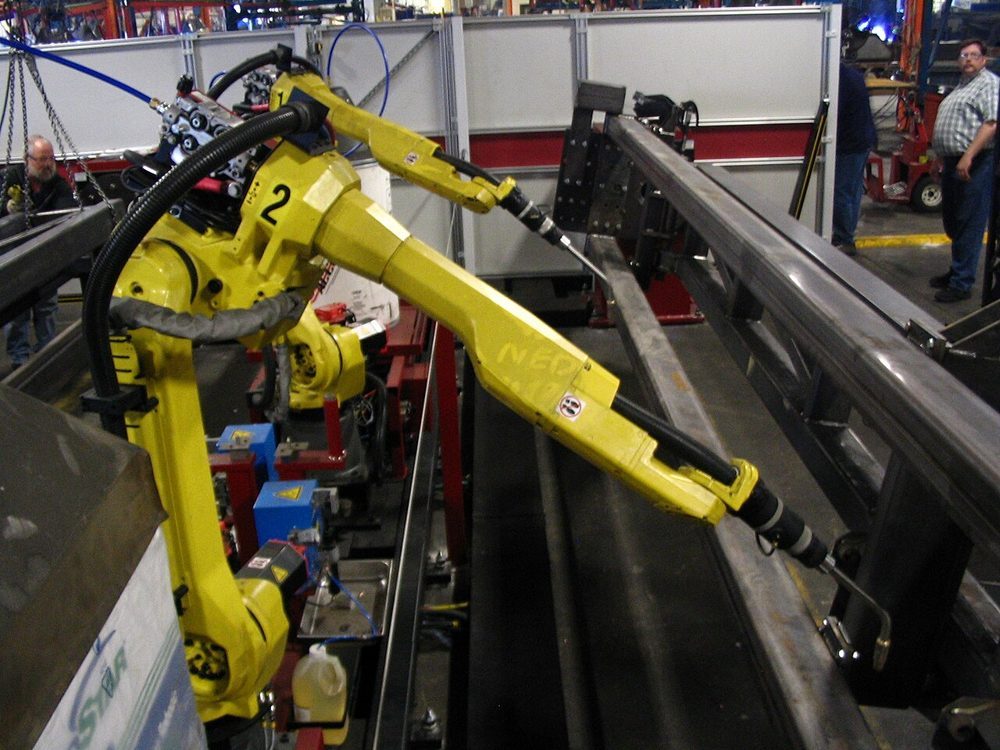 FANUC
FANUC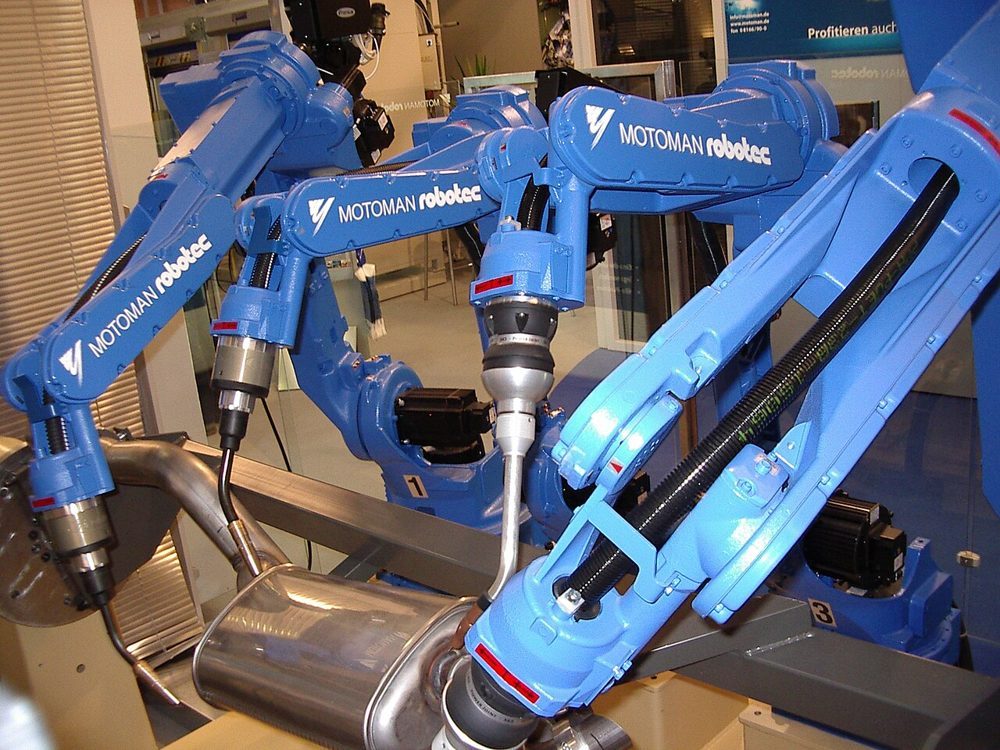 Yaskawa Electric
Image: A FANUC welding robot (Phasmatisnox, CC BY 3.0) / A Yaskawa Electric MOTOMAN robot (Michael KR, CC BY-SA 4.0), Wikimedia Commons


Company History: FANUC's Split From Fujitsu, Yaskawa's Continuity From a Meiji-Era Educator
FANUC's roots trace to 1956, when Fujitsu named Tokuo Inaba to head its numerical control (NC) research effort at its Kawasaki plant, working to catch up with — and eventually surpass — research underway at MIT in the U.S. Inaba developed his own electro-hydraulic pulse motor in 1959, establishing proprietary NC technology, and in May 1972 spun off Fujitsu's computer control division as Fujitsu Fanuc (today's FANUC), becoming senior managing director. After becoming president in 1975, he expanded the business from NC systems into robots and machine tools, building a company that would hold a leading world share in both NC and robotics. In 1980 the company relocated its headquarters to the foot of Mt. Fuji, in Oshino Village, Yamanashi Prefecture, and has since built an expansive, self-contained production complex there known as "the FANUC forest."
Yaskawa Electric was founded in 1915 in Fukuoka Prefecture by Keiichiro Yasukawa as Yasukawa Electric Manufacturing, a limited partnership. Yasukawa, who in 1909 spent his own fortune to found Meiji Technical School (today's Kyushu Institute of Technology) to develop skilled talent, established the company to develop and manufacture electrical equipment for Meiji Mining, the coal company he had founded. In 1932 the company shifted to become a specialist maker of motors and control equipment, building a business foundation centered on motion-control technology. In 1977 it unveiled the world's first all-electric industrial robot, and in 1990 it opened the "Motoman Center," equipped with a CIM (computer-integrated manufacturing) system for industrial robots — a consistent thread, since its founding, of turning motor and control technology into a robotics business.
Comparing Company Scale: Five-Year Trend
The two companies' fiscal years differ (FANUC's runs to March, Yaskawa Electric's to February), so the last five fiscal years are laid out along each company's own fiscal calendar.
| Fiscal Year | FANUC Revenue | FANUC Operating Profit | Yaskawa Revenue | Yaskawa Operating Profit |
|---|---|---|---|---|
| FY ending Mar/Feb 2022 | ¥733.0 billion | ¥183.2 billion | ¥479.1 billion | ¥52.9 billion |
| FY ending Mar/Feb 2023 | ¥852.0 billion | ¥191.4 billion | ¥556.0 billion | ¥68.3 billion |
| FY ending Mar/Feb 2024 | ¥795.3 billion | ¥141.9 billion | ¥575.7 billion | ¥66.2 billion |
| FY ending Mar/Feb 2025 | ¥797.1 billion | ¥158.8 billion | ¥537.7 billion | ¥50.2 billion |
| FY ending Mar/Feb 2026 | ¥857.8 billion (record) | ¥183.8 billion (+15.7% YoY) | ¥542.1 billion | ¥47.3 billion (down) |
| Metric | FANUC (FY ending Mar 2026) | Yaskawa Electric (FY ending Feb 2026) |
|---|---|---|
| Net profit | ¥166.5 billion (+12.9% YoY) | ¥35.2 billion (-38.2% YoY) |
| Consolidated employees | 10,040 | 12,833 (as of February 2025) |
FANUC's revenue runs roughly 1.6x Yaskawa Electric's — yet the reverse holds for headcount, with Yaskawa Electric employing more people. Both companies saw profit decline in their FY ending March/February 2024, hit by an adjustment cycle in semiconductor and electronic-component demand, but their recovery paths afterward diverged sharply. FANUC's revenue and operating profit both climbed back to record territory in FY ending March 2026, with net profit up 12.9%. Yaskawa Electric, by contrast, saw revenue roughly flat in FY ending February 2026 while both operating and net profit declined — a sign that the sluggish recovery in electronic components and semiconductor-related markets is weighing heavily on results. FANUC is known for a highly profitable business built partly around its CNC business for machine tools; Yaskawa Electric's core business spans motion-control products — servo motors, inverters — alongside robotics, likely giving it a somewhat more labor-intensive business mix overall.
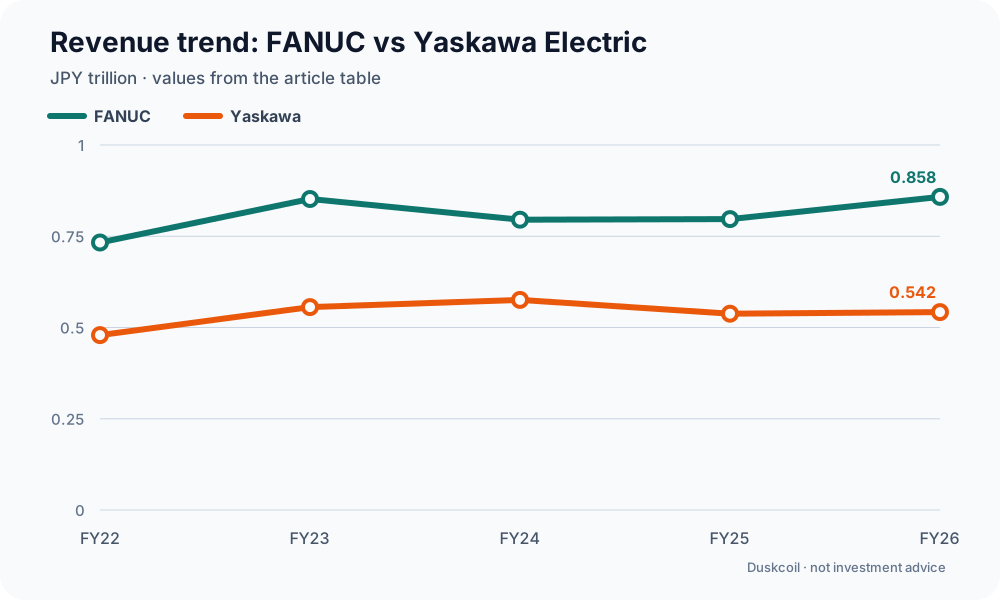
Diagram: Duskcoil. Revenue values in the article table, converted to JPY trillions; the companies have different fiscal year-ends. This diagram is not investment advice.
Comparing Flagship Products and Businesses
Two Different Roads to an Industrial Robot
Both companies built their global standing on robots for the automotive industry, but they arrived there differently, with different core strengths.
FANUC makes nearly every one of the "yellow robots" seen across auto plants, holding the leading share of Japan's domestic articulated-robot market and roughly a fifth of the world market. Its strength lies in heavy processes like painting, welding, cleaning, and palletizing, and more recently it has expanded its "CRX" collaborative robot series — designed to work safely alongside people — across a wide range of applications. The CRX lineup spans a payload range from 5 kg to 30 kg, and is defined by a feature that lets it stop safely with minimal force on contact with a person, plus simple direct-teach operation.
Yaskawa Electric is a pioneer of the robotics industry, having unveiled the world's first all-electric industrial robot back in 1977. Its current "MOTOMAN" series has shipped more than 700,000 units cumulatively, running worldwide primarily on automotive spot-welding and paint lines. A defining feature is that it develops the servo motors at the heart of each robot's drive system in-house — a vertically integrated approach that builds its robotics business on top of its own motion-control technology.
CNC Systems vs. Servo Motors and Inverters: Each Company's "Hidden Core Business"
Comparing the robots alone doesn't tell the whole story. Alongside its robotics business, FANUC holds roughly half the world market (and roughly 70% of the domestic market) in CNC systems for machine tools, and in its "Robomachine" business — compact cutting machines, electric injection-molding machines, and more — holds roughly 80% of the world market for its Robodrill line. It organizes its business around four pillars — factory automation (FA), robots, robomachines, and IoT — and holds firmly to a policy of never entering any area outside the single, consistent theme of "factory automation."
Alongside its robotics business, Yaskawa Electric runs a motion-control business holding the world's top share in both AC servo motors and inverters. Servo motors go into equipment requiring high-speed, high-precision positioning — semiconductor manufacturing equipment, electronic-component placement machines — while inverters control motor rotation speed in large air-conditioning systems, escalators, and elevators. The company operates in more than 30 countries, runs 28 production sites across 12 countries, and derives roughly 70% of its sales from overseas.
| Item | FANUC (CNC and Robomachine businesses) | Yaskawa Electric (Motion Control business) |
|---|---|---|
| Core products | CNC systems for machine tools, Robodrill (compact cutting machine) | AC servo motors, inverters |
| World share | CNC ~50% (~70% domestic), Robodrill ~80% | World-leading share in both servo motors and inverters |
| Position in the business | A profit pillar alongside robotics, one of four pillars (FA/robots/robomachines/IoT) | The heart of the robotics business (in-house servo motor supply) and a world-leading business in its own right |
Next-Generation Technology: Yaskawa's Autonomous Robot "MOTOMAN NEXT" and FANUC's Physical AI
Yaskawa Electric has recently introduced a new series, "MOTOMAN NEXT," that judges and acts autonomously based on its surroundings. Traditional industrial robots specialize in precisely repeating a pre-taught motion — MOTOMAN NEXT instead ships with a built-in NVIDIA GPU as standard, processing a large volume of sensor and image data in real time and pairing it with AI, aiming to handle non-routine work and changing conditions.
FANUC, too, announced a partnership with Google in May 2026, building an "AI agent system for industrial robots" on Google Cloud technology that includes the enterprise generative-AI product "Gemini Enterprise." In this system, an AI agent interprets a simple human instruction, recognizes objects, and then drives multiple robots — including mixed cells of collaborative and non-collaborative robots — to carry out the task; FANUC is also participating in research on foundation models for robotics. From a machine that precisely repeats a pre-taught motion to a machine that perceives a situation and judges what to do — the fact that the two companies are converging on the same direction through different approaches (Yaskawa embedding the GPU directly in its own hardware, FANUC linking to cloud AI through Google) is itself a sign of a broader shift underway across the industrial robotics industry.
Development & Manufacturing Facilities
FANUC is centered on its headquarters (Oshino Village, Minamitsuru District, Yamanashi Prefecture) — the expansive, self-contained "FANUC forest" complex — and runs domestic plants in Mibu, Tochigi; Chikusei, Ibaraki; and Kirishima, Kagoshima. Yaskawa Electric's headquarters site (Yahatanishi Ward, Kitakyushu, Fukuoka Prefecture) houses "Robot Village," which consolidates a robot assembly plant and the Yaskawa Technology Center, and the company runs domestic plants in Nakama, Fukuoka (mid- and large-robot assembly); Yukuhashi, Fukuoka (inverters); and Iruma, Saitama (motion control, at its next-generation "Yaskawa Solution Factory" plant). The map below plots the major domestic facilities we could confirm (overseas facilities are out of scope).
Sources: for FANUC, the official "Factories" page (company profile). For Yaskawa Electric, the official "Domestic Network" page. Where neither company discloses a precise street/lot number, the town/block-level location was confirmed via map/directory services (Mapion, Yahoo! Maps, etc.). Coordinates were geocoded to town/block level via OpenStreetMap Nominatim.
Strategy & Outlook
FANUC is known for not publishing a mid-term management plan with formal numerical targets, guided instead by the management philosophy of founder Tokuo Inaba to "walk straight down the Narrow Path" — a consistent concentration of resources on the single domain of "factory automation," spanning FA, robots, robomachines, and IoT. This conservative financial approach and the ample cash reserves it produces are what make agile technology partnerships possible, like the one announced with Google in May 2026. In January 2026 the market responded favorably to strong order trends for collaborative robots, sending FANUC's stock higher — a sign of high expectations for AI and robotics investment — but the company has also missed its own full-year forecasts on occasion, and its business remains as exposed as ever to swings in the semiconductor and electronic-component markets.
Yaskawa Electric announced in May 2026 a new mid-term management plan, "Dash 35," covering FY2026 through FY2029 (through the fiscal year ending February 2030), alongside a longer-horizon "Vision 2035" plan looking further out. "Dash 35" sets an operating-profit target of ¥100 billion for its final year — 2.1x the ¥47.3 billion actually posted in the fiscal year ending February 2026 — and identifies physical AI as a priority area for capturing growth markets. Building on its established solution concept "i³-Mechatronics" (an automation approach centered on three elements — information, technology, and the field), the company plans to accelerate the rollout of robotics and motion-control products that incorporate AI technology.
The shared external challenge both companies face is fluctuating demand from the automotive industry and the rise of Asian robot makers, particularly from China. Chinese manufacturers are rapidly building technical capability across both servo motors and robots, and Yaskawa Electric has responded by pushing regionally tailored development and production at its China sites. FANUC and Yaskawa Electric are both moving toward the same destination — a next generation of AI-equipped robots — but they're getting there while holding onto very different management styles: the former through agile technology partnerships underwritten by conservative finances, the latter through a mid-term plan with explicit numerical targets.
References
- FANUC Official Site / Investor Relations
- Yaskawa Electric Official Site / MOTOMAN Series (Japanese)
- FANUC's Competitors: The World's 4 Major Industrial Robot Makers Compared (Japanese)
- An Introduction to Yaskawa's MOTOMAN NEXT (Japanese)
- FANUC Company History (The-Shashi, Japanese)
- FANUC Performance Highlights (The-Shashi, Japanese)
- Yaskawa Electric: The YASKAWA Story, from 1915 (Japanese)
- IRBANK: FANUC (6954) financial results (Japanese) / IRBANK: Yaskawa Electric (6506) financial results (Japanese)
- FANUC CRX Collaborative Robot Series (Japanese)
- FANUC News Release: Partnership With Google Accelerates Physical AI Deployment (Japanese)
- FANUC Basic Management Policy (Company Profile, Japanese)
- FANUC Factories (Company Profile, Japanese)
- Yaskawa Electric Domestic Network (Company Information, Japanese)
- Yaskawa Electric Mid-Term Management Plan "Dash 35" (FY2026–2029, Japanese)
- Automation News: "Yaskawa Electric Revenue Reaches ¥479.1 Billion, Record High in FY Ending Feb 2022" (Japanese)
Current step · 1 / 21 · Corporate Research
Comments
Please log in to post a comment
No comments yet.