Contents — find the section you need
A reducer connects a fast motor to a slower robot joint, trading speed for torque. This article compares fixed-ratio planetary, strain-wave and cycloidal mechanisms. Mechanism names alone do not rank accuracy or life.
Calculate speed, torque and reflected inertia
Let N be the magnitude of input/output speed ratio and η motoring efficiency. In steady operation:
The last relation assumes ideal rigid transmission. Gearbox inertia, elasticity and friction remain additional effects. Reverse-driving efficiency need not equal η.
For hypothetical input 3,000 rpm and 0.20 N m, N=50 and η=0.8 give 60 rpm and approximately 8 N m. Mechanical input power is about 62.8 W; output is about 50.3 W. Torque multiplication does not create energy. These are arithmetic assumptions, not selected product ratings.
Planetary gearing
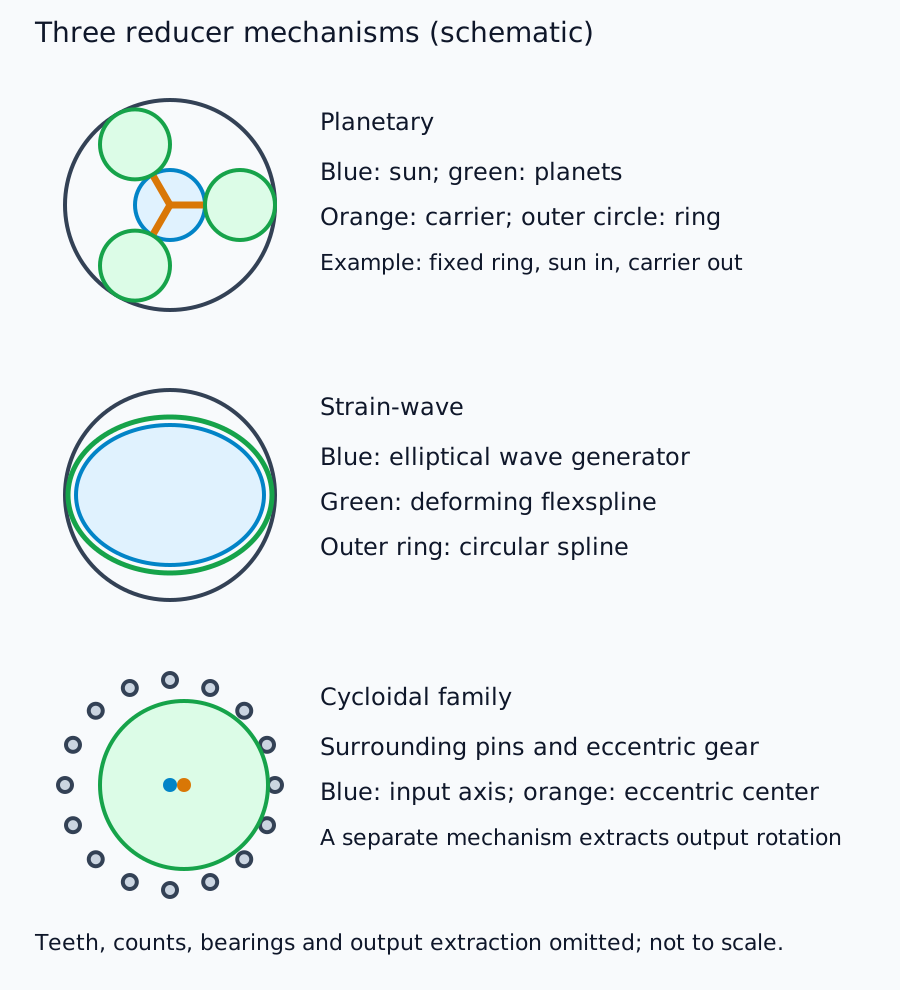
A sun, planets, internal ring and carrier form the mechanism. Fixed, input and output members determine ratio and direction. In a simple stage with fixed ring, sun input and carrier output, ratio is 1+ring teeth/sun teeth.
A 60-tooth ring, 20-tooth sun and 20-tooth planets give ratio 4 under that arrangement. Do not omit the member constraints when using the formula. Multiple stages can raise the ratio while changing efficiency, dimensions and stiffness. The HDS product list includes both precision planetary and strain-wave products; a manufacturer is not necessarily tied to one mechanism.
Strain-wave gearing
An elliptical wave generator, flexible flexspline and rigid circular spline move the engagement region. The HDS operating principle explains these elements and the tooth-count difference.
With circular spline fixed, wave-generator input and flexspline output, 200 flexspline teeth and 202 circular-spline teeth produce −2/200 output revolutions per input revolution: ratio magnitude 100. Elastic deformation is intentional, making assembly, lubrication and load conditions important.
Cycloidal mechanisms
An eccentrically moving gear/disc engages surrounding pins or related elements to derive reduced rotation from count differences. An output mechanism extracts rotation without passing on the full eccentric motion. Not every product has the same single-stage architecture.
Nabtesco's RV principle describes an initial spur-gear stage and a second eccentric stage. RV is a product family, not a synonym for every cycloidal reducer. Separate mechanism understanding from individual model ratings.
Compare on common axes
| Axis | What to check | Common mistake |
|---|---|---|
| Speed/torque | Rated, acceleration peak, emergency load and duty | Treating short peaks as continuous ratings |
| Backlash/lost motion | Test load and definition | Confusing unloaded clearance with reversal behavior |
| Torsional stiffness | Load versus deflection | Assuming low backlash means no deflection |
| Support/mounting | Output bearing, moments and alignment | Expecting gear components alone to support external loads |
| Friction/backdriving | Temperature, speed, efficiency and breakaway torque | Misjudging contact forces or manual movement |
| Life/service | Load history, lubrication, sealing and environment | Assuming equal ratio implies equal life |
Precision positioning, contact tasks and fast transport prioritize different axes. Define load history and mounting first, then compare actual model documentation under those conditions. There is no universal mechanism ranking here.
Connect control and company research
Output elasticity and friction mean a motor-side encoder may not fully describe load state. Increasing ratio changes speed range, reflected inertia and backdrivability along with resolution. Connect these effects to torque generated by motor FOC.
Next, reducer manufacturer research compares supply boundaries: components, bearing-supported units and actuators.
Comments
Please log in to post a comment
No comments yet.