Contents — find the section you need
Background and reading guide
Background No specialist background required; check the reporting period and scope of financial measures.
Industry research · Read the sources, reporting period and comparison criteria together.
Canon, Nikon, and Olympus all trace back to optical technology as their founding business, but they have since taken entirely different paths. Canon grew into a diversified maker of cameras and office equipment, Nikon staked its future on semiconductor lithography equipment, and Olympus let go of its camera business to become a dedicated medical device maker. This piece examines the gap in company scale between the three, and which battlefield each is now fighting on.
 Canon
Canon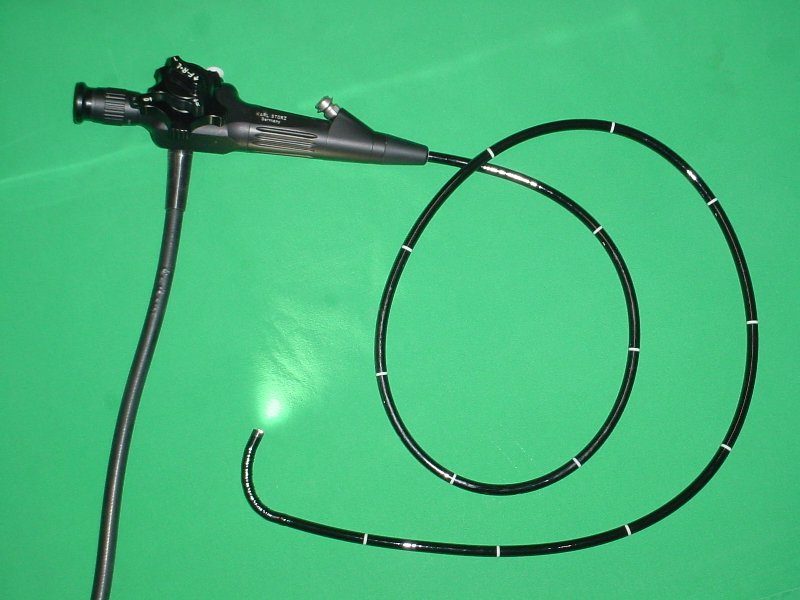 Flexible endoscope (reference example)
Image: Canon logo (public domain; trademark rights apply separately) / Flexible endoscope (Kalumet, CC BY-SA 3.0), Wikimedia Commons. The endoscope photo is a German Karl Storz product — a general image of a flexible endoscope, not the specific Olympus product discussed in the text.


Company History: A Lens Laboratory, a Shipbuilding-Derived Optical Instrument Maker, and a Precision Maker That Started with Thermometers
Canon traces back to 1933, when the Precision Optical Instruments Laboratory was set up in a rented Roppongi, Tokyo apartment. After a prototype 35mm focal-plane-shutter camera, the "Kwanon," the company launched the "Hansa Canon" in 1934 and was incorporated as Precision Optical Industry Co., Ltd. on August 10, 1937. Starting out as a camera maker, it moved into copiers and calculators in the 1950s-60s, and from the 1980s onward diversified into office and industrial equipment built around semiconductor laser technology for laser beam printers; today it also operates in medical devices (through Canon Medical Systems, discussed below), making it a diversified precision equipment maker.
Nikon was established in July 1917 as Nippon Kogaku K.K. by merging the optical instruments division of Tokyo Keiki and the reflecting-mirror division of Iwaki Glass, funded by Koyata Iwasaki of the Mitsubishi zaibatsu. From founding, its purpose was domestic production of military optical equipment such as rangefinders and binoculars, and through the military production buildup from 1933 onward, it had swelled into a massive company of 25,000 employees and 20 plants by the end of the war in 1945. After the war it shifted to civilian production, growing on two pillars — cameras (the "Nikon I" in 1948) and semiconductor lithography equipment (Japan's first reduction-projection stepper, the "NSR-1010G," in 1980) — though the two businesses' subsequent trajectories would diverge sharply (discussed below).
Olympus was founded in 1919 when Takeshi Yamashita established Takachiho Seisakusho in Hatagaya, Shibuya-ku, Tokyo, initially handling thermometers, microscopes, and other physical/chemical instruments. In 1923 it sold off its thermometer business and poured the proceeds into its microscope business, and in 1936 it also entered the camera business, launching its first model, the "Semi-Olympus I." The company name changed over time: Takachiho Seisakusho (1919) → Takachiho Optical Industry Co., Ltd. (1942) → Olympus Optical Co., Ltd. (1949) → Olympus Corporation (2003). In June 2020 it announced the sale of its imaging business, including cameras, to the investment fund Japan Industrial Partners, completing the transfer to OM Digital Solutions on January 1, 2021; then in August 2022 it sold its founding business — the microscope and scientific instruments business (Evident) — to US-based Bain Capital for approximately ¥427.6 billion (completed April 2023), finishing its transition to a dedicated medical device company.
Comparing Company Scale Over Time: Three Different Fiscal Calendars
Because the three companies have different fiscal year-ends (Canon's ends in December; Nikon's and Olympus's end in March), the five-year trend is shown separately for each.
Canon (fiscal year ending December)
| Fiscal Year | Revenue | Operating Profit |
|---|---|---|
| FY Dec 2021 | ~¥3.5 trillion (+11% YoY) | ~¥198.0 billion (+79% YoY) |
| FY Dec 2022 | ¥4.0314 trillion (+15% YoY, back above ¥4 trillion for the first time in 5 years) | ¥353.399 billion (+25% YoY) |
| FY Dec 2023 | ¥4.1809 trillion | ¥375.366 billion |
| FY Dec 2024 | ¥4.50982 trillion (+7.9% YoY) | ¥279.754 billion (-25.5% YoY) |
| FY Dec 2025 | ¥4.6247 trillion (+2.5% YoY, a record revenue for a 2nd straight year) | ¥455.39 billion (+62.8% YoY) |
Nikon (fiscal year ending March)
| Fiscal Year | Revenue | Operating Profit |
|---|---|---|
| FY March 2022 | ¥539.6 billion (+20% YoY) | ¥49.934 billion (return to profit) |
| FY March 2023 | ¥628.1 billion | ¥54.908 billion |
| FY March 2024 | ¥717.2 billion (+14.2% YoY) | ¥39.776 billion (down ¥15.2 billion YoY) |
| FY March 2025 | ¥715.285 billion | ¥2.422 billion |
| FY March 2026 | ¥677.163 billion (-5.3% YoY) | -¥112.448 billion (operating loss) |
FY March 2026 also produced a net loss of ¥85.0 billion (the first net loss in 5 years, and the largest on record). The main cause was an impairment loss (roughly ¥90.6 billion including goodwill and intangible assets) tied to the metal 3D printing business (discussed below).
Olympus (fiscal year ending March)
| Fiscal Year | Revenue | Operating Profit (IFRS) |
|---|---|---|
| FY March 2022 | ¥868.867 billion | ¥153.898 billion |
| FY March 2023 | ¥881.923 billion (+18% YoY) | ¥186.609 billion (+21% YoY; hit its 21.2% operating-margin target) |
| FY March 2024 | ¥936.21 billion (+6.2% YoY) | ¥51.387 billion (-72.5% YoY; hurt by market corrective actions and impairments) |
| FY March 2025 | ¥997.332 billion | ¥162.462 billion (adjusted operating profit ¥188.5 billion, 18.9% margin) |
| FY March 2026 | ¥1.010676 trillion (+1.3% YoY, topping ¥1 trillion for the first time) | ¥97.12 billion (-40.2% YoY; adjusted operating profit ¥143.3 billion, -24% YoY) |
*All figures in this section were cross-checked against each company's own earnings releases and presentation materials, plus Nikkei and other press reports. For Nikon's revenue, some financial-data aggregator sites showed figures one digit too small (for example, listing FY March 2022 as "¥53.96 billion"); the figures used here instead follow Nikkei's earnings coverage ("Nikon's FY March 2022 consolidated results showed revenue up 20% YoY to ¥539.6 billion").
| Metric | Canon | Nikon | Olympus |
|---|---|---|---|
| Consolidated employees | 165,547 (-2.8% YoY) | 20,069 (as of March 2025) | 29,297 (as of March 2025) |
By recent revenue, Canon towers over the other two — about 4.6x Olympus and 6.8x Nikon. This reflects a structural difference: Canon is a diversified maker spanning not just cameras but printers, copiers, and medical devices (Canon Medical Systems), while Nikon has narrowed to cameras and precision equipment (semiconductor lithography, etc.), and Olympus has narrowed to medical devices. Looking at the five-year trend, Canon and Olympus have grown roughly steadily, while Nikon's profitability deteriorated sharply after peaking in FY March 2024 — the contrast among the three has, if anything, widened over these five years.
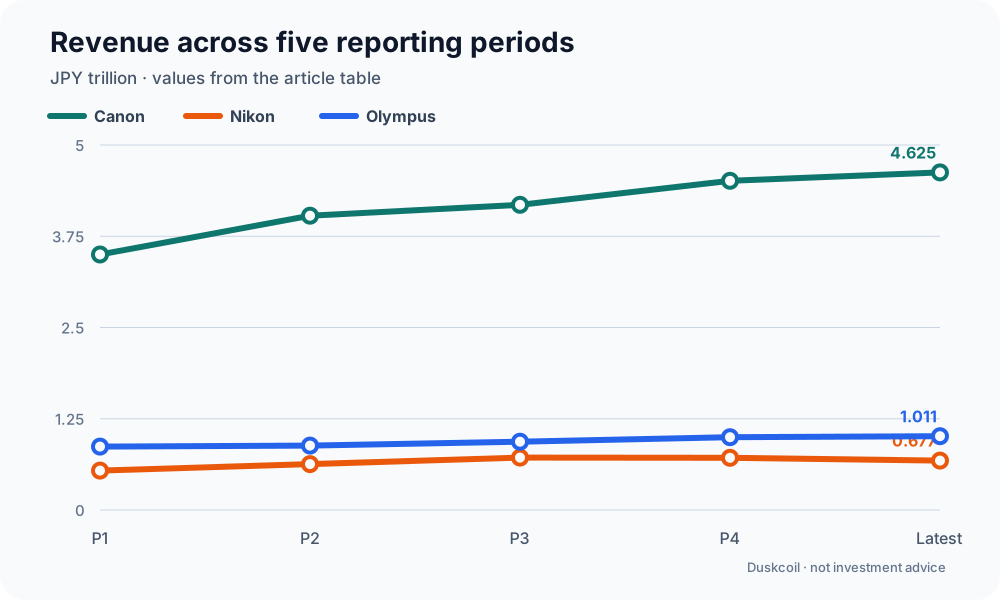
Diagram: Duskcoil. Revenue values from the company tables, converted to JPY trillions. Canon has a December year-end, while Nikon and Olympus have March year-ends, so the axis represents reporting-period order rather than identical fiscal dates. This diagram is not investment advice.
Where the Three Companies Stand Today, and Comparing Their Flagship Products
Cameras: Canon Leads Interchangeable Lenses, Nikon Slips to #3 Domestically
Canon has held the #1 global share in interchangeable-lens digital cameras for 22 consecutive years (46.5% as of 2023, versus Sony's 27.9% in 2nd and Nikon's 11.3% in 3rd), giving it the most stable position of the three in the camera business. Nikon has slipped to #3 domestically in cameras, and some surveys reported it falling to 4th place in 2025 after being overtaken by Fujifilm as well. As noted above, Olympus sold its camera business in 2021 — the only one of the three companies to have exited the camera market entirely.
Semiconductor Lithography Equipment: Canon Holds Ground in "Back-End," Nikon Alone Loses Ground at the Leading Edge
In the 2000s, Japan's makers — Canon and Nikon combined — held 80% of the world lithography equipment market, an "emperor of equipment" duopoly. Since then the Netherlands' ASML has monopolized extreme ultraviolet (EUV) lithography, and in the leading-edge "front-end" market (for shrinking processor and memory geometries), ASML held 94.1% as of 2024, versus Nikon's 2.5% and Canon's 3.4% — a near-total ASML dominance. But the picture changes when the battlefield shifts to "back-end" equipment (for non-leading-edge processes, such as power semiconductors and sensors). In the back-end market for i-line lithography systems, Canon expanded its share to 74.6% as of 2024, while both ASML (18.0%) and Nikon (7.4%) lost ground. Canon is bringing a new semiconductor equipment plant online in Utsunomiya in September 2026, building toward annual sales of more than 300 units — roughly double the 2021 level — as it tries to cement its position as the de facto standard in the back-end market on the strength of that lead. Nikon, meanwhile, is fighting back amid the hardship of its largest-ever net loss (¥85.0 billion) in FY March 2026: under Yasuhiro Omura, who became president in April 2026, the company plans to ship a prototype of a new ArF immersion lithography system, co-developed with a major semiconductor maker, by FY March 2029.
Medical Devices: Olympus's Endoscopes vs. Canon Medical's CT and MRI
Olympus has completed its transition to a dedicated medical device maker centered on gastrointestinal endoscopes. The world market for gastrointestinal endoscopes is over 90% controlled by three Japanese makers — Olympus, Fujifilm, and Pentax (HOYA) — and Olympus alone commands an overwhelming roughly 70% share. It builds endoscopes through a plant network anchored by Aizu Olympus in Aizuwakamatsu, Fukushima Prefecture, alongside Shirakawa Olympus, Aomori Olympus, and others. Canon, once a competitor, has in recent years shifted into a collaborative relationship with Olympus in the endoscope field.
Canon, meanwhile, works in CT (computed tomography), MRI (magnetic resonance imaging), and ultrasound diagnostic equipment through its subsidiary Canon Medical Systems — acquired from Toshiba — supplying diagnostic imaging equipment to more than 150 countries and regions worldwide. It has set a target of growing medical business revenue to more than ¥600 billion, roughly 1.5x its FY Dec 2020 level, and holds a leading domestic share in CT sales. Nikon also once worked in microscopy and bioscience, including regenerative-medicine-related equipment, but in 2023 it spun off and sold its founding scientific instruments business (microscopes, etc.) as Evident, leaving it with the most limited presence of the three in medicine and life sciences.
All three companies share optical technology as a founding business, but Canon has pursued scale through breadth, Nikon has struggled through upheaval in both of its former strongholds (cameras and lithography equipment), and Olympus has narrowed drastically to secure a dominant share in endoscopes. Three contrasting paths.
Development and Manufacturing Sites
All three companies keep their headquarters in Tokyo, but Canon concentrates optical equipment and semiconductor manufacturing equipment production in Tochigi and Oita prefectures, Nikon concentrates semiconductor lithography equipment in Ibaraki and cameras in Miyagi, and Olympus concentrates endoscope plants within Fukushima Prefecture (Aizuwakamatsu and Nishigo Village). The map below shows the confirmed domestic sites (overseas sites are out of scope).
Sources: site names from each company's official locations/plant introduction pages, with addresses individually confirmed via a map/directory service (Mapion, NAVITIME, etc.). Coordinates were geocoded to the town/chome level via OpenStreetMap Nominatim (Aizu Olympus was geocoded by facility name search).
Business Strategy and Outlook: Canon's Expansion, Nikon's Triage, Olympus's Selection and Concentration
In January 2026, Canon announced "Excellent Global Corporation Plan Phase VII," covering fiscal 2026-2030. Building further on FY Dec 2025's revenue of ¥4.6247 trillion, the company is continuing a growth-oriented strategy centered on its IT solutions and medical businesses — its Canon Marketing Japan Group subsidiary, for example, has set a target of ¥750 billion in revenue and ¥66 billion in operating profit by 2030. The increased semiconductor manufacturing equipment production discussed above, via the new Utsunomiya plant, is positioned as part of this expansion strategy.
Nikon, under Yasuhiro Omura, who became president in April 2026, has formulated a new mid-term management plan running through FY March 2031, positioning semiconductor lithography equipment and metal 3D printing as priority fields for concentrated capital investment. Omura has said the company will "selectively choose businesses that connect to corporate value while generating room for growth investment," targeting ¥80 billion in operating profit, 7% ROIC, and 10% ROE by FY March 2031. The impairment on the metal 3D printing business that drove FY March 2026's record loss also, in effect, marks the completion of a full review of that business portfolio — the Omura administration's task from here is rebuilding on that foundation.
Olympus, having sold its camera business in 2021 and its scientific business (microscopes, etc.) in 2023, has completed its transformation into a "global medtech company" that concentrates resources on two businesses: the Endoscopic Solutions Division (ESD) and the Therapeutic Solutions Division (TSD). For FY March 2027, it has set targets of ¥1.055-1.076 trillion in revenue and ¥136.5-155.5 billion in operating profit (+40.5% to +60.1% YoY), centered on recovering from the FDA-related import alert and voluntary shipment halt (an estimated ¥30 billion impact) that weighed on FY March 2026 results. Olympus is the only one of the three that has chosen to pursue margin over scale — a strategy whose success will now be tested by growth in the medical device market going forward.
References
- Canon Official Site (Japanese) / IR Information (Japanese)
- Nikon Official Site (Japanese) / Performance Highlights (Japanese)
- Olympus Official Site (Japanese) / IR Information (Japanese)
- Canon's Strong Showing in Lithography Equipment Shipments — The Difference from Nikon (Japanese)
- The Three Pillars Behind Roughly 70% Global Share in Gastrointestinal Endoscopes (Japanese)
- Canon History (Official, Japanese)
- Nikon Corporate History — The-Shashi (Japanese)
- Olympus Timeline 1919-1945 (Official, Japanese)
- Olympus Notice on Completion of Imaging Business Transfer (Japanese)
- Olympus Transfers Scientific Business (Evident) to US-based Bain Capital (Japanese)
- Canon FY Dec 2022 Earnings (Nikkei, Japanese)
- Canon FY Dec 2024 Earnings Overview (PDF, Japanese)
- Canon FY Dec 2025 Earnings Overview (PDF, Japanese)
- Nikon FY March 2022 Net Profit ¥42.6 Billion (Nikkei, Japanese)
- Nikon Swings to Largest-Ever Loss, ¥85 Billion Net Loss for FY March 2026 (Nikkei, Japanese)
- Olympus FY March 2023 Earnings, Operating Margin Above 20% (xTECH, Japanese)
- Olympus FY March 2024 Earnings, Losses from Lung-Examination Devices (Nikkei, Japanese)
- Olympus FY March 2026 Earnings, Revenue Tops ¥1 Trillion (Japanese)
- Japan's Front-End Equipment Makers Keep Losing Share — Is Canon's Strength a Ray of Hope? (EE Times Japan, Japanese)
- Roundup of the Three Lithography Makers' Earnings (Mynavi News, Japanese)
- Can Nikon Fight Back in Semiconductor Lithography Equipment? (EE Times Japan, Japanese)
- Nikon's Growth Key: President Yasuhiro Omura Narrows Focus to "Semiconductors" in New Mid-Term Plan (Nikkei Tech Foresight, Japanese)
- "Excellent Global Corporation Plan Phase VII" (PDF, Japanese)
- Canon Aims to Grow Medical Device Business Revenue 1.5x to Over ¥600 Billion (Newswitch, Japanese)
- Olympus Sheds Its Founding Business to Concentrate Resources on Endoscope-Centered Medical Field (M&A Online, Japanese)
- Aizu Olympus Company Profile (Japanese)
- Shirakawa Olympus Company Profile (Japanese)
- Sendai Nikon Company Profile (Japanese)
- Nikon Notice of Headquarters Relocation (Japanese)
Current step · 3 / 21 · Corporate Research
Comments
Please log in to post a comment
No comments yet.