Contents — find the section you need
Background and reading guide
Background No specialist background required; check the reporting period and scope of financial measures.
Industry research · Read the sources, reporting period and comparison criteria together.
From automotive microcontrollers to memory chips — "semiconductors" is one label covering two entirely different businesses. Renesas Electronics fights primarily in logic semiconductors, above all the microcontrollers (MCUs) that go into every car by the dozens or even hundreds of units, while Kioxia specializes in the NAND flash memory that underpins storage in everything from smartphones to data centers. Both companies emerged from the reshuffling of Japan's electronics industry, yet they arrived by opposite routes. Renesas is an "integrator" — born from consolidating the semiconductor divisions of several heavy-electrical and electronics makers, then continuing to expand its business scope through M&A ever since. Kioxia is a "spin-off" — a memory business carved out of a single giant, Toshiba, and set independent. Across 2025–2026, the contrast sharpened further: Renesas booked a massive loss tied to a partner's bankruptcy, while Kioxia posted a record profit on AI-driven demand.
 Renesas Electronics
 Kioxia
Image: Renesas Electronics logo / Kioxia logo (both public domain — Wikimedia Commons judged them to consist only of simple shapes/text and therefore not eligible for copyright; trademark rights still apply separately), Wikimedia Commons.


Company History: Renesas Built from Several Companies' Cast-Offs, Kioxia Carved Out of Toshiba
Renesas Electronics was formed in April 2010 through the business integration of Renesas Technology — itself spun off from Mitsubishi Electric and Hitachi — and NEC Electronics, spun off from NEC. The basic integration agreement was signed in September 2009, driven by a push for scale to turn around deteriorating performance. The company name "Renesas" comes from "Renaissance Semiconductor for Advanced Solutions." M&A-driven expansion continued after formation: Renesas acquired U.S.-based Intersil for roughly ¥320 billion in 2017, U.S.-based IDT for roughly ¥730 billion in 2019, and UK-based Dialog Semiconductor for roughly ¥620 billion in August 2021 in succession, broadening its footprint from a pure-play MCU maker into a full-line semiconductor company. It then completed the acquisition of Australia's Altium — a maker of PCB design software — for roughly ¥887.9 billion in August 2024, extending its business beyond semiconductors themselves into a "design platform."
Kioxia's origins trace to Toshiba's semiconductor memory business. The former Toshiba Memory Corporation was established in February 2017 and took over the business that April; after a bidding war, all shares were transferred to Pangea, a vehicle led by U.S.-based Bain Capital, with the roughly ¥2 trillion acquisition completing on June 1, 2018. Kioxia moved to a holding-company structure in March 2019, and on October 1 of that year renamed itself "Kioxia" — a blend of the Japanese word for "memory" (記憶, kioku) and the Greek "axia," meaning value. Just over six years after leaving the Toshiba group, on December 18, 2024, Kioxia listed on the Tokyo Stock Exchange Prime Market.
Comparing Company Scale: Five-Year Trend
Renesas closes its fiscal year in December while Kioxia closes in March, so the reporting periods don't line up exactly — but lining up the last five fiscal periods for each still makes the two companies' contrasting performance patterns visible.
| # | Renesas Fiscal Period | Revenue | Operating Profit (IFRS) | Kioxia Fiscal Period | Revenue | Operating Profit |
|---|---|---|---|---|---|---|
| 1 | FY ending Dec 2021 | ¥993.9 billion | ¥173.8 billion | FY2022/3 | ¥1.5264 trillion | ¥216.2 billion |
| 2 | FY ending Dec 2022 | ¥1.5009 trillion | ¥424.2 billion | FY2023/3 | ¥1.2821 trillion | -¥99.0 billion |
| 3 | FY ending Dec 2023 | ¥1.4694 trillion | ¥390.8 billion | FY2024/3 | ¥1.0766 trillion | -¥252.7 billion |
| 4 | FY ending Dec 2024 | ¥1.3485 trillion | ¥223.0 billion | FY2025/3 | ¥1.7065 trillion | ¥453.0 billion |
| 5 | FY ending Dec 2025 | ¥1.3212 trillion | ¥201.2 billion | FY2026/3 | ¥2.3376 trillion | ¥876.2 billion (Non-GAAP, all-time record) |
| Metric | Renesas | Kioxia |
|---|---|---|
| Employees | ~22,000 consolidated (operations in 30+ countries) | 15,218 consolidated (as of March 31, 2026) |
| Global share | Top-tier in automotive microcontrollers (#6 globally and #1 domestically in the 2025 automotive-semiconductor revenue ranking) | #3 globally in NAND flash memory (15.3% share in Q3 2025, behind Samsung Electronics and SK Hynix) |
Renesas grew both revenue and operating profit sharply in the fiscal year ending December 2022, then posted three straight years of declining revenue from 2023 through 2025; the massive Wolfspeed-related loss discussed below pushed FY2025 into a net loss on top of that. Kioxia, by contrast, is a textbook "silicon cycle" company whose results track memory-market swings almost directly: after two straight years of operating losses in FY2023/3–FY2024/3 (over ¥350 billion combined), it swung to two consecutive record-profit years in FY2025/3–FY2026/3 on a surge in data-center SSD demand. The same label — "Japanese semiconductor maker" — hides a structural difference: logic semiconductors (Renesas) aren't exposed to price swings as extreme as memory semiconductors (Kioxia), but their upswings aren't as explosive as memory's, either, and that pattern shows up clearly across these five fiscal periods.
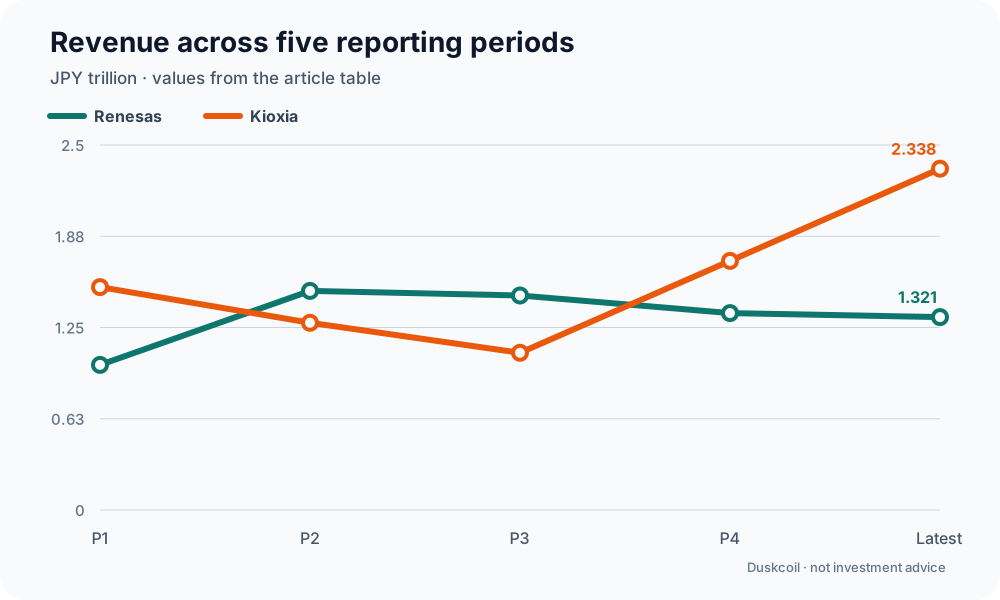
Diagram: Duskcoil. The article's comparison table converted to JPY trillions. Because the two companies' fiscal periods don't align, the horizontal axis represents each company's own sequence from its oldest period to its most recent. Not intended for investment decisions.
Comparing Flagship Products: MCUs and Analog at Renesas, NAND Flash at Kioxia
Because the two companies' product lines are fundamentally different even though both are "semiconductor makers," this isn't a direct spec-for-spec matchup — each company's flagship product families are best viewed on their own terms.
Renesas: Automotive Microcontrollers, Analog, and Power Semiconductors
| Product Family | Overview | Notable Features |
|---|---|---|
| RH850 family | Automotive MCUs built on a proprietary CPU core | Over 4 billion units shipped cumulatively; model lineup spans engine control, body control, and EV/HEV motor control |
| RA family | General-purpose 32-bit MCUs built on Arm Cortex-M | Announced October 2019; lineup spans the 60 MHz max-clock "RA2" up to the dual-core, 200+ MHz "RA8" |
| Analog and power product group | Power ICs, timing ICs, wireless ICs, etc. acquired via the Intersil, IDT, and Dialog acquisitions | 39 "Winning Combination" solutions announced, pairing these with MCUs for IoT and industrial applications |
Renesas's strength lies not in any single product like the automotive MCU, but in its ability to pitch MCU + analog + power semiconductors as a bundled "combination." The 2017 Intersil acquisition, the 2019 IDT acquisition, and the 2021 Dialog acquisition were all aimed at this same shift — from selling standalone MCUs to selling system solutions.
Kioxia: NAND Flash Memory and SSDs
| Product Family | Overview | Notable Features |
|---|---|---|
| BiCS FLASH (8th generation) | 3D-stacked NAND flash memory | 218 word-line layers, memory density of 18.3 Gb/mm². Co-developed with Western Digital; CBA (CMOS directly Bonded to Array) technology lifts memory density 50% over the 6th generation |
| CM7 series | Enterprise SSDs | PCIe 5.0 / NVMe 2.0 support, up to 30.72 TB, up to 2.7 million random-read IOPS |
| CD8P series | Data-center SSDs | Supports both 2.5-inch and E3.S form factors, with a model lineup spanning read-intensive to mixed-use workloads |
Almost all of Kioxia's products are derivatives of a single technology — NAND flash memory — and the core of its technical edge is the ongoing race to raise BiCS FLASH's stacked layer count. The 8th generation (218 layers) was jointly announced with Western Digital in March 2023, and is mass-produced at both the Yokkaichi and Kitakami plants.
Differing Technology Strategies: Renesas's "Combination" Play, Kioxia's "Stacking" Race
The two companies' technology strategies diverge sharply, reflecting the character of their products.
Renesas doesn't compete on the raw performance of a single product; instead its strategy is to vertically integrate MCUs, analog, and power semiconductors into a "combination" that reduces customers' design workload. The completed August 2024 acquisition of U.S.-based Altium (roughly ¥887.9 billion) extends this same logic: in March 2025 Renesas unveiled the "Renesas 365" platform, integrating Altium's PCB design software "Altium 365" with its own semiconductor products, and is positioning itself as an "electronic design platformer" that spans everything from silicon selection through board design to system lifecycle management. In 2026, Renesas laid out a "three-stage rocket" strategy — expanding its growth areas in stages from AI infrastructure/compute demand, to physical AI/SDV (software-defined vehicles) from 2030 onward, and beyond that to edge intelligence — moving away from its historical dependence on the automotive market alone.
Kioxia's technical edge centers on the manufacturing technology that continuously raises the stacked word-line count determining NAND flash's memory density. The 8th-generation BiCS FLASH (218 layers) uses CBA technology, in which two wafers are processed separately and then bonded together with high precision, raising memory density while preserving mass-production efficiency. Notably, this development is never done alone: it presupposes a joint-development arrangement with Western Digital, which co-operates both the Yokkaichi and Kitakami production sites. The two companies' merger talks — which fell apart twice before, in 2021 and 2023 — were reported to be back on again in 2026, making Kioxia's technology strategy effectively inseparable from the shape of its Western Digital partnership going forward (more on this below).
Development and Manufacturing Facilities
Beyond its head office (Koto, Tokyo), Renesas operates eight domestic sites in Japan — five front-end fabs and three back-end plants. Beyond its head office (Minato, Tokyo), Kioxia's footprint centers on two major production sites, Yokkaichi and Kitakami, plus a development site in Yokohama. The map below shows the domestic sites that could be confirmed (overseas sites are excluded).
Sources: For Renesas, addresses for the five front-end fabs (Naka, Takasaki, Saijo, Kawajiri, Kofu) were taken as primary data from the official site's "Bases and Major Group Companies" list. The three back-end plants (Yonezawa, Oita, Nishiki) aren't listed with addresses on that page, so they were individually confirmed via map information services (Yahoo! Maps, Baseconnect, etc.). For Kioxia, the official site's "Location List" was used as primary data. Coordinates come from OpenStreetMap Nominatim business-name searches (the Yokkaichi plant, Kitakami plant, and Yokohama Technology Campus matched results aligned with facility polygons); some are geocoded at the level of a district or nearest station (the Renesas Naka, Kawajiri, and Nishiki plants had no business-name-search hit, so nearby place names/stations were used as approximations).
Business Strategy and Outlook: Renesas's "Electronic Design Platformer" Push, Kioxia's Merger Talks Reopen
In 2025 Renesas was hit by an unexpected headwind: the bankruptcy of Wolfspeed, its U.S. SiC power-semiconductor partner. Renesas had signed a SiC wafer supply agreement with Wolfspeed in July 2023 and deposited roughly $2 billion (about ¥292 billion), but Wolfspeed filed for U.S. Chapter 11 bankruptcy protection in June 2025. Renesas booked roughly ¥250 billion in related losses in the first half of 2025 (Jan–Jun), and the fiscal year ending December 2025 closed with a net loss (¥51.763 billion). That said, core operating profit itself stayed solidly positive at ¥201.1 billion, so the underlying business hasn't collapsed. Even amid this headwind, Renesas has kept pushing its transformation into an "electronic design platformer," built around the Altium acquisition and Renesas 365 platform discussed above; in 2026 it laid out a three-stage growth strategy — "AI infrastructure/compute" → "physical AI/SDV" → "edge intelligence" — aiming to grow AI-related revenue more than fivefold by 2040.
For Kioxia, the biggest focus of 2026 is the fate of its merger talks with Western Digital. The two companies have pursued integration twice before, in 2021 and 2023, and both times the deal collapsed — once over SK Hynix's opposition, once over unresolved terms. But in July 2026, reports that integration talks had resumed sent Western Digital's stock up 12.51% in a single day, and the market is watching closely for a third attempt. Some estimates suggest that if the merger goes through, the two companies' combined NAND shipment share would reach roughly 25% — surpassing SK Hynix's estimated ~22% and putting them within striking distance of global #1 Samsung Electronics. For Kioxia, which has jointly operated its Yokkaichi and Kitakami production sites with Western Digital from the start, this is really a question of whether to formalize on the capital side what already exists on the technology side. Whether Kioxia — which listed on the TSE Prime Market only in December 2024 — continues down the road of an independent listed company or opts to merge with a U.S. company is a story worth watching through the second half of 2026.
References
- Renesas Electronics official site / Bases and Major Group Companies
- Kioxia Holdings official site / Kioxia Location List
- Renesas Electronics - Wikipedia
- Kioxia Holdings | The Spin-Off of Toshiba Memory and Its Acquisition by the Bain Capital Consortium - The社史
- Renesas Electronics (6723) Long-Term Financial Trend - The社史
- Kioxia's FY2026/3 Results: Operating Profit Hits an 8-Year High - EE Times Japan
- Kioxia's FY2023 Posts a Record ¥243.7 Billion Loss, Q4 Swings to Profit - EE Times Japan
- Renesas's FY Ending Dec 2023 Net Profit Up 31.4% - Mynavi News
- Renesas's FY Ending Dec 2024 Full-Year Results Show Lower Revenue and Profit - Mynavi News
- Renesas to Book ¥250 Billion Loss Related to Wolfspeed Restructuring - Dempa Shimbun
- Renesas Completes Altium Acquisition - EE Times Japan
- Renesas Charts Three-Stage Growth Centered on AI - Mynavi News
- Western Digital and Kioxia Advance Merger Talks - Data Center Café
- Top 19 Automotive Semiconductor Companies by 2025 Revenue, Renesas Leads Japanese Makers at #6 - Mynavi News
- Q3 2025 NAND Market: Kioxia Expands Its Share - Mynavi News
- Kioxia Announces NVMe Enterprise SSD Using 8th-Generation BiCS FLASH TLC Technology - Mynavi News
Current step · 4 / 21 · Corporate Research
Comments
Please log in to post a comment
No comments yet.