Contents — find the section you need
Background and reading guide
Background No specialist background required; check the reporting period and scope of financial measures.
Industry research · Read the sources, reporting period and comparison criteria together.
City gas has long run on a supply network close to a regional monopoly, but two regulatory shifts changed that: full retail liberalization in April 2017, and the legal unbundling of pipeline operations in April 2022. Since then, both companies have pushed hard beyond their home territory. Tokyo Gas, anchored in greater Tokyo, runs roughly 1.4x the revenue of Kansai-based Osaka Gas (the Daigas Group) — yet the reverse holds for headcount, where Osaka Gas leads. Both companies sit on the same kind of pipeline infrastructure, but they assemble their non-gas businesses — overseas energy, electricity retail, real estate — in starkly different ways, and even their shared decarbonization bet, methanation, splits into two distinct technical lineages: a Sabatier reaction descended from space technology versus catalyst know-how descended from petrochemicals.
 Tokyo Gas
 Osaka Gas
Image: Tokyo Gas logo / Osaka Gas logo (both public domain; trademark rights still apply separately), Wikimedia Commons


Company History: Tokyo Gas, Raised by Shibusawa Eiichi; Osaka Gas, Founded in Kujo
Tokyo Gas traces back to 1874, when the Tokyo prefectural government first launched a gas business. Demand grew slowly and the operation struggled, so in 1876 it was transferred to the Tokyo Prefectural Gas Bureau, whose first director, Shibusawa Eiichi, put it on a sound footing. Shibusawa opposed selling the loss-making operation off cheaply, instead pushing further investment until it turned profitable — and on October 1, 1885, he and Asano Soichiro founded it as a private company, Tokyo Gas Company, with capital of ¥270,000. Shibusawa became its first chairman and spent the next 22 years building out the gas business. The company marked its 140th anniversary in 2025.
Osaka Gas was established in April 1897 in Kujo Oaza Iwasaki, Nishi Ward, Osaka City (now Chiyozaki 3-chome). It brought in US capital in 1902, then reverted to a purely Japanese company in 1925. It began supplying gas within Osaka City in October 1905, and in 1911 its Wakayama Gas operation started up, extending its service territory across the wider Kansai region. A key turning point on the feedstock side: after decades manufacturing gas from coal- and petroleum-based feedstocks, Osaka Gas completed its conversion to LNG in 1990 — and the catalyst technology and process-design know-how built up during that petroleum-feedstock era now underpins the methanation work discussed below.
The single largest institutional shift shared by both companies in recent years is the pair of 2017 and 2022 reforms: full retail liberalization of city gas in April 2017, and the legal unbundling of pipeline operations in April 2022. In August 2020 the government required Tokyo Gas, Osaka Gas, and Toho Gas — the three majors — to stop combining gas production/retail with pipeline operations, mandating a legal separation to strengthen pipeline neutrality. Tokyo Gas launched "Tokyo Gas Network Co., Ltd." as a standalone pipeline entity on April 1, 2022; Osaka Gas, via a preparatory holding company set up the year before, launched "Osaka Gas Network Co., Ltd." on the same schedule. With the network that once protected each company's regional monopoly now institutionally opened up, both have entered a phase of pushing growth outside their home turf — into overseas energy and non-gas businesses.
Comparing Company Scale: Five-Year Trend
Both companies' fiscal years run through March. Looking at the trend over five fiscal years (FY2022/3 through FY2026/3) rather than a single snapshot reveals that the two companies' profit swings are badly out of phase with each other.
| Fiscal Year | Tokyo Gas Revenue | Tokyo Gas Ordinary Income | Osaka Gas Revenue | Osaka Gas Ordinary Income |
|---|---|---|---|---|
| FY2022/3 | ¥2.1548 trillion | ¥136.5 billion | ¥1.5869 trillion | ¥110.5 billion |
| FY2023/3 | ¥3.2896 trillion (peak) | ¥408.8 billion (peak) | ¥2.2751 trillion | ¥75.6 billion (trough) |
| FY2024/3 | ¥2.6624 trillion | ¥222.8 billion | ¥2.0830 trillion | ¥226.6 billion (record) |
| FY2025/3 | ¥2.6368 trillion | ¥113.6 billion (trough) | ¥2.0690 trillion | ¥189.6 billion |
| FY2026/3 | ¥2.8347 trillion | ¥193.7 billion | ¥2.0303 trillion | ¥204.5 billion |
| Metric | Tokyo Gas | Osaka Gas |
|---|---|---|
| Consolidated employees | 15,572 (as of March 31, 2025) | 21,404 |
| City gas sales volume | 11.175 billion m³ (FY2026/3 actual, -0.4% YoY) | 6.692 billion m³ (FY2027/3 forecast, +1.4% YoY — the actual FY2026/3 figure wasn't found, so the forecast is shown for reference) |
Tokyo Gas leads Osaka Gas by roughly 1.4x on revenue, yet the reverse holds for headcount — Osaka Gas has more employees, likely reflecting its broader footprint in labor-intensive non-gas businesses (real estate, telecommunications, overseas energy).
The more striking pattern is that the two companies' five-year profit trajectories run almost exactly out of phase. In FY2023/3, Tokyo Gas posted an unprecedented ¥408.8 billion in ordinary income, while Osaka Gas's ordinary income fell to ¥75.6 billion in the very same fiscal year. The reason is traceable: as the yen weakened and resource prices spiked that year, Tokyo Gas's largely long-term-contract procurement structure kept its costs relatively low, and it further benefited from reselling surplus LNG (trading profit) plus stronger earnings from its Australian resource-development business. Osaka Gas, by contrast, was hit first by the price spike — its fuel-cost adjustment mechanism passes import-price changes through to customer tariffs with a lag of several months — and also absorbed extra procurement costs after a June 2022 fire at the Freeport LNG terminal in the US, one of its investees and LNG suppliers, forced it to source substitute cargoes. By FY2024/3, Osaka Gas's ordinary income hit a record ¥226.6 billion just as Tokyo Gas entered an adjustment phase — a pattern that shows how differently the timing of resource-price swings feeds through each company's books over several fiscal years. In FY2026/3, Osaka Gas's net profit hit a fresh record, driven by strength at the Freeport LNG terminal and its US upstream business (Sabine), plus a gain on the sale of a US power-generation asset it held.
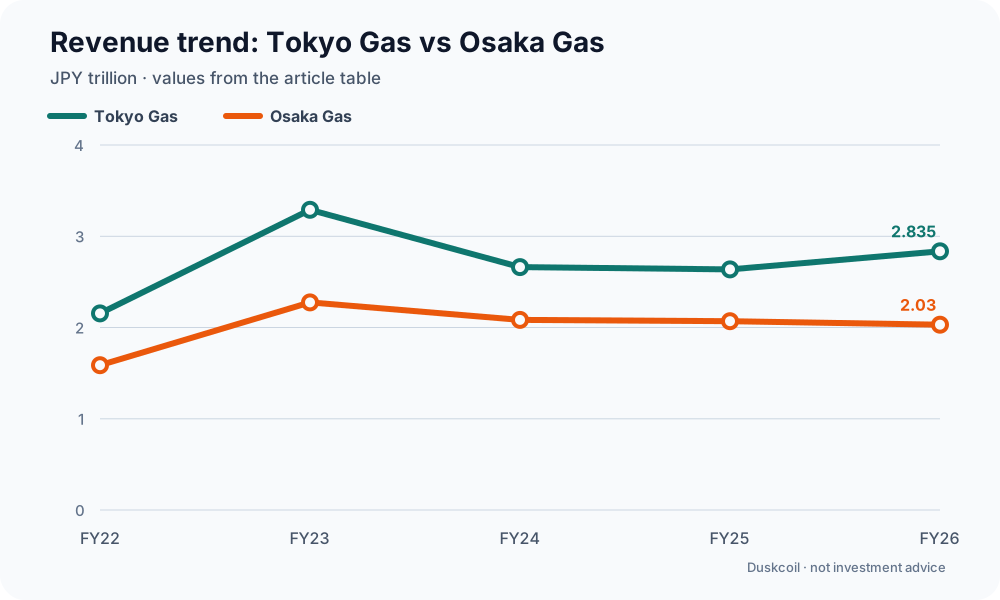
Diagram: Duskcoil. Revenue values in the article table, converted to JPY trillions. Revenue alone does not measure earning power because energy prices materially affect it. This diagram is not investment advice.
Comparing Core Businesses: LNG Procurement, Overseas Energy, Electricity Retail, and Non-Gas Business
Beyond selling city gas itself, both companies build out three adjacent business areas: upstream LNG procurement and overseas energy, electricity retail, and non-gas businesses such as real estate and telecommunications. The strategic differences here connect directly to the profit-timing mismatch described above.
LNG Procurement & Overseas Energy: Tokyo Gas Bets on Shale Gas Development, Osaka Gas Runs a Two-Front LNG Terminal + Upstream Strategy
Tokyo Gas develops and produces shale gas mainly in the Haynesville area of Texas, concentrating its development and operating footprint there to hold down production costs and sustain gas output above 1 Bcfe/day. In April 2025, its US subsidiary TG Natural Resources (TGNR) acquired 70% of Chevron's East Texas natural gas assets for roughly $525 million, adding further to its shale-gas position. On the LNG procurement side, Tokyo Gas has announced a 20-year contract starting in 2030 to buy 1 million tonnes of US LNG annually — a procurement strategy that leans on US-origin cargoes' looser destination clauses, which make them easier to resell.
Osaka Gas joined the Freeport LNG project in Texas alongside JERA in 2019, and after commercial operations began that December, gained rights to roughly 2.32 million tonnes of LNG annually under its liquefaction processing agreement. That same year, it became the first Japanese company to acquire a US shale-gas developer outright, buying all shares of Sabine Oil & Gas Corporation — giving it upstream acreage of about 1,300 km² and roughly 900 wells in East Texas, and positioning it as the third pillar of its US energy business (as of 2021, output was equivalent to roughly 2.8 million tonnes of LNG per year). This vertically integrated structure — Freeport downstream (liquefaction/receiving) paired with Sabine upstream (production) — is, as noted above, the main driver behind Osaka Gas's record net profit in FY2026/3.
Electricity Retail: Tokyo Gas Leads on Scale, Osaka Gas Plans a Sharp Ramp-Up
On electricity retail sales volume, Tokyo Gas's FY2026 plan calls for 28.49 billion kWh (+7.4% YoY, over 4 million retail contracts), while Osaka Gas's FY2026/3 plan calls for 16.60 billion kWh (+0.1% YoY). Tokyo Gas leads on scale, but Osaka Gas has set a target of 20.93 billion kWh for FY2027/3 (+26.1% YoY) — a clear signal that it's positioning electricity retail as a near-term growth driver.
Non-Gas Business: Osaka Gas's "Life & Business Solutions" versus Tokyo Gas's "Urban Business"
Osaka Gas organizes its operations into three pillars — domestic energy, overseas energy, and Life & Business Solutions (LBS) — with the LBS segment covering real estate development and leasing, information-processing services, and fine-materials/carbon-material products. Its real estate business spans everything from condo and apartment development to office buildings, logistics facilities, and selling properties into private REITs.
Tokyo Gas runs a comparable "Urban Business" segment covering real estate sales/leasing and hotel operations, but that segment posted revenue of only ¥77.8 billion (-14.6% YoY) — modest next to Osaka Gas's LBS business. Tokyo Gas has instead put more emphasis on energy-adjacent solutions: in 2025 it made Trust Engi (Toshima Ward, Tokyo), which builds central-monitoring (building-automation) systems for commercial buildings, a subsidiary. Both companies run "non-gas" businesses, but they've put the weight in different places.
A Difference in Technology Strategy: Decarbonizing City Gas via Methanation
The technology area both companies are investing most heavily in right now is methanation — reacting hydrogen (H2) with carbon dioxide (CO2) to synthesize methane (CH4, the main component of city gas). Using CO2 captured from a power plant or factory as the feedstock means the CO2 released when the resulting gas is burned is offset by the CO2 that was captured to make it — letting city gas become effectively carbon-neutral while still running through the existing gas pipeline network and gas appliances, unchanged.
Tokyo Gas is jointly researching "hybrid Sabatier" technology — an evolution of the Sabatier reaction, which synthesizes methane directly from hydrogen and CO2 — together with the Japan Aerospace Exploration Agency (JAXA) and IHI. It's a notable case of material-cycling technology developed for closed environments in space being applied to decarbonization on the ground. In 2023, it also began a demonstration project with the City of Yokohama capturing CO2 from a waste-incineration plant's exhaust for use in methanation, building out this track record largely through its Yokohama Techno Station (Tsurumi Ward, Yokohama) R&D site.
Osaka Gas is applying catalyst technology and scale-up design know-how it built up from its earlier days manufacturing city gas and substitute natural gas from petroleum-based feedstocks, now used to design CO2-methanation equipment and optimize the process. Since 2023, it has partnered with INPEX to build a demonstration facility processing 400 Nm³-CO2/h — equivalent to the gas use of 10,000 households, and among the largest of its kind in the world. Looking further ahead, it's pursuing "SOEC methanation" — using solid oxide electrolysis cells to target an energy-conversion efficiency of 85–90%, among the highest in the world — at a new R&D site in the Torishima district of Konohana Ward, Osaka, which broke ground in 2022. The research building, "Daigas Innovation Center," was completed in September 2025; roughly 250 researchers there are carrying the technology from bench-scale testing (FY2025–2027) through to pilot-scale testing (FY2028–2030). The Torishima district — once a city-gas manufacturing site — now hosts the R&D base working on the next generation of city-gas feedstock.
Even as competitors, the two companies have set up a joint committee under NEDO's (New Energy and Industrial Technology Development Organization) Green Innovation Fund program, exchanging advice as each develops its own path toward putting this technology into practical, real-world use. Synthetic methane is also known as "e-methane," and it was showcased as the next generation of city gas at Expo 2025 Osaka, Kansai.
Development & Manufacturing Facilities
Beyond its Tokyo headquarters, Tokyo Gas operates three LNG terminals inside Tokyo Bay (Negishi, Sodegaura, Ogishima) and one outside it (Hitachi), which handle regasification and city-gas production; its R&D is concentrated at the Yokohama Techno Station in Tsurumi Ward, Yokohama. Beyond its Osaka headquarters, Osaka Gas operates the Senboku Plant (two factories in Nishi Ward, Sakai, and in Takaishi City) that alone sends out roughly 70% of the Kansai region's city gas, the Himeji Plant (Himeji, Hyogo), and its new R&D site in Torishima, Konohana Ward, Osaka, whose research building was completed in 2025. The map below plots every domestic facility confirmed (overseas facilities and small offices without LNG receiving jetties are out of scope).
Sources: Tokyo Gas's official "Locations" page. Osaka Gas's official facility-list page timed out under WebFetch, so each facility's address was confirmed individually via news releases and map/directory services (Mapion Phonebook, NAVITIME, etc.). Coordinates were geocoded to town/block level via OpenStreetMap Nominatim.
Strategy & Outlook
Tokyo Gas is executing its FY2026–2028 mid-term plan, the first phase under its "Compass 2030" vision. Its standalone FY2026 targets call for segment profit of ¥195 billion, net profit of ¥134 billion, ROE of 8.0%, and ROIC of 4.8%, funded by a ¥477.7 billion investment plan aimed at "carefully selecting investments and rotating assets, as needed for profit growth, capital-efficiency improvement, and maintaining a stable earnings base." That asset-rotation logic is visible in a string of portfolio moves since 2025: it made building-automation firm Trust Engi a subsidiary in April 2025 to strengthen its solutions business, then sold 80% of Tokyo Gas Lease to Shizuoka Financial Group in January 2026 and divested its entire stake in a US gas-fired power business (Birdsboro Power Holdings II) in May 2026 — shedding non-core assets to redeploy capital into its core areas. Marking its 140th anniversary in 2025, the company has also signaled an intent to expand beyond its traditional region and energy-sector boundaries.
Osaka Gas is in the final year of its "Daigas Group Mid-Term Management Plan 2026 — Connecting Ambitious Dreams" (FY2024–2026), set in March 2024. It's pursuing its "Three Promises" strategic pillars — co-creating future value, enhancing employee vibrancy, and evolving its management foundation — across its three business domains (domestic energy, overseas energy, Life & Business Solutions), targeting FY2026 figures of roughly 5% ROIC, roughly 8% ROE, an equity ratio above 45%, and non-financial goals including a 7-million-tonne cut in CO2 emissions and 4 GW of renewable-energy capacity added. On the overseas-energy front, it invested in US natural-hydrogen exploration startup Koloma, Inc. in 2024 and made a second investment in India's city-gas business through a consortium with Sumitomo Corporation and JOIN — laying groundwork for its next growth areas. With the gain on its US asset sale layered on top, FY2026/3 delivered a record net profit; heading into its next mid-term plan, the open question is how to turn overseas energy's earnings contribution into a stable, durable pillar rather than a swing factor.
Both companies face the same structural pressure: since full retail liberalization in 2017, power utilities and LPG providers have entered the city-gas market, intensifying competition through bundled electricity-and-gas offers. Even as the two majors hold onto their regional pipeline networks, the mandated neutrality (legal unbundling) of those networks keeps lowering the bar for new entrants. With domestic city-gas sales volume itself unlikely to grow much further, Tokyo Gas and Osaka Gas are both pointed in the same direction — diversifying into overseas energy, electricity, and non-gas businesses, while betting on methanation to decarbonize "in place," using the gas infrastructure that already exists.
References
- Tokyo Gas Official Site / Investor Relations / Financial Highlights
- Osaka Gas (Daigas Group) Official Site / Investor Relations
- Agency for Natural Resources and Energy: An Explainer on Methanation (Japanese)
- Tokyo Gas "Hybrid Sabatier" Technology Article (Japanese)
- Osaka Gas / INPEX World-Leading Methanation Demonstration Facility (Japanese)
- Shibusawa Corporate History Database: "The Tokyo Gas Story: 1885-1985" (Japanese)
- Tokyo Gas GAS MUSEUM: "Shibusawa Eiichi and the Gas Business" (Japanese)
- Osaka Gas: "The 100-Year History of Osaka Gas: 1905-2005" (Shibusawa Corporate History Database, Japanese)
- Daigas Group: "History" (Japanese)
- Kankyo Business Online: "Legal Separation of Pipeline Operations Mandated for Tokyo Gas and the Other Two Majors" (Japanese)
- Tokyo Gas: "METI Minister's Approval of the Company Split" (Japanese)
- IRBANK: Tokyo Gas (9531) financial results / IRBANK: Osaka Gas (9532) financial results
- Nikkei: "Tokyo Gas Posts Highest Net Profit in 7 Years — FY2023/3, on a Weak Yen and High Resource Prices" (Japanese)
- Nikkei: "Tokyo Gas's FY2023/3 Net Profit Hits a Record, Aided by Long-Term LNG Contracts" (Japanese)
- Osaka Gas: "FY2023/3 (208th Term) Earnings Results" (Japanese)
- Osaka Gas: "FY2026/3 (208th Term) Earnings Results" (Japanese)
- Tokyo Gas: news release on TG Natural Resources' acquisition of Chevron's gas assets (Japanese)
- Osaka Gas: "Commencement of Commercial Operations at the Freeport LNG Project" (Japanese)
- Osaka Gas: "Full Acquisition of US Shale Gas Developer Sabine Oil & Gas Corporation" (Japanese)
- Osaka Gas: "Establishment of a New R&D Site in the Torishima District" (Japanese)
- Osaka Gas: "Completion Ceremony for the Daigas Innovation Center Research Building" (Japanese)
- Tokyo Gas: "On the FY2026 Tokyo Gas Group Management Plan" (Japanese)
- Osaka Gas: "Daigas Group Mid-Term Management Plan 2026 'Connecting Ambitious Dreams'" (Japanese)
- Osaka Gas: "Capital Alliance with a US Startup Engaged in Natural Hydrogen Exploration, Development, and Production" (Japanese)
- Osaka Gas: "Expansion of the City Gas Business in India" (Japanese)
- M&A Online: "Tokyo Gas Acquires a Building-Automation Company" (Japanese)
- Nihon M&A Center: "Shizuoka Financial Group Makes Tokyo Gas Lease a Subsidiary" (Japanese)
Current step · 16 / 21 · Corporate Research
Comments
Please log in to post a comment
No comments yet.