Contents — find the section you need
Background and reading guide
Background Basic force, motion and energy terminology; use the linked background explanations.
Fundamentals · Explanations of principles, structure and trade-offs.
The phrase "construction-machinery automation" easily conjures images of an unmanned bulldozer silently hauling earth. But what's actually advancing on site is centered on stages well short of such extreme unmanned operation. Machine guidance, which merely displays blade-edge position on a screen; machine control, which restricts valve commands so as not to exceed the design surface; remote operation, in which a person pilots by radio from a hazardous location; and autonomous haulage systems, operated at specific mines and quarries — each of these presupposes a different safety design and sensor configuration. Lumping them together as a single "automation" leads to misjudging what's actually realistic on site today and what's still at the research stage.
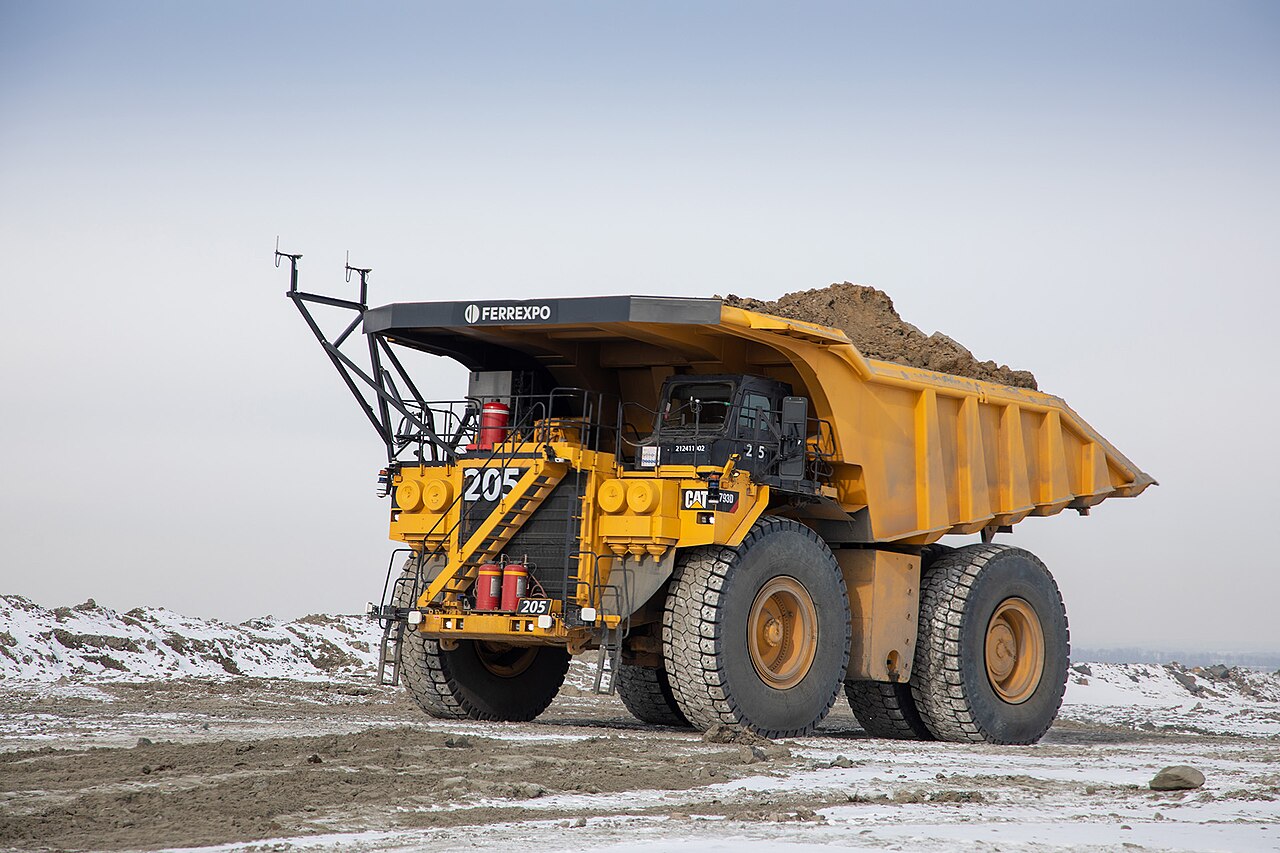 An autonomous haulage system (AHS) truck in service
Image: Ferrexpo autonomous truck (RobSimmons223311, CC BY-SA 4.0), Wikimedia Commons. Not Komatsu's FrontRunner AHS or Caterpillar Command discussed in the text — a representative example of an autonomous haul truck in mine service (a CAT 793D at Ferrexpo's Yeristovo mine).

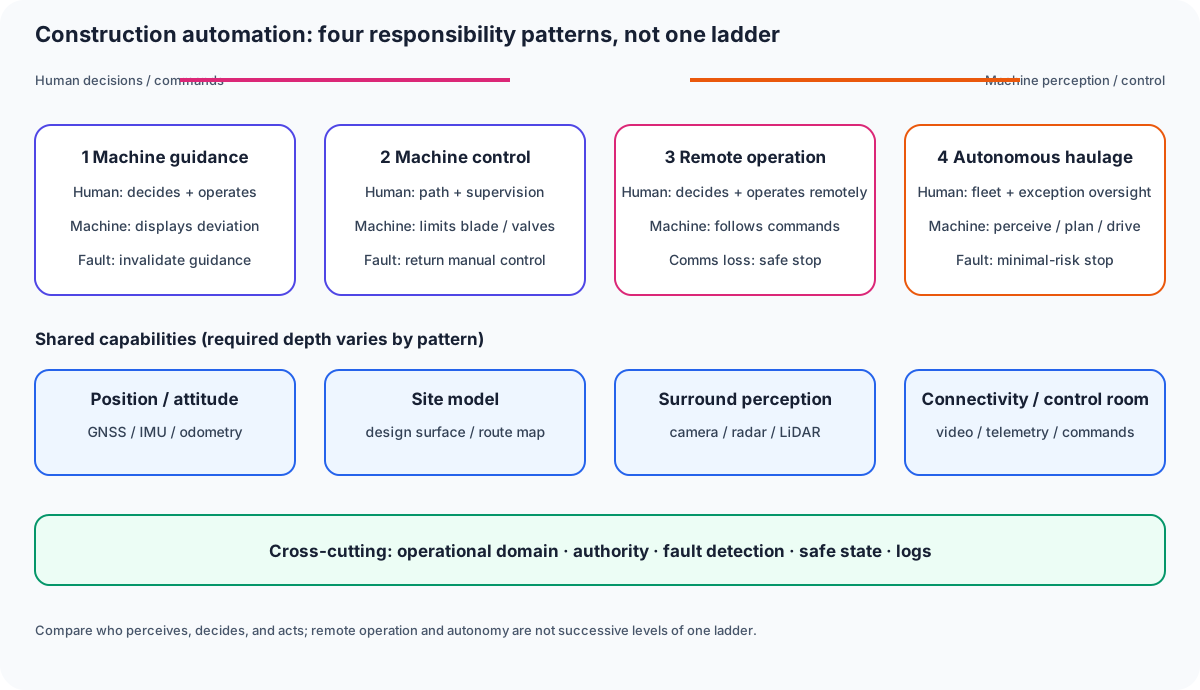
Figure 1 — The four patterns are not a simple maturity ladder. In remote operation a person still decides and commands from elsewhere; in autonomous haulage the machine perceives, plans, and drives. Required capabilities and the safe state under faults differ by pattern.
0. 30-Second Summary
- The Ministry of Land, Infrastructure, Transport and Tourism's i-Construction is a policy promoted since fiscal 2016 around three pillars: full-scale adoption of ICT earthwork, overall optimization through standardization of specifications, and leveling out construction timing. In 2024, "i-Construction 2.0" presented a new set of three pillars: automating construction, automating data linkage, and automating construction management.
- Machine guidance and machine control combine absolute position from GNSS with attitude and angular velocity from an IMU, cross-referencing blade-edge or blade position against design data. This site's GNSS and IMU explainer articles cover the sensor principles that underpin this measurement.
- The origin of remote operation (teleoperation) traces back to the radio-controlled construction work during the 1991 pyroclastic-flow disaster at Mt. Unzen-Fugendake. It became established as a technology for operating heavy machinery from a safe location without sending people into hazardous zones, and has since been used in more than 300 disaster-response construction projects.
- For autonomous haulage systems (AHS) at mines and quarries, Komatsu's FrontRunner brought its 1,000th ultra-large autonomous haul truck into operation in 2026, having accumulated more than 11.5 billion tonnes of hauling since 2008. Caterpillar has likewise expanded Command for hauling from mines into quarries, reporting one million tons hauled autonomously at Luck Stone's Bull Run Quarry.
- No stage supports the simplistic claim that "unmanned means safe." The mechanism for transitioning to a safe state on communication loss or abnormality, and the division of roles between the humans monitoring and the machines, is central to the design regardless of automation level.
1. The Skeleton of the i-Construction Policy
i-Construction is a policy the Ministry of Land, Infrastructure, Transport and Tourism has pursued since fiscal 2016, aimed at raising productivity at construction sites. Its original three pillars were: "full-scale ICT adoption (ICT earthwork)," using 3D data across the entire process from surveying through design, construction, and inspection; "introducing overall optimization," which optimizes the entire production process through measures such as standardizing concrete-work specifications; and "leveling out construction timing," reducing the gap in construction volume between busy and slow seasons.
In April 2024, "i-Construction 2.0," an evolution of this, was announced. Setting a goal of raising productivity 1.5x by fiscal 2040, it presents a new set of three pillars: "automating construction," which includes building shared infrastructure for construction-machinery operating data, establishing safety rules, spreading remote construction, and AI-based automation of construction; "automating data linkage," which includes standardizing BIM/CIM data and building data-linkage infrastructure; and "automating construction management," which includes labor savings and adoption of new technology through remote site visits and remote supervision. Even though the policy name includes "automation," this shouldn't be read as uniformly mandating a specific technology — it's a framework for advancing remote operation, data linkage, and labor savings in stages.
2. Machine Guidance and Machine Control: The GNSS + IMU Foundation
As covered in this site's explainer articles on the hydraulic excavator and bulldozer, machine guidance is a function that compares blade-edge or blade position against the design surface and displays it on a screen, while machine control takes this a step further, restricting the valve commands themselves so as not to exceed the design surface. Both are made possible by combining GNSS (in many cases RTK-based), which obtains the vehicle's absolute position at a few-centimeter level of accuracy, with an IMU, which measures the vehicle's and work equipment's attitude and angular velocity at high frequency.
GNSS struggles to obtain a fix where structures block radio waves or inside tunnels, and an IMU alone accumulates error over time (drift). The two are combined to compensate for each other's weaknesses, and this basic mechanism is covered in this site's How GNSS Works, and the Major Products and How IMUs Work, and the Major Products. When evaluating construction-machinery automation, it's worth going beyond phrases like "GNSS-equipped" or "IMU-equipped" to also confirm the fallback method under radio blockage, and the update frequency and calibration procedure for attitude estimation.
3. Remote Operation: From Mt. Unzen-Fugendake to Today's Unmanned Construction
Remote operation (teleoperation) of construction machinery traces back to 1991, when Taisei Corporation used remote-controlled heavy machinery to carry out restoration work at a site where people couldn't enter the warning zone following the pyroclastic-flow disaster at Mt. Unzen-Fugendake. In 1993, "radio remote-controlled construction (unmanned construction)" was adopted through the former Ministry of Construction's test-field system, and through subsequent, ongoing disaster-response construction projects, the technology became established and spread nationwide. The unmanned construction method combines two radio systems — a radio-control system that operates the construction machinery, and an image-transmission radio system that sends video from near the machine — and at Unzen-Fugendake it was adopted for work such as building sabo dams and removing debris, and is said to have more than 300 track-record projects to date.
Remote operation is used not only at sites with high secondary-disaster risk, such as volcanic or landslide disasters, but also in environments with constant, ongoing hazard, such as quarry or mine faces. While removing the operator from the machine lowers personal-injury risk, it introduces challenges absent from manned operation — video-transmission latency, communication interruption, and the lack of vibration, sound, and tilt sensation that the machine's own sensors alone don't convey. To compensate, mechanisms such as multiple cameras, vibrator-based feedback, and automatic stop on communication loss are combined.
4. Autonomous Haulage Systems (AHS): Where Mines and Quarries Stand Today
An autonomous haulage system (AHS) goes a step further than remote operation, autonomously driving haul vehicles within predetermined routes and rules. In April 2026, Komatsu's FrontRunner AHS announced the operation of its 1,000th ultra-large-class autonomous haul truck. The one chosen as the 1,000th unit was a 930E-5AT (930E series) ultra-large electric-drive truck capable of hauling 290 metric tonnes, deployed at Barrick's Nevada Gold Mines in Nevada, USA. The 930E series is the most widely deployed model among the company's autonomous haul trucks, with more than 500 units said to be operating across customer sites. Komatsu has commercially deployed FrontRunner AHS since 2008, and states that the cumulative total volume its customers have hauled autonomously has exceeded 11.5 billion metric tonnes.
Caterpillar has likewise deployed autonomous haulage for mines under Cat MineStar Command for hauling, and in 2025 announced that the number of units in operation reached 827, along with its first-ever mixed-fleet autonomy contract spanning multiple models. It has also been expanding beyond mines into quarries, deploying autonomous Cat 777 off-highway trucks at Luck Stone's Bull Run Quarry in Virginia, USA, and reporting one million tons of autonomous hauling there. It has also announced a contract to deploy an autonomous-haulage solution at Carmeuse's Drummond Island Quarry in Michigan. An autonomous haul truck is said to handle everything from responding to a call from the loading machine, to moving to the loading position, to hauling to the dump point, to entering the shop for maintenance — all without an operator.
AHS at mines and quarries has become practical precisely because, unlike public roads, the operator can fully grasp and control the travel route and traffic participants within a closed environment. The loading machine, crusher, dump point, road map, and control room are linked by communication, with intersection priority and emergency evacuation behavior built in beforehand as rules. For this reason, the track record of mine-oriented AHS can't be directly extrapolated to automation of public roads or sites open to unspecified traffic.
5. An Overview of the Stages of Automation
| Stage | Main sensors/mechanism | Human's role | Spread of practical use |
|---|---|---|---|
| Machine guidance | GNSS + IMU + design data | Operator operates the machine, checks the difference on screen | Widely adopted; little variation by model or region |
| Machine control | The above + automatic restriction of valve commands | Operator supervises; the machine suppresses dangerous-direction operation | Spreading as ICT-equipped construction machinery |
| Remote operation | Radio-control system + video transmission | Operator pilots from a safe location | Established mainly in disaster response and hazardous-site work |
| Autonomous haulage (AHS) | GNSS + IMU + radar/camera + control-room communication | Control room monitors multiple units, intervenes on exceptions | Commercial track record at mines, expanding into quarries |
Moving further right in the table, the degree shifts from "assistance" to "substitution," but the design question of how to fail safe on sensor or communication abnormality is needed in common, regardless of stage. This is also why i-Construction 2.0 lists "establishing safety rules" as a challenge alongside "automation."
6. Summary
Construction-machinery automation and remote operation aren't a single technology — they're a system in which multiple mechanisms, differing in degree of assistance, are layered on top of a measurement foundation built from GNSS and IMU. The skeleton of the i-Construction policy, the history of unmanned construction beginning at Mt. Unzen-Fugendake, and the AHS now building a track record at mines and quarries each arose from the demands of a different era and site — but all rest on the shared design principle of "accurately knowing the machine's position and attitude, and defaulting to a safe state under hazardous conditions." When reading a news headline about "unmanning," it's essential to discern which stage it's actually referring to, and what kind of environment it presupposes — a closed mine, or an open public road.
Is autonomy just remote operation from another seat?
Remote operation retains human decisions and commands. Autonomy assigns some perception and action decisions to the machine, changing responsibilities and stop conditions.
References
- Ministry of Land, Infrastructure, Transport and Tourism — i-Construction 2.0: Automating the Construction Site
- Ministry of Land, Infrastructure, Transport and Tourism — Construction Work and Construction Machinery: Full-Scale Adoption of ICT
- Japan Society of Civil Engineers — Unmanned Construction Technology Born From an Entry Ban: The Recovery From the Mt. Unzen-Fugendake Disaster
- Advanced Construction Technology Center — Unmanned Construction
- Komatsu — Komatsu becomes first OEM to commission 1,000 ultra-class autonomous haul trucks
- International Mining — Caterpillar sets out to hit over 2,000 autonomous mining trucks by 2030
- Caterpillar — Caterpillar and Luck Stone celebrate one million tons hauled autonomously at Bull Run Quarry
- How GNSS Works, and the Major Products — u-blox, Trimble, Fixposition
- How IMUs Work, and the Major Products — Xsens, Bosch, Analog Devices
Current step · 7 / 7 · Construction Machinery Engineering
Comments
Please log in to post a comment
No comments yet.