Contents — find the section you need
Background and reading guide
Background Basic force, motion and energy terminology; use the linked background explanations.
Fundamentals · Explanations of principles, structure and trade-offs.
A dump truck's productivity isn't determined by engine output or bed capacity alone. What decides the volume of earth a site can move is how many minutes it takes to safely complete one cycle — loading, travel, climbing, turning, unloading, and the empty return trip. Large dump trucks used in road construction and the ultra-large off-highway trucks used in mines differ greatly in structure, but they share the same underlying principle: coordinating load, drive, braking, and position estimation.
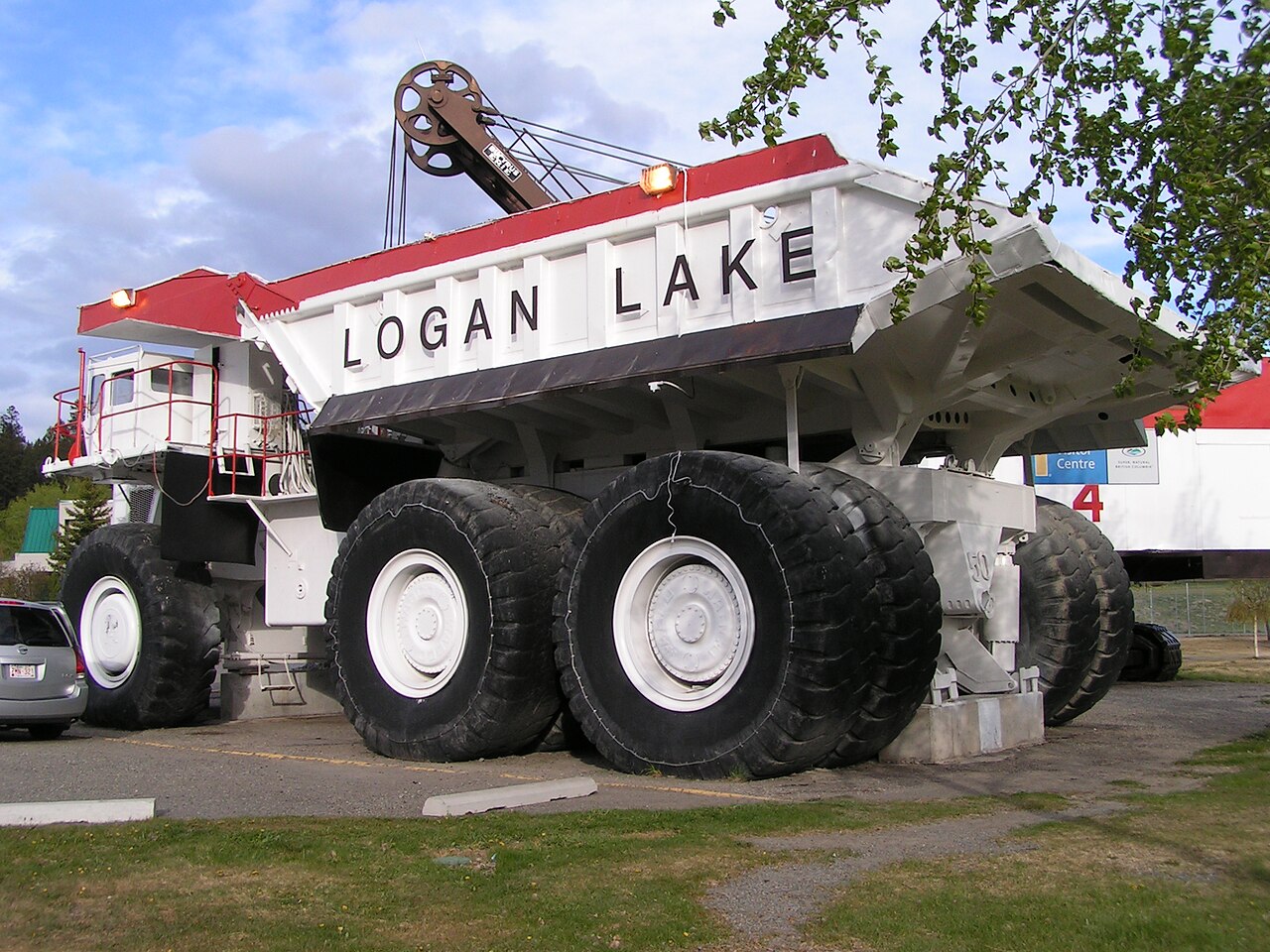 Mining dump truck in the field
Image: Logan Lake Mining Dump Truck 2 (dave_7, CC BY-SA 2.0), Wikimedia Commons. A representative mining vehicle, not a specific Komatsu or Caterpillar model.

0. 30-Second Summary
- Payload isn't just "bed volume × soil density" — it's constrained by axle load, tires, braking distance, and road strength.
- The traction force needed to climb a grade is the sum of grade resistance, rolling resistance, and acceleration resistance. Electric drive makes it easy to get high torque at low speed and regenerative braking.
- The bed is tipped by a hydraulic cylinder. Hydraulic flow rate determines rise time; pressure and cylinder area determine lifting force.
- In mines, autonomous haulage using GNSS, IMU, radar, cameras, and vehicle-to-vehicle communication has become practical, centered on mixed operation with manned vehicles and remote monitoring.
- Metrics for evaluating autonomy include not just unmanned travel distance but payload, cycle time, tire wear, fuel/electricity consumption, and safety margin when stopped.
1. Running Resistance and Required Output
Let vehicle mass be m, gravitational acceleration g, grade i (small-angle approximation), rolling resistance coefficient C_r, and acceleration a. The approximation of running resistance is
With wheel radius r and total drive torque T_w, the traction force transmitted to the road surface is F_t=T_w/r. However, exceeding the upper limit F_t\le\mu mg set by road friction causes the tires to spin. Engine output P at speed v is
so a steep climb at low speed is dominated by high torque, while a high-speed empty return trip is dominated by output and cooling.
2. The Bed and the Hydraulic Tipping Mechanism
Let the piston area of the hydraulic cylinder lifting the bed be A and the differential pressure be \Delta p; the ideal thrust is F=\Delta pA. Letting the distance between the bed's center of gravity and the hinge be l, and the moment arm to the cylinder's point of action be r_m(\theta), the required thrust is
In the initial, near-horizontal bed attitude, r_m is small, making it easy to use maximum pressure. As the bed rises, the gravity moment decreases, enabling a design that increases hydraulic flow rate to dump quickly. Because required torque changes when clay sticks, material freezes, or the load is uneven, pressure sensors and attitude sensors are used to detect anomalies.
3. Drive Types: Mechanical, Diesel-Electric, and Battery
For mid-size on-road dump trucks, a mechanical drivetrain — diesel engine, clutch/torque converter, transmission, propeller shaft, and differential — is common. For ultra-large mining trucks, a diesel-electric drivetrain, which generates electricity with a diesel generator and drives inverters and wheel motors, is widely used. It allows fewer gear stages and makes it easier to distribute torque independently to the left and right wheels.
Battery-electric drive can reduce exhaust gas and idling, but energy density, charging time, weight, cold-climate capacity, and fast-charger installation are challenges. Electric drive's regenerative braking can return kinetic energy to the battery on downhill grades, but at full charge or high temperature it needs to switch over to mechanical retarders and friction brakes.
4. Measuring Payload
Overloading damages tires, the frame, brakes, and roads, while underloading lowers productivity per cycle. A weighing system combines suspension pressure, axle strain, hydraulic cylinder pressure, and acceleration to estimate payload while the vehicle is moving. A simple force balance gives
but road-surface unevenness, dump pitching, and uneven load distribution introduce error. It's important to cross-check static weighing after stopping against dynamic estimation while moving, and update the per-vehicle bias.
5. Autonomous Haulage and Safety Design
A mine's autonomous haulage system (AHS) isn't self-contained in the hauling vehicle alone. It links loaders, crushers, dump points, maintenance yards, road maps, and a control room via communication, scheduling intersection priority, no-passing zones, stop lines, and emergency evacuation. In pits where GNSS is blocked, an IMU and wheel speed are used for short-term estimation, with radar, LiDAR, and landmarks used to return to the map.
Komatsu publicly offers its mining-oriented Autonomous Haulage System (AHS) as a product with deployment case studies, and Caterpillar likewise offers remote/autonomous haulage solutions such as Command for hauling. Because safety requirements and operational design differ from driver-assistance systems for on-road dump trucks, mining track records shouldn't simply be extrapolated to public roads.
Safety-oriented design separates the following three layers:
- Vehicle layer: independently moves brakes, steering, bed lock, and emergency stop to a safe state.
- Coordination layer: shares position, speed, and intent with surrounding vehicles, workers, and loaders.
- Control layer: detects communication loss or map inconsistency and transitions to slow-down, stop, or evacuation.
6. Comparing by Cycle Time
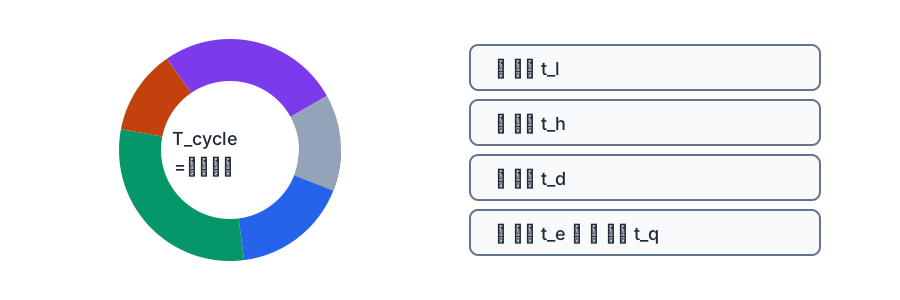
Figure 1 — A cycle-time view exposes queues and turning delays that an engine-power comparison misses. The shortest nominal travel time is not always the highest site productivity.
From loading time t_l, outbound travel t_h, dumping t_d, return trip t_e, and waiting time t_q, one cycle is
Earth volume per hour, using payload M_p and utilization rate \eta_u, is
The value of autonomous haulage lies less in raising top speed than in reducing waiting time and variability, and aligning the utilization rates of loaders and crushers. Fuel or electricity consumption should also be evaluated over this same full cycle, including the empty return trip, idling, and congestion.
7. Summary
A dump truck is designed as a single transport machine unifying bed, hydraulics, drivetrain, braking, and communication. Competing solely on payload size overlooks bottlenecks in climbing, tires, roads, charging, and stopping distance. When reading about current mining AHS or electric dump trucks, it's worth checking not just the vehicle's standalone autonomy level, but the full cycle from loading to dumping, and the procedures by which a person can safely intervene in an abnormal situation.
Does a bigger payload always mean higher hourly transport?
Loading, travel, queues, and unloading set cycle time. Compare payload together with the complete cycle.
References
Current step · 4 / 7 · Construction Machinery Engineering
Comments
Please log in to post a comment
No comments yet.