Contents — find the section you need
Background and reading guide
Background Basic force, motion and energy terminology; use the linked background explanations.
Fundamentals · Explanations of principles, structure and trade-offs.
Unlike other construction machinery — which digs, hauls, or piles — compaction equipment is a machine that "changes soil or paving material without moving it." A roller or plate applies repeated loading to the ground, pressing the air out from between soil particles, raising density to increase strength, bearing capacity, and durability. It's an unglamorous process, but insufficient compaction of a subgrade or embankment always shows up later, in the form of settlement or rutting.
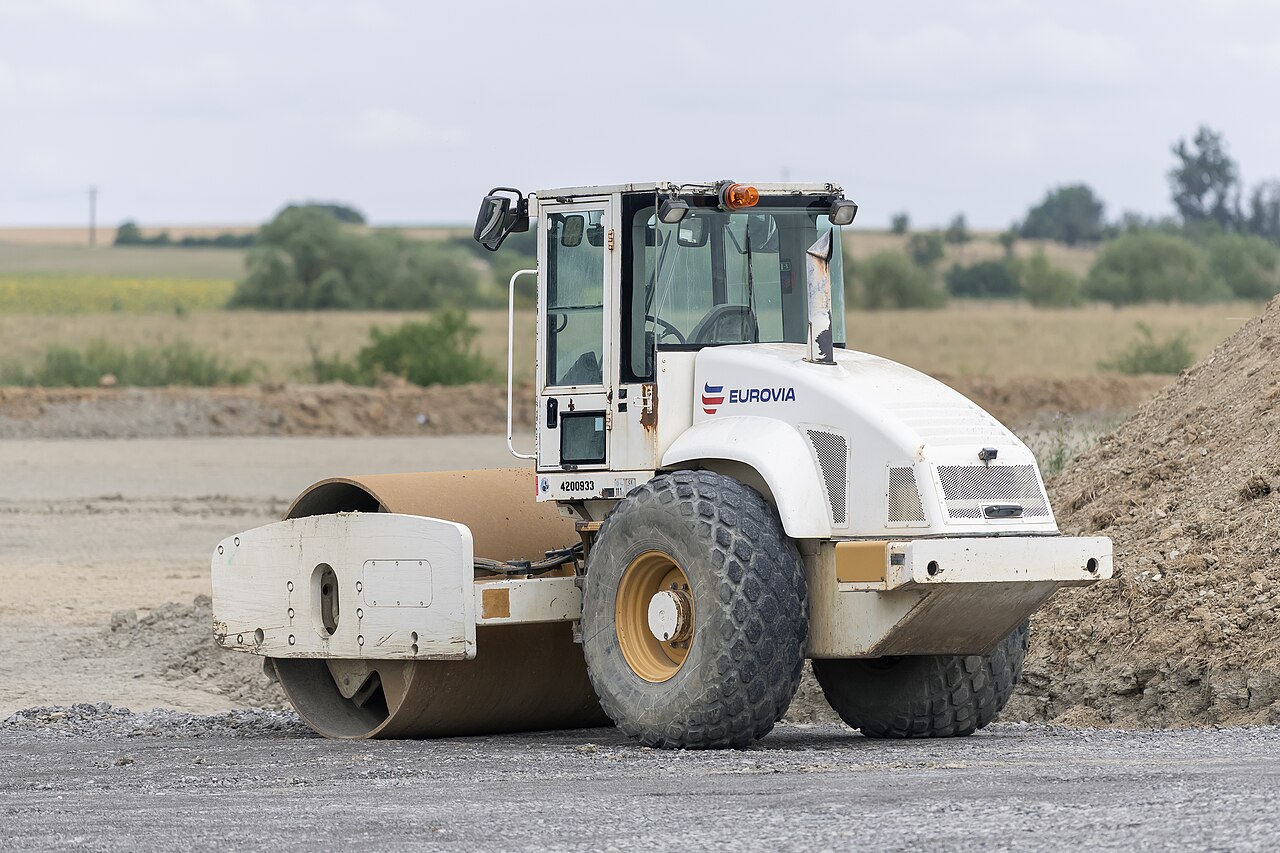 A vibratory roller in service
Image: CAT CS563E (Alexandre Prevot, CC BY-SA 4.0), Wikimedia Commons. Not the specific Sakai Heavy Industries or Mikasa Sangyo models discussed in the text — a representative example of a single-drum vibratory roller's layout.

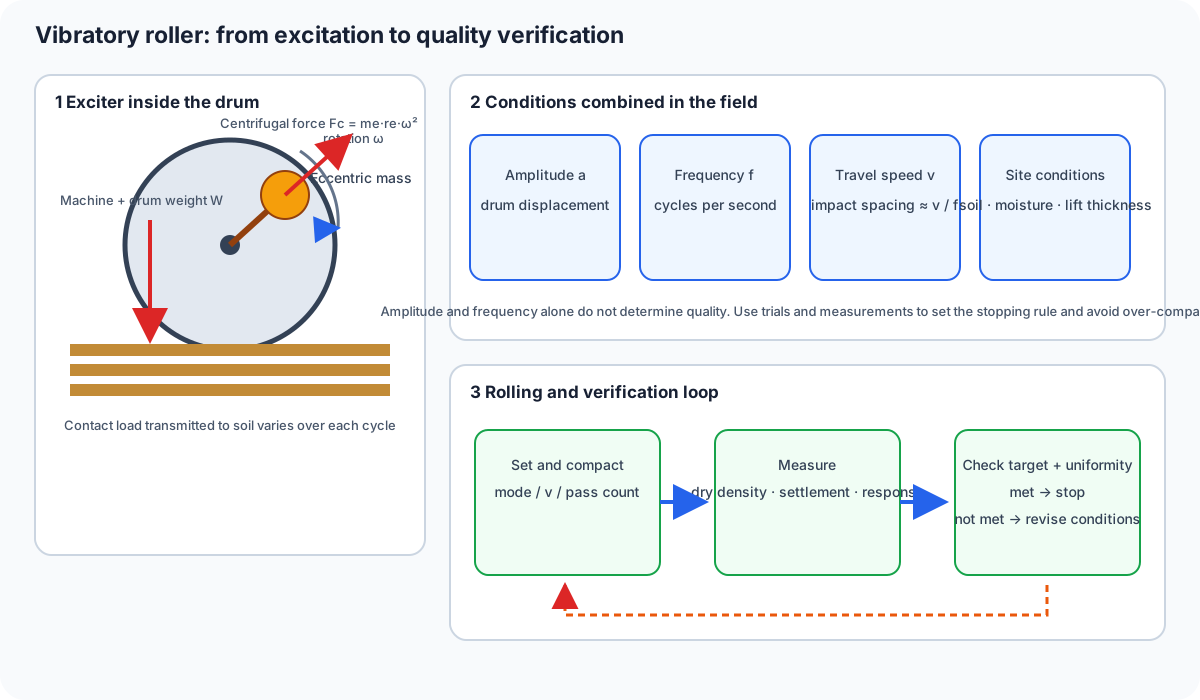
Figure 1 — Rotation of the eccentric mass generates excitation; together with machine weight, it produces a contact load that varies over each cycle. Quality also depends on travel speed, soil, moisture, and lift thickness, so trials and measurements should define both operating conditions and the stopping rule.
0. 30-Second Summary
- For soil compaction, there exists an "optimum moisture content" at which the highest dry density is obtained for a given moisture content. The laboratory test that finds this is the Proctor test (the compaction test for soil by rammer), organized as a compaction curve.
- A vibratory roller rotates an eccentric weight inside the drum to generate centrifugal force (the exciting force). This exciting force is often set to roughly 2–3 times the drum's own weight, combining static loading from self-weight with dynamic loading from vibration to compact the soil.
- A large amplitude with low frequency suits thick layers and coarse-grained soil; a small amplitude with high frequency suits thin layers and finish rolling. This differentiation determines both machine type and mode-switching design.
- Plate compactors and rammers are small machines that handle compaction in places a large roller can't enter — slopes, areas near structures, narrow excavation trenches, and the like.
- In asphalt paving, a macadam roller (initial rolling), a tandem roller (finish rolling), and a tire roller (secondary rolling/smoothing) are used in sequence for each stage of the process.
1. Why Compact at All: The Proctor Test and Optimum Moisture Content
The strength, settlement resistance, and permeability of an embankment or subgrade are closely tied to the soil's dry density (the mass of soil particles per unit volume). In 1933, the American researcher Proctor found that when the same soil is compacted at different moisture contents, dry density reaches a maximum at a particular moisture content. In Japan, the "compaction test for soil by rammer" (a laboratory test conforming to JIS, equivalent to the Proctor test) is used to investigate this relationship.
In the test, sample soil is placed in a container called a mold, and a rammer (weight) of specified mass is repeatedly dropped in free fall from a specified height to compact it. Compacting at roughly 6 to 8 different moisture contents and plotting the relationship between moisture content and dry density as a "compaction curve" yields a mountain-shaped curve. The moisture content at which dry density is maximized is called the optimum moisture content w_{opt}, and the dry density at that point is the maximum dry density \rho_{d,max}. For well-graded, coarse sandy soil, the compaction curve becomes a sharp peak, with \rho_{d,max} tending to be large and w_{opt} low (as a rough guide, w_{opt} around 8–20% and \rho_{d,max} around 1.7–2.1 g/cm³). Cohesive soil with a high fines content, by contrast, gives a gentler curve, with \rho_{d,max} smaller and w_{opt} higher (as a rough guide, w_{opt} around 30–70% and \rho_{d,max} around 1.1–1.3 g/cm³, both for Method A).
On site, the management standard is what percentage of this laboratory-derived maximum dry density the actually compacted soil's dry density reaches (the degree of compaction). Soil whose moisture content is far from the optimum value won't reach the target density no matter how much the machine's exciting force is increased. Moisture-content adjustment through watering or aeration, and the machine's compaction capability, always need to be considered as a set.
2. The Exciting Mechanism of a Vibratory Roller
A vibratory roller has a rotating shaft with an eccentric weight (unbalanced mass) inside the drum, and generates exciting force by spinning this at high speed with a motor. Letting the eccentric weight's mass be m_e, its eccentric distance from the center of rotation be r_e, and the angular velocity be \omega, the amplitude of the centrifugal force (exciting force) is
Since angular velocity \omega=2\pi f (where f is frequency), the higher the frequency, the more sharply exciting force increases, as the square of angular velocity. The force the drum transmits to the ground is the static load from the drum's own weight, M_{drum}g, superimposed with this rotating exciting force, F_c\sin(\omega t). In practice, the exciting force is often set to roughly 2–3 times the drum's own weight, which means the drum is periodically applying a dynamic load large enough to momentarily lift it off the ground.
The amplitude a is determined by something close to
dividing the eccentric weight's static moment m_e r_e by the equivalent mass M_{eq} of the vibrating system including the drum. Frequency and amplitude are parameters that can be designed and adjusted independently: a large amplitude and low frequency lets compaction energy reach deep into thick soil layers, suiting initial rolling of thick layers such as an embankment, while a small amplitude and high frequency concentrates the effect near the surface, suiting scenarios such as asphalt finish rolling that demand thin layers and high flatness. Many current machines have modes that switch frequency and amplitude in stages, letting the same unit cover everything from rough finishing to finish rolling.
Sakai Heavy Industries' SV160DV publishes specs showing a frequency of 28.3 Hz (high vibration) and an exciting force of 343 kN, which serves as one benchmark for the exciting force found in mid-to-large vibratory rollers for earthwork.
3. Plate Compactors and Rammers: Compaction in Tight Spaces
In slopes, areas near structures, around buried pipes, and narrow excavation trenches — places a large vibratory roller can't enter — portable plate compactors or rammers (tampers) are used. A plate compactor has a vibration mechanism built into the underside of a flat plate, self-propelling forward/backward and side-to-side to compact areally. A rammer applies impact by bouncing vertically, suiting narrow vertical holes and backfilling.
Mikasa Sangyo's plate compactor MVC-40H publishes specs of 49 kg machine mass, 7.2 kN (730 kgf) centrifugal force, and a frequency of 103 Hz (6,200 times per minute). Its exciting force is an order of magnitude smaller than a large vibratory roller's, but its frequency is, conversely, higher — showing it's designed for use where a person pushes the unit through a narrow area, compacting finely. The light 49 kg machine mass is a result of prioritizing manual handling and portability.
4. Asphalt Rollers: Differentiated Use by Process Stage
Compacting asphalt paving isn't completed by a single machine. The macadam roller, with one steel wheel at the front and two at the rear, is heavy — with a self-weight of roughly 6–16 t — and is used for compacting crushed stone and the initial rolling of asphalt mixture. The tandem roller, with steel wheels spanning the full vehicle width at both front and rear, can roll a wide area at once, suiting finish rolling. The tire roller, using rubber tires at both front and rear wheels, has a ground-pressure distribution that's easy to adjust via tire air pressure, and is used for secondary rolling and surface smoothing. The combined roller, equipped with both steel wheels and tires, covers a broad range from initial rolling through finishing with a single machine.
On site, the typical sequence is initial rolling (macadam roller, or a vibratory roller) to gain most of the density, secondary rolling (tire roller) to correct ruts and unevenness, and finish rolling (tandem roller) to refine surface smoothness and texture. Because asphalt mixture becomes harder to compact as its temperature drops, the timing of rolling and the combination of machines is an especially tightly time-managed process within the construction plan.
5. The Range of Compaction Equipment Seen in Current Products
| Model | Classification | Key published specs | Main use |
|---|---|---|---|
| Sakai Heavy Industries SV160DV | Vibratory roller (earthwork) | Frequency 28.3 Hz (high), exciting force 343 kN | Initial-to-secondary rolling of embankments and subgrades |
| Mikasa Sangyo MVC-40H | Plate compactor | Machine mass 49 kg, centrifugal force 7.2 kN, frequency 103 Hz | Compaction in tight spaces, slopes, and backfilling |
The order of magnitude of exciting force, frequency, and mass differs greatly between a large vibratory roller and a portable plate compactor. This isn't simply a case of "the bigger one can also do the smaller job" — it shows that the design philosophy of the vibrating system itself changes according to the thickness of the layer being compacted and the available work space.
6. Summary
Compaction equipment's role is to apply repeated loading to soil or paving material, reducing voids to achieve a targeted dry density and bearing capacity. The optimum moisture content and maximum dry density shown by the Proctor test give the target value for moisture-content adjustment as a construction-management goal, and a vibratory roller's exciting force, frequency, and amplitude are the design variables that determine how much dynamic energy reaches that target, and to what depth. From plate compactors to asphalt rollers, even as the machine type differs, the principle of "transmitting self-weight plus exciting force to the ground, matched to layer thickness and soil type" is shared, and model selection and process sequencing on site are built on top of this one principle.
Do more roller passes always improve compaction?
Moisture, soil type, and lift thickness matter. Measure the achieved result and relate it to the operating conditions.
References
- Building Research Institute Testing Center — Compaction test for soil by rammer (Easy-to-Understand Test Series)
- Doken Testing Laboratories — What is the compaction test for soil by rammer (JIS-compliant)
- Ministry of Land, Infrastructure, Transport and Tourism, Chubu Regional Development Bureau — Compaction management technology via vibratory-roller acceleration response, the "α system"
- Mikasa Sangyo — Plate Compactor MVC-40H
- ARAV — What Is a Vibratory Roller? Types and Uses, Including Earthwork and Compact Types
- ARAV — What Is a Macadam Roller? Features and Differences From a Tandem Roller
Current step · 6 / 7 · Construction Machinery Engineering
Comments
Please log in to post a comment
No comments yet.