Contents — find the section you need
Background and reading guide
Background No specialist background required; check the reporting period and scope of financial measures.
Industry research · Read the sources, reporting period and comparison criteria together.
The steel industry is a foundational materials sector underpinning virtually every branch of manufacturing — automobiles, construction, shipbuilding, home appliances — yet it is also one of the hardest industries to decarbonize, because the ironmaking process, particularly the reduction reaction in a blast furnace, emits enormous amounts of CO2. Nippon Steel, Japan's largest steelmaker, and JFE Holdings, #2 domestically, show a clear gap in company scale, yet on decarbonization technology the two rivals join forces across that competitive wall.
 Nippon Steel
 JFE Holdings
Image: Nippon Steel logo / JFE Holdings logo (both public domain; trademark rights apply separately), Wikimedia Commons


Company History: The Lineage of the State-Run Yawata Works, and the Merger of Kawasaki Steel and NKK
Nippon Steel traces back to the state-run Yawata Works, which began operating in 1901. In 1934, the state-run Yawata Works merged with seven private steelmakers to form the national policy company "Nippon Seitetsu" (Japan Iron & Steel), but postwar anti-monopoly legislation broke it up in 1950 into four companies, including Yawata Iron & Steel and Fuji Iron & Steel. In March 1970, Yawata and Fuji merged again to form "Nippon Steel Corporation" (Shin Nippon Seitetsu), and for decades it reigned as Japan's largest steelmaker. In 2012 it merged with Sumitomo Metal Industries to become "Nippon Steel & Sumitomo Metal," renaming itself to its current name, "Nippon Steel Corporation," in 2019.
JFE Holdings was born from the merger of the former NKK (Nippon Kokan, #2 in domestic crude steel output) and the former Kawasaki Steel (#3), a combination of the industry's #2 and #3 players. Following a basic agreement in December 2001, the holding company JFE Holdings was established in September 2002, and in April 2003 the operating companies were reorganized to establish JFE Steel, JFE Engineering, and others. Where Nippon Steel was built through repeated mergers of #1 players, JFE was formed by a #2-and-#3 alliance assembling enough scale to compete against Nippon Steel — a difference in origin story between the two.
Comparing Company Scale Over Time: The Most Recent Five Fiscal Years
Both companies' fiscal years end in March, but Nippon Steel tends to foreground "business profit" (an IFRS metric reflecting underlying earning power, including inventory valuation effects) as its headline indicator, while JFE Holdings tends to foreground "ordinary income." The five-year trend is shown below using each company's own primary disclosed metric.
Nippon Steel (business profit basis)
| Fiscal Year | Revenue | Business Profit | Net Profit |
|---|---|---|---|
| FY March 2022 | ~¥6.81 trillion (estimated +20%s YoY) | ¥938.1 billion (record high, 8.5x YoY) | ¥637.3 billion (highest since the 2012 merger) |
| FY March 2023 | ¥7.9755 trillion (+17% YoY) | ¥916.4 billion (-2% YoY) | ¥694.0 billion (+9% YoY, record profit for a 2nd straight year) |
| FY March 2024 | ¥8.868 trillion | ¥800.0 billion (-13% YoY; on an underlying basis, ¥890 billion, a record) | ¥470.0 billion (-32% YoY) |
| FY March 2025 | ¥8.6955 trillion | ¥683.2 billion (underlying business profit ¥793.7 billion) | ¥350.2 billion |
| FY March 2026 | ¥10.0632 trillion (+15.7% YoY; consolidation effect from US Steel) | ¥514.1 billion (-24.8% YoY; hurt by a review of the US business) | ¥17.1 billion (sharply down YoY; the company had initially forecast a ¥60 billion net loss) |
*The FY March 2022 revenue figure is estimated by working backward from the confirmed FY March 2023 figure (¥7.9755 trillion, +17% YoY).
JFE Holdings (ordinary income basis)
| Fiscal Year | Revenue | Ordinary Income | Net Profit |
|---|---|---|---|
| FY March 2022 | ~¥4.3652 trillion (estimated) | ~¥388.8 billion (estimated) | (varies by source; a back-calculated figure for comparison purposes) |
| FY March 2023 | ¥5.26894 trillion (+20.7% YoY) | ¥210.282 billion (-45.9% YoY) | ¥162.621 billion (-43.5% YoY) |
| FY March 2024 | ¥5.17463 trillion (-1.8% YoY) | ¥268.386 billion (+27.6% YoY) | ¥197.421 billion (+21.4% YoY) |
| FY March 2025 | ¥4.85965 trillion (-6.1% YoY) | ¥144.315 billion (-46.2% YoY) | ¥91.867 billion (-53.5% YoY) |
| FY March 2026 | ¥4.53927 trillion (-6.6% YoY) | ¥87.417 billion (-39.4% YoY) | ¥70.165 billion (-23.6% YoY) |
*The FY March 2022 figures are estimated by working backward from the confirmed FY March 2023 results.
| Metric | Nippon Steel | JFE Holdings |
|---|---|---|
| Consolidated employees | 113,845 (as of March 2025) | 61,628 (+332 YoY) |
The five-year trend reveals a contrasting picture. Both companies posted record-high-range profits in FY March 2022-2023 amid a surge in steel prices, but since FY March 2024 both have been on a five-consecutive-year declining-profit trend, driven by a global slowdown in steel demand and China's overcapacity and low-price exports. Nippon Steel's revenue topped ¥10 trillion in FY March 2026 thanks to consolidating US Steel, but profit has stagnated due to a review of the US business. JFE Holdings' revenue and profit have both continued shrinking — the backdrop for the structural reform (blast furnace idling) discussed below.
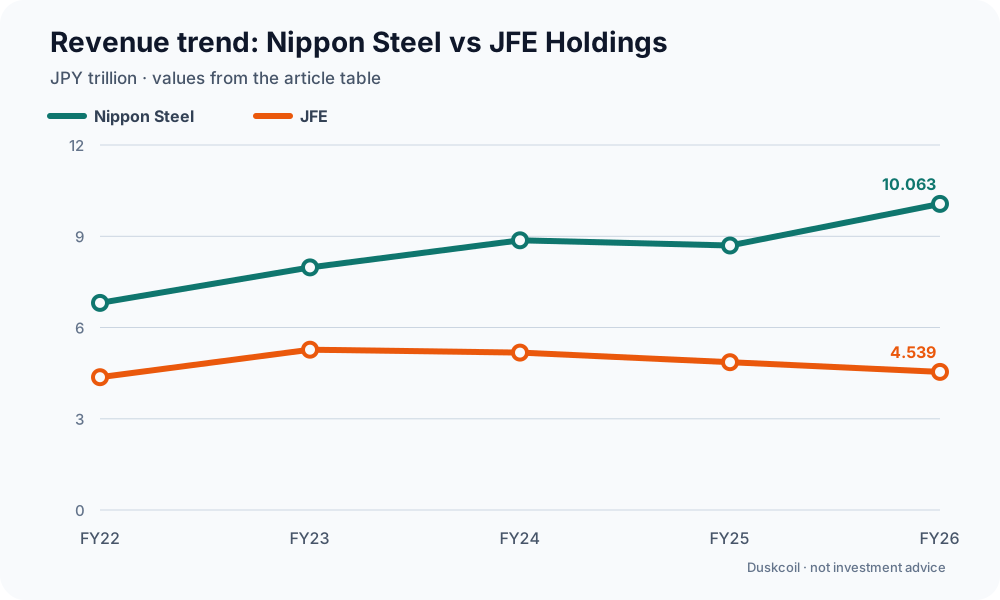
Diagram: Duskcoil. Revenue values in the article table, converted to JPY trillions; FY2022 includes approximate or derived figures as identified in the article. This diagram is not investment advice.
Comparing Flagship Products: Electrical Steel Sheet, High-Tensile Steel, and Shipbuilding Steel
Non-Oriented Electrical Steel Sheet: The Core Material Behind EV Motors
As vehicle electrification advances, one arena where the two companies compete fiercely is non-oriented electrical steel sheet, used in the iron cores of EV and HEV drive motors. Nippon Steel is the world's largest maker of electrical steel sheet, holding roughly 30% global share (with South Korea's POSCO #2 and Russia's NLMK #3), and has a history of developing high-performance grades at Toyota's request dating back to the original "Prius." JFE Steel is a pioneer that began producing cold-rolled non-oriented electrical steel sheet in 1954; it doubled its production capacity for premium-grade non-oriented electrical steel sheet at its Western Japan Steel Works' Kurashiki district in September 2024, and in 2023 began local joint-venture production in India as well. Both companies are prioritizing investment in this field as a "core material that determines motor efficiency," positioning it as one of the few growth areas even as overall steel demand shrinks.
Automotive High-Tensile Steel: Balancing Lightweighting and Crash Safety
Both companies position high-tensile steel sheet ("hi-ten") as a flagship product, as a technology that simultaneously satisfies the conflicting demands of lightweighting a vehicle body (to improve fuel or energy efficiency) and improving crash safety. According to Nippon Steel, high-tensile steel now accounts for 40-60% of a modern vehicle's body. JFE Steel is likewise developing "application technology" — body structural design, press-forming, and welding methods that draw out high-tensile steel's full performance — going beyond simply supplying steel to embed itself in automakers' design processes as a point of differentiation. One 2026 industry ranking of high-tensile-steel-related companies placed JFE Steel #1, Nippon Steel #2, and Kobe Steel #3.
Plate Steel for Shipbuilding and Energy: Expanding into LNG Carriers and Offshore Wind
Both companies also run plate steel businesses serving shipbuilding and energy infrastructure, developing cryogenic-grade steel for LNG carriers and large-format plate for offshore wind foundation structures, aimed at capturing new decarbonization-related demand. This segment is less prominent than automotive steel, but as Japan's shipbuilding industry rebuilds and offshore wind adoption expands, both companies are positioning it as a future source of demand.
The Difference in Technical Strategy
Nippon Steel's technical strategy centers on combining the integrated strength in premium steel grades it has built up since merging with Sumitomo Metal Industries (2012) with the overseas production base it suddenly expanded through the US Steel acquisition, aiming for a top-tier global position on both "quantity" and "quality." JFE Holdings holds the combined strengths of the former NKK's and former Kawasaki Steel's technologies, but is steering toward raising its ratio of high-value-added products by restructuring its domestic production system (shifting from quantity to quality via blast furnace idling, discussed below). The biggest difference in technical strategy between the two companies comes down to a contrast between "scaling up" (Nippon Steel) and "selection and concentration" (JFE).
A Joint Project That Transcends Rivalry: Hydrogen-Reduction Steelmaking
The steel industry's biggest technical challenge is reducing the CO2 emitted by the reduction of iron ore in a blast furnace. To tackle this, Nippon Steel and JFE Holdings (JFE Steel), together with Kobe Steel, have formed a four-way joint consortium, developing the technology with support from the Green Innovation Fund under NEDO (New Energy and Industrial Technology Development Organization), part of the Ministry of Economy, Trade and Industry.
Nippon Steel has developed "Super COURSE50," a technology that injects heated hydrogen into a blast furnace to replace part of the conventional coal-based reduction reaction with hydrogen reduction (an endothermic reaction); in tests conducted November-December 2023, the company confirmed a 33% reduction in CO2 emissions from the blast furnace itself — a world-leading result. Alongside this blast-furnace hydrogen reduction technology, Nippon Steel positions large-scale electric-arc-furnace production of premium steel and hydrogen-based direct reduced iron production as its three "ultra-innovative technologies," aiming to achieve carbon neutrality by 2050.
That Nippon Steel and JFE — fierce rivals within the same industry — join forces on technology development for a challenge that neither can solve alone (decarbonization) is a pattern also seen in the joint methanation committee in the gas infrastructure sector discussed elsewhere on this site — an interesting recurring pattern among Japan's heavy industries.
Development and Manufacturing Sites
Nippon Steel operates its headquarters (Marunouchi, Chiyoda-ku, Tokyo) alongside steelworks nationwide, including Kimitsu (Chiba), Yawata (Kitakyushu, Fukuoka), and Nagoya (Tokai, Aichi). JFE Holdings operates its headquarters (Uchisaiwaicho, Chiyoda-ku, Tokyo), with JFE Steel running its steelworks across four districts under two works: East Japan Works (Chiba and Keihin) and West Japan Works (Kurashiki and Fukuyama). The map below shows the confirmed major sites (overseas sites and the full roster of both companies' group companies are out of scope).
Sources: district names from each company's official steelworks introduction and locations pages, with addresses individually confirmed via each steelworks' official access page and a map service (Yahoo! Maps, etc.). Coordinates were geocoded to the town/chome or facility-name level via OpenStreetMap Nominatim.
Business Strategy and Outlook: Nippon Steel's "Scale and Quality," JFE's "From Quantity to Quality"
In December 2025, Nippon Steel announced its "2030 Mid-to-Long-Term Management Plan," covering fiscal 2026 onward. Built on two pillars — strengthening the profitability of its domestic business and executing a growth strategy for its overseas business — the plan aims to restore Nippon Steel's position as the world's #1 steelmaker, directing roughly ¥4 trillion of a total ¥6 trillion in planned investment over five years toward overseas operations. It positions the US, Europe, India, and Thailand as growth markets, and has already agreed with the US government to invest an additional roughly $11 billion in US Steel by 2028. The plan sets targets of reliably achieving consolidated underlying profit of ¥1 trillion or more and, longer-term, global crude steel output of 100 million tons or more — pursuing both quantitative expansion and qualitative improvement centered on premium steel, built on the production capacity gained through the US Steel acquisition discussed above.
JFE Holdings formulated its long-term vision "JFE Vision 2035" and its 8th mid-term management plan (fiscal 2025-2027) in May 2025. In its domestic steel business, it has set out to "shift from quantity to quality," advancing the completion of structural reforms, raising the share of high-value-added products, and reviewing its pricing structure, while focusing on business expansion in growing overseas markets such as India. The concrete expression of this "shift from quantity to quality" is blast furnace idling: JFE has idled one blast furnace at its West Japan Works' Kurashiki district as of May 2025 (planned restart in FY2028) and disclosed plans to idle one blast furnace at the Fukuyama district as well, in FY2027 (the blast furnace at the East Japan Works' Keihin district was already idled back in 2023). The company is also pushing the expanded sale of "GX Steel," which balances environmental measures with economics, and developing an innovative electric arc furnace slated to start operating in FY2028 — narrowing production capacity while racing to build a "leaner, more resilient production system" that raises profitability.
The two companies' strategic directions are contrasting. Nippon Steel is on an "expansion" path, adding overseas production capacity with the US Steel acquisition as its starting point, while JFE Holdings is on a path of "qualitative transformation through managed contraction," methodically idling domestic blast furnaces while shifting toward high-value-added products. Facing the same shrinking market environment in the steel industry, Nippon Steel is competing on scale, while JFE is competing on profitability by narrowing its scale — two contrasting responses side by side.
References
- Nippon Steel Official Site (Japanese) / IR Information (Japanese)
- JFE Holdings Official Site (Japanese) / JFE by the Numbers (Japanese)
- Nippon Steel's Path to Completing the US Steel Acquisition (Japanese)
- Nippon Steel's Results with the Super COURSE50 Blast-Furnace Hydrogen Reduction Technology (Japanese)
- Nippon Steel Carbon Neutral Vision 2050 (Japanese)
- Nippon Steel Corporate History (Official, Japanese)
- The Prehistory of the JFE Group (Official, Japanese)
- Nippon Steel x Sumitomo Metal: The Century's Biggest Merger (Nikkei Business, Japanese)
- Nippon Steel Posts Record Profit for FY March 2022 (Nikkei, Japanese)
- Nippon Steel Posts Record Profit for a 2nd Straight Year, FY March 2023 (Nikkei, Japanese)
- Nippon Steel's Net Profit Down 32%, Margin Improvement Beats Forecast, FY March 2024 (Nikkei, Japanese)
- Nippon Steel's FY March 2025 Consolidated Operating Profit Down 29.6% to ¥547.9 Billion (IFRS Basis) (Traders Web, Japanese)
- Nippon Steel FY2025 (FY March 2026) Full-Year Results: Underlying Business Profit ¥650.4 Billion (Investalk, Japanese)
- JFE's Net Profit Down 51% for FY March 2023 (Nikkei, Japanese)
- JFE's Net Profit Up 16.8% for FY March 2024 (Nikkei, Japanese)
- JFE's Net Profit Up 4%, FY March 2025 Results (Nikkei, Japanese)
- JFE's Net Profit to More Than Double for FY March 2027 (Nikkei, Japanese)
- What's So Impressive About Nippon Steel's "Non-Oriented Electrical Steel Sheet"? (Motor Fan, Japanese)
- JFE Steel Doubles Production of Electrical Steel Sheet for EV Motors (Nikkei Cross Tech, Japanese)
- Why Nippon Steel and JFE Steel Are Both Expanding Electrical Steel Sheet Capacity (Newswitch, Japanese)
- Nippon Steel High-Tensile Steel (Official Technology Site, Japanese)
- JFE Steel's Distinctive Automotive Steel Sheets and Application Technology (JFE Technical Report, Japanese)
- Nippon Steel to Invest ¥6 Trillion Over 5 Years, Strengthening Overseas Business (Kyodo News, Japanese)
- Nippon Steel's Mid-to-Long-Term Plan Targets Underlying Profit of ¥1 Trillion+ (Japan Metal Daily, Japanese)
- JFE Group Long-Term Vision "JFE Vision 2035" and 8th Mid-Term Management Plan (Official PDF, Japanese)
- JFE to Idle One Blast Furnace at Fukuyama in FY2027 (Nikkei, Japanese)
- JFE Temporarily Idles a Kurashiki Blast Furnace (Nikkei, Japanese)
- Nippon Steel East Japan Works, Kimitsu District — Access and Map (Japanese)
- Nippon Steel Nagoya Works Overview (Japanese)
- Nippon Steel Kyushu Works, Yawata District Overview (Japanese)
- JFE Steel West Japan Works / Kurashiki District (Japanese)
- JFE Steel West Japan Works / Fukuyama District (Japanese)
- JFE Steel East Japan Works / Keihin District (Japanese)
Current step · 8 / 21 · Corporate Research
Comments
Please log in to post a comment
No comments yet.