Contents — find the section you need
Background and reading guide
Background No specialist background required; check the reporting period and scope of financial measures.
Industry research · Read the sources, reporting period and comparison criteria together.
Tractors, combine harvesters, and rice transplanters are central to mechanizing farm work in Japan, and Kubota and Yanmar both have a major presence in this field. On the latest disclosed consolidated figures, Kubota is around ¥3 trillion in revenue and Yanmar Holdings around ¥1.2 trillion, making Kubota roughly 2.5 times larger by revenue. Revenue scale and domestic share for an individual product category use different denominators, so this article treats the comparison as one of company scale. Both companies started out in fields far removed from agricultural machinery. Kubota built its footing manufacturing cast-iron water pipes before entering agricultural machinery, while Yanmar entered the market on the strength of what's regarded as the world's first practical small diesel engine. Despite the gap in company scale, the two go toe-to-toe — arguably better — in the race to commercialize autonomous combine harvesters and in building out farm-management cloud platforms.
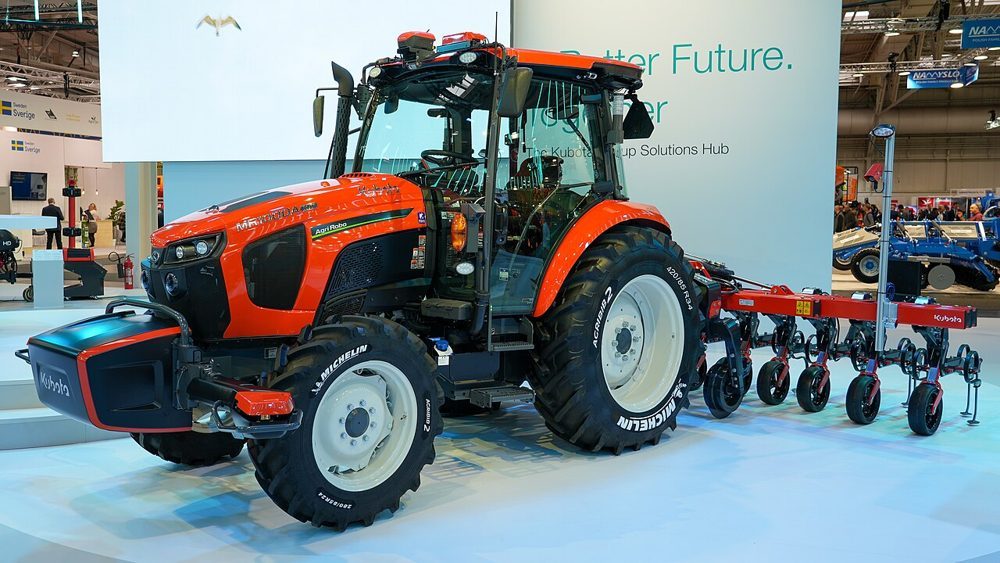 Kubota
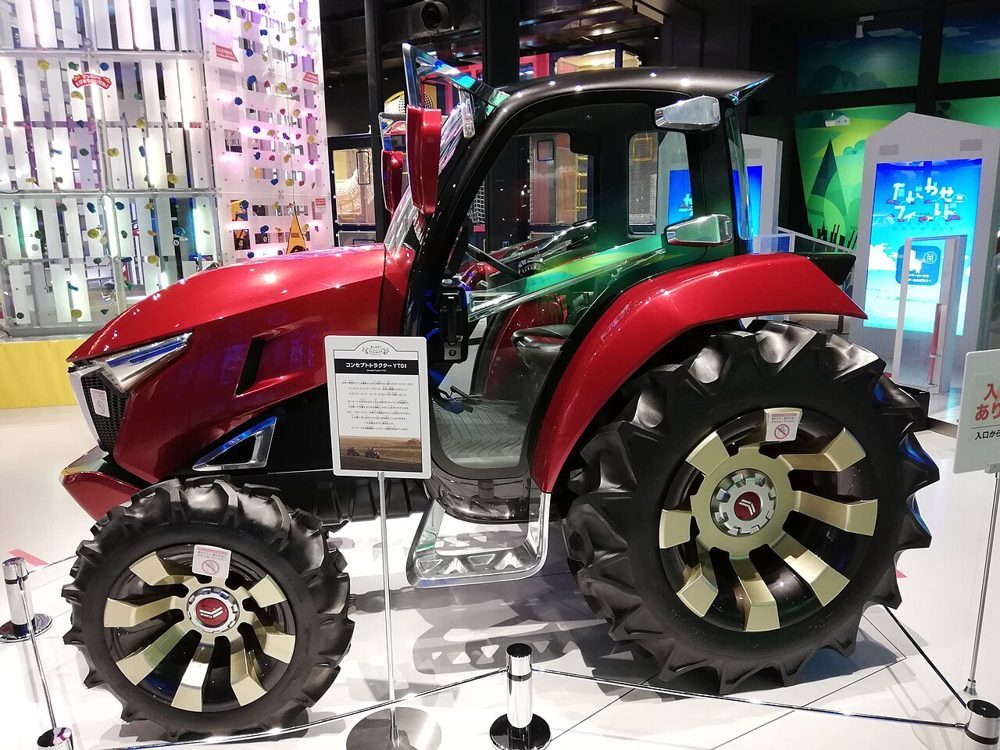 Yanmar
Image: A Kubota autonomous tractor (AgriRobo MR1000A, on display at Agritechnica 2023) (MarcelX42, CC BY-SA 4.0) / A Yanmar concept tractor (YT01) (CC0), Wikimedia Commons. The Yanmar photo is a design-study show vehicle, not the production YT5114S compared in the text below.
.jpg)
.jpg)
Company History: Kubota's Path from Casting to Farm Machinery, Yanmar's Path from Diesel Engines to Farm Machinery
Kubota traces back to February 1890, when 19-year-old Daisuke (later Kubota) Gonshiro founded the casting business "Daisuke Foundry" in Osaka. Starting with cast-iron scales and household goods, it began manufacturing cast-iron water pipes in 1893, and in 1897 renamed itself "Kubota Iron Works," expanding into water and sewage products like fire hydrants and control valves. It entered agricultural engines and labor-saving equipment in 1922 and went public in 1939. In 1947 it launched its first tiller, the "K1," marking its full entry into agricultural machinery, and in 1953 it renamed itself "Kubota Iron Works Co., Ltd." while simultaneously entering construction machinery. It launched what's regarded as Japan's first domestically produced field-crop riding tractor, the "T15," in 1960, followed by the paddy-field riding tractor "L15R" in 1962 — laying the foundation for its tractor business as it stands today. In 1990, marking its 100th anniversary, it renamed itself "Kubota Corporation," its present name. It has accelerated overseas expansion in recent years, making Indian tractor maker Escorts a consolidated subsidiary in 2022.
Yanmar traces back to "Yamaoka Gas Shokai," a business reselling and modifying gas engines that Magokichi Yamaoka opened in Osaka in 1907. On March 22, 1912, Yamaoka spun this off into an independent company, "Yamaoka Engine Works," and from 1920, after World War I, moved into manufacturing his own agricultural kerosene engines. In 1930, struck by the fuel efficiency of diesel engines he saw at a German trade fair, Yamaoka poured himself into miniaturizing them, completing in 1933 what's regarded as the world's first practical small diesel engine — the "HB" model (3 hp, 500 kg) — now registered as a Mechanical Engineering Heritage by Japan's National Museum of Nature and Science. The company renamed itself "Yanmar Diesel Co., Ltd." in 1952, then established "Yanmar Agricultural Equipment Co., Ltd." in 1961 to enter agricultural machinery in earnest, launching its first riding tractor, the "YM12A," in 1963. After renaming itself "Yanmar Co., Ltd." in 2002, it moved to a holding-company structure in April 2013, establishing "Yanmar Holdings Co., Ltd.," and in 2020 renamed the operating company "Yanmar Co., Ltd." to "Yanmar Power Technology Co., Ltd." — a series of group-structure reorganizations.
Comparing Company Scale: Five-Year Trend
The two companies' fiscal years differ (Kubota's runs to December, Yanmar Holdings' to March), so a simple same-calendar-year comparison isn't possible. Lining up each company's most recent five fiscal years shows how differently they've grown.
| # | Kubota FY | Revenue | Operating Profit | Yanmar HD FY | Revenue | Profit |
|---|---|---|---|---|---|---|
| 5 periods ago | FY2021/12 | ¥2.1968 trillion | ¥246.2 billion | FY2022/3 | ¥871.4 billion | Ordinary income ¥48.9 billion |
| 4 periods ago | FY2022/12 | ¥2.6788 trillion | ¥218.9 billion | FY2023/3 | ¥1.0222 trillion | Ordinary income ¥61.8 billion |
| 3 periods ago | FY2023/12 | ¥3.0207 trillion | ¥328.8 billion (peak) | FY2024/3 | ¥1.0814 trillion | Ordinary income ¥80.4 billion |
| 2 periods ago | FY2024/12 | ¥3.0163 trillion | ¥315.6 billion | FY2025/3 | ¥1.0796 trillion | Ordinary income ¥41.0 billion (-49% YoY) |
| Latest | FY2025/12 | ¥3.0189 trillion | ¥265.5 billion | FY2026/3 | ¥1.2220 trillion (record) | Operating profit ¥47.1 billion (+10% YoY) |
Yanmar Holdings is unlisted (it issues only corporate bonds), and its financial disclosures usually lead with ordinary income rather than operating profit. For FY2026/3, press coverage confirmed an actual operating-profit figure (¥47.1 billion), which is used here; earlier periods are reported on an ordinary-income basis, so the two metrics aren't directly comparable across rows.
| Metric | Kubota | Yanmar Holdings |
|---|---|---|
| Consolidated employees | 52,503 (FY2025/12) | 26,671 (as of March 31, 2025) |
| Listing status | Tokyo Stock Exchange Prime | Unlisted (bonds only) |
| Main business mix | The machinery segment accounts for 87.1% of revenue (¥2.6286 trillion, FY2025/12) | Agricultural machinery, construction machinery, engines, energy systems, marine systems, and more |
By revenue, Kubota runs roughly 2.5 times Yanmar's size in the latest period (¥3.0189 trillion vs. ¥1.2220 trillion). The gap, long described as "roughly 3x," narrowed somewhat after Yanmar posted record revenue in FY2026/3, helped by yen depreciation and rising demand for data-center power-generation equipment. On business mix, Kubota's machinery segment — centered on agricultural machinery like tractors and combines — accounts for nearly 90% of revenue, a strongly specialized structure, while Yanmar's portfolio is spread across construction machinery (mini excavators, for instance), engines, power-generation equipment, and marine systems alongside agricultural machinery. The trend lines also contrast: Kubota grew revenue in four of the five periods and hit record operating profit in FY2023/12 (¥328.8 billion) before settling into a plateau of two consecutive profit declines, while Yanmar saw ordinary income plunge 49% YoY in FY2025/3 before rebounding sharply in FY2026/3 — a far more volatile trajectory.
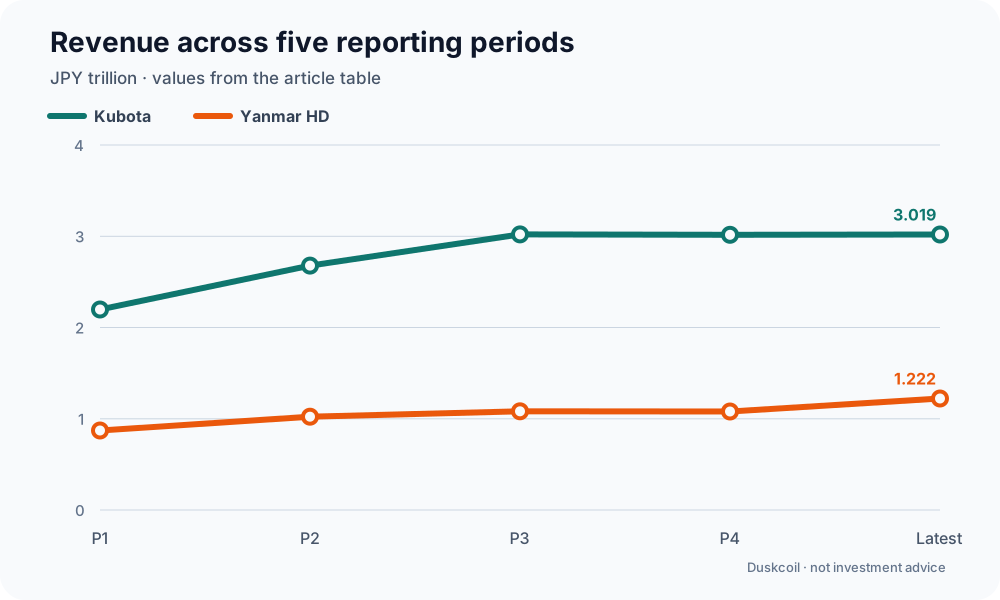
Diagram: Duskcoil. Revenue values in the article table, converted to JPY trillions. Because the fiscal year-ends differ, the horizontal axis shows oldest-to-latest reporting periods rather than identical dates. This diagram is not investment advice.
Comparing Flagship Products
Large Field-Crop Tractors
Large tractors for large-scale farming are where both companies' engineering comes together most visibly.
| Item | Kubota M7 Series (M7-174) | Yanmar YT5 Series (YT5114S) |
|---|---|---|
| Max output | 170 hp | 114 PS |
| Engine | The in-house "Kubota V6108," meeting Japan's 4th-stage emissions regulations for special-purpose vehicles, with a power-boost function | A high-output common-rail (CR) engine with urea SCR, clearing 4th-stage emissions regulations |
| Notable feature | Kubota's own in-house-developed series — Japan's first domestic large-tractor lineup of this kind; holds output under heavy load | Handles everything from heavy towing and tilling to ultra-low-speed digging; max hydraulic lift capacity of 4,500 kgf |
On paper, Kubota's M7-174 outputs more (170 hp) than Yanmar's YT5114S (114 PS), but both series sit at the top tier of domestic large tractors, and both companies separately field even larger series for export and the North American market. In practice, selection tends to weigh hydraulic lift capacity, compatibility with implements, and auto-steering accuracy (covered next) more heavily than a simple horsepower comparison.
Combine Harvesters: A Race to Widen the Scope of Automation
Combine harvesters are another category where the two companies compete on autonomous-driving functionality. Kubota's "Agri Robo DR6130A" is a flagship model that Kubota itself states was the industry's first head-feed combine to achieve autonomous operation (cutting and unloading) under operator supervision, and it won the Mechanical Engineering Design Award "IDEA" in 2020. Yanmar, in August 2025, launched three new auto-combine models (YH6115A/YH6135A/YH7135A) that automate even "corner cutting" — the complex steering maneuver needed to harvest a field's four corners, which required manual operation on prior models.
| Item | Kubota Agri Robo DR6130A | Yanmar YH6135A (new auto-combine) |
|---|---|---|
| Cutting width | 6 rows | 6 rows |
| Max output | 130 hp | 138 hp (Yanmar's highest ever in a combine) |
| Automation | Autonomous operation (cutting, unloading) under operator supervision — stated by Kubota to be an industry first for a head-feed combine | Automates straight-line travel, cutting-height adjustment, turning, and movement to unload, plus the complex "corner cutting" maneuver; auto mode usable from as early as the second lap |
| List price (tax included) | ¥26.059 million | ¥20.064 million |
| Launch | On the market as of 2020 (IDEA award) | August 1, 2025 (one of three new auto-combine models) |
On horsepower, Yanmar's YH6135A (138 hp) edges out Kubota's DR6130A, but Kubota's list price is higher. Both companies are locked in a development race that keeps widening the scope of automation on head-feed combines: Kubota claims to have been first to commercialize supervised autonomous operation (cutting and unloading), while Yanmar's 2025 model extends automation to "corner cutting" and moves the start of auto mode up from the third lap around the field's perimeter to the second. It's difficult to settle definitively who was "first" in the strictest sense from primary sources alone, but both companies are clearly pushing development in the same direction — expanding what gets automated.
Rice Transplanters: A Category Where Kubota Holds a Strong Lead
In the rice-transplanter market, Kubota has held roughly 60% of Japan's overall agricultural-machinery market since becoming the first in the industry to launch a walk-behind rice transplanter in 1986. Yanmar continues to sell both riding and walk-behind transplanters, touting its own usability features such as a planting-adjustment lever within reach of the driver's seat and a "Just Arm" function that adjusts plant spacing with near-hand-planting precision — but public information didn't turn up a share figure or "industry first" milestone on the scale of Kubota's. Much as Komatsu and Hitachi Construction Machinery have an asymmetric relationship in bulldozers, this is one example showing that Kubota and Yanmar don't compete evenly across every agricultural-machinery category.
A Difference in Technology Strategy: Where Autonomous Driving and Smart Agriculture Stand Today
Both companies are pushing practical autonomous tractors, but their development history and where they've actually landed differ.
Kubota was first to market: in 2017, it became the first domestic maker to start monitor sales of an autonomous tractor, going to general sale in 2018. Its autonomous farm-machinery lineup, "AgriRobo," combines three technologies — an RTK-GNSS unit, a surround-view camera system, and a system that detects people and obstacles — to enable either a single unmanned machine operating under human supervision, or one worker running a coordinated pair (one unmanned, one manned) at once.
Yanmar began developing robot tractors in 2013, and in 2018 launched the first generation under its "SMARTPILOT" autonomous-driving technology: a fully unmanned "Robot Tractor" and an "Auto Tractor" that requires minimal human input. Its current robot farm machinery has reached automation level 2 — operable from a single tablet under short-range supervision with no one riding the tractor, letting one worker run two machines at once. In June 2026, it launched a new "YT4S/5S Series" for large-scale farmland, with RTK-GNSS-based auto-steering delivering straight-line accuracy within ±2–3 cm.
Both companies' autonomous technology is built on RTK-GNSS (high-precision satellite positioning) as its foundation, and it's effectively becoming the industry standard.
Beyond automating the machines themselves, the two companies also take different approaches to building out farm-management cloud platforms. Kubota's "KSAS" (Kubota Smart Agri System) integrates field management, planting plans, work-log management, and status/maintenance notifications for compatible machines into a single cloud platform, backed by a wide entry point — free to use from year two onward for up to 100 registered fields. Yanmar's "Smart Assist" focuses more narrowly on day-to-day farm-management decisions, with features like automatic per-field weather forecasts, accumulated-temperature tracking, and daily-log entry through a dedicated smartphone app. It's a similar contrast to the one in construction machinery, where Komatsu blankets the entire job site with its "Smart Construction" platform (a "plane" strategy) while Hitachi Construction Machinery sharpens the excavator itself (a "point" strategy) — the same pattern shows up between Kubota and Yanmar in agricultural machinery.
Development & Manufacturing Facilities
Beyond its Osaka headquarters and Tokyo headquarters, Kubota operates numerous production and research facilities across Japan, including its Sakai Plant (its mother plant), Tsukuba Plant, and Utsunomiya Plant. Yanmar, centered on its group headquarters in Chayamachi, Kita-ku, Osaka, operates agricultural-machinery- and engine-related facilities across the country, including the Biwa Plant and Kinomoto Plant (small engines) in Nagahama, Shiga Prefecture, and Yanmar Agri's plants in Okayama, Kochi, and Kagoshima. The map below plots 10 confirmed domestic facilities for Kubota and 6 for Yanmar (some overseas facilities are out of scope, and some pins belong to businesses other than agricultural machinery, such as water infrastructure or construction machinery).
Sources: Kubota's official "Locations" page lists addresses (primary-source), but doesn't state each facility's product lineup, so functions were confirmed individually via news releases and regional-business writeups; some pins belong to non-agricultural-machinery businesses such as water/environment. For Yanmar, facility names come from its official group-company pages (Yanmar Power Technology, Yanmar Agri, etc.), with addresses individually confirmed via map/directory services (Yahoo! Maps, NAVITIME, etc.) since Yanmar's own integrated locations page could not be fetched via WebFetch. Coordinates were geocoded to town/block level via OpenStreetMap Nominatim (the Kagoshima site and part of the Kochi plant lacked a confirmable street-level address, so those are approximated to a wider area).
Strategy & Outlook
On February 13, 2026, Kubota announced a new mid-term management plan, "Focus & Breakthrough," running through FY2030/12. It marks a shift from a volume-driven, share-expansion approach toward a balance-sheet-conscious "corporate value management," committing roughly ¥1.4 trillion in investment over five years. It reclassifies its business portfolio into growth-driving businesses, value-rebuilding businesses, and structural-reform businesses, targeting a high growth rate (CAGR) in three areas — construction machinery, its India-originated business, and lifecycle support. M&A has grown more selective too: Kubota has directed resources into growth areas, such as making India's Escorts a consolidated subsidiary in 2022 and bringing U.S. AI-image-diagnostics startup Bloomfield Robotics into the group in September 2024, while simultaneously trimming non-core businesses.
On March 23, 2026, Yanmar Holdings announced it had formulated a mid-term management plan, "MTP2030," running through FY2030, aimed at realizing "A Sustainable Future." It targets ¥1.5 trillion in revenue and an ROS (return on sales) of 8% or higher by FY2030, with "achieving Global Tier 1 status" as one of its strategic priorities. It's also pushing new-business creation that shifts the business model from selling products to solving customer problems, targeting ¥200 billion in revenue from new-business areas alone by 2040. On the M&A front, Yanmar acquired a majority stake in Dutch battery-electrification technology company ELEO Technologies in 2025 to accelerate electrification, while simultaneously booking a special loss in FY2026/3 tied to restructuring its European small/mid-size construction-machinery business — investing in growth areas and trimming unprofitable ones at the same time.
What both companies share is a shift away from simple scale expansion toward management that prioritizes profit margins and capital efficiency — with selective investment in growth areas and the trimming of non-core businesses proceeding in parallel behind the scenes.
References
- Kubota Official Site / Investor Relations
- Yanmar Official Site
- Kubota Company History
- Yanmar Founders' Spirit
- Yanmar HB-Model Small Horizontal Water-Cooled Diesel Engine (Mechanical Engineering Heritage)
- IRBANK: Kubota financial results
- Kubota Locations
- Yanmar Power Technology Facility Introduction
- Yanmar Agri Factory Introduction
- Kubota Press: An Explainer on Autonomous Farm Machinery
- Yanmar SMARTPILOT
- Kubota KSAS Farm Management Support System
- Kubota M7 Series Product Information
- Yanmar YT4S/5S Series Specs
- Kubota Agri Robo DR6130A Product Information
- Yanmar YH6135/YH7135 Product Information / Pricing
- Yanmar: Three New Auto-Combine Models Launch News
- Kubota Mid-Term Management Plan "Focus & Breakthrough" Presentation
- Nikkei: Kubota's new mid-term plan shifts from market share to profitability
- Yanmar: Formulation of Mid-Term Management Plan "MTP2030"
- Nikkei: Yanmar HD net profit more than doubles, FY2026/3
- Yanmar: FY2025/3 Financial Results Overview
Current step · 12 / 21 · Corporate Research
Comments
Please log in to post a comment
No comments yet.