Contents — find the section you need
Background and reading guide
Background No specialist background required; check the reporting period and scope of financial measures.
Industry research · Read the sources, reporting period and comparison criteria together.
Hydraulic excavators, bulldozers, dump trucks — the construction machinery market that keeps civil-engineering, mining, and demolition sites running is led globally by America's Caterpillar, with Komatsu close behind in second. Hitachi Construction Machinery sits further back globally, but holds the #2 spot domestically, just behind Komatsu. Despite a nearly 3x gap in company scale, the two go toe-to-toe — arguably better — on ultra-large excavator performance, and their technology strategies are a study in contrast: Komatsu blankets the entire job site with ICT, Hitachi Construction Machinery sharpens the excavator itself.
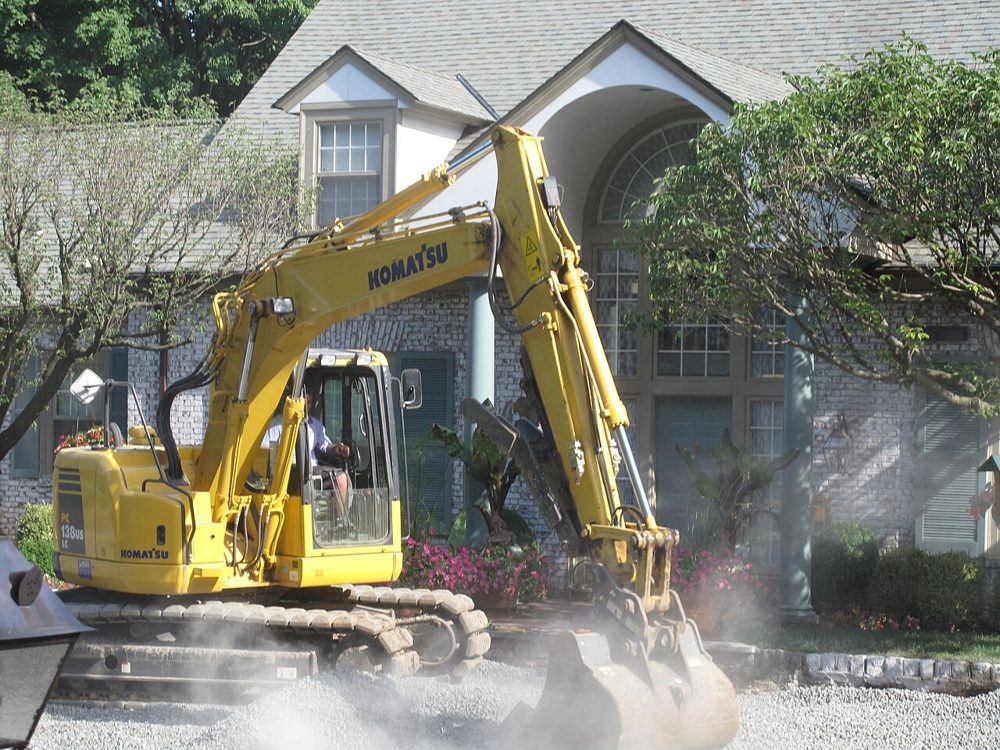 Komatsu
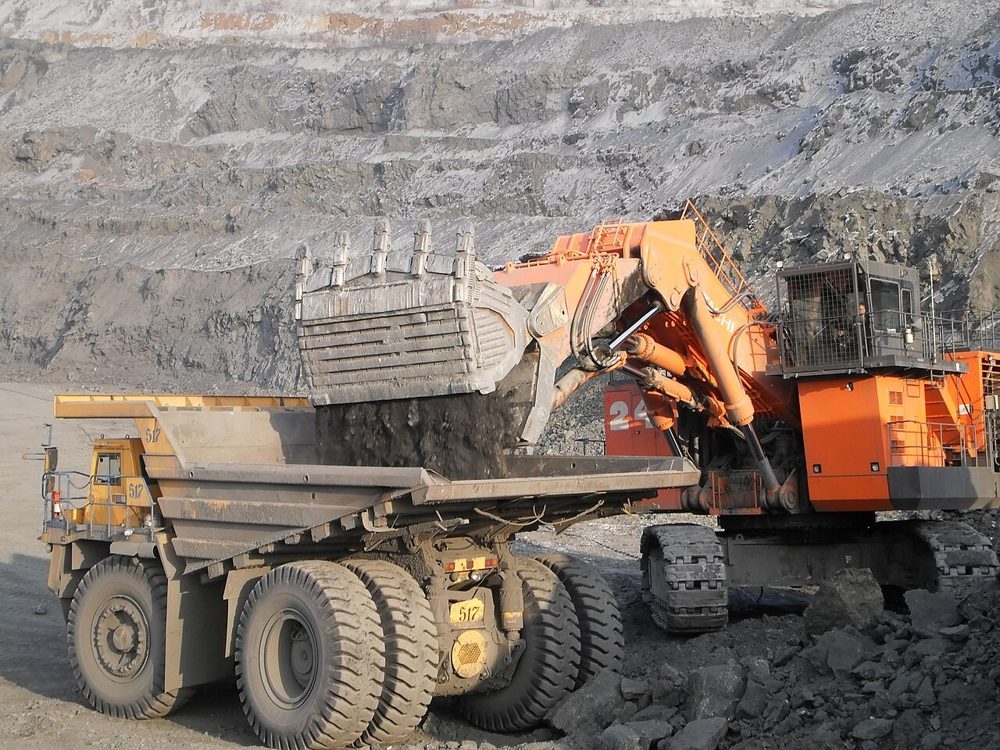 Hitachi Construction Machinery
Image: A small Komatsu hydraulic excavator (PC138US) (CC BY 2.0) / A large Hitachi Construction Machinery mining excavator (Sandrerro, CC BY-SA 3.0), Wikimedia Commons. Neither photo shows the flagship models compared in this article (PC9000-12/EX8000) directly — both are representative examples from each company's lineup.


Company History: Komatsu's Mining-Company Roots, Hitachi Construction Machinery's Break from Its Parent
Komatsu traces back to 1917, when Takeuchi Mining — a copper-mine operator in Ishikawa Prefecture — opened the Komatsu Iron Works. In 1921 the ironworks split off from Takeuchi Mining as an independent company, Komatsu Ltd. It built its first commercial press in 1924 and Japan's first domestically produced agricultural tractor in 1931. In 1943 it produced the "Komatsu Type 1 Land Leveler," regarded as the prototype for Japan's domestic bulldozer, followed by the first "D50" bulldozer unit in 1947; from 1968 it entered hydraulic-excavator production and established itself as a full-line construction-machinery maker. In 2017 it acquired U.S. mining-equipment maker Joy Global, sharply strengthening its position in mining machinery.
Hitachi Construction Machinery started life as a division of Hitachi, Ltd. Hitachi spun off an aftersales-service company in 1955, a sales company (the original Hitachi Construction Machinery) in 1965, and a manufacturing company (Hitachi Construction Machinery Manufacturing) in 1969, then merged the sales and manufacturing arms in October 1970 to form the unified, present-day Hitachi Construction Machinery. It grew as part of the Hitachi group for 55 years, but in 2022 moved from being Hitachi's consolidated subsidiary to an equity-method affiliate, and Hitachi sold additional shares in November 2025 — a steady march toward capital independence that culminates in the company-name change discussed below (April 2027).
Comparing Company Scale: Five-Year Trend
Looking at the trend over the last five fiscal years (FY2022/3 through FY2026/3) rather than a single snapshot makes the two companies' different growth patterns much clearer.
| Fiscal Year | Komatsu Revenue | Komatsu Operating Profit | Hitachi CM Revenue | Hitachi CM Operating Profit |
|---|---|---|---|---|
| FY2022/3 | ¥2.8023 trillion | ¥317.0 billion | ¥1.0249 trillion | ¥106.6 billion |
| FY2023/3 | ¥3.5435 trillion | ¥490.7 billion | ¥1.2649 trillion | ¥135.7 billion |
| FY2024/3 | ¥3.8651 trillion | ¥607.2 billion | ¥1.4059 trillion (record) | ¥162.7 billion (record) |
| FY2025/3 | ¥4.1044 trillion | ¥657.1 billion (peak) | ¥1.3712 trillion (down) | ¥154.7 billion (down) |
| FY2026/3 | ¥4.1327 trillion | ¥567.3 billion (down) | ¥1.4054 trillion (recovered) | ¥130.1 billion (still falling) |
| Metric | Komatsu | Hitachi Construction Machinery |
|---|---|---|
| Employees | 66,697 (non-consolidated) | 5,800 (non-consolidated) / ~26,200 (consolidated, as of March 2024) |
| Domestic market share | #1 | #2 (globally, in the group behind Caterpillar and Komatsu) |
Komatsu grew revenue for five consecutive years, roughly 1.5x from FY2022/3 to FY2026/3. Hitachi Construction Machinery hit record revenue and profit in FY2024/3, then swung to falling revenue and profit in FY2025/3 as demand softened across its core European, North American, and Asian markets; by FY2026/3, revenue had recovered to near-record levels, but operating profit kept falling for a fourth straight period. Revenue bouncing back while margins haven't is exactly the asymmetric recovery behind the sweeping restructuring — LANDCROS — discussed below.
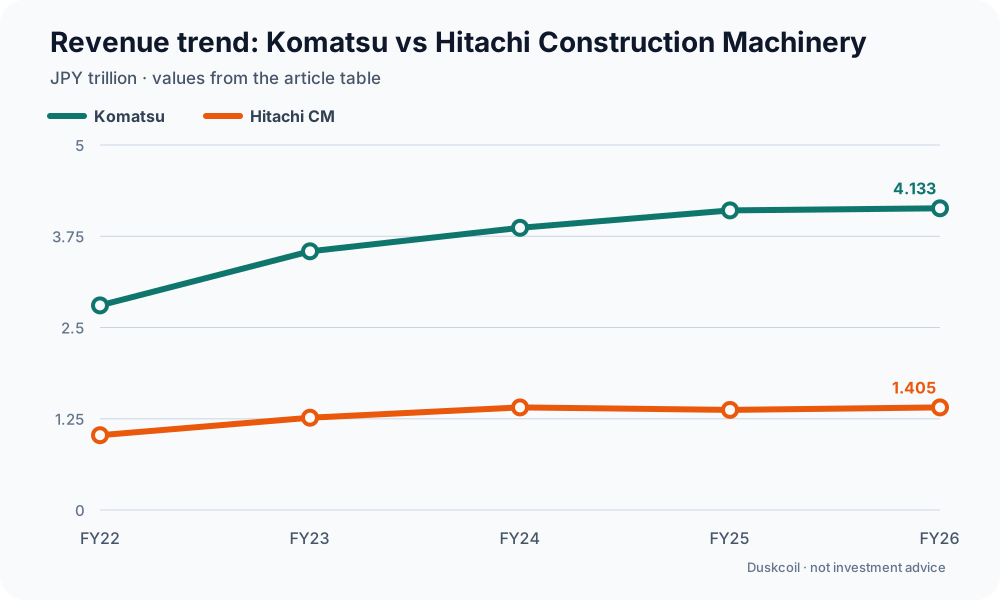
Diagram: Duskcoil. Revenue values in the article table, converted to JPY trillions. This diagram is not investment advice.
Comparing Flagship Products: Ultra-Large Mining Excavators
The clearest showcase of a construction-machinery maker's engineering is its ultra-large excavator lineup for mining. Both companies build machines in the hundreds-of-tonnes class.
| Item | Komatsu PC9000-12 | Hitachi Construction Machinery EX8000 |
|---|---|---|
| Operating weight | ~896 t (backhoe configuration) / 884 t (front-shovel configuration) | ~800–811 t |
| Bucket capacity | 49 m³ (backhoe) / 46 m³ (front shovel) | 40 m³ |
| Engine output | Twin 1,678 kW-class engines, 3,356 kW combined (~4,500 hp) | (public specs are mostly presented per individual model rather than a single flagship figure) |
| Notable feature | The flagship of Komatsu's PC series — the largest in bucket capacity, reach, and digging force in the lineup | Among the heaviest operating weights in the world for this class; body length ~12 m and height 9.9 m, comparable to a 3-story building |
Komatsu's PC9000-12, with its twin-engine setup delivering a combined 3,356 kW, also outguns Hitachi's EX8000 on bucket capacity. Hitachi, on the other hand, fields a broad lineup of ultra-large excavators from the 800-t-class EX8000 down to the 190-t-class EX1900, letting a site choose a model to match its rock hardness or the size of the haul trucks it's loading.
Wheel Loaders: Where the Two Lineups Collide Head-On
More than the ultra-large excavators, wheel loaders are where the two companies' products go directly up against each other.
| Item | Komatsu WA480-11 | Hitachi CM ZW310-6 |
|---|---|---|
| Operating weight | 27,845 kg | 23,760 kg |
| Bucket capacity | 4.9 m³ | 4.2 m³ |
| Engine | New "DBA127" engine; rated output +21% over the previous model | Cummins QSL9; net max output 203 kW |
| Top speed | (not publicly specified) | 35.9 km/h |
Komatsu's WA480-11 is a brand-new model launched in December 2025, built around its new engine's higher output as the headline feature. Hitachi's ZW310-6 runs a U.S.-made Cummins engine and carries a 375 L fuel tank plus a 35 L urea (DEF) tank for long-duration operation. Komatsu edges ahead on both operating weight and bucket capacity, but this class sees frequent model changes from both makers — the lead has swapped back and forth on a multi-year cycle.
Bulldozers: Komatsu's Uncontested Category
Bulldozers, by contrast, are a category Hitachi Construction Machinery doesn't compete in at all. Komatsu's flagship D475A-8R is an ultra-large bulldozer with an operating weight of 112.1 t and an overall length of 11.3 m, deployed for large-scale grading and excavation at mine sites. Hitachi Construction Machinery builds hydraulic excavators, wheel loaders, and dump trucks, but has never historically fielded a bulldozer product line — a clean illustration that these two companies can't be compared head-to-head across every category.
Electrification: Two Different Battery Philosophies
Both companies are electrifying their compact machines, but with different approaches. Komatsu's PC33E-6 (a 3-tonne-class electric mini excavator) carries a 35 kWh lithium-ion battery and is designed around a dedicated fast charger; it launched in Japan in October 2023. Hitachi Construction Machinery sells three models domestically — the ZX55U-6EB (5-t class), ZE85 (8-t class), and ZE135 (13-t class) — whose defining feature is that battery power and cable power (direct connection to commercial mains) can be combined depending on site conditions. Its charging infrastructure follows the same modular logic: a portable charging system built from a main unit, sub unit, and fast-charge unit that can be combined freely, with the fast-charge unit cutting charging time roughly in half. Where Komatsu is pursuing pure battery-only operation, Hitachi Construction Machinery is designing the charging infrastructure itself as something you bring to the job site.
A Difference in Technology Strategy: Komatsu's "Plane," Hitachi's "Point"
The two companies' technology strategies diverge in a clear way.
Komatsu takes a "plane" strategy under the banner of "Smart Construction," delivering everything end to end — ICT-equipped machines, drone surveying, construction-management software. The signature example is its Autonomous Haulage System (AHS) for mining dump trucks: commercially deployed for the first time in the world in 2008, it's now running 24/7 across six countries, with cumulative hauled volume topping 11.5 billion tonnes. In April 2026, Komatsu announced that its cumulative deployment of ultra-large autonomous mining trucks had reached 1,000 units — a world first. Published figures put the cost savings versus human-operated trucks at over 15%, with a 40% improvement in tire life from reduced hard acceleration and hard steering. Komatsu has also partnered with Toyota to automate the light vehicles that share the AHS site.
Hitachi Construction Machinery takes a "point" strategy, focused on strengthening the excavator itself. Representative examples include "Solution Linkage MG," which retrofits 3D machine guidance onto existing machines, and "ConSite," which combines maintenance and inspection data with AI to detect signs of failure — reportedly reaching a 90% detection rate for predicting faults before they occur. Rather than covering its entire process end to end, the strategy is to sharpen individual capabilities into something that can also extend to other companies' products — one that keeps an eye on tying into "Lumada," the IoT platform of parent company Hitachi, Ltd.
Development & Manufacturing Facilities
Beyond its Tokyo headquarters, Komatsu operates 12 production and technology facilities in Japan; Hitachi Construction Machinery operates 6 production facilities beyond its own Tokyo headquarters. The map below plots every domestic facility we could confirm (overseas facilities are out of scope).
Sources: Komatsu's official "Locations" page (addresses and functions are primary-source). For Hitachi Construction Machinery, plant names come from its official "Office List," but addresses were individually confirmed via map/directory services (NAVITIME etc.) since the detailed functional role of each plant — beyond Tsuchiura's status as the "mother plant" — is not publicly disclosed. Coordinates were geocoded to town/block level via OpenStreetMap Nominatim.
Strategy & Outlook: Komatsu's "Expand and Balance," Hitachi Construction Machinery's Name-on-the-Line Reinvention
In April 2025, Komatsu launched its new three-year mid-term management plan for FY2025–2027, "Driving Value with Ambition." Building on the prior plan, "DANTOTSU Value," it sets three pillars — "co-creating value through innovation," "pursuing growth and profitability," and "reforming the management foundation" — and targets a cumulative ¥1 trillion in free cash flow over three years, driven by investment in automation, electrification, and DX plus expansion into growth regions like Asia and Africa. The AHS fleet reaching 1,000 units (noted above) and the rollout of electric mini excavators both read as early moves that anticipate this plan's direction.
Hitachi Construction Machinery went further. Its FY2025–2028 mid-term plan, "LANDCROS 2028," commits ¥500 billion in growth investment over three years with a goal of reaching the global top 3 by 2030 — and in 2025 the company announced that it will change its corporate name to LANDCROS Corporation on April 1, 2027. The new brand name "LANDCROS" is a coinage combining LAND with Customer, Reliable, Open, and Solutions, signaling a shift from selling standalone hydraulic excavators to becoming a provider of AI- and digital-technology-driven solutions. The renaming lines up with the capital shift described above — Hitachi, Ltd. moved Hitachi Construction Machinery from consolidated subsidiary to equity-method affiliate in 2022 and sold further shares in November 2025 — marking the moment the company steps out from under the 75-year-old "Hitachi" name to assert its independence. As the FY2026/3 results show — revenue recovered, but margins haven't — this name change isn't just a branding exercise for Hitachi Construction Machinery; it's the banner over an effort to rebuild the underlying profit structure itself.
References
- Komatsu Official Site / Investor Relations
- Hitachi Construction Machinery Official Site / Large Excavator Series
- Komatsu AHS (Autonomous Haulage System) News Release
- Hitachi Construction Machinery ConSite AI News Release
- Komatsu Locations by Region
- Hitachi Construction Machinery Japan Office List
- Komatsu History (recruiting site)
- Hitachi Construction Machinery timeline - The-Shashi
- IRBANK: Komatsu financial results / IRBANK: Hitachi Construction Machinery financial results
- Komatsu mid-term plan "Driving value with ambition" (Komatsu Report 2025)
- Hitachi Construction Machinery's rename to "LANDCROS" — special site
- Nikkei: Hitachi Construction Machinery to rename itself "LANDCROS" from April 2027
- Komatsu WA480-11 (wheel loader) launch news
- Hitachi Construction Machinery: three battery-electric excavator models launch news
- Nikkei: Komatsu launches electric mini excavator PC33E-6
Current step · 13 / 21 · Corporate Research
Comments
Please log in to post a comment
No comments yet.