Contents — find the section you need
Background and reading guide
Background No specialist background required; check the reporting period and scope of financial measures.
Industry research · Read the sources, reporting period and comparison criteria together.
The automobile industry is a foundational manufacturing sector with an enormous supplier base, and it's in the middle of a once-in-a-century technology shift toward electrification and autonomous driving. Toyota, Honda, and Nissan diverge sharply in company scale, and are racing to commercialize solid-state batteries, each with a different technical approach.
 Toyota
 Honda
HondaImage: Toyota logo / Honda logo (both public domain; trademark rights still apply separately), Wikimedia Commons. No Nissan logo meeting Commons' copyright threshold was found, so Nissan is covered in text only.


Company History: Diversifying From Looms, an Independent Motorcycle Repairman, and the Datsun Lineage
All three companies trace back to the prewar era, but by very different routes. Toyota's starting point is 1933, when Kiichiro Toyoda — whose father, Sakichi Toyoda, had built the family's loom business — set up an automobile department inside Toyoda Automatic Loom Works and began disassembling imported Chevrolets to study them. On August 28, 1937, that automobile department was spun off as an independent company, Toyota Motor Corporation (Toyota Motor Co., Ltd. at the time), and the company's founding anniversary was later set as November 3, 1938, the completion date of the Koromo Plant (now the Honsha Plant). Toyota's starting point was entering the automobile business on the back of the production expertise and capital built up in the loom business.
Honda (Honda Motor Co.) traces back to Soichiro Honda, born into a blacksmith's family, opening an auto-repair shop called "Art Shokai Hamamatsu Branch" in Hamamatsu in 1928. After transferring Tokai Seiki Heavy Industry (a piston-ring maker he had founded in 1937) to the Toyota side shortly after the war, he founded the Honda Technical Research Institute as a sole proprietorship in October 1946, restarting the business by making and selling bicycle auxiliary engines converted from surplus wartime radio generator engines, then establishing Honda Motor Co., Ltd. on September 24, 1948. In 1949 the company launched its first complete vehicle, the "Dream D-Type," marking its shift from an engine-only maker to a complete-vehicle manufacturer.
Nissan's lineage is the most tangled of the three. One of its roots is Kwaishinsha Motor Car Works, founded by Masujiro Hashimoto in 1911. Kwaishinsha developed a car it named "DAT" (an acronym of its three investors' surname initials — Ta, Aoyama, and Takeuchi), but ran into financial trouble, and the business passed to its successor, DAT Motor Manufacturing. Yoshisuke Aikawa, who led the Nissan zaibatsu, saw an opportunity to scale up production of the resulting "Datsun," and in December 1933 established "Jidosha Seizo Co., Ltd." in Yokohama, Kanagawa Prefecture, to acquire the manufacturing rights; the company was renamed "Nissan Motor Co., Ltd." in 1934 — the company's direct starting point. Comparing the three: Toyota diversified out of an existing business (looms), Honda was founded by an individual engineer, and Nissan emerged from the consolidation of multiple companies — three distinct paths to formation.
Comparing Company Scale: Five-Year Trend
Looking at the trend over the last five fiscal years (FY2022/3 through FY2026/3, all three companies sharing a March fiscal year-end) rather than a single snapshot makes the divergence among the three companies far clearer.
| Fiscal Year | Toyota Revenue | Toyota Operating Profit | Honda Revenue | Honda Operating Profit | Nissan Revenue | Nissan Operating Profit |
|---|---|---|---|---|---|---|
| FY2022/3 | ¥31.3795 trillion | ¥2.9956 trillion | ¥14.5526 trillion | ¥871.2 billion | ¥8.4245 trillion | ¥247.3 billion |
| FY2023/3 | ¥37.1542 trillion | ¥2.725 trillion | ¥16.9077 trillion | ¥780.8 billion | ¥10.5966 trillion | ¥377.1 billion |
| FY2024/3 | ¥45.0953 trillion | ¥5.3529 trillion (record) | ¥20.4288 trillion | ¥1.3819 trillion | ¥12.6857 trillion | ¥568.7 billion (record) |
| FY2025/3 | ¥48.0367 trillion | ¥4.7955 trillion (down) | ¥21.6887 trillion | ¥1.2134 trillion | ¥12.6332 trillion | ¥69.8 billion (sharp drop) |
| FY2026/3 | ¥50.6849 trillion (record) | ¥3.7662 trillion (down for a 3rd straight year) | ¥21.7966 trillion | -¥414.3 billion (fell into a loss) | ¥12.0079 trillion | ¥58.0 billion (still weak) |
| Metric | Toyota | Honda | Nissan |
|---|---|---|---|
| Consolidated employees (FY2026/3) | 390,927 | 195,109 | 120,079 (down 12,711 YoY amid large-scale restructuring) |
| Notable | First Japanese company ever to top ¥50 trillion in revenue; operating profit down for a 3rd straight year | Fell into an operating loss after booking charges tied to its EV strategy review | Large net loss for a 2nd consecutive year; consolidating 17 plants down to 10 |
Toyota grew revenue every year across the five-year span, and its operating profit hit a record ¥5.3529 trillion in FY2024/3, but has since fallen for three straight years — partly due to U.S. tariffs, which alone cut roughly ¥1.4 trillion from FY2026/3's operating profit. Even so, its scale kept expanding, and in FY2026/3 it became the first Japanese company ever to top ¥50 trillion in revenue. Honda topped ¥1 trillion in operating profit in FY2024/3, but booked charges tied to a review of its EV strategy (publicly stated at up to ¥2.5 trillion) in FY2026/3, pushing it into an operating loss of ¥414.3 billion. Nissan hit a record ¥568.7 billion in FY2024/3, then plunged nearly 90% to ¥69.8 billion in FY2025/3, and remained weak at ¥58.0 billion in FY2026/3. All three companies share a common pattern of peaking in FY2024/3 and deteriorating since, but the source of the deterioration differs for each: an external factor (tariffs) for Toyota, a miscalculated EV strategy for Honda, and more structural issues — weak sales and eroding cost competitiveness — for Nissan.
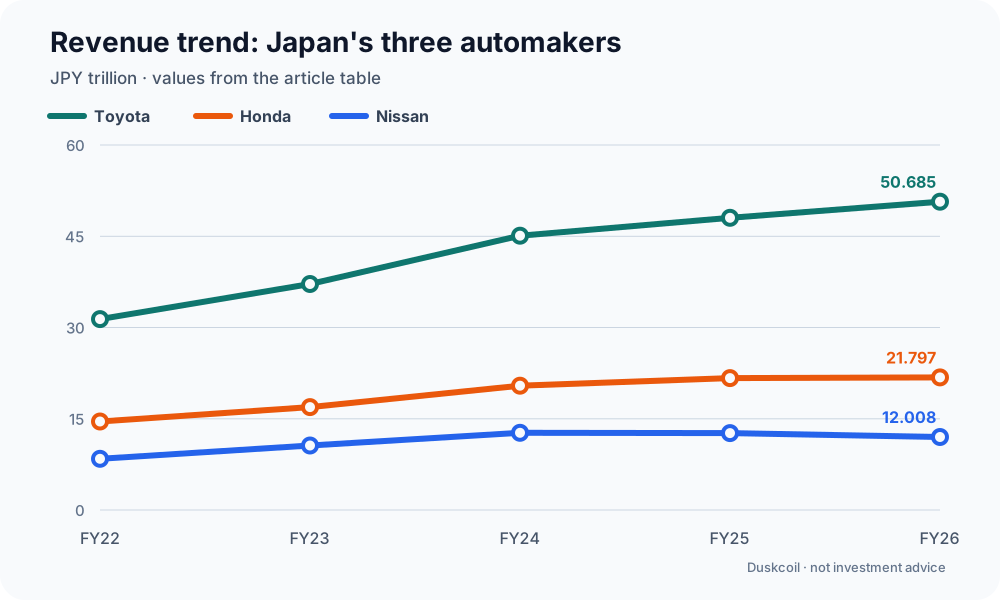
Diagram: Duskcoil. Revenue values in the article table, converted to JPY trillions. This diagram is not investment advice.
Comparing Flagship Businesses: Production-Network Restructuring and Divergent EV Strategies
Behind FY2026/3's divergent results lie real differences in each company's production footprint and electrification strategy.
| Item | Toyota | Honda | Nissan |
|---|---|---|---|
| Direction of domestic production | Maintaining its network around Toyota City and Tahara plus Tohoku, while pushing its transformation into a "mobility company" | Already consolidated into a 3-site structure (Yorii, Suzuka, Yokkaichi) after closing its Saitama Sayama plant in 2024 | Consolidating 17 global plants down to 10 under the "Re:Nissan" plan; the Oppama plant is scheduled to end vehicle production by the end of FY2027/3 |
| Current state of EV/electrification strategy | Continuing an "all-powertrain" strategy selling HEVs, BEVs, FCEVs, and PHEVs side by side; electrified-vehicle sales exceed 5 million units a year | Announced in March 2026 that it was canceling development and launch of 3 North America-bound BEV models (Honda 0 SUV/Saloon, Acura RSX); scaling back EV investment to refocus on HEVs | Even mid-restructuring, keeps developing a next-generation EV platform and solid-state batteries; e-POWER covers near-term hybrid demand |
| Defining moment | Became the first Japanese company ever to top ¥50 trillion in revenue in FY2026/3 | Disclosed up to ¥2.5 trillion in EV-related charges in March 2026 | Announced the "Re:Nissan" restructuring plan — including 7 plant closures and roughly 20,000 job cuts — in May 2025 |
Toyota has refused to bet on a single electrified powertrain, instead selling HEVs, BEVs, FCEVs, and PHEVs side by side depending on regional demand — an "all-powertrain" strategy that pushed annual electrified-vehicle sales past 5 million units in FY2026/3. Honda, by contrast, canceled development and launch of three BEV models it had planned for North America, pivoting to prioritize strengthening next-generation hybrids and rebuilding cost competitiveness. Nissan, in the middle of its own restructuring, has kept development resources for the solid-state batteries and next-generation EV platform discussed below, while securing near-term earnings mainly through "e-POWER" hybrids — a pragmatic choice aimed at survival. On production-network restructuring specifically, Honda has already finished consolidating into its 3-site structure, while Nissan is still in the middle of a much larger overhaul involving 7 plant closures — a large gap in how far each company's restructuring has progressed.
The Solid-State Battery Race: Three Companies, Three Approaches
To move past the limits of today's lithium-ion batteries — driving range, charging time, and safety — all three companies are racing to commercialize solid-state batteries, which replace the liquid electrolyte with a solid one, each taking a distinct technical approach.
Toyota has officially stated a plan to bring solid-state-battery EVs to market in 2027-2028, the earliest commercialization timeline of the three. It's leaning on years of accumulated battery-materials and production expertise as it works toward mass production.
Nissan is pursuing an in-house solid-state battery with a target commercialization date of fiscal year 2028. It's accelerating development on a pilot production line at its Yokohama plant, and announced in April 2026 that it had completed performance verification on battery cells scaled up to a 23-layer structure sized for actual vehicle installation. Even in the middle of a corporate restructuring, Nissan has kept development resources committed to next-generation battery technology.
Honda is also pursuing an in-house development path, with a distinctive technical wrinkle: it uses a proprietary "roll-press method" to densify the solid electrolyte, aiming to improve both production efficiency and the adhesion at electrode interfaces at the same time. Targeting a late-2020s market launch, Honda has invested roughly ¥43 billion and built a pilot production line for solid-state batteries in Sakura, Tochigi Prefecture, where it began demonstration production in 2025.
Separately, Nissan continues to refine its hybrid technology as well: its third-generation "e-POWER" (rolling out from 2025) integrates five core components — motor, inverter, reduction gear, generator, and step-up gear — into a single modular unit, aiming for lighter weight, a smaller footprint, and higher rigidity.
The three companies' financial results diverged sharply, but on the long-term technology race for next-generation batteries, none of them has slowed down regardless of financial strain. That's the underlying technical resilience of the Japanese auto industry as a whole.
Development & Manufacturing Facilities
Toyota centers its production around a network in and near Toyota City, Aichi Prefecture, extending north to Tohoku (Toyota Motor East Japan); Honda has consolidated into a 3-site structure across Saitama and Mie following its 2024 closure of the Sayama plant; and Nissan is restructuring its Yokohama headquarters function and nationwide plant network under its recovery plan. The map below plots every major domestic headquarters and plant we could confirm (overseas facilities and every affiliated-company plant are out of scope).
Sources: facility names from Toyota, Honda, and Nissan's respective official "facilities"/"plants" pages; addresses were primary-source where confirmable on each company's own site, and individually confirmed via map/directory services (NAVITIME, Yahoo! Maps, Mapion Phonebook, etc.) where not (noted here honestly). Coordinates were geocoded to town/block level via OpenStreetMap Nominatim (a town/block-level address could not be confirmed for Honda's Ogawa engine plant, so that pin is plotted at a representative point for Ogawa Town). Nissan's Oppama plant has been publicly announced to end vehicle production by the end of FY2027/3.
Strategy & Outlook: Toyota's "Mobility Company," Honda's EV Course Correction, and Nissan's Restructuring
From late 2024 into early 2025, Honda and Nissan held talks toward a business integration, but on February 13, 2025, both companies formally announced they were ending the discussion. Mitsubishi Motors' lukewarm interest in joining and differences in corporate culture between the two are both cited as factors. Collaboration on the software and ECUs (electronic control units) that will serve as the brains of next-generation vehicles has continued even after the deal collapsed, but any restructuring involving actual capital integration has, for now, been shelved.
Toyota is pursuing a company-wide transformation into a "mobility company," organized around three approaches: electrification, intelligence, and diversification. It plans to launch 10 new BEV models by 2026, targeting annual sales of 1.5 million units, and is expanding beyond the auto business itself — including an agreement to form a new joint venture with Panasonic. Building on FY2026/3 results that made it the first Japanese company ever to top ¥50 trillion in revenue, Toyota is pursuing scale expansion and business diversification simultaneously, even against the headwind of U.S. tariffs.
Honda announced on March 12, 2026, that a review of its four-wheel electrification strategy could produce charges of up to ¥2.5 trillion, and decided to cancel development and launch of three BEV models planned for North America (the Honda 0 SUV, Honda 0 Saloon, and Acura RSX). President Toshihiro Mibe personally acknowledged the strategic miscalculation, saying the company "didn't have multiple scenarios," and gave up part of his own compensation. Going forward, Honda has shifted to rolling out EVs on a longer time horizon guided by demand and profitability, and for now is focused on improving its four-wheel business's profitability by expanding its next-generation hybrid lineup and rebuilding cost competitiveness.
Nissan's "The Arc" management plan, announced in March 2024 (covering FY2024-2026, targeting 1 million more units sold versus FY2023 and an operating margin above 6% by FY2026), now looks set to fall short, and the company has rolled out a more aggressive restructuring plan, "Re:Nissan." It calls for consolidating 17 global plants down to 10, cutting production capacity by 1 million units from FY2024 levels to hold capacity at roughly 2.5 million units by FY2027; domestically, the closures of the Oppama and Shonan plants have already been decided. Under this plan — built around "efficiency over expansion, profit over volume" — roughly 20,000 job cuts are also underway, while Nissan keeps investing in next-generation technology, including the solid-state battery work noted above, even as rebuilding its near-term profit structure remains the top priority.
What all three companies share is that they're all confronting the same technology trend — electrification — but from wildly different financial positions and on wildly different timelines. Toyota's all-powertrain strategy leverages its scale advantage; Honda is course-correcting from an EV shift that went too far, too fast; and Nissan is undertaking structural reform for its very survival. In 2026, Japan's auto industry is a story of the electrification race and each company's differing financial resilience playing out at the same time.
References
- Toyota Official Site / Investor Relations
- Honda Official Site / IR Library
- Nissan Official Site / Investor Relations
- 2026 Comparison of Japan's Three Automakers: Toyota Tops ¥50 Trillion, Honda Struggles With EVs, Nissan Fights for a Comeback (Japanese)
- Toyota's FY2026/3 Full-Year Results: Revenue Up, Profit Down at ¥3.7662 Trillion Operating Profit (Japanese)
- When Will Solid-State Batteries Arrive? Toyota, Nissan, and Honda's Latest Roadmaps (Japanese)
- A Deep Dive Into Nissan's e-POWER (Japanese)
- Toyota 75-Year History: The Founding of Toyota Motor Co., Ltd. and the Construction of the Koromo Plant (Japanese)
- Honda Corporate Site, 75-Year History, Chapter 1: The Founding and Pioneering Era (Japanese)
- Nissan's Pre-History and the 1930s | Nissan Corporate Site (Japanese)
- IRBANK: Toyota financial results / IRBANK: Honda financial results / IRBANK: Nissan financial results
- Nikkei: Honda and Nissan end integration talks, unable to agree on merger ratio (Japanese)
- Why Honda, having had Nissan turn down the merger, still wants to collaborate on SDVs - JBpress (Japanese)
- Toyota accelerates its transformation into a "mobility company": President Sato on Toyota's future (Japanese)
- Honda: charges from the review of its four-wheel electrification strategy and revised full-year consolidated forecast and future direction (Japanese)
- Bloomberg: Honda faces up to ¥2.5 trillion in losses as it revises its EV strategy — Mibe forgoes part of his compensation (Japanese)
- Nissan announces its "The Arc" management plan
- The "7 plants, 20,000 jobs" cut plan: Nissan's massive restructuring for a comeback - Toyo Keizai Online (Japanese)
- Toyota's domestic production facilities (official site) (Japanese)
- Honda: Saitama Factory, Yorii complete-vehicle plant (Japanese)
- Nissan Monozukuri (manufacturing) site: NISSAN PLANT (Japanese)
Current step · 11 / 21 · Corporate Research
Comments
Please log in to post a comment
No comments yet.