Contents — find the section you need
Background and reading guide
Background No specialist background required; check the reporting period and scope of financial measures.
Industry research · Read the sources, reporting period and comparison criteria together.
Machine tools are the "mother machine" — the equipment that cuts and shapes metal and other materials into parts — underpinning nearly every branch of manufacturing, from automobiles to aircraft to semiconductor equipment. Of Japan's three major makers — DMG Mori, Okuma, and Yamazaki Mazak — only Yamazaki Mazak is privately held and discloses no financial information; what follows weighs all three against that gap in disclosure. As it happens, Okuma and Yamazaki Mazak are also literal neighbors — both headquartered in the same town, Oguchi, Niwa District, Aichi Prefecture.
 DMG Mori
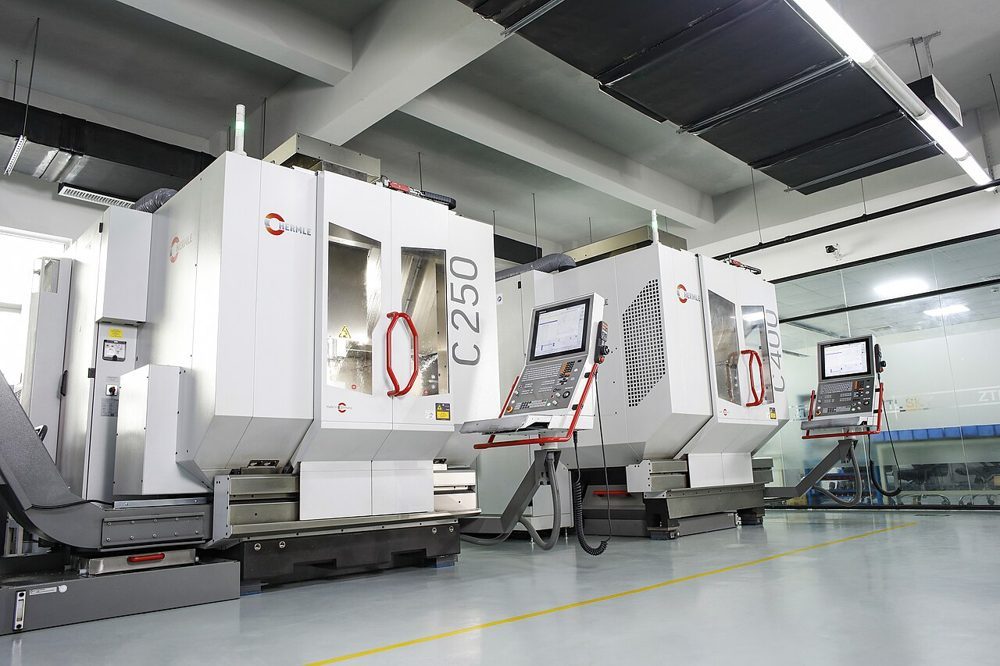 A 5-axis machining center (reference example)
Image: DMG Mori logo (public domain; trademark rights still apply separately) / A 5-axis machining center (Jokkx, CC BY-SA 4.0), Wikimedia Commons. The photo on the right is a machine made by Germany's Hermle — a generic illustration of a 5-axis machining center, not a product of any of the three companies covered in this article.


Company History: A Textile-Machinery Maker, a Noodle-Machine Shop, and a Tatami-Loom Workshop — All Three Started Somewhere Else Entirely
All three companies share something in common: none of them started out in machine tools.
DMG Mori's roots trace back to 1948, when it began manufacturing and selling textile machinery in Yamatokoriyama, Nara Prefecture. It pivoted to become a machine-tool maker in 1958 by shifting focus to high-speed precision lathes, brought its Iga plant online in 1970, and broadened its business in step with the era's push toward numerical control (NC) and multi-tasking machining. It relocated its head-office functions to Nagoya in 2004; formed a capital and business alliance with Germany's GILDEMEISTER AG (today's DMG MORI AG) in 2009; renamed itself DMG Mori in 2013 after a phased share acquisition; and consolidated Germany's DMG MORI AG as a subsidiary in 2015, unifying its Japanese, German, and European machine-tool businesses under a single management structure.
Okuma started life in 1898 in Nagoya, when Eiichi Okuma, a former police officer, founded Okuma Noodle Machine Company to manufacture and sell noodle-making machines. It moved into machine-tool manufacturing in 1904, renamed itself Okuma Iron Works in 1916, and incorporated as a stock company in 1918. From 1963, it began developing its own CNC (computer numerical control) system in-house — the technology that would become the origin of "OSP," its single biggest differentiator today. It took its current name, Okuma Corporation, in 1991.
Yamazaki Mazak was founded in 1919 in Nagoya, Aichi Prefecture, by Sadakichi Yamazaki as Yamazaki Iron Works, starting out making tatami-weaving machinery. It moved into lathes, milling machines, and other machine tools in 1927, and shifted its focus fully to machine-tool manufacturing from 1931. Manufacturing was temporarily banned by GHQ (the Allied occupation authority) after World War II, but Teruyuki Yamazaki, credited with reviving the family business, joined in 1946, and production resumed in 1959. In 1963 it became the first Japanese machine-tool maker to export to the U.S.; in 1974 it became the first Japanese maker to begin local production in the U.S., leading the industry's international expansion; and in 1987 it reportedly reached the world's top spot in machine-tool maker revenue, a position it is said to have held ever since.
Consolidated results: separate reporting periods and forecasts
Amounts are JPY million. Each row covers 12 months ending on the stated date. DMG MORI closes in December and Okuma in March; matching calendar-year labels do not represent identical reporting periods.
DMG MORI
| Year ended | Revenue | Operating profit | Basis |
|---|---|---|---|
| 2022-12-31 | 474771 | 41213 | Actual |
| 2023-12-31 | 539450 | 55356 | Actual |
| 2024-12-31 | 540945 | 43726 | Actual |
| 2025-12-31 | 514976 | 18974 | Actual |
| 2026-12-31 | 580000 | 30000 | Company forecast |
DMG MORI actuals use the ten-year financial data in Integrated Report 2025 (printed page 91). The 2026 forecast is the company outlook published on 2026-08-04, not an actual result.
Okuma
| Year ended | Revenue | Operating profit | Basis |
|---|---|---|---|
| 2022-03-31 | 172809 | 14462 | Actual |
| 2023-03-31 | 227636 | 24804 | Actual |
| 2024-03-31 | 227994 | 25364 | Actual |
| 2025-03-31 | 206822 | 14651 | Actual |
| 2026-03-31 | 235888 | 15505 | Actual |
For the year ended March 2026, Okuma reported revenue of JPY 235,888 million and operating profit of JPY 15,505 million, up 14.1% and 5.8%. Its operating margin was about 6.6% (operating profit / revenue): a sales recovery does not necessarily imply a margin improvement.
Comparable consolidated results for Yamazaki Mazak were not verified in this source review. We exclude it from the numerical comparison rather than estimate revenue from headcount.
Sources; checked 2026-10-01
- DMG MORI — Integrated Report 2025, p. 91
- DMG MORI — 2026-08-04
- Okuma — 2023-03-31
- Okuma — 2024-03-31
- Okuma — 2026-03-31
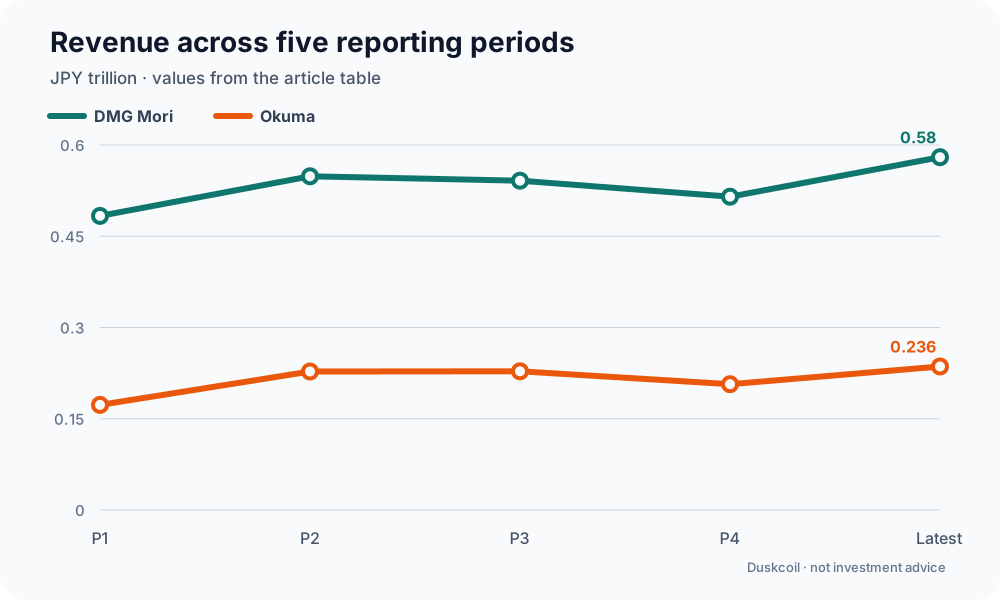
Revenue by company. Solid lines: actuals; dashed line: company forecast. Year-end dates are on the horizontal axis. Chart: JPY billion; tables: JPY million.
Comparing Flagship Products
CNC Systems: Okuma's In-House Development vs. Outside Suppliers at the Other Two
How each company sources its CNC — the "brain" of a machine tool — is a major dividing line among the three. Okuma has developed its CNC, "OSP," in-house continuously since 1963, making it one of the few makers that handles everything from the machine itself to the control system in-house. Its latest version, "OSP-P500," roughly doubles the computation speed of its predecessor and adds a "digital twin" capability that simulates the machining process in digital space, letting an operator check the machining sequence and estimate cycle time before ever running the physical machine. DMG Mori and Yamazaki Mazak, like most machine-tool makers, mainly source their CNC from outside suppliers such as FANUC or Siemens (DMG Mori layers its own "CELOS" operating system on top as a UI for the CNC) — a contrast that makes Okuma's degree of vertical integration stand out.
Comparing Multi-Tasking Machines and 5-Axis Machining Centers
| Item | DMG Mori (5-axis and multi-tasking machines) | Okuma (CNC lathe, LB-EX series) | Yamazaki Mazak (multi-tasking machine, INTEGREX series) |
|---|---|---|---|
| Flagship product / feature | 5-axis machining centers broadly, multi-tasking machines that mill and turn on one unit, the "ULTRASONIC" series adding ultrasonic-vibration machining | LB3000 EX III (single-saddle CNC lathe): 5,000 min⁻¹ spindle speed, 22 kW max output, 30 m/min rapid traverse (+20% over the previous model) | INTEGREX i series and INTEGREX j series and others; multi-tasking machines that combine turning, milling, gear cutting, and measurement in one unit, reportedly holding one of the world's largest shares in the category |
| Direction of strength | Versatility across a wide range of industries (automotive, mold-making, aerospace, semiconductors, medical devices) and automation (long, unattended runs) | High-rigidity gantry-bed structure and thermal-displacement compensation technology that keep dimensional accuracy stable through long runs; more than 18,000 units sold worldwide across the series | Consolidating turning, milling, gear cutting, and measurement into one process; handles everything from mass production to high-mix, low-volume production |
DMG Mori fields a broad lineup of 5-axis machining centers for automotive, mold-making, aerospace, semiconductor, and medical-device applications, and holds a strong global share. It's pushing technology in two directions at once — automation (workpiece loading and transport automated for long, unattended runs) and process consolidation — including its "ULTRASONIC" series, which adds ultrasonic vibration alongside cutting to achieve precision machining on hard-to-cut materials like ceramics and difficult alloys. Okuma's LB-EX series is a long-running brand dating back to the original LB15 launched in 1982, pursuing "high precision and energy efficiency" as an answer to shop-floor challenges like labor shortages, skills succession, and decarbonization. Yamazaki Mazak's INTEGREX series is said to hold one of the largest shares in multi-tasking machines that combine turning and milling on a single unit, and has evolved under a consistent philosophy of process consolidation — its AG series, for instance, folds gear cutting and measurement into the same machine as well.
Development & Manufacturing Facilities
Beyond its Nagoya headquarters (Nakamura Ward, Nagoya, Aichi Prefecture), DMG Mori operates its Iga plant (Iga, Mie Prefecture), the core of its machine-tool manufacturing, and its Nara plant (Yamatokoriyama, Nara Prefecture), dedicated to automation systems and expanded to four times its former size in 2025. Okuma is centered on its headquarters and main plant (Oguchi, Niwa District, Aichi Prefecture), with additional domestic plants in Konan, Aichi; Kani, Gifu; and Ota, Gunma (online since 2023). Yamazaki Mazak's headquarters and Oguchi Plant (Oguchi, Niwa District, Aichi Prefecture — the same town as Okuma's headquarters) is joined by its largest production site, the Minokamo Plant (Minokamo, Gifu Prefecture); the Inabe Plant (Inabe, Mie Prefecture), which builds large machines; and the Seiko Plant (Kuwana, Mie Prefecture), a components plant. The map below plots the major domestic facilities we could confirm (overseas facilities are out of scope).
Sources: the official facilities/production-site pages for DMG Mori, Okuma, and Yamazaki Mazak. For some sites (Okuma's Konan and Kani plants) only a town/block-level address could be confirmed, which was cross-checked via map/directory services (Mapion, NAVITIME, etc.). Coordinates were geocoded to town/block level via OpenStreetMap Nominatim.
Strategy & Outlook
At its August 2026 announcement, DMG Mori laid out a new mid-term business plan through FY2028, targeting orders of ¥700 billion, revenue of ¥680 billion, and EBIT of ¥68.5 billion — a new high surpassing its FY2023 peak. By industry, orders grew across a wide range of sectors excluding automotive — aerospace, defense, medical, data centers, power, energy, shipbuilding, mold-making — a clear sign that diversification away from automotive is now underpinning results. The company's president has also floated a longer-horizon target of ¥800 billion in revenue and ¥120 billion in operating profit (a 15% margin) by 2030, with a stated policy of growing its parts, MRO (maintenance, repair, and overhaul), and engineering businesses to roughly ¥200 billion in scale, beyond machine sales alone.
For the year ended March 2026, Okuma reported revenue of JPY 235,888 million and operating profit of JPY 15,505 million, up 14.1% and 5.8%. Its operating margin was about 6.6% (operating profit / revenue): a sales recovery does not necessarily imply a margin improvement.
Yamazaki Mazak, as a private company, doesn't publish numerical targets like a mid-term management plan, but under the banner of "Mazak iSMART Factory," it is networking its machine tools via IoT and using the resulting production data to improve uptime, reduce energy use, and pursue carbon neutrality. The company is also rolling out DX know-how tested in its own plants as smart-factory solutions for customers, and its large-machine production site in Inabe, Mie Prefecture, is understood to be an investment aimed at aircraft-parts demand. Financial information remains undisclosed, but the company's posture toward AI- and IoT-driven manufacturing DX points in the same direction as its two publicly listed peers.
The shared external backdrop for all three companies is a structural industry shift: softening demand tied to the automotive industry, offset by growing demand from non-automotive sectors like semiconductors, aerospace, and data centers. DMG Mori has explicitly framed its strategy around diversifying away from automotive, and Okuma's mid-term plan foregrounds creating new growth businesses — but how demand is shifting at privately held Yamazaki Mazak is something public information simply can't reveal. That information asymmetry is itself a clear illustration of how hard it is to compare an industry that includes a company that discloses almost nothing.
References
- DMG Mori Official Site / Financial Highlights (Japanese)
- Okuma Official Site / OSP-P500 Product Information (Japanese)
- Yamazaki Mazak Official Site
- DMG Mori's 5-Axis Machining Centers (Japanese)
- DMG Mori [JP:6141] Company History (finboard, Japanese)
- Okuma 120th Anniversary Site (Japanese)
- Yamazaki Mazak: Get to Know Mazak (careers site, Japanese)
- IRBANK: DMG Mori (6141) financial results (Japanese) / IRBANK: Okuma (6103) financial results (Japanese)
- MONOist: "Even With Its Shift Away From Automotive, DMG Mori Revises Results Upward Again, Targets Peak Profit in FY2028" (Japanese)
- Nikkan Kogyo Shimbun: "DMG Mori Announces New Mid-Term Performance Targets: ¥700 Billion in Orders for FY2028" (Japanese)
- xTECH: "DMG Mori's President: 'Reaching ¥800 Billion in Revenue Is No Problem'" (Japanese)
- Okuma Mid-Term Management Plan (IR Information, Japanese)
- kikai-news.net: "Okuma's FY2025 Revenue Up 14.1% to ¥235.9 Billion" (Japanese)
- Yamazaki Mazak: Mazak iSMART Factory (Japanese)
- MONOist: "Yamazaki Mazak and Cisco Take On Smart Factory Transformation" (Japanese)
- Yamazaki Mazak Inabe Plant Overview (Japanese)
- Newswitch: "Machine Tools Aim for the Sky — Yamazaki Mazak Builds a New Plant in Mie Prefecture" (Japanese)
Current step · 10 / 21 · Corporate Research
Comments
Please log in to post a comment
No comments yet.