Contents — find the section you need
Power engineering connects generation to delivery, voltage conversion and changing demand. This guide maps the site's detailed articles before you study individual machines.
Four connected parts
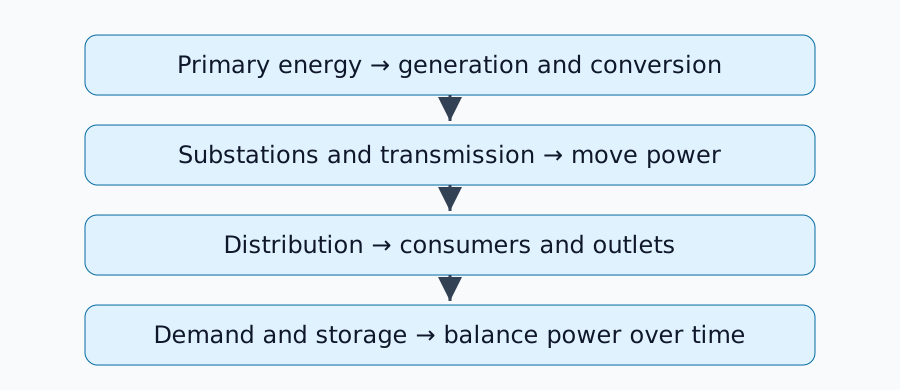
This is a learning sequence, not a claim that electricity always flows one way. Consumers with solar panels or storage may export power. The EIA grid overview explains the basic roles of generation, substations and delivery networks.
Distinguish kW from kWh
A constant 1 kW load operating for three hours uses 3 kWh. Power describes the instantaneous rate; energy accumulates that rate over time. A 10 kWh battery therefore does not necessarily deliver 10 kW. Read its power limit and usable energy separately.
For an illustrative battery with 3 kWh usable energy, a 1 kW load and 90% conversion efficiency, runtime is 3 imes0.9/1=2.7 hours. Temperature, aging, auxiliary loads and state-of-charge limits change this result. Keep these assumptions visible when continuing to battery fundamentals.
Read generation through energy conversion
Thermal and nuclear plants connect heat to rotation; hydro and wind use moving fluids; solar photovoltaics convert light to DC. Compare these with the generation overview. Separate the energy source from the machine that produces electricity.
Why transmit at higher voltage?
In a simplified DC model, P=VI and resistive loss is I^2R. At the same transmitted power and resistance, ten times the voltage gives one tenth the current and one hundredth the resistive loss. This proportional example excludes reactive power, insulation constraints and transformer losses; it is not a real transmission-loss percentage. Continue to substations and transmission.
Connect balancing and conversion
| Question | Read | Distinction to retain |
|---|---|---|
| How does DC become AC? | Inverters | Conversion versus generation |
| What happens when demand rises suddenly? | Grid inertia | Immediate response versus sustained supply |
| Can energy move into the night? | Pumped hydro and hydrogen | Power versus stored energy |
| How are many devices coordinated? | VPPs | Individual devices versus aggregate control |
Storage shifts energy through time with losses; it does not create an unlimited supply. The EIA storage explanation provides additional context.
Check your understanding
If a solar installation's rated power exceeds a home's peak load, can it operate the home all day without storage? The rating alone does not describe nighttime or weather variation. Return to the power-system overview and draw generation, lines, converters, loads and storage on one diagram.
Comments
Please log in to post a comment
No comments yet.