Contents — find the section you need
Background and reading guide
Background Voltage, current, power, energy and unit conversion.
Fundamentals · Explanations of principles, structure and trade-offs.
Look only at the instant electricity reaches an outlet and it just looks like "something with voltage." In reality, the generator at a power plant, the transformer that steps voltage up to hundreds of kV, transmission lines running hundreds of kilometers, distribution substations, and the inverter and battery in someone's home all have to balance out at that same instant. The shortest path to understanding power engineering isn't memorizing generation methods — hydro versus solar and so on — it's viewing generation, transmission, consumption, and control as one system coupled together, second by second.
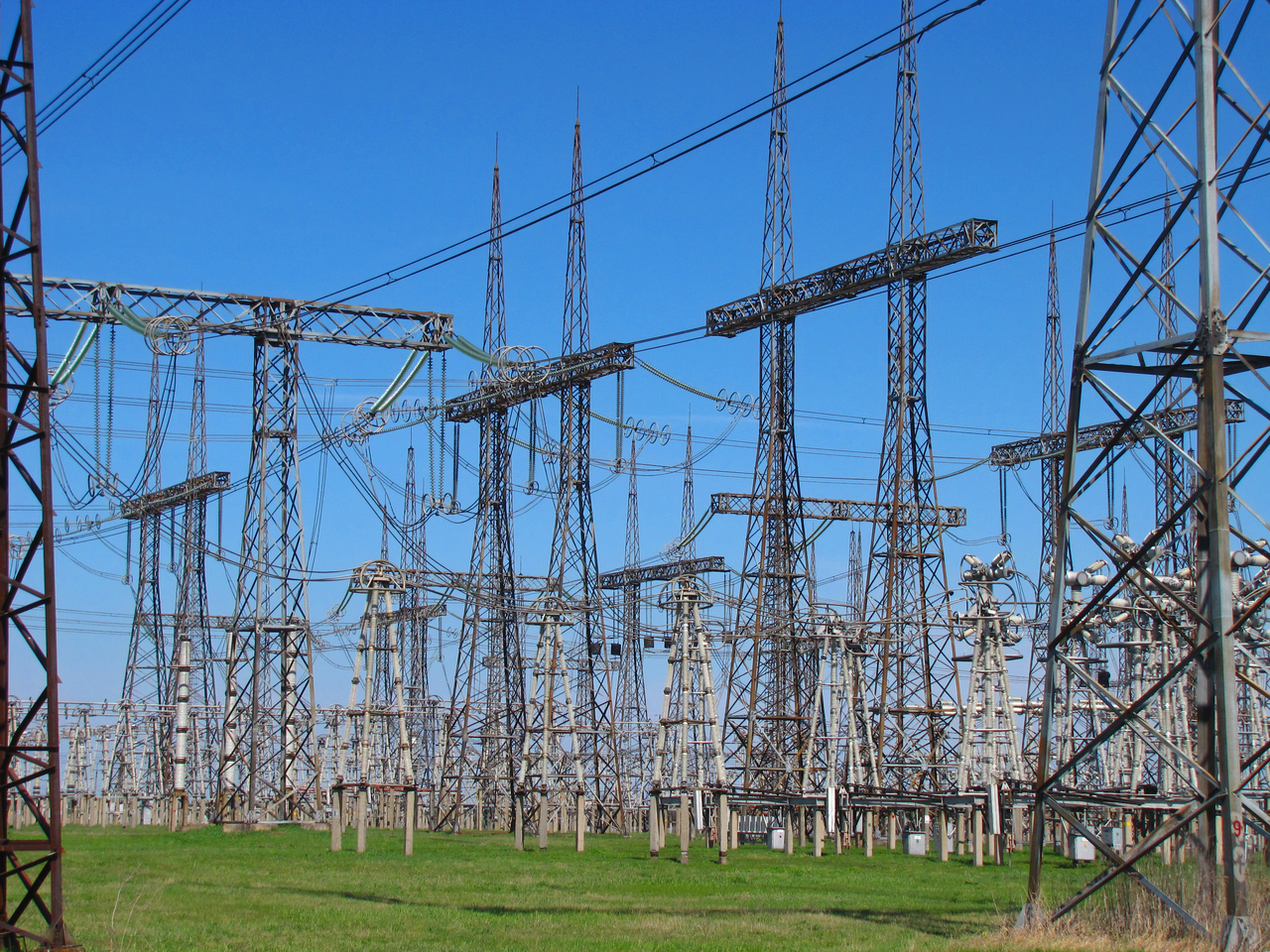 Substation example
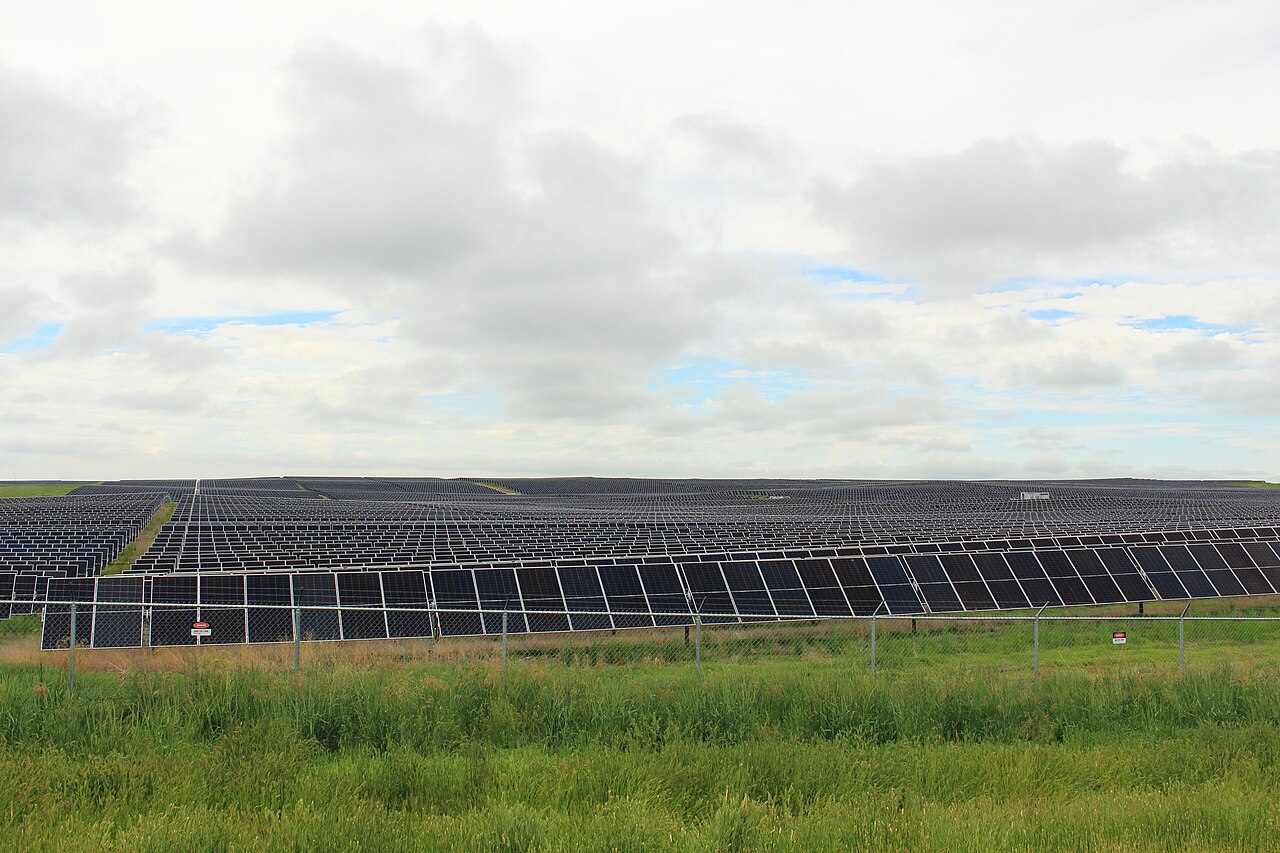 Solar generation example
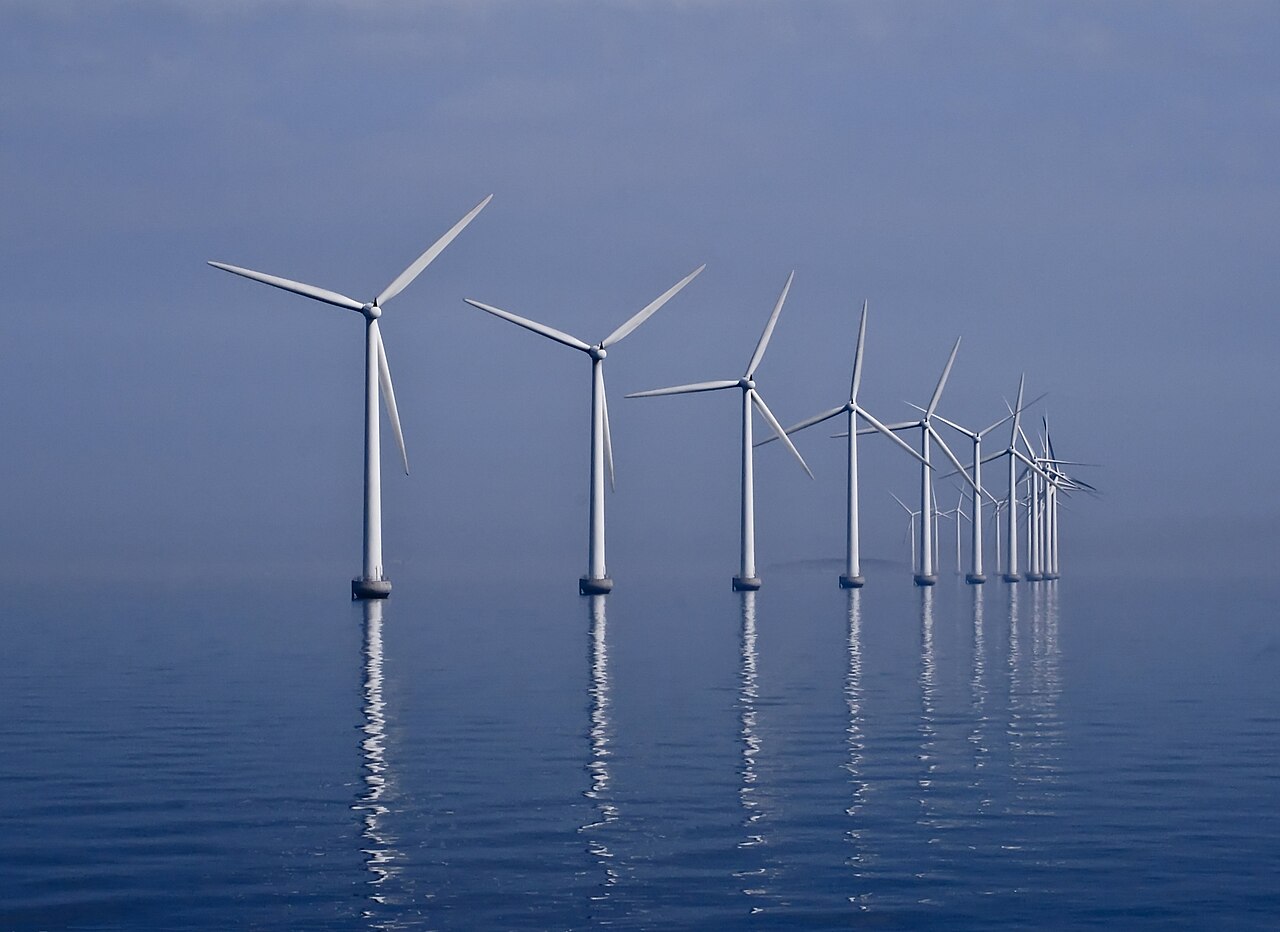 Offshore wind example
Images: Switchyard of electric substation 750kV (Novoklimov, CC BY 4.0), Travers Solar Farm (Kkiefuik, CC BY 4.0), and Middelgrunden wind farm (Kim Hansen / Richard Bartz, CC BY-SA 3.0), Wikimedia Commons. Facility examples, not one single connected grid.


0. The 30-second version
- On an AC grid, generator rotational speed sets the frequency. Japan's commercial grids split between 50 Hz and 60 Hz, and the gap between supply and demand shows up as frequency deviation.
- For a given transmitted power P, raising voltage V lowers current I=P/V, which cuts resistive loss P_{loss}=I^2R. That's why power is stepped up right after generation and stepped back down in stages near where it's consumed.
- Hydro, thermal, and nuclear tend to carry inertia and adjustability through synchronous generators. Solar and wind go through power converters instead, which makes forecasting, storage, and inverter control the keys to stability.
- A battery isn't "a stand-in for a power plant" — it's a device that converts between time scales, from sub-second frequency regulation to hour-scale peak shifting.
- Every generation method carries its own tradeoffs — cost, siting, fuel, environment, and behavior during a fault. No single source solves everything.
1. The big picture of a power system
Figure 1 shows the path electricity takes from power plant to home, along with the measurement and control signals running alongside it. Solid lines are energy flow; dashed lines represent information from SCADA (supervisory control and data acquisition), protection relays, and battery controllers.
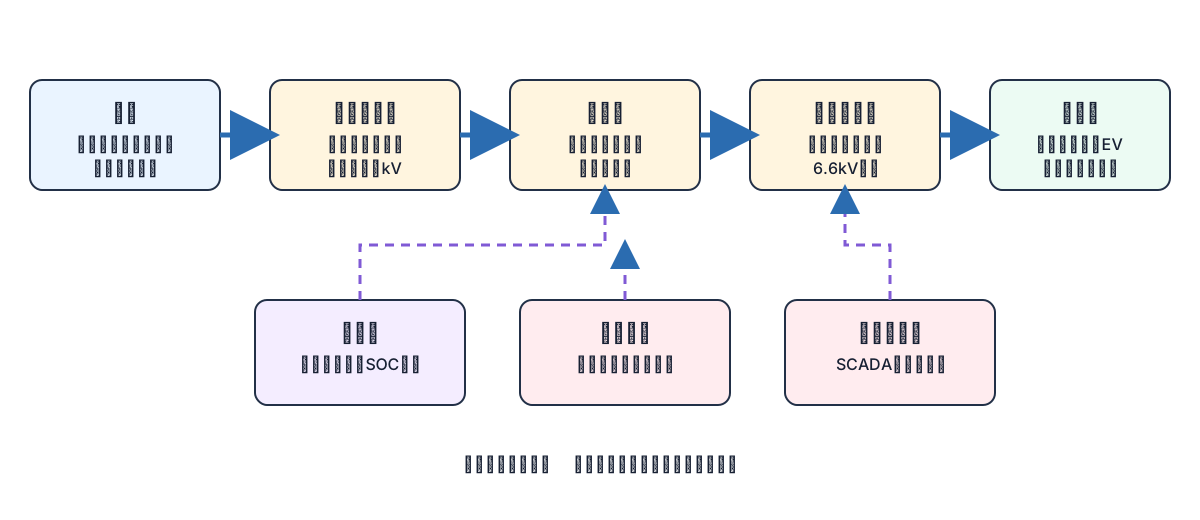
Figure 1 — Power doesn't just flow one-way from generation to consumers; measurement, control, and storage coordinate it across time and place. Batteries and solar inverters become part of the grid through the control system shown with dotted lines.
What makes a power system interesting is that it holds almost no inventory. Gas or oil can sit in a tank until you need it, but AC power is consumed at almost the same instant it's generated. If demand rises by 1 MW, some generator somewhere has to raise output, or a battery has to discharge, or frequency drops. This "simultaneous balance" requirement drives nearly every design decision in power engineering.
2. The basics of voltage, current, and loss
Whether DC or AC, simplifying the magnitude of apparent power gives a relationship between transmitted power P, voltage V, and current I:
If the transmission line's resistance is R, the power lost as heat is
Multiply voltage by 10 and the idealized resistive loss drops to 1/100. Of course, real grids run into other constraints — insulation clearance, corona discharge, transformer losses, reactive power, conductor heating. Even so, the principle of "send it far at high voltage, step it down close to the load" holds because this square-law relationship is that powerful.
AC systems also have to account for reactive power Q — the power that coils and capacitors temporarily exchange — alongside active power P. The approximate three-phase relation is
where V_{LL} is line-to-line voltage, \phi is the phase difference between voltage and current, and \cos\phi is the power factor. Managing reactive power is what governs voltage stability at large industrial motors or on long transmission lines, which is why capacitors, static var compensators (SVC/STATCOM), and inverter reactive-power control all get used.
3. Comparing generation methods by time
Hydroelectric
Hydro converts the potential energy of water at elevation into turbine rotation, then into electricity via a synchronous generator. The idealized output is
where \rho is water density, g gravitational acceleration, Q flow rate, H effective head, and \eta the combined turbine-and-generator efficiency. Gates can shift output over tens of seconds to minutes, which makes hydro valuable as adjustable capacity tracking demand swings. Pumped storage is a giant "potential-energy battery": surplus power sends water from a lower reservoir back up to an upper one, to be released through the turbine when needed.
Thermal
Thermal plants burn natural gas, coal, or oil to turn steam or gas turbines. Combined-cycle plants (where a gas turbine's exhaust heat also drives a steam turbine) extract the fuel's chemical energy across multiple stages, reaching high efficiency. Output is adjustable, but you have to weigh thermal-cycle temperature swings, minimum load, fuel prices, and emissions all at once. A fast-starting gas turbine and a large steam turbine built for steady operation play different roles on the grid even though both are "thermal."
Nuclear
Nuclear power uses fission heat to make steam and, fundamentally, spin a steam turbine like any other heat engine. Fuel energy density is extremely high and the plant suits continuous operation, but the design center of gravity sits less on output adjustment and more on lifecycle design spanning safety systems, cooling, maintenance, and waste management. The reactor type — light-water, high-temperature gas, small modular reactor, and so on — drives major differences in temperature, coolant, construction approach, and passive safety-system design.
Solar
Solar cells output DC via the photoelectric effect, and a power conditioner converts it for the AC grid. Output swings with irradiance and temperature, and the "duck curve" — demand rising in the evening just as solar output falls — is an operational challenge. Maximum power point tracking (MPPT) is a control scheme that nudges voltage step by step to maximize power P=VI, tracking changes from shading or panel temperature.
Wind
The theoretical upper limit on energy extractable from wind's kinetic energy is the Betz limit (about 59.3%). Real turbines combine blade pitch angle, generator torque, and yaw control to balance wind-speed variation against structural loads. Offshore wind's newer research themes include turbine scale-up, maintenance-vessel operations, transmission cabling, and floating-foundation motion.
The table below compares generation methods not just by "how much they generate" but by "when their output can change."
| Method | Primary converter | Output predictability/adjustability | Grid-friendly traits | Typical challenges |
|---|---|---|---|---|
| Hydro | Turbine + synchronous machine | Weather-dependent, but adjusts fast | Frequency regulation, pumped storage | Water rights, environment, siting |
| Thermal | Turbine + synchronous machine | Continuous/adjustable given fuel | Inertia, adjustable capacity | Fuel cost, emissions, startup time |
| Nuclear | Steam turbine + synchronous machine | Long continuous runs | Large-scale base supply | Safety, construction, waste |
| Solar | PV + inverter | Depends on irradiance forecast | Distributed siting, daytime supply | Zero at night, output volatility |
| Wind | Turbine + inverter | Depends on wind forecast | No fuel needed, scales up | Wind resource, transmission, maintenance |
4. What's happening at substations and transmission lines
A substation is more than a building full of transformers. Circuit breakers, disconnectors, surge arresters, instrument transformers, protection relays, busbars, and communication equipment all coordinate to isolate a faulted section fast. Say a short circuit occurs on a transmission line: protection relays detect current, voltage, and phase, then send a trip signal to the breaker. Cut it too slowly and generators lose synchronism; cut it too fast and you black out healthy sections too — so protection coordination needs careful design of both timing and current thresholds.
A transmission line is a distributed circuit with inductance and capacitance as well as resistance. On long lines you have to consider traveling waves, reactive power, the Ferranti effect, and stability limits. In a simplified two-machine system with power angle \delta, the approximate deliverable power is
where E and V are the generator-side and receiving-end voltages and X is the system reactance. If load grows and \delta gets too large, synchronism can't be maintained even though voltage is still present. Beyond building new lines, series compensation, HVDC, grid-stabilizing devices, and synchronous condensers all help relax this constraint.
5. Three time scales for holding frequency steady
- Instantaneous to a few seconds: the inertia stored in synchronous generators' rotating mass, plus fast inverter control, damps sudden frequency swings.
- Seconds to minutes: governor-free operation, hydro output changes, and battery frequency regulation close the supply-demand gap.
- Tens of minutes to days: economic load dispatch, pumped storage, batteries, demand response, and next-day generation planning absorb fuel costs and forecast error.
Simplifying a synchronous generator's equation of motion, the relationship between inertia constant H and frequency deviation \Delta f is
Δf=f−f₀ is in Hz and x=Δf/f₀ is the per-unit deviation. Pm/Pe use a shared power base, H is in seconds on that base, and D is per-unit power per per-unit frequency. Thus 2H dx/dt=Pm−Pe−Dx, matching the frequency Lab.
where P_m is mechanical input, P_e is electrical output, and D is the load's frequency-response characteristic. When generation falls short and P_m-P_e<0, rotational speed — and frequency — drops. As solar and wind grow and synchronous machines shrink as a share of the grid, research is underway into inverters that reproduce inertia- and voltage-source-like response through "virtual synchronous machine" and grid-forming control.
6. What batteries solve, and what they don't
The value of lithium-ion batteries lies in being able to design energy (kWh) and power (kW) somewhat independently. Frequency regulation needs high power over a short duration; shifting solar output into the evening needs hours of capacity. A BMS monitoring cell voltage, current, and temperature estimates not just SOC (remaining charge) but SOH (degradation), insulation, abnormal heating, and cell-to-cell imbalance. See also our explainer on battery sensors and BMS for the fundamentals.
A simple balance describing battery charge/discharge is
where N_{cell} is the series/parallel configuration, V_{nom} nominal voltage, Q_{Ah} capacity, and \eta_{rt} round-trip efficiency. In practice, temperature, C-rate, SOC range, aging, and cooling power all matter, so rated capacity alone doesn't translate directly into what the battery can deliver to the grid.
7. Where current technology ends and research begins
Today's power systems run on synchronous generators, transformers, protection relays, SCADA, batteries, and inverters working together. Research is now less about replacing these components than about coordinating them across different time scales and different owners.
- Grid-forming inverters: moving beyond grid-following control, which just tracks grid voltage, toward inverters that behave as voltage sources — stability on weak grids and islands is the evaluation target.
- Digital twins and predictive maintenance: monitoring transformer dissolved gas, transmission-line temperature, and turbine vibration through time-series models, servicing equipment before it fails.
- High-temperature superconductivity and DC transmission: potential to improve transmission loss and cable capacity, but cooling, conversion equipment, and fault protection remain challenges.
- Demand response and V2G: bundling EVs and water heaters as small storage/load resources to ease grid constraints, while handling communication latency and user comfort at the same time.
- Renewable forecasting: fusing weather models, satellite imagery, and plant measurements to forecast from minutes to days ahead, with forecast error itself increasingly handed to planning as a probability distribution rather than a point estimate.
Moving research results into actual operations requires checking not just efficiency numbers but failure modes, cybersecurity, displays maintenance staff can actually understand, and compatibility with existing protection equipment.
8. Conclusion: read the grid's design, not a winner among power sources
Hydro brings adjustability, thermal and nuclear bring continuous operation, solar and wind bring fuel-free distributed generation, and batteries shift time — each source has a time scale it's good at. Only once you add in substations, transmission lines, protection relays, communications, and markets does it become the "electricity available whenever you need it" that homes and factories require.
Next time you're looking into a piece of equipment, check these four things beyond just the name of the generation method:
- What time scale of supply-demand variation does this equipment handle — seconds, or hours?
- Does its power converter behave as a voltage source to the grid, or does it follow as a current source?
- During a fault, which protection device acts, in how many ms, and over what scope?
- Where's the bottleneck — fuel, heat, batteries, or transmission capacity?
Keep those four in mind and you can place any individual product announcement or research paper within the power system as a whole.
Is matching annual supply and demand sufficient?
The grid needs balance on short timescales too. Separate annual energy from instantaneous power and frequency–voltage management.
References
Current step · 2 / 15 · Power Engineering Primer
Comments
Please log in to post a comment
No comments yet.