Contents — find the section you need
Background and reading guide
Background Units used in specifications, such as voltage, current, distance and time.
Fundamentals · Explanations of principles, structure and trade-offs.
A battery converts the exchange of electrons from a chemical reaction into usable electric current, and a lithium-ion battery specifically draws power from the potential difference created as lithium ions shuttle between a positive and negative electrode. When people talk about what makes a robot or drone perform well, the spotlight tends to fall on sensors like LiDAR or IMUs — but in practice, what actually caps a vehicle's range, payload capacity, and safety margin is almost always the battery and the BMS (Battery Management System) that controls it. No matter how capable the sensors or motors are, if the power system is the bottleneck, the aircraft doesn't fly and the robot doesn't walk.
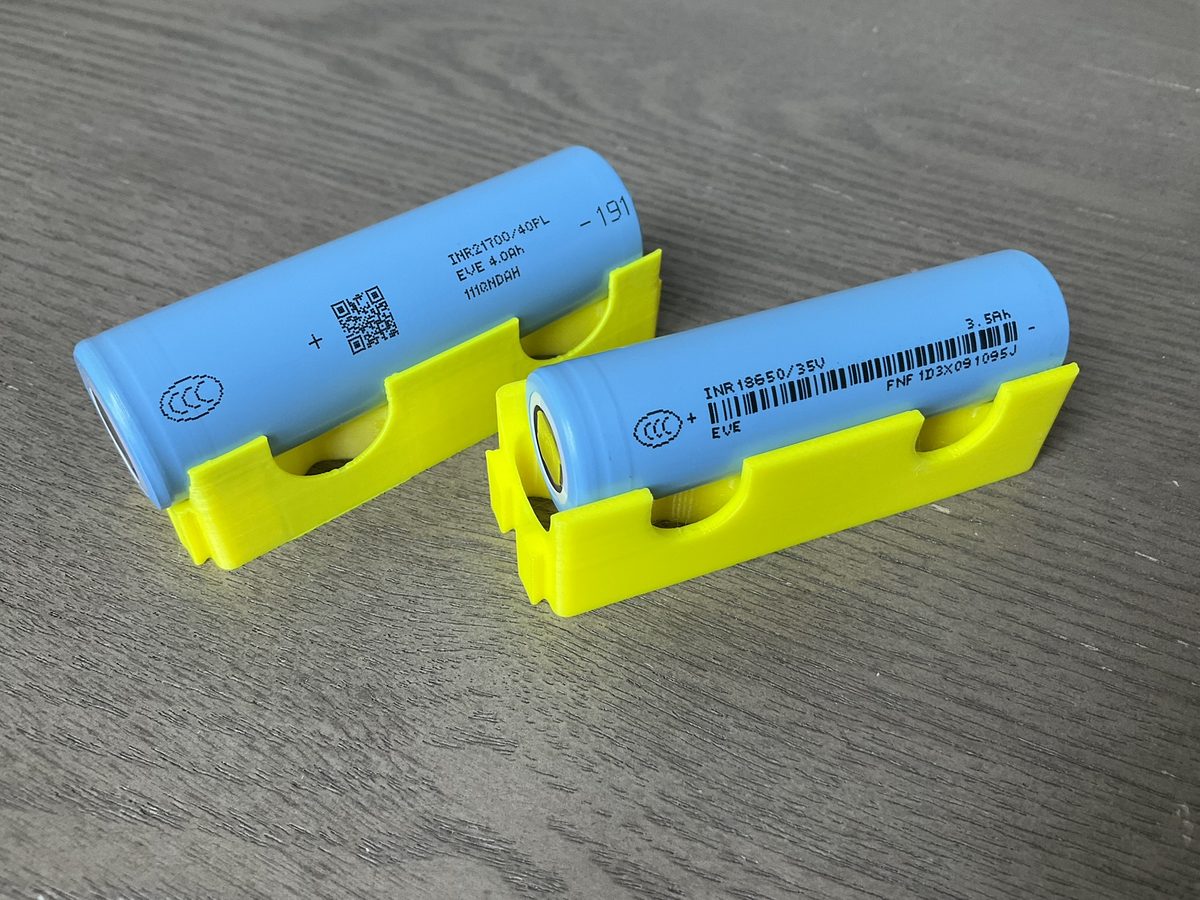 18650 (left) and 21700 (right) cylindrical lithium-ion cells
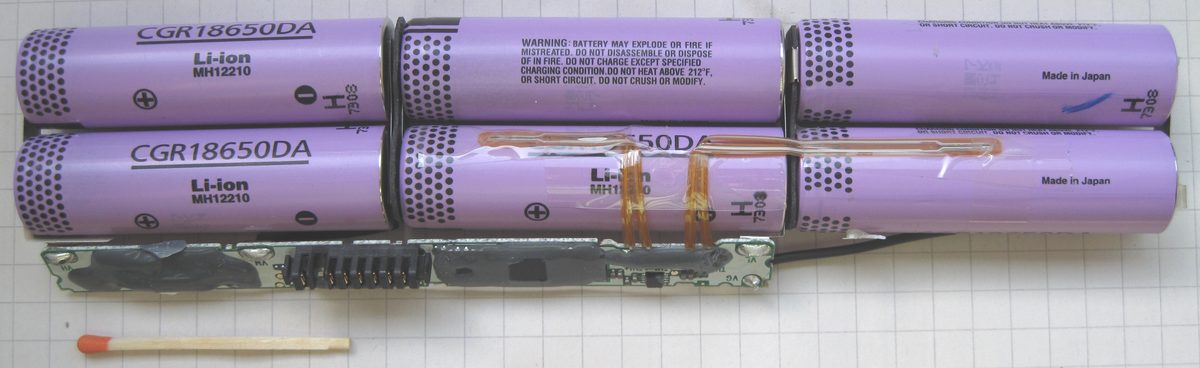 Inside a battery pack: multiple cells wired in series/parallel, plus a BMS board
Images: 18650 and 21700 lithium ion battery cell (Sevenethics, CC0) / Lithiumion-laptop-battery-internals (Lead holder, CC BY-SA 3.0), both Wikimedia Commons.


Principle: lithium ions shuttling back and forth, and the constraint called C-rate
During discharge, lithium ions held in the negative electrode (typically graphite) move through the electrolyte to the positive electrode (a transition-metal oxide such as lithium cobalt oxide), while electrons simultaneously flow through the external circuit to the positive electrode, generating current. For the common graphite-anode / lithium cobalt oxide-cathode pairing, the half-reactions can be written as follows.
During charging this reaction runs in reverse: an external power source forces electrons back into the negative electrode, driving lithium ions back to that side. The specific combination of electrode materials determines nominal voltage, energy density, and safety characteristics — which is exactly where the chemistry differences (NMC, NCA, LiFePO4, and so on) between the products compared below come from.
 Lithium-ion battery discharge model (liquid electrolyte / separator design)
Image: General discharging Li battery diagram (Sdk16420, CC BY-SA 4.0), Wikimedia Commons.

For robotics and drone applications, a metric that matters more in practice than the electrochemistry itself is "C-rate." C-rate is a dimensionless figure expressing how many multiples of a cell's rated capacity Q (in Ah) the actual current I represents.
For example, drawing 45A from a cell rated at 4.2Ah works out to roughly 10.7C. In drones and legged robots that demand large instantaneous currents to drive motors, choosing a cell that can't sustain a high C-rate discharge doesn't just cap performance through voltage sag and heat from internal resistance — it also raises the risk of accelerated degradation and thermal runaway. Energy density (Wh/kg, Wh/L) and high-C-rate discharge capability sit in tension with each other, and this tradeoff directly connects to the current demands on the actuator (motor) side of the system.
This same structure underlies the SOC (State of Charge) estimation a BMS performs. The simplest method, Coulomb counting, integrates current over time to track remaining capacity.
This equation has the same structure as integrating angular velocity for attitude estimation in an IMU, and it carries the same problem: errors in the current sensor's measurement accumulate over time as "drift." In practice, a BMS periodically resets the Coulomb-counting error by referencing the open-circuit voltage (OCV) — the relationship between OCV and SOC when the battery is under no load — or fuses the OCV reference with the integrated current using an extended Kalman filter.
Solid-state batteries: swapping the electrolyte for a solid
Nearly every lithium-ion battery in service today uses a flammable liquid organic solvent as the electrolyte separating the positive and negative electrodes. An all-solid-state battery replaces that liquid electrolyte with a solid one — ceramic (oxide-based), sulfide, or polymer — which structurally reduces the risk of leakage and of fire from a volatile solvent. It also opens the door to using lithium metal itself as the anode (depositing and dissolving lithium directly, without a host material like carbon), which can substantially raise energy density per unit volume and weight. Where a typical lithium-ion pack sits in the rough range of 160–260 Wh/kg, solid-state designs are reported to exceed 300 Wh/kg, with some lab-scale results reaching 400–500 Wh/kg.
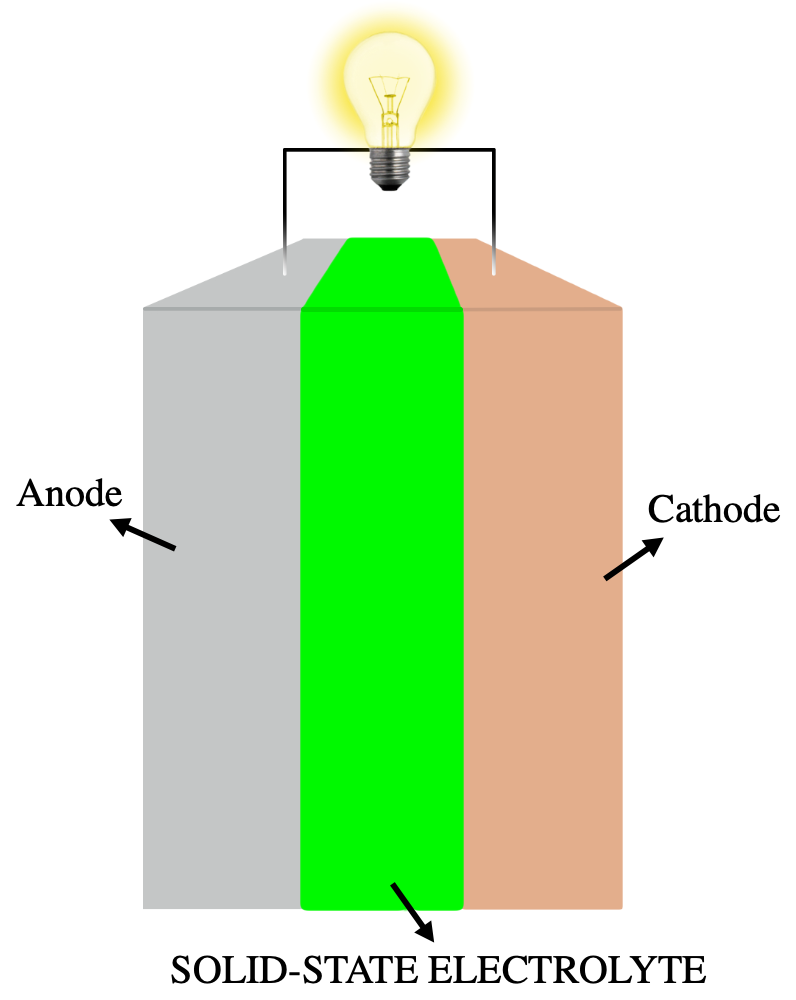 Structural schematic of an all-solid-state battery
Image: All-Solid-State Battery (Luca Bertoli, CC BY-SA 4.0), Wikimedia Commons.

The challenges are just as clear. Solid-solid interfaces can't achieve the same seamless contact as a liquid electrolyte, so interfacial resistance tends to be a problem, and matching liquid-electrolyte-level ionic conductivity has long been the central technical obstacle. It has also turned out that the early assumption — that a solid electrolyte would physically block dendrite growth — doesn't fully hold: reports have documented dendrites propagating through the grain boundaries of solid electrolytes and causing internal shorts. Simply switching to a solid electrolyte doesn't automatically guarantee safety.
What a BMS does: monitoring, balancing, and protection
A BMS is a control circuit built around two core functions: continuously monitoring the voltage, current, and temperature of every cell in a pack, and evening out the differences between cells through "cell balancing," while cutting current in the event of a fault ("protection").
 BMS control board inside a lithium-polymer battery pack (laptop application)
Image: Asus Zenbook UX31E - Lithium-Polymer battery controller (Raimond Spekking, CC BY-SA 4.0), Wikimedia Commons.

Cell balancing addresses the small differences in voltage and capacity that inevitably emerge among cells wired in series within a pack. The most common approach, "passive balancing," bleeds off just the higher-voltage cells slightly through a resistor to bring them in line with the rest — simple to implement, but the discharged energy is wasted as heat. The pricier alternative, "active balancing," actually transfers energy from higher-voltage cells to lower-voltage ones, which is more energy-efficient but adds circuit complexity. Skip balancing, and the effective capacity of the whole series pack gets bottlenecked by its weakest cell, with a degraded cell more likely to drift into the dangerous overcharge or overdischarge zone.
The protection function cuts the current path via a MOSFET switch the moment it detects overcharge, overdischarge, overcurrent, a short circuit, or overheating. Alongside this, the BMS estimates SOH (State of Health, the battery's degree of degradation) — the ratio of current effective capacity to original capacity — and reports it to the flight controller or robot control system, which keeps remaining-range estimates accurate. The entire onboard electronics stack, including the SBC (single-board computer), makes power-allocation and emergency-landing or emergency-stop decisions based on the figures this BMS reports.
Key product specification comparison
| Product | Type | Manufacturer | Key specs | Notes |
|---|---|---|---|---|
| INR21700-P42A | Cylindrical Li-ion cell (21700) | Molicel | Typical capacity 4200mAh, continuous discharge 45A (approx. 10.7C), nominal voltage 3.6V, energy 15.5Wh | A high-capacity, high-discharge 21700 cell widely used in DIY drones, power tools, and robotics |
| 2170 cell (reduced-cobalt variant) | Cylindrical Li-ion cell (21700) | Panasonic (for Tesla) | Energy density approx. 250–260 Wh/kg, approx. 18Wh per cell | A high-energy-density cell used in Tesla vehicles; an improved 2020 variant raised density while cutting cobalt content |
| TB65 Intelligent Flight Battery | Li-ion battery pack (BMS built in) | DJI | 5880mAh capacity, 44.76V, 263.2Wh energy, approx. 1.35kg weight, up to 400 cycles | For the Matrice 350 RTK / 300 RTK industrial drones. Onboard BMS handles per-cell voltage management and self-heating |
| BQ76952 | BMS IC (battery monitor/protector) | Texas Instruments | Supports 3S–16S, measures cell voltage at 16-bit resolution (1mV steps), autonomous or host-controlled cell balancing, I2C/SPI/HDQ comms | A highly integrated battery monitor/protector IC that also integrates charge/discharge MOSFET drivers on-chip |
| LTC6811-1 | BMS IC (multi-cell stack monitor) | Analog Devices | Supports up to 12 series cells, total measurement error under 1.2mV, measures all 12 cells in 290µs, isoSPI for long-distance comms | Provides per-cell PWM-controlled passive balancing with a noise-resistant isolated communication interface |
| All Solid Battery (ASB) | Solid-state battery (sample-shipment stage) | Samsung SDI | Volumetric energy density 900 Wh/L (+40% vs. mass-produced prismatic cells) | Built a pilot line at its R&D center in Suwon and is shipping samples to EV, embedded-AI, and humanoid-robotics customers, targeting mass production in 2027 |
A high-discharge cell like Molicel's P42A suits applications that demand large instantaneous currents — drone motors, or the joints of a robot arm — through a design that balances capacity against C-rate. By contrast, a cell that prioritizes energy density above all, like the Panasonic cells used by Tesla, tends to get chosen for EV applications where the motor load profile is comparatively smooth. DJI's TB65 isn't a bare cell but a complete pack with a built-in BMS; in industrial drone operations, it's standard to treat these "smart batteries" as the unit of operation rather than handling individual cells directly. Among BMS ICs, TI's BQ76952 is a highly integrated design that folds even the charge/discharge MOSFET drivers onto a single chip, while Analog Devices' LTC6811-1 specializes in higher-precision cell-voltage measurement (under 1.2mV) and can be daisy-chained across multiple chips to scale beyond 12 cells per pack. That Samsung SDI's ASB is shipping samples not just to EV makers but to embedded-AI and humanoid-robotics customers signals that solid-state batteries are broadening their scope well beyond automotive.
History: a byproduct of the oil crisis, Sony's commercialization, and a Nobel Prize
Lithium-ion's origin traces back to the early 1970s. M. Stanley Whittingham discovered that lithium ions could be reversibly inserted into and removed from the layered structure of titanium disulfide (TiS2), and after moving to Exxon, prototyped a battery built on this principle. But the metallic lithium anode of that era had safety problems, and when the late-1970s collapse in oil prices led Exxon to scale back its investment in alternative-energy research, the technology fell out of the path toward commercialization for a time.
In 1980, John Goodenough at Oxford University made a major leap in battery stability by using lithium cobalt oxide (LiCoO2) as the cathode material. Then Akira Yoshino at Asahi Kasei paired Goodenough's LiCoO2 cathode with a petroleum-coke-derived carbon anode, establishing by 1985 a battery structure that dropped metallic lithium entirely while balancing safety and practicality. This basic structure remains the mainstream design for lithium-ion batteries to this day.
It was Sony that took the leap into commercialization: in 1991, Sony Energy Tec (now Sony Energy Devices) became the first in the world to ship lithium-ion batteries. Asahi Kasei and Toshiba's joint venture began production the following year, and Sanyo Electric and Matsushita Electric Industrial (now Panasonic) joined in 1994, with Japanese companies leading the market in its earliest years. This achievement wasn't formally and widely recognized until a quarter century later: in 2019, the Nobel Prize in Chemistry was awarded jointly to Whittingham, Goodenough, and Yoshino.
What the Boeing 787 taught the industry about the limits of a BMS, and the frontier of degradation prediction
Sony's "largest ever" laptop battery recall — In August 2006, Dell, Apple, and several other PC makers launched a massive recall of laptops built with Sony-manufactured lithium-ion batteries. A manufacturing defect — metal particulate contamination — was found capable of causing internal short circuits, overheating, and fire, and the recall eventually covered roughly 9.6 million units. The US Consumer Product Safety Commission (CPSC) called it "the largest computer-related recall" in its history. Sony's share of the costs is estimated to have run into the hundreds of millions of dollars. The recall became an industry-wide lesson: no BMS design, however good, can fully substitute for quality control at the individual cell manufacturing level.
The thermal runaway that grounded the Boeing 787 worldwide — In January 2013, a Japan Airlines (JAL) Boeing 787 parked at Boston's Logan International Airport suffered smoke and fire from a GS Yuasa-manufactured lithium-ion battery powering its auxiliary power unit. In a report adopted in 2014, the US National Transportation Safety Board (NTSB) concluded that an internal short circuit within a cell caused a "thermal runaway" that cascaded to adjacent cells — that was the direct cause. Just as important: the investigation explicitly noted that "the safety circuit built into the connector end... [was] unable to stop a thermal runaway once in progress." In response, the US Federal Aviation Administration (FAA) grounded the entire 787 fleet — an extraordinary step it hadn't taken since 1979. A BMS can detect the early signs of trouble and cut current, but it fundamentally has no means to halt a thermal-runaway chain reaction once it has begun inside a cell — a limitation this incident drove home hard for the entire industry.
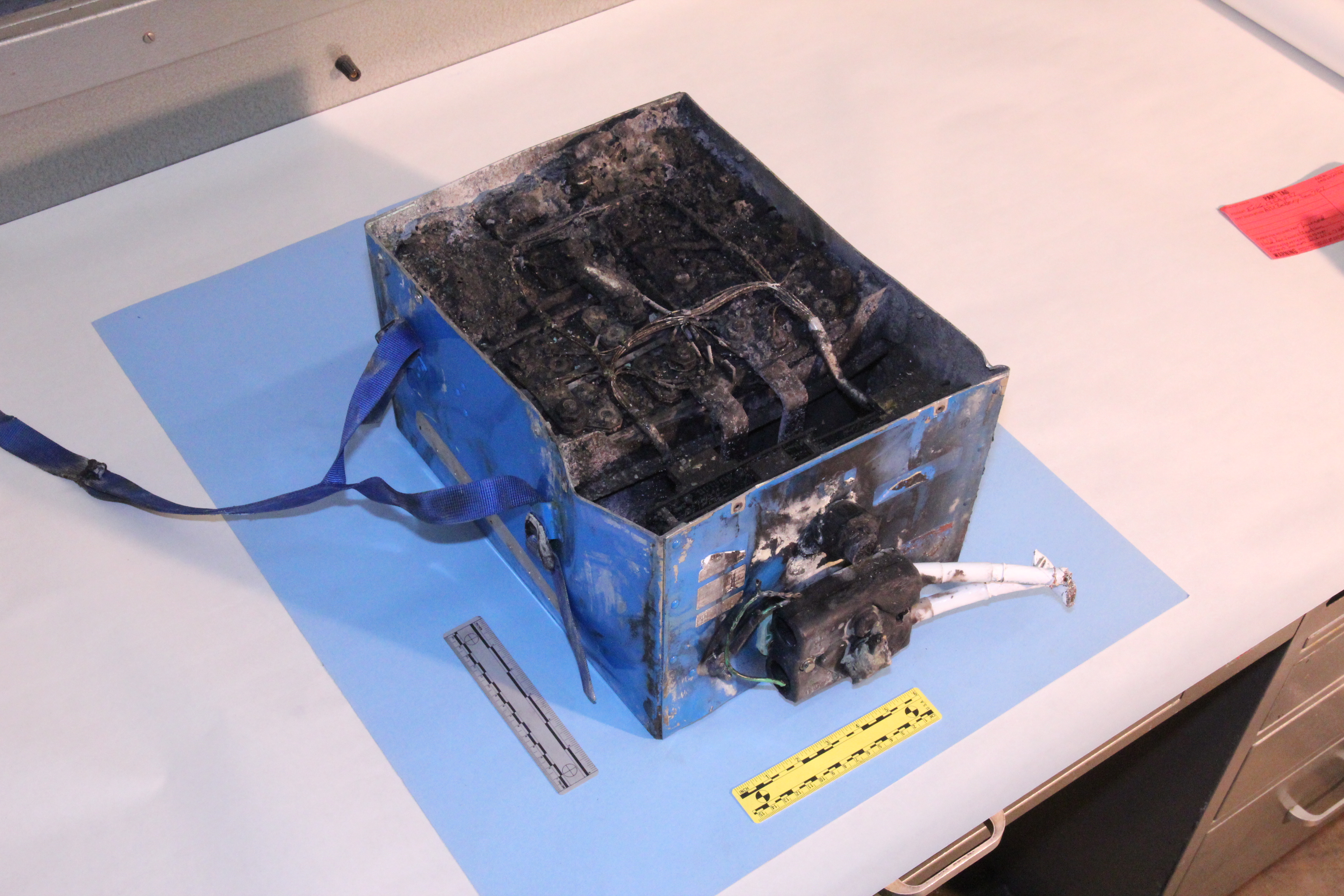 The APU lithium-ion battery burned in the 2013 JAL 787 fire incident (photographed by the NTSB)
Image: 1-7-12 JAL787 APU Battery (National Transportation Safety Board, Public Domain), Wikimedia Commons.

Predicting degradation before it breaks — Every one of these thermal-runaway incidents only became visible after degradation or an internal defect had already crossed some threshold. Research aimed at changing this "you only find out after it breaks" pattern has become one of the main battlegrounds in recent BMS research. A paper published in April 2026, "A Deep Learning Model for Battery State Prediction towards Intelligent Energy Management" (arXiv:2605.00898), applies a deep learning model to a large-scale operational dataset to forecast a battery's remaining capacity and degradation trajectory ahead of time, proposing a framework that supports both predictive maintenance and safer energy management. Layering data-driven degradation prediction on top of the classical combination of Coulomb counting and OCV reference is a direction likely to spread into BMS design for the increasingly electrified robotics and drone sector as well.
Parameters That Determine Performance
- Energy density (Wh/kg, Wh/L): Directly determines a drone's flight time or a payload-carrying autonomous ground robot's range. Solid-state batteries are chasing beyond 300 Wh/kg, while today's practical lithium-ion packs sit around 160–260 Wh/kg — that gap is exactly the design headroom for next-generation platforms
- C-rate (discharge capability): Determines whether a cell can meet the instantaneous high-current demands of motors and actuators. A high-C-rate cell like Molicel's P42A (45A, roughly 10.7C) suits applications with large load swings, like a legged robot's jump or a drone's rapid acceleration. Substitute an energy-density-optimized cell instead, and voltage sag or heat can keep it from delivering its rated output
- Cycle life: A figure like DJI TB65's up to 400 cycles directly maps to operating cost through how many charge/discharge cycles the pack tolerates. In high-utilization settings like daily commercial drone operations, this number effectively sets replacement frequency and running cost
- Cell-balancing accuracy: How precisely a BMS can track cell voltage — as with the LTC6811-1's sub-1.2mV measurement error — governs both the pack's effective capacity and cell lifespan. Miss a growing imbalance, and one degraded cell ends up bottlenecking the whole pack's performance
- Protection-circuit response speed and its limits: How fast a BMS detects overcurrent or overheating and cuts current is directly tied to safety, but as the Boeing 787 case shows, a BMS has no power to stop a thermal-runaway chain reaction once it has already begun inside a cell. Quality control at the cell level, and choosing a chemistry less prone to thermal runaway (LiFePO4, for instance), have to complement the protection circuit rather than the other way around
- Operating temperature range: A figure like Molicel P42A's -40°C to 60°C rating matters for real-world availability, since outdoor drones and robots need resilience against the capacity and output loss that comes with low temperatures. DJI's battery self-heating function is one answer to exactly this problem
- Fast-charge capability: Next-generation batteries — from Samsung SDI's ASB to Toyota and Idemitsu Kosan's stated goal of charging from 10% to 80% SOC in under 10 minutes — are treating charge-time reduction as a clear point of differentiation. For commercial drone and delivery-robot operations chasing maximum utilization, charging downtime itself becomes an effective performance metric
Does greater battery capacity guarantee higher current?
Current ratings, internal resistance, temperature, and BMS limits matter. Separate energy capacity from instantaneous power capability.
References
- Molicel INR21700-P42A datasheet
- Molicel P42A spec summary (About:Energy)
- DJI TB65 Intelligent Flight Battery product page
- Matrice 350 RTK specs (DJI Enterprise)
- Top features of the Matrice 300 RTK, incl. dual-battery redundancy (DJI Enterprise Insights)
- Texas Instruments BQ76952 product page
- Analog Devices LTC6811-1 product page
- Samsung SDI unveils 900Wh/L solid-state battery (Samsung SDI official news)
- Samsung SDI plans mass production of solid-state batteries starting in 2027 (Battery-News)
- Toyota and Idemitsu Kosan collaborate on solid-state battery mass production (Toyota official)
- Tesla 2170 cell energy density (InsideEVs)
- The Nobel Prize in Chemistry 2019, Popular Information (Nobel Prize official site)
- Akira Yoshino special site (Asahi Kasei official)
- Dell announces recall of notebook computer batteries due to fire hazard (CPSC official)
- Auxiliary Power Unit Battery Fire, JAL Boeing 787-8, JA829J investigation report (NTSB official PDF)
- NTSB Cites 'Thermal Runaway' in Boeing 787 Battery Fire (Flying Magazine)
- A Deep Learning Model for Battery State Prediction towards Intelligent Energy Management (arXiv:2605.00898)
Current step · 18 / 21 · Sensors & Hardware
Comments
Please log in to post a comment
No comments yet.