Contents — find the section you need
Background and reading guide
Background Voltage, current, power, energy and unit conversion.
Fundamentals · Explanations of principles, structure and trade-offs.
A wind turbine blade is not a "board that catches the wind." It uses an airfoil's lift and drag to generate rotational torque, handing a large, low-speed rotation to a gearbox or a direct-drive generator. The generator's power is conditioned by a converter for voltage, frequency, and reactive power, then passes through a transformer and transmission line onto the grid. Reading wind power as a single machine means looking not just at wind strength but at turbulence, fatigue, forecasting, maintenance, and grid control together.
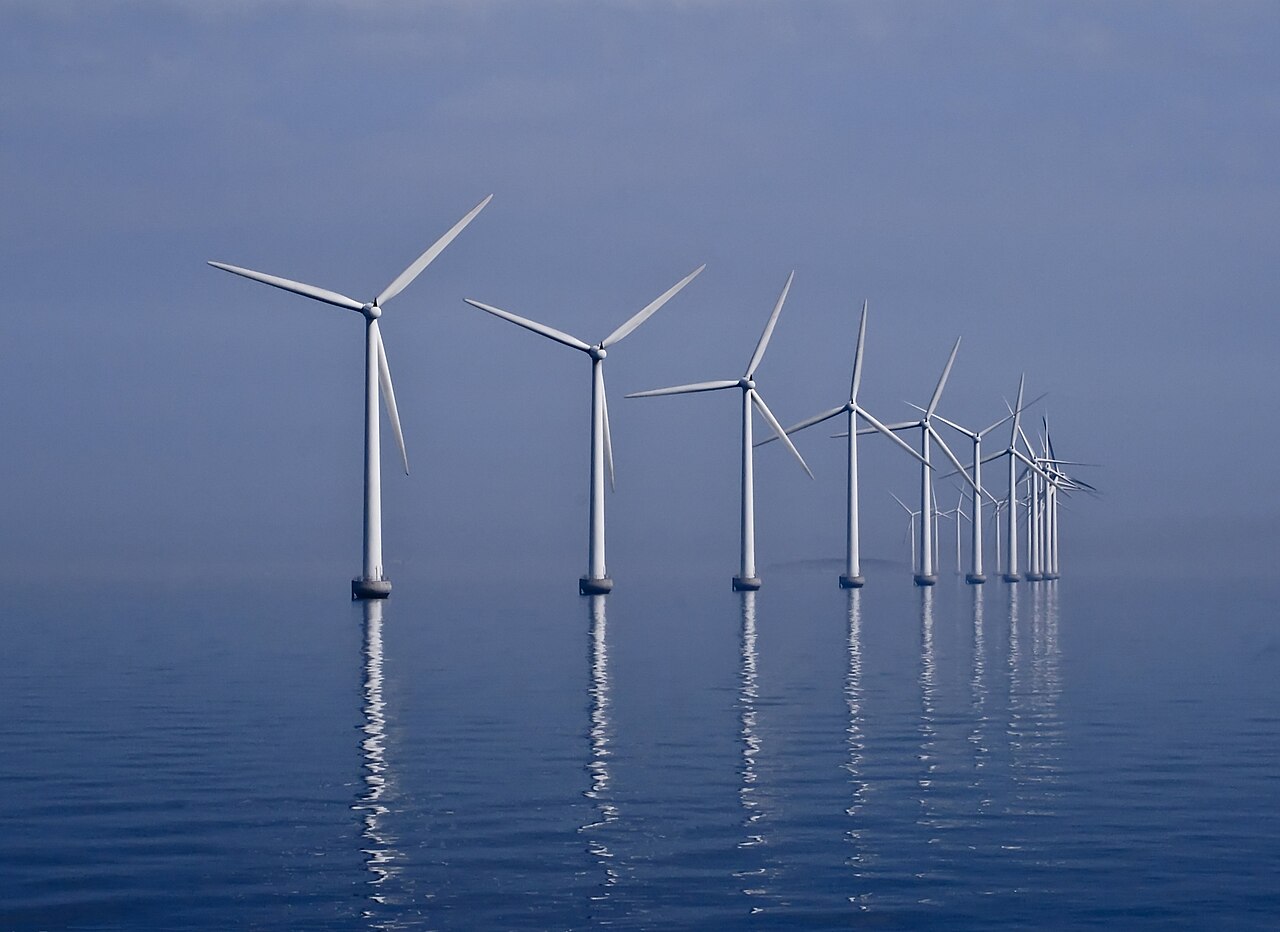 Offshore wind example
Image: Middelgrunden wind farm (Kim Hansen / Richard Bartz, CC BY-SA 3.0), Wikimedia Commons. A field photograph illustrating turbine spacing, not a specification for every current turbine.

0. 30-Second Summary
- The ideal power extractable from wind is P=\frac12\rho A v^3 C_p. Because it's proportional to the cube of wind speed v, small differences in wind resource make a large difference in annual generation.
- No turbine can recover 100% of the wind's kinetic energy; the ceiling is the Betz limit, about 59.3%. A real machine's C_p varies with wind speed, blade angle, control, and turbulence.
- Pitch control adjusts blade angle, yaw control points the nacelle into the wind, and generator torque control governs rotor speed. In high winds, output is throttled back and the turbine stops for safety.
- Onshore, transport, noise, and landscape dominate; offshore (fixed-bottom), foundations, subsea cables, typhoons, and maintenance vessels dominate; floating offshore, mooring and motion dominate.
- In grid interconnection, variable-speed inverters handle active power, reactive power, voltage, and frequency response. Forecast error is offset by combining batteries, hydro, and demand response.
1. The Kinetic Energy of Wind and the Betz Limit
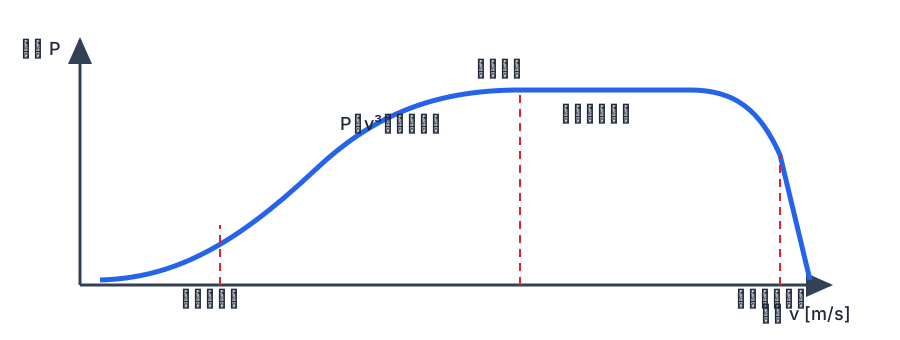
Figure 1 — Below cut-in there is no useful output; between cut-in and rated speed, power rises steeply; above rated speed, pitch control limits output until cut-out.
Air of density \rho passing at speed v through a swept area A=\pi R^2 carries kinetic energy per unit time of
If the wake speed behind the turbine were driven all the way to zero, air would stop flowing through at all — so optimizing the speed drop across the turbine via conservation of momentum caps the extractable fraction at
and no higher. C_p is the power coefficient, a function C_p(\lambda,\beta) of tip-speed ratio \lambda=\omega R/v and pitch angle \beta. At low wind speed, the turbine speeds up to track the optimal \lambda; above rated wind speed, pitch is changed to hold output constant.
2. Blade, Nacelle, Tower
The blade converts an airfoil's lift into a tangential force. Longer, slimmer blades add area, but also add fatigue from gravity, centrifugal force, and wind loading. The hub and main shaft, generator, gearbox, and control cabinet sit inside the nacelle, with the tower and foundation carrying loads to the ground. As turbines scale up, blade natural frequency, tower resonance, control latency, lightning, salt corrosion, and icing all bear directly on the design.
3. Pitch, Yaw, and Torque Control
Pitch Control
Changing the blade pitch angle \beta changes lift and torque. Below rated wind speed, \beta is held at its optimal value; above rated wind speed, angle of attack is reduced to cap output. Redundancy is needed so that if the hydraulic or electric actuator fails, the blade can still move to feather (an angle that spills the wind).
Yaw Control
Yaw control, which points the nacelle into the wind, uses the wind vane and anemometer, generation output, and tower torsion. Yawing too frequently strains the yaw drive and cables, so the average wind direction and turbulence are filtered to balance generation loss against fatigue.
Generator Torque
In variable-speed turbines, generator torque T_g is varied with speed to track the optimal tip-speed ratio. The equation of rotational motion is
where J is inertia, T_a is aerodynamic torque, and T_f is loss torque. Control schemes that virtually provide inertia to the grid temporarily release the turbine's rotational kinetic energy to soften frequency drops — but output must then be reduced during the period the rotor recovers speed afterward.
4. Fixed-Speed, Variable-Speed, and Grid Interconnection
Fixed-speed induction generators are simple to build, but wind-speed changes readily propagate into mechanical torque and onto the grid. A doubly-fed induction generator (DFIG) uses a partial-capacity converter on the rotor side to control the variable-speed range and reactive power. A permanent-magnet synchronous generator with a full-capacity converter electrically decouples the generator from the grid, allowing control over a wide speed range — at the cost of more power-semiconductor and magnet expense.
Inverters commonly use grid-following control, tracking grid phase via a PLL, but weak offshore grids or isolated islands require grid-forming control. A farm controller that oversees a cluster of turbines coordinates individual turbines' output, reactive power, ramp rate, and curtailment, passing grid-operator commands, weather forecasts, and battery state of charge into the same control hierarchy.
5. Onshore, Fixed-Bottom Offshore, and Floating
| Type | Strengths | Main Challenges | Research Focus |
|---|---|---|---|
| Onshore | Relatively easy construction/maintenance; close to transmission | Noise, landscape, road transport, turbulence | High-terrain adaptation, forecasting, repowering |
| Fixed-bottom offshore | Strong wind, larger scale possible, distant from habitation | Foundations, subsea cables, shipping, corrosion | Fatigue at 15 MW class, port/construction logistics |
| Floating offshore | Can be deployed in deep water | Mooring, motion, typhoons, subsea cables | Coupled control, lightweight floaters, maintenance robots |
At sea, the turbine, floater, mooring, waves, and power cable are all coupled. Changing blade pitch changes aerodynamic load, which affects tower and floater motion; changing generator torque changes rotor speed and mooring load. Research is moving beyond a single PID toward model predictive control, load-mitigation control, and digital twins that extend fatigue life.
6. Forecasting, Maintenance, and Environment
Wind power forecasting combines weather models, lidar, satellite data, nacelle wind speed, and neighboring turbines' wake data to produce probability distributions from minutes to days ahead. During periods of large forecast error, battery capacity is held in reserve, and thermal, hydro, and demand response are pre-arranged.
Maintenance monitors vibration, temperature, and oil analysis on the main-shaft bearing, gearbox, generator, pitch bearing, and blades. Drone imagery and acoustic inspection check for blade delamination and lightning damage, combining anomaly signs with wind conditions to decide when to schedule shutdowns. Impacts on birds and bats, marine mammals, fisheries, and seabed ecosystems need to be assessed together with siting, operational control, and monitoring — not in isolation.
7. Summary
Wind power is a system that hands air's momentum in sequence to blade, shaft, generator, inverter, transformer, and grid. The cube law of wind speed and the Betz limit set the ceiling on output; pitch, yaw, and torque control set mechanical load and power quality; forecasting and maintenance set availability. When reading research on offshore/floating turbines or grid-forming inverters, it's worth comparing them not just on conversion efficiency alone, but including fatigue, cabling, ports, weather, environment, and grid operation.
What happens to wind power flux when speed doubles?
It rises eightfold at equal density and area. A turbine's actual output is limited by its power curve and shutdown conditions.
References
Current step · 7 / 15 · Power Engineering Primer
Comments
Please log in to post a comment
No comments yet.