Contents — find the section you need
Background and reading guide
Background Voltage, current, power, energy and unit conversion.
Fundamentals · Explanations of principles, structure and trade-offs.
A solar panel doesn't output AC directly. A semiconductor pn junction splits a photon's energy into an electron and a hole, the DC current the cells produce is bundled in series and parallel, and MPPT (maximum power point tracking) and a power conditioner convert it into usable electricity. Reading everything from a few rooftop panels to a megasolar plant, batteries, and the electricity market as one system connects the generation graph to grid operations.
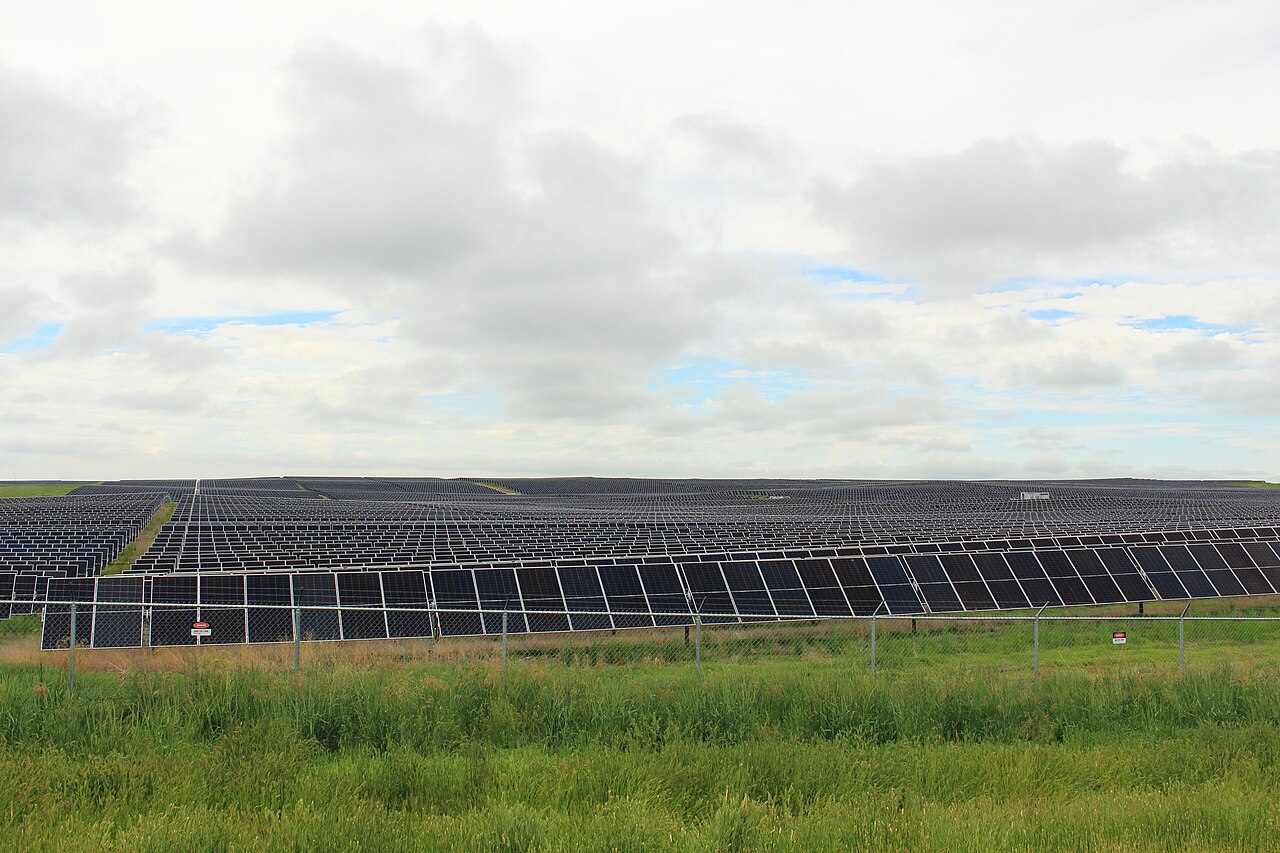 Utility-scale PV example
Image: Photovoltaic Panels at the Travers Solar Farm (Kkiefuik, CC BY 4.0), Wikimedia Commons. A layout photograph, not a direct measurement of the output or efficiency numbers in this article.

0. The 30-second version
- A solar cell's output is set by the product P=VI of voltage V and current I. More irradiance mainly raises current; higher temperature lowers voltage.
- The I-V curve has a single maximum power point (MPP), and MPPT tracks the DC-DC converter's operating point to it. Shading can create multiple local peaks.
- The inverter converts DC to AC and controls power factor, reactive power, harmonics, and anti-islanding detection. With a battery, midday surplus can be shifted to the evening.
- Rooftop, agrivoltaic, floating, and offshore installations each face different temperature, reflection, maintenance, grid-capacity, and environmental considerations depending on siting.
- Perovskites, tandem cells, recycling, and grid-forming inverters are all under research, but need evaluation across lifespan, encapsulation, lead management, bankability, and maintenance.
1. The pn junction turns light into current
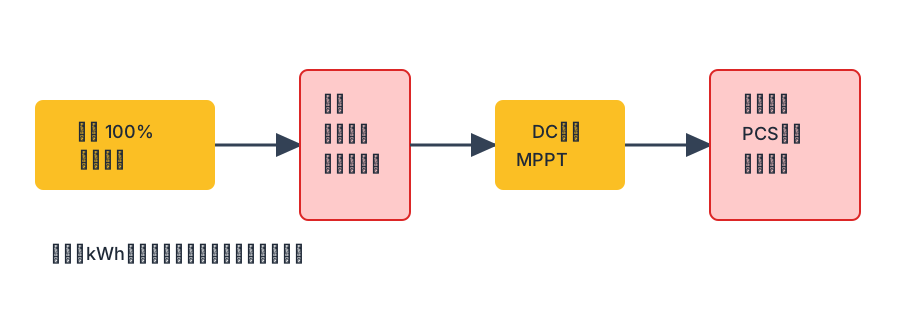
Figure 1 — Separate cell conversion, temperature, shading, wiring, power-conditioning, and curtailment losses before comparing two PV systems.
If the energy E_{ph}=hc/\lambda of a photon striking a solar cell exceeds the semiconductor's bandgap E_g, an electron-hole pair is generated. The electric field in the pn junction's depletion region separates the two in opposite directions, driving current through the external circuit. An idealized cell current can be written as
where I_{ph} is the photocurrent, I_0 the dark current, q the elementary charge, n the ideality factor, and T absolute temperature. Near the open-circuit voltage V_{oc}, current falls off sharply; near the short-circuit current I_{sc}, voltage is nearly zero. The bend in this curve is the MPP.
Connecting cells in series raises voltage; in parallel raises current. A panel's bypass diodes avoid hotspots, where partial shading reverse-biases an entire string of cells and generates heat. Shading, dirt, snow, and aging all change each string's I-V curve, so generation monitoring records voltage, current, and temperature together.
2. MPPT: tracking the maximum power point
The maximum condition for power P(V)=V I(V) is
Representative MPPT methods include Perturb & Observe (hill-climbing), which nudges the operating voltage slightly and watches how power responds, and Incremental Conductance, which controls to satisfy dI/dV=-I/V. When irradiance changes suddenly, these methods can mistakenly chase the previous increase or decrease, which is why research combines weather sensors, multiple strings, and predictive control.
3. The power conditioner and grid interconnection
PV's DC output becomes AC through a boost converter, DC-link capacitor, and an H-bridge or three-phase inverter. Grid-following control, which tracks grid phase via a PLL and shapes current into a sine wave, is the common approach. Because rooftop PV continuing to feed power during a grid outage is dangerous to workers, anti-islanding detection and disconnection are required.
On weak grids with a high renewable share, grid-forming control — where the inverter behaves as a voltage source rather than merely tracking grid voltage — is drawing attention. Virtual synchronous machines, virtual oscillators, and droop control let it respond fast to frequency deviation and voltage fluctuation. This isn't about changing the solar cell's semiconductor — it's about matching the power converter's control and protection to the grid as a whole.
4. Irradiance, temperature, and installation angle
With irradiance on the plane G [W/m²], module area A, and conversion efficiency \eta, instantaneous output can be approximated as
Efficiency \eta falls with a temperature coefficient. The gap to the roofing material, rear-side ventilation, mounting structure, azimuth, tilt angle, and reflected light all affect annual generation. Bifacial modules exploit ground reflectance (albedo), so even the condition of the installation surface — white gravel, snow, farmland — needs to be included in the design.
Agrivoltaic sites need to avoid cutting too much light reaching the crops, spread panel shading, and keep clearance for farm-machinery working height. Floating installations need to evaluate the water surface's cooling effect, anchoring, waves, cabling, and impact on algae and water quality. Maximizing generation alone can overlook tradeoffs against crop yield and maintainability.
5. Batteries and forecasting
Solar surplus charges a battery for discharge in the evening or during cloud cover. The battery's state of energy E can be updated using power command P_b and round-trip efficiency \eta_{rt} as
where P_{ch} and P_{dis} are charge and discharge power, and \eta_c,\eta_d their respective efficiencies. SOC upper/lower bounds, temperature, degradation, and interconnection capacity all go in as constraints. Forecasting cloud shadow a few minutes ahead lets you choose between keeping the battery available or accepting curtailment.
6. Current technology and research
A typical PV system today consists of crystalline silicon cells, a string or micro-inverter, a monitoring gateway, circuit breakers, grounding/lightning protection, and, where applicable, a battery. Performance comparisons should look beyond rated efficiency to part-load efficiency, nighttime standby power, MPPT voltage range, arc-fault detection, remote firmware updates, replacement parts, and salt-air/snow-load ratings.
Research centers on tandem cells stacking a different-bandgap perovskite on top of silicon, lightweight thin films that can be applied to curved surfaces, long-lived encapsulation, lead recovery and recycling, grid-forming inverters, and operations bundling PV with batteries, hydrogen, and demand response. Even where lab conversion efficiency is high, large-module uniformity, UV/humidity/thermal cycling, 25-plus-year warranties, and end-of-life recovery remain barriers to commercialization.
7. Monitoring, maintenance, and safety
Finding a drop in output means comparing weather-normalized expected values against actual measurements. Check string-current outliers, panel temperature differences, inverter insulation resistance, arc-fault detection, junction-box fuses, and cable connectors. Drone infrared imaging can spot hotspots, but reflection, wind, and measurement angle affect it, so anomaly determination should be cross-checked against electrical measurement.
DC arcs can persist even after a breaker opens. Workers should assume generation voltage remains present as long as the panel is receiving sunlight, and follow the relevant electrical safety regulations and manufacturer procedures. When batteries are co-located, fire response — extinguishing, isolation, re-ignition, and coordination with fire and utility companies — needs to be built into the plan.
8. Conclusion
Solar power is a continuous system spanning cell photoconversion, MPPT, DC-DC conversion, the inverter, transformer, monitoring, storage, and grid protection. When comparing annual generation, align irradiance, temperature, shading, dirt, degradation, conversion loss, and curtailment to the same conditions. Reading about perovskites or grid-forming inverters should likewise weigh demonstration scale, durability, maintenance, recycling, and safety across the whole lifecycle.
Does a 1 kW solar rating mean 24 kWh every day?
The rating applies under specified conditions; panels do not generate at night. Energy depends on irradiance, temperature, and losses over time.
References
Current step · 6 / 15 · Power Engineering Primer
Comments
Please log in to post a comment
No comments yet.