Contents — find the section you need
Background and reading guide
Background Voltage, current, power, energy and unit conversion.
Fundamentals · Explanations of principles, structure and trade-offs.
Look only at a nuclear plant's generator and it's the same steam turbine you'd find at a thermal plant. The difference is that instead of a boiler there's a reactor, and instead of combustion, fission heat is controlled over an extended period. Understanding nuclear power means reading not just nuclear physics but thermodynamics, materials, cooling, radiation protection, and grid operation as a single safety case.
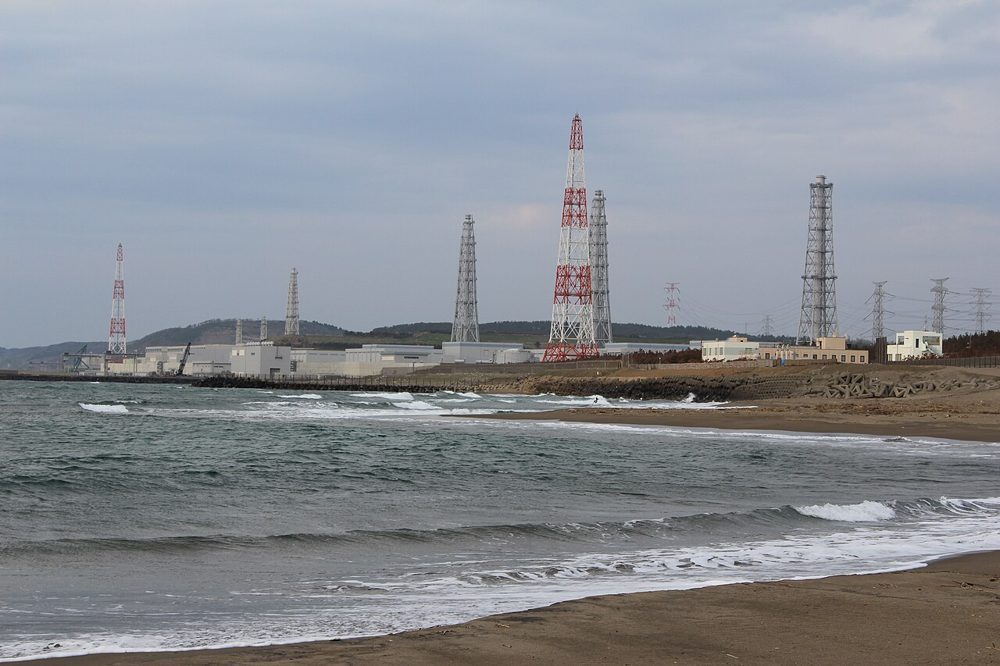 Kashiwazaki-Kariwa
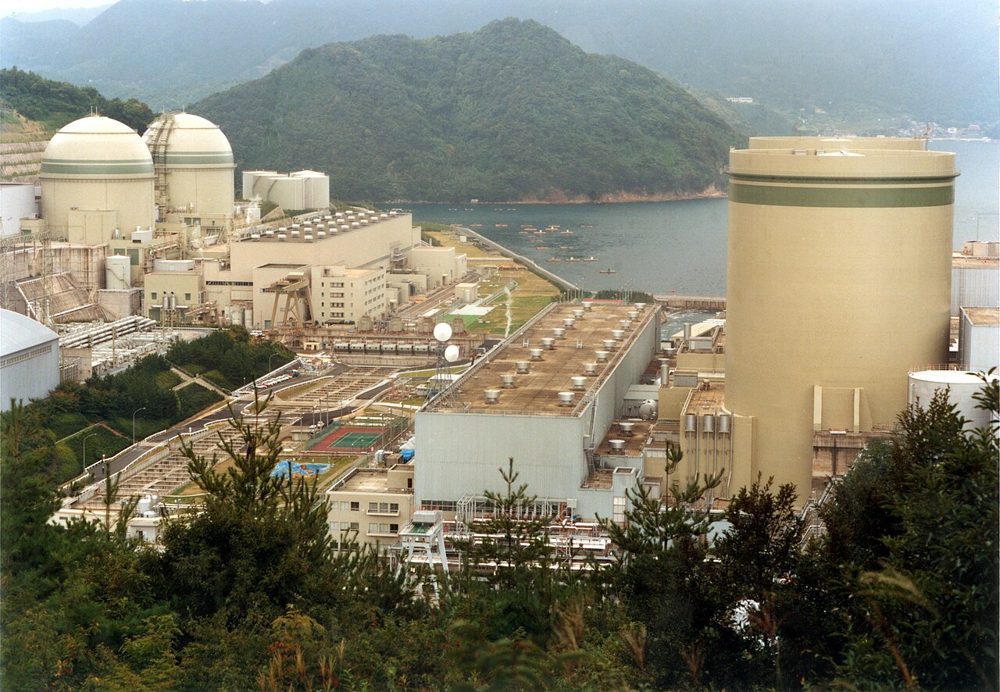 Takahama
Images: Kashiwazaki-Kariwa Nuclear Power Plant (Triglav, CC BY-SA 3.0) / Takahama Power Station (IAEA Imagebank, CC BY-SA 2.0), Wikimedia Commons. Exterior examples; reactor type and operating status cannot be inferred from the photographs alone.

.jpg)
The 30-second version
- Heat released by fission of uranium and similar materials transfers to a coolant, which becomes electricity via a steam turbine and generator. The final stage of generation is the same heat engine as thermal power.
- Reactor output is set by neutron population and reactivity, with negative feedback introduced through control rods, dissolved boron, coolant temperature, and other means.
- In light-water reactors, the representative types are the PWR, which pressurizes the primary system to suppress boiling and passes heat to the secondary system via steam generators, and the BWR, which produces steam directly inside the reactor.
- Emergency core cooling, containment, emergency power, and passive safety systems are multiple layers of defense meant to halt an accident's progression and confine radioactive material.
- SMRs (small modular reactors), high-temperature gas reactors, sodium-cooled fast reactors, and fusion are all under active research and development, but need to be evaluated not just on power density but on construction, regulation, fuel, waste, and grid connection.
1. From fission to electricity
When a heavy atomic nucleus absorbs a neutron and splits into roughly two nuclei, the mass defect converts to energy, releasing kinetic energy, gamma rays, and additional neutrons. If, on average, exactly one neutron from each fission goes on to cause the next fission, the reactor is critical; below one, output falls; above one, output rises. Real reactors control reactivity accounting for delayed neutrons and temperature feedback as well.
Fission heat moves through the fuel pellet, cladding, and coolant into the steam system. The relationship between thermal output P_{th} and electrical output P_e can be considered through the thermodynamic upper bound
Because fuel and material constraints keep a reactor from running as hot as a thermal plant, generation efficiency is largely set by this temperature difference in the heat engine. Beyond simply raising output, steam conditions, the condenser, cooling water, and turbine moisture content all affect efficiency.
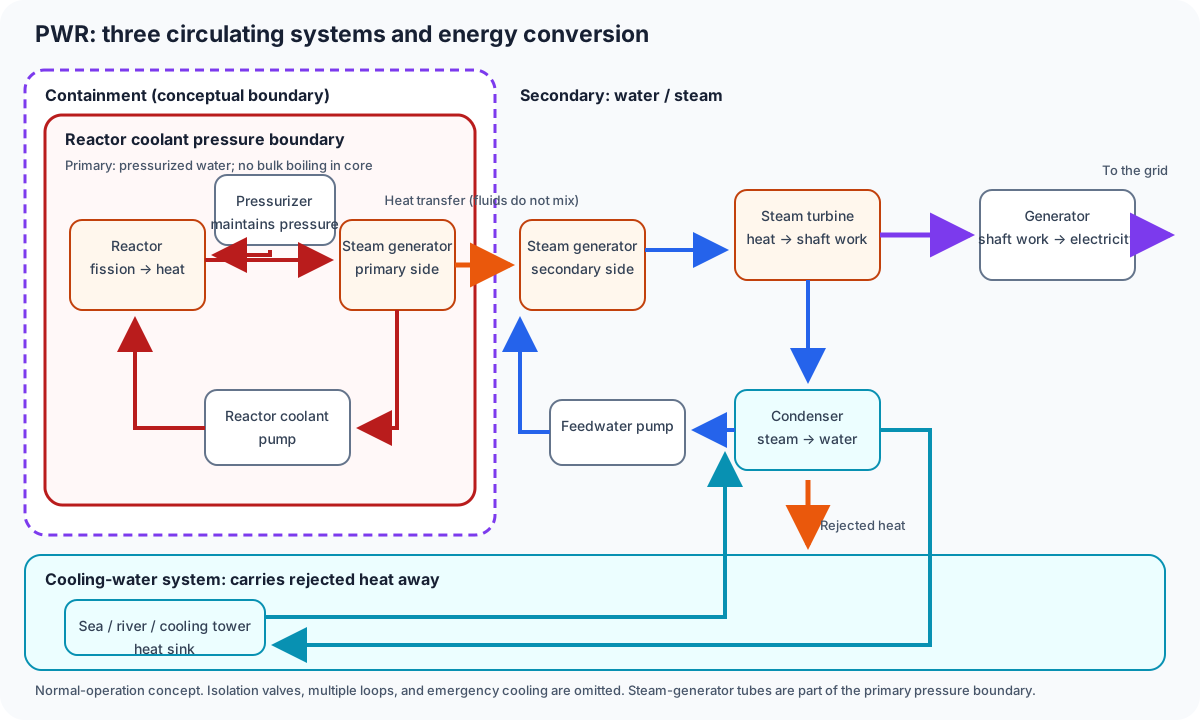
Figure 1 — In a PWR, pressurized primary coolant circulates between the reactor and steam generator, transferring only heat across the tubes. Secondary steam drives the turbine before condensation and feedwater return, while a separate cooling-water system carries rejected heat to a heat sink. The steam-generator tubes form part of the primary pressure boundary; the three fluids do not mix in normal operation.
2. What separates a PWR from a BWR
A PWR (pressurized-water reactor) keeps its primary coolant under high pressure so it doesn't boil inside the reactor, and turns secondary-system water into steam via steam generators. This makes it easier to separate the reactor building's systems from the turbine building's, but it requires a pressurizer, steam generators, and primary pumps. A BWR (boiling-water reactor) produces steam directly inside the reactor and sends it to the turbine through steam separators and dryers. The system is simpler, but radiation management and water-quality management on the turbine side become more important.
Both designs bundle fuel as pellets sealed in zirconium-alloy cladding, with coolant flow carrying away the heat. Cladding temperature, oxidation, hydrogen generation, and fuel-rod vibration are all kept within design limits. Raising burnup improves resource utilization, but the thermal-mechanical margin and accident behavior need to be reassessed as well.
3. Reactivity and output control
Changes in reactor output are governed by reactivity \rho, neutron lifetime, and the delayed-neutron fraction. Conceptually this can be expressed as
where n is neutron population, \beta the delayed-neutron fraction, \Lambda the generation time, and C_i the delayed-neutron precursors. Control rods absorb neutrons to change reactivity, while a PWR also adjusts boric-acid concentration to manage output and burnup over the long term.
As fuel temperature rises, the Doppler effect increases resonance absorption, lowering reactivity. Coolant density changes also alter the moderation condition for neutrons. These negative temperature coefficients naturally push back against output increases, but their magnitude varies with design and operating conditions, so it's confirmed through analysis and testing.
4. Defense in depth and heat removal during an accident
Safety design consists of defense in depth: don't cause an abnormal event, control it if it happens, and confine it even if it progresses. The fuel pellet, cladding, reactor pressure vessel, and containment vessel serve as barriers to radioactive material. Control-rod insertion, emergency core cooling, emergency diesel generators, batteries, alternative water injection, and containment cooling are made redundant through different principles.
Even after the reactor is shut down, decay heat from fission products remains. With decay heat immediately after shutdown as P_0 and time as t, a simplified approximation is
a decay of this general form (coefficients and units depend on the model). Because cooling can't be stopped even days later, passive safety systems that remove heat via natural circulation, steam-driven pumps, gravity injection, or air cooling during a total loss of AC power are under research and adoption.
Safety evaluation considers not just design-basis accidents but multiple failures, external flooding and earthquakes, prolonged station blackout, human factors, and even cyberattacks. Probabilistic risk assessment (PRA) estimates core damage frequency and radioactive release frequency, but a small number alone doesn't guarantee safety. Risk communication that includes analytical uncertainty, evacuation planning, and emergency decision-making is necessary as well.
5. Turbine, generator, and grid operation
Nuclear plants run for extended periods at high capacity factors, with little variation in fuel cost. On the other hand, refueling, periodic inspection, output changes, cooling-water temperature, and transmission-line constraints all shape the operating plan. The steam turbine expands through high-, intermediate-, and low-pressure stages, returning to water in the condenser. Because wet-steam droplets erode blades, reheat, moisture separation, and drain management are all used.
A synchronous generator supplies the grid with the inertia of its rotating mass. Suddenly changing output affects thermal stress, fuel temperature, control-rod position, and steam conditions, so it isn't a simple division of labor where nuclear tracks all renewable variability. It's combined with batteries, hydro, gas turbines, and demand response, each sharing regulation duty at its own time scale.
6. The fuel cycle and waste
The fuel cycle runs from ore mining, conversion, enrichment, and fuel fabrication, through in-core irradiation, to spent-fuel storage, reprocessing, and final disposal. Light-water reactors use low-enriched uranium, but higher-enriched HALEU (high-assay low-enriched uranium) is needed for some advanced reactors. Supply-chain geopolitics and safeguards at enrichment and reprocessing facilities are also part of the technology assessment.
Spent fuel is kept in pools or dry casks to let decay heat and radiation decrease over time. High-level radioactive waste's deep geological disposal is evaluated over long time spans across multiple barriers — vitrified waste form, metal container, buffer material, and bedrock. It's a sociotechnical system involving not just volume but heat generation, radionuclide migration, transport, and regional consent.
7. SMRs and cutting-edge research
- Small modular reactors (SMRs): aim for factory fabrication and passive safety. Smaller output doesn't automatically mean safer — construction cost per kW, module transport, regulatory review, and fuel supply all need comparison.
- High-temperature gas reactors: extract high-temperature heat using helium cooling and heat-resistant fuel, for use in hydrogen production or industrial heat. Graphite irradiation behavior and accident heat removal are the focus.
- Sodium-cooled fast reactors: use fast neutrons for fuel breeding and transmutation. Sodium's chemical reactivity, material corrosion, and the fuel cycle all need managing.
- Accident-tolerant fuel (ATF): uses SiC cladding or improved alloys to suppress high-temperature oxidation and hydrogen generation. Compatibility with normal-operation heat transfer, manufacturability, and irradiation life needs evaluation.
- Digital instrumentation and control: digitizing redundant safety systems, advancing diagnostics and maintenance. Verifying software common-cause failure and cybersecurity is essential.
Fusion runs on a different principle from fission, but it's power-generation research that integrates plasma control, superconducting magnets, the blanket, tritium fuel, heat removal, and remote maintenance. An experimental reactor's plasma performance and a power plant's capacity factor and material lifetime are separate metrics — worth keeping apart when reading the news.
Conclusion
Nuclear power is a heat engine that hands fission heat to a steam turbine, and at the same time a safety system controlling reactivity, cooling, radiation, and the grid. High capacity factor and fuel density are strengths, but evaluation needs to include decay heat during an accident, waste, construction duration, and regulatory and regional consent.
When comparing facilities and research, it helps to confirm: (1) which reactor type handles which temperature and pressure, (2) how many days of post-shutdown heat need to be removed and how, (3) which barriers and protection layers are independent, and (4) who's responsible for fuel, waste, and grid operation.
Why distinguish thermal and electrical nuclear output?
Only part of reactor heat becomes electricity. Align the quantity being compared and check whether internal consumption is deducted.
References
Current step · 5 / 15 · Power Engineering Primer
Comments
Please log in to post a comment
No comments yet.