Contents — find the section you need
Background and reading guide
Background Voltage, current, power, energy and unit conversion.
Fundamentals · Explanations of principles, structure and trade-offs.
Solar power is in surplus at midday and short in the evening. Wind power comes in stronger or weaker than forecast. Grid-scale batteries fill that time gap, handling everything from second-scale frequency regulation to hour-scale peak shifting. But a battery isn't a device that generates fuel — it can only return a fraction of the power it used to charge. In power engineering, you have to evaluate not just capacity (kWh) but also power (kW), response time, lifetime, thermal safety, and grid interconnection, all at once.
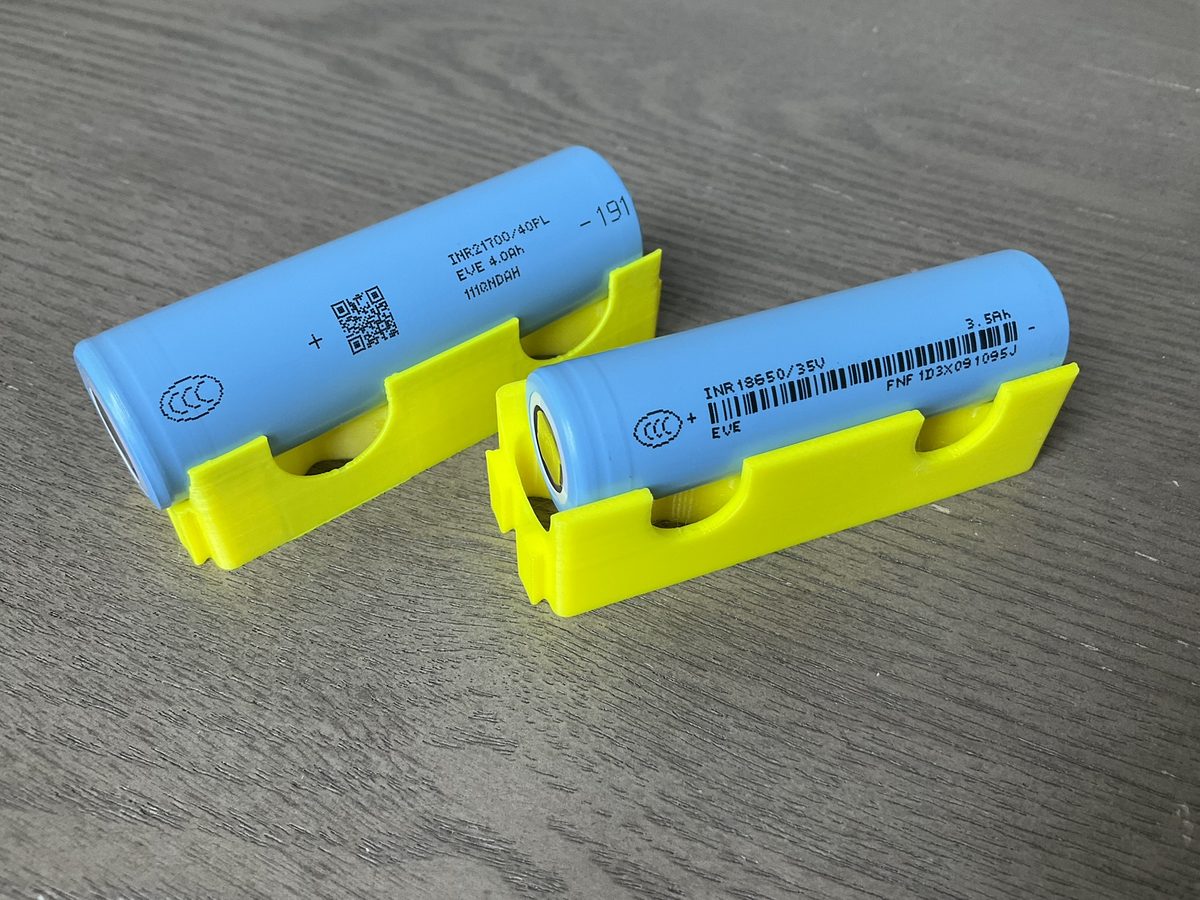 18650 / 21700 cells
 BMS control board
Images: 18650 and 21700 lithium ion battery cell (Sevenethics, CC0) / Asus Zenbook UX31E battery controller (Raimond Spekking, CC BY-SA 4.0), Wikimedia Commons. Representative cell and BMS photos, not a stationary storage-rack product.


The Bottom Line in 30 Seconds
- The number of series cells sets the voltage; the number of parallel cells sets the capacity and maximum current. Nominal energy can be estimated as E=N_sN_pV_{cell}Q_{cell}.
- Lithium-ion batteries offer high round-trip efficiency and power density, but lifetime varies with temperature, charge rate, and SOC range. LFP, NMC, sodium-ion, and other chemistries each have their own strengths depending on the application.
- The BMS monitors cell voltage, current, temperature, and insulation, and estimates SOC (remaining charge), SOH (degree of degradation), and SOP (available power). Don't confuse protection thresholds with estimated values.
- For grid applications, short-term frequency regulation, smoothing renewable output, hour-scale energy shifting, and black-start during an outage are each designed for separately.
- Compare not just the price of the battery itself, but the LCOS (Levelized Cost of Storage), which includes the rack, PCS, transformer, fire-suppression equipment, replacement cells, and disposal.
1. From Cell to Rack
A single cell's electromotive force is set by the potential difference between its positive and negative electrodes. Connecting N_s cells in series raises the voltage; connecting N_p cells in parallel raises the capacity and allowable current. The idealized energy is
For example, arranging 3.2 V, 100 Ah LFP cells into 100 in series and 10 strings in parallel gives a nominal energy of about 32 kWh. The capacity actually usable is estimated by factoring in the upper/lower SOC bounds, temperature, degradation, and PCS efficiency,
Figure 1 — A battery gets bigger simply by adding more cells, but it only becomes a piece of power equipment once you include voltage monitoring, thermal management, contactors, fire suppression, the PCS, and the transformer.
2. Choosing a Chemistry
The positive electrode material has a large effect on energy density, lifetime, cost, and safety. NMC (nickel-manganese-cobalt) tends to achieve high energy density, an advantage in vehicles and other volume-constrained applications, but it needs attention paid to thermal stability and resource cost. LFP (lithium iron phosphate) is at a disadvantage on energy density, but its strengths are thermal stability, cycle life, and a supply chain that doesn't need cobalt. Sodium-ion is promising for its low-temperature characteristics and resource availability, but its energy density per unit volume still falls short of lithium chemistries.
Graphite remains the dominant negative electrode material, with research underway into mixing in silicon to increase capacity. But silicon undergoes large volume changes on charge/discharge, and particle fracture and initial irreversible capacity loss remain challenges. Solid-state batteries, which use a solid electrolyte, can potentially reduce leakage and flammability, but interfacial resistance, the need for applied pressure, manufacturing yield, and low-temperature ionic conductivity remain barriers to practical use.
3. The BMS Is Not a Fuel Gauge
A BMS (Battery Management System) reads each cell's voltage, temperature, and current, and computes the range within which charge and discharge are permitted. SOC can be tracked via coulomb counting,
but the current sensor's offset accumulates over time. Drift is corrected by cross-checking against open-circuit voltage (OCV), an extended Kalman filter, or an equivalent-circuit model. SOH is estimated by separately tracking capacity fade and the rise in internal resistance, and SOP computes the "maximum power available right now" from temperature, SOC, and resistance.
When cell-to-cell variation is large, the weakest cell hits its upper or lower limit first and shuts down the whole pack. Passive balancing, which bleeds energy off through a resistor, is simple but wastes it as heat; active balancing, which shifts energy via capacitors or inductors, is more efficient but adds circuit complexity. In large racks, cell-monitoring ICs, isolated communication, contactors, pre-charge resistors, and fuses are all built in with redundancy.
4. Thermal Design and Safety
Heat generation can be written approximately as
The first term is resistive heating; the second is the reaction's entropic term. High C-rates, low-temperature charging, and internal short circuits within a cell all increase localized heat generation. A large temperature spread also causes degradation rates to diverge, further concentrating current onto the weaker cells.
Thermal runaway is the phenomenon where heat generation outpaces cooling, and electrolyte decomposition, gas generation, and heat propagation to neighboring cells cascade into a chain reaction. It's addressed with a combination of temperature sensors, fuses, vents, rack spacing, smoke/gas detection, water spray or inert-gas suppression, exhaust, and an evacuation plan. Passing a standardized test doesn't mean it's safe if the installation site's ventilation and fire-suppression equipment are inadequate.
5. Matching Use Cases on the Grid
| Application | Typical duration | Key metric | Example control |
|---|---|---|---|
| Frequency regulation | 0.1 s – a few minutes | Response speed, output tracking | Droop, AGC assist |
| Renewable smoothing | Minutes – hours | Forecast error, round-trip efficiency | Charge/discharge scheduler |
| Peak shifting | 2–8 hours | Cost per kWh, cycle life | Optimization, demand forecasting |
| Uninterruptible power | ms – tens of minutes | Switchover time, reliability | UPS, coordination with backup generators |
| Black start | Tens of minutes – hours | Islanded operation, establishing sync | Grid-forming PCS |
Frequency regulation needs high power over a short time; peak shifting needs large capacity over a long time — the required kW and kWh differ. Simply making the battery bigger doesn't solve everything; lifetime and grid interconnection capacity constraints often come first. Whether the PCS is grid-following or grid-forming also determines whether it can stand alone as a voltage source during an outage.
6. V2G and Second Life
V2G (Vehicle-to-Grid), which pools electric vehicles and discharges them back to the grid, is the idea of using distributed batteries as a source of regulating power. It requires simultaneously optimizing users' departure times, state of charge, distribution-line capacity, and battery degradation cost, and it also raises communication-latency and privacy concerns. VPP (Virtual Power Plant), which pools home batteries and water heaters, is built on the same idea.
Second life, which repurposes batteries that have finished their service life in a vehicle for stationary use, has the potential to make better use of the carbon emitted during manufacturing. On the other hand, when a cell's history is unknown, SOH variation is large, and the cost of re-inspection, teardown, and warranty coverage rises. Rather than a simple price comparison against a new cell, the decision should factor in the error in estimating remaining capacity and the cost of safety monitoring.
7. A Lens for Reading Current Research
- Fast charging and low-temperature performance: research into electrolytes that suppress lithium plating, heating control, and negative-electrode structure. Look at the trade-off against cycle life, not just charge time.
- Sodium-ion: aims to reduce resource constraints and lower cost for stationary applications. Check whether the cell voltage and energy density suit the intended use.
- Solid-state batteries: hoped to bring non-flammability and high energy density, but the solid interface, applied pressure, and manufacturing yield remain the bottlenecks.
- Digital twins for degradation: linking operating history, temperature, impedance, and teardown analysis to estimate remaining lifetime as a probability distribution.
- Recycling: comparing wet, dry, and direct-regeneration processes across recovery rate, purity, energy use, and logistics all together. Economics shift as material prices fall.
A research paper's "X% capacity improvement" figure changes meaning depending on electrode area, C-rate, temperature, and cycle-life endpoint. Moving to a commercial rack requires, beyond single-cell performance, module-level thermal-propagation testing, control compatibility with the PCS, and a fire-safety, insurance, and disposal plan.
Summary
A power battery is a system combining the chemical cell, the BMS, thermal management, the PCS, the transformer, communications, and fire suppression. Rather than comparing kWh alone, checking the required timescale, peak kW, round-trip efficiency, lifetime, and isolation on failure reveals the chemistry and configuration that actually fits the application.
Are kW and kWh interchangeable battery ratings?
kW is power and kWh is energy. Estimate duration by dividing usable energy by average power, accounting for losses and operating limits.
References
Current step · 10 / 15 · Power Engineering Primer
Comments
Please log in to post a comment
No comments yet.