Contents — find the section you need
Background and reading guide
Background Basic force, motion and energy terminology; use the linked background explanations.
Fundamentals · Explanations of principles, structure and trade-offs.
The tractors, combines, rice transplanters, and seeders covered so far in "Agricultural Machinery Engineering 101" were all machines that process seasonal work over a short period. Livestock machinery has a different character. What it deals with isn't a field but a living creature, and milking, feeding, and manure removal continue without stopping, multiple times a day, 365 days a year. And cows can't be made to wait, and rushing them unduly rebounds on milk yield and health. The core of livestock machinery engineering isn't horsepower or processing speed — it's the design of metering, conveyance, and sensing systems that keep managing "when, to whom, what, and how much," without ever letting a living creature's rhythm stop.
This article covers four areas: the automatic milking system (milking robot), the TMR mixer (feed-mixing and feeding machine), automation of manure removal and barn cleaning, and individual-management sensors (activity meters, wearable tags). All primarily target dairy and beef cattle operations. Unless otherwise noted, product specs and feature descriptions are based on each maker's public information confirmed as of September 4, 2026.
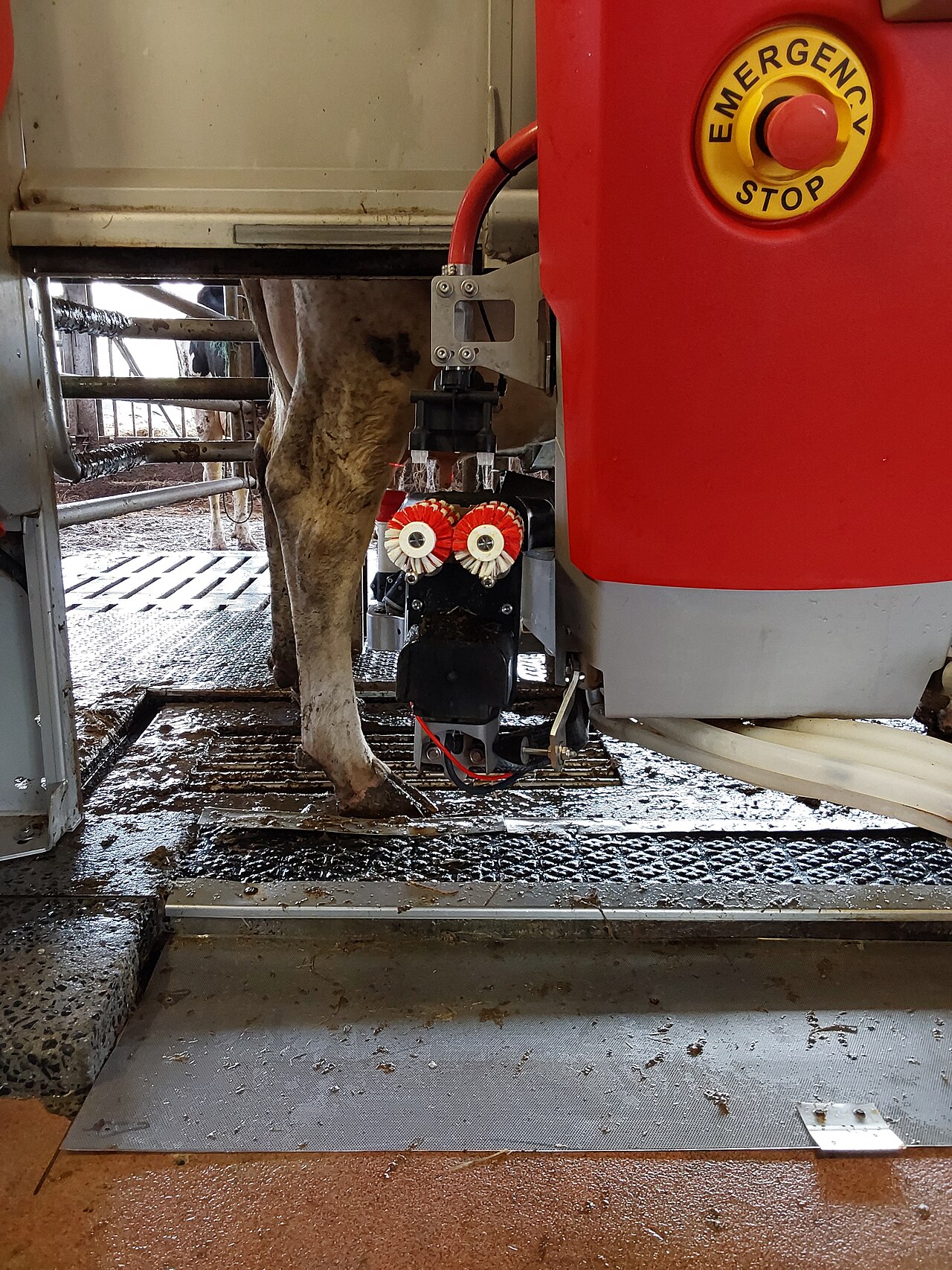 An automatic milking robot in use
Image: Cow in milking robot 01 (.Anja., CC BY-SA 4.0), Wikimedia Commons. Not the Lely Astronaut or DeLaval VMS V300 discussed in the text — a representative example showing how a milking robot locates, cleans, and attaches to the teats.

30-Second Summary
- A milking robot integrates individual identification, laser/camera-based teat detection, automatic attachment via a robotic arm, and milk-quality sensing (conductivity, color, somatic cell count, etc.), realizing "voluntary milking," in which the cow visits the milking robot of her own will.
- Cow-traffic design comes in two approaches: "free traffic," where cows move freely around the barn, and "guided traffic," where selection gates direct the sequence of feeding, resting, and milking — and this balance affects a milking robot's processing efficiency and labor burden.
- The TMR (Total Mixed Ration) mixer is a metering-and-mixing machine that blends materials of differing physical properties — forage, concentrate feed, and additives — into a single uniform feed, using a horizontal or vertical auger. Towed, self-propelled, and stationary types, in both electric and engine-driven forms, coexist in the market.
- Manure removal and barn cleaning are automating from the traditional continuous-conveyance mechanism of chain scrapers, to robots that collect via vacuum suction, to robots that autonomously drive through the barn and collect manure into an onboard tank.
- Individual-management sensors are a technology that uses a wearable tag with a built-in accelerometer to measure a cow's activity level and rumination time, detecting deviation from each individual's baseline to catch signs of estrus, disease, or calving earlier and more broadly than human observation.
- The Lely Astronaut A5 Next targets roughly 60 cows per unit; the DeLaval VMS V300 claims up to a 99.8% attachment success rate and support for herds up to 10,000 head. Domestically, Ryokusan's Mixtron series is representative for TMR mixers, Orion Machinery's BARN-E for autonomous manure-collection robots, and Farmnote's Farmnote Color for individual-management sensors.
1. The Design Philosophy Shared Across Livestock Machinery: Never Stop the Cow's Rhythm
Machinery aimed at crops only needs to deliver high processing capacity during the fixed seasons of seeding, pest control, and harvest. Livestock machinery, by contrast, carries constraints that come from its target being a living creature. Milking frequency and interval must be managed in relation to yield, udder condition, and the rest of the feeding program; feed must be given every day at a consistent quality and quantity or the fermentation environment inside the rumen (first stomach) is disrupted; and manure left on the floor makes hoof and udder hygiene harder to manage. In other words, livestock machinery isn't "a machine that levels out the peaks of seasonal labor" — it's "a machine that keeps running, more reliably than by hand, work that must never be interrupted, every single day."
This difference also shows up in design philosophy. A milking robot is a passive system that operates based on the cow's own will (her visiting behavior); a TMR mixer is a device that translates the results of a numerical calculation — nutritional design — into mechanical metering precision; and manure-removal robots and sensors are continuous-monitoring machines aimed at "noticing before an abnormality occurs." The rest of this article looks at each of these in turn.
2. The Milking Robot: A Machine Where the Cow Chooses "When She's Milked"
The prototype of the milking robot (voluntary milking system, VMS) dates back to the early 1990s. Lely positions August 18, 1992 — the day raw milk first flowed into the tank from the first Astronaut milking robot — as a major step in commercial robotic milking. Lely: 25 Years of Robotic Milking It has since developed in stages: automatic teat-cup attachment (A2), integration of milk-quality sensing into the robotic arm (A3), and the I-Flow concept (A4), a straight-line passage layout that doesn't impede cow movement. Lely: History of the milking robot
Individual Identification, Teat Detection, and Automatic Attachment
A milking robot's basic flow proceeds in this order: (1) individual identification of the cow, (2) detection of teat position via 3D camera/laser, (3) pre-treatment (cleaning, stimulation) and automatic teat-cup attachment via robotic arm, (4) milk-quality/volume monitoring during milking, and (5) post-milking disinfection and cleaning. The Lely Astronaut A5 Next is equipped with a teat-detection system combining three-layer laser scanning with a wide-field camera, a hybrid arm that substantially cuts air consumption compared with the previous model, and a control system called AOS-2. Cornes Agri: Astronaut A5 The DeLaval VMS V300 claims up to a 99.8% attachment success rate via its DeLaval InSight teat-detection system, up to a 50% reduction in attachment time compared with the previous model, and up to a 99% hit rate for teat spray (teat disinfection), with an arm range of motion covering teat heights of 27–75 cm. DeLaval: VMS V300 product brochure The latest model, announced in April 2025, uses a feature called Flow-Responsive Milking to achieve an average time savings of 27 seconds per milking (up to 40 seconds), and it's reported that existing customers have said the same single robot can now milk roughly five additional cows. DeLaval: 2025 model announcement
For milk-quality sensing, conductivity, color, and temperature are measured in real time, and milk showing signs of mastitis is automatically diverted. It's worth noting this isn't a feature that increases milk volume itself — it's a quality-control function that keeps abnormal milk from mixing into the tank destined for shipment.
Cow-Traffic Design: Free Traffic and Guided Traffic
Looking only at the tens of seconds to few minutes of work involved in attaching teat cups, a milking robot might look like a simple piece of automation. In practice, though, its actual performance depends heavily on the barn-wide traffic design that governs "when a cow visits the robot." DeLaval cites two approaches: "free traffic," where cows can move freely between the feed area, resting area, and the robot, and "guided traffic," where a selection gate judges the cow's destination and directs her toward feeding, resting, or milking — stating that free traffic offers strength in barn-design flexibility and low cost, while guided traffic offers strength in reducing the fetching of cows who refused milking and stabilizing milking frequency. DeLaval: VMS V300 product brochure Which is superior isn't the question — it's a design decision made according to herd size, barn layout, and labor structure.
Figure: Created by Duskcoil. Actual gate configuration and milking-eligibility criteria vary by barn design and maker.
Factors That Determine Cows-Per-Unit
A commonly used metric for deciding how many milking robots to install is a rule of thumb of "about X cows per unit." Lely explains that, while it varies by herd size, milk-yield level, and barn layout, many farms use a rough target of about 60 cows per unit. Lely: Astronaut A5 Next The DeLaval VMS V300 states that large-scale operations can achieve performance even with herds of 10,000 head or more — but this doesn't mean a single unit processes 10,000 head; it refers to the capability of an entire large facility combining multiple units. DeLaval: VMS V300 product brochure
The thinking behind this rule of thumb is easier to understand when organized as an equation. Let T [min] be the daily operating time, t [min] be the average time per visit (including individual identification, teat detection, attachment, milking, and washing), and f [visits/day] be the average number of times one cow visits per day. Then the theoretical maximum number of cows the unit can process, N_{\max}, can be approximated as
In actual operation, a realistic head count is N\approx\eta N_{\max}, applying a utilization rate \eta<1 that accounts for the robot's idle time, cleaning, failure response, and time-of-day skew in visits (e.g., concentration at night). What this equation shows is that a milking robot's processing capacity isn't determined simply by "milking speed" — it's determined by two wheels together: mechanism design, in how much the per-visit time t can be shortened (this is where DeLaval's attachment-time-reduction claims come into play), and barn design, in how stably the visit frequency f can be maintained.
3. The TMR Mixer: A Metering Machine That Blends Feed into a "Uniform Meal"
TMR (Total Mixed Ration) is feed in which forage (hay, silage, etc.), concentrate feed (grain, soybean meal, etc.), and minerals/additives are uniformly blended in a ratio based on nutritional design. A TMR mixer is a metering-and-mixing machine, either tractor-towed or self-propelled, that performs this blending, with the aim of preventing cows from "selective feeding" — picking out only certain components from the feed — and delivering the designed nutritional balance across the whole herd. Livestock Terminology Dictionary: TMR mixer
Horizontal-Auger and Vertical-Auger Types
A TMR mixer's mixing mechanism splits broadly into horizontal and vertical types. In the horizontal type, two cross augers rotate inside a cylindrical box, driving feed to the center of the box where it collides and piles up, then breaking it apart via circulating motion front-to-back. In the vertical type, one or more vertical augers inside a funnel-shaped hopper draw feed downward while cutting and agitating it. Ryokusan's horizontal-axis series is an example of the former, and Kuhn's TMR Vertical Twin Mixer VT200 series (twin augers, required power 75.0–140.0 PS, vehicle weight 4,720–8,040 kg) is an example of the latter. Ryokusan: Mixtron MSK Agricultural Machinery: VT200 series Generally, because the auger sits at the bottom in a vertical-type unit, machine height is easier to keep low, and it's said to suit facilities with strict height constraints at the barn entrance or feed trough.
Figure: Created by Duskcoil. Actual auger shape, count, and rotation direction vary by machine.
Drive Method and Higher-Frequency Feeding
Drive methods include the towed type, driven by a tractor's PTO, the self-propelled type (engine-mounted), and the stationary type installed within a facility (engine or electric). Ryokusan's Mixtron series spans a public spec range including: towed SG-T at 5–33 m³, 3-wheel self-propelled FKG at 7–11 m³ (55 kW), 4-wheel self-propelled FL at 13–17 m³ (90 kW), stationary engine-driven MGS at 15–33 m³ (90–140 kW), and stationary electric SG-SE at 5–33 m³ (15–160 kW). Ryokusan: Mixtron
Feed mixed by a TMR mixer is normally given in bulk to the feed trough once or twice a day. A feeding robot such as Lely Vector, by contrast, loads materials from the feed storage area into a mixing hopper and then patrols the feeding aisle at high frequency, delivering small amounts at a time. A laser sensor detects the remaining amount of feed in the trough and replenishes it whenever it's insufficient, aiming to reduce the "stretch of time after fresh feed has decreased when the cow doesn't eat for a while" that tends to occur with bulk feeding, boosting intake and reducing leftover (wasted) feed. Cornes Agri: LELY Vector
Confirming the Ration Formulation with an Equation
Keep the mass and concentration bases consistent. Let m_i be as-fed mass, d_i the dry-matter fraction (0 to 1), and C_i nutrient concentration on a dry-matter basis. Ingredient dry mass is m_i d_i.
If C_i is entered as a percentage, the first result is a percentage. Do not weight dry-basis concentrations directly by wet masses. In a synthetic example with 10 kg as-fed of each ingredient, dry fractions 0.4/0.9 and dry-basis concentrations 10%/20%, dry masses are 4/9 kg, mixed concentration is about 16.92%, and the dry fraction is 65%. Moisture changes therefore require both moisture measurement and mass adjustment. Penn State Extension.
4. Automating Manure Removal and Barn Cleaning
When manure and urine pool on a barn floor, hooves are constantly exposed to an unsanitary, damp environment, raising the risk of hoof disease and mastitis. Manure removal is less conspicuous than milking or feeding, but its frequency and thoroughness are directly linked to cow health.
The traditional approach is the chain-type barn cleaner, in which a scraper driven by a chain travels continuously or intermittently back and forth inside a channel embedded in the floor, collecting manure and urine and sending it to an outlet or an underground pit. Orion Machinery's barn cleaners (BCB-8A, BCB-10) belong to this lineage, and are characterized by high durability and a damage-prevention safety mechanism. Orion Machinery: Manure treatment system
The Lely Discovery Collector, in contrast, uses no floor-fixed channel — it collects manure and urine via vacuum suction while autonomously driving through the barn. A front scraper gathers the manure and urine before it's drawn into the machine via a suction nozzle, and in sand-bedded barns, water is used to flush the sand/manure mixture out of the tank. Charging is via a wireless charging pad, and dumping, charging, and water refill can all be handled together at a single central station. Lely: Discovery Collector
Autonomous-drive products have also appeared from domestic makers. "BARN-E," released by Orion Machinery in February 2024, is a robot that automatically drives through the barn at a set time and collects manure and urine directly into an onboard tank; it drives at a low speed of 6.5 m per minute, out of consideration for cow safety, can clean the entire step-free area, and is expected to help prevent hoof disease by helping keep hooves dry. Operating status can be checked over the internet via the JMS management system. Rakuconne: Automatic manure-collection device "BARN-E"
Figure: Created by Duskcoil. Actual structure, driving route, and discharge method vary by machine.
Regardless of method, the common goal is to "minimize the dwell time of manure and urine." Continuously operating chain-type systems are simple in structure and reliable, but require incorporating the civil-engineering constraint of a floor channel into the barn design. Autonomous-drive robots have the advantage of requiring less floor renovation, but adapting to the barn environment — aisle width, steps, obstacles — and building out battery/charging infrastructure are conditions for adoption.
5. Individual-Management Sensors: Reading Signs of Estrus and Disease from Behavioral Data
The key to reproductive management in dairy operations is accurately catching the timing of estrus and performing artificial insemination at the right time. Human observation (visual checking) carries a heavy labor burden and easily misses nighttime or brief signs of estrus. Individual-management sensors are a technology that supplements this observation labor by continuously acquiring behavioral data via a wearable tag attached to, for example, a cow's neck, detecting signs of estrus, calving, and disease.
Farmnote Color is a collar-type wearable device with a built-in accelerometer that collects a cow's activity data in real time, sends it to the cloud via a gateway, and uses AI-based behavioral analysis to detect abnormalities such as signs of estrus or disease, notifying a smart device. The unit measures 106mm × 80mm × 29mm, weighs about 165g, and has a battery life of about five years; the relay unit, Air Gateway, is stated to support up to 100 head within a 30-meter radius of its installation point in the barn. Detection items span a wide range, including signs of estrus, decline in activity level (signs of disease), signs of calving up to 24 hours before, and rumination-time data. Farmnote: Farmnote Color
Capturing Abnormality via Deviation from an Individual's "Baseline"
A concept shared across these wearable-based estrus and health monitoring systems is that, rather than using a single uniform threshold across the whole herd, they detect deviation from each individual's own baseline state. Letting a given cow's daily activity index be A(d), and letting \mu and \sigma be the mean and standard deviation over a recent fixed period (excluding event periods such as estrus or calving), the standardized deviation can be expressed as
The framework is that if z(d) is large in the positive direction and persists for a certain time, it suggests a possible rise in activity associated with estrus, while a large deviation in the negative direction suggests a possible decline in activity associated with disease or lameness. By absorbing individual differences (naturally active cows vs. calm cows) into \mu,\sigma, sensitivity can be raised beyond a fixed threshold applied across the whole herd — but this requires an accumulation period to establish the baseline, and it's worth noting that activity level can also change due to other factors, such as around calving or with seasonal/temperature changes. Which specific algorithm actual products use is largely undisclosed; what's presented here is the framework of thinking commonly used in the industry.
6. Comparing the Public Specs of Current Products
The table below extracts, for each of the four areas, metrics that can be reliably read from public pages. Because pricing varies by spec, region, and options, adoption decisions should be reconfirmed with a dealer quote. The reference date is September 4, 2026.
| Category | Product example | Key points readable from public information | Official URL |
|---|---|---|---|
| Milking robot | Lely Astronaut A5 Next | Rough target of ~60 cows per unit, three-layer laser + camera teat detection, hybrid arm, AOS-2 control | Astronaut A5 Next / Domestic distributor |
| Milking robot | DeLaval VMS V300 | Up to 99.8% attachment success rate, up to 50% shorter attachment time, up to 99% teat-spray hit rate, supports free/guided traffic | Product brochure PDF |
| TMR mixer | Ryokusan Mixtron series | Towed (5–33 m³), 3-wheel self-propelled (7–11 m³/55 kW), 4-wheel self-propelled (13–17 m³/90 kW), stationary engine-driven (15–33 m³), stationary electric (5–33 m³) | Mixtron |
| TMR mixer | Kuhn VT200 series (Vertical Twin) | Vertical twin auger, required power 75.0–140.0 PS, vehicle weight 4,720–8,040 kg | VT200 series |
| Feeding robot | Lely Vector | Automatic mixing + high-frequency patrol feeding, remaining-feed detection via laser sensor, feed grabber with load measurement | LELY Vector |
| Manure-removal robot | Lely Discovery Collector | Vacuum-suction method, wireless charging, dump/charge/water-refill handled together at a central station | Discovery Collector |
| Manure-removal robot | Orion Machinery BARN-E | Autonomous collection robot, driving speed 6.5 m/min, JMS remote monitoring, released February 2024 | BARN-E introduction article |
| Individual-management sensor | Farmnote Color | Collar-type accelerometer (106×80×29mm, ~165g), ~5-year battery life, Air Gateway 30 m radius / up to 100 head, detects estrus, calving signs, and rumination | Farmnote Color |
What to be careful of in comparison is not simply ranking figures like "head count per unit" or "attachment success rate" side by side. Actual values vary with test-farm data, herd breed composition, barn layout, and management skill. DeLaval itself states plainly, in its own materials, that published figures are data from test/demonstration farms and don't guarantee results. DeLaval: VMS V300 product brochure
7. Data Integration and the Management Impact of Smart Dairy Farming
Milk volume and quality data from the milking robot, feeding records from the TMR mixer, operational logs from the manure-removal robot, and activity data from individual-management sensors each hold value on their own, but they show their real worth when integrated into a single herd-management system. If a decline in milk volume seen in milking data, a decline in activity shown by an individual-management sensor, and an increase in leftover feed on the TMR side all coincide for the same individual at the same time, that can lead to early disease detection or a review of feed design. The Ministry of Agriculture, Forestry and Fisheries' Smart Agriculture Technology Catalog (Livestock) organizes such technologies into categories — "sensing/monitoring," "use of biometric data," "use of feeding-environment data," "automated driving/labor reduction," and "management data" — positioning livestock farming as one of the areas of Japanese agriculture where ICT adoption and smartification have progressed furthest. Ministry of Agriculture, Forestry and Fisheries: Smart Agriculture Technology Catalog (Livestock)
On the management-impact side, the Agriculture and Livestock Industries Corporation has published a case analysis of farms that adopted milking robots, estimating trends in labor hours after adoption and the effect on profitability through improvements in milking speed, feeding optimization, and livestock-management efficiency. Agriculture and Livestock Industries Corporation: The impact of milking robots on improving dairy management profitability and labor conditions These estimates are based on specific farms and premises, and should be read with the understanding that the magnitude of the effect varies with management scale and operating method.
8. Points to Watch in Adoption and Operation
Automation of livestock machinery brings the clear benefit of reduced labor burden, but comes with several operational caveats. First, for the milking robot, feeding robot, and manure-removal robot alike, if sensor or mechanism calibration drifts, it leads to false detections or degraded work quality. Teat-detection accuracy, feed-metering accuracy, and the accuracy of the activity sensor's baseline estimation can't be maintained without regular inspection, cleaning, and software updates.
Second, automation doesn't mean "observation is no longer needed." Even when an individual-management sensor flags a deviation from baseline, the final judgment — confirming estrus, deciding whether treatment is needed — is made by a person. The sensor is only an aid to reduce oversights; it doesn't replace on-site observation, palpation, or clinical findings.
Third, the high humidity, ammonia, and dust inside a barn are a harsh environment for electronics, batteries, and wireless communication. When adopting wireless charging or an autonomous-driving robot, it's necessary to confirm communication stability, dust/water resistance, and fail-safe behavior in the event of a power or communication outage. Fourth, the herd's traffic design (free traffic or guided traffic) is a critical variable affecting a milking robot's performance, and needs to be considered as one with barn design — not just compared on the machine's standalone specs.
Summary
Unlike agricultural machinery aimed at crops, livestock machinery is a category of machine aimed at keeping daily work running without stopping a living creature's rhythm. A milking robot operates on a voluntary basis triggered by the cow's own visiting behavior, and both the processing time of the sequence — teat detection, automatic attachment, milk-quality sensing — and barn traffic design together determine processing capacity. The TMR mixer is a metering machine that keeps blending an inhomogeneous material, feed, according to a nutritional design expressed as a weighted average, and the horizontal-vs-vertical auger distinction represents a trade-off between machine shape and installation constraints. Manure removal and barn cleaning are expanding from the traditional chain type toward vacuum-suction and autonomous-drive methods, and individual-management sensors attempt to catch signs of abnormality from each individual's deviation from their own baseline. All of these technologies need to be evaluated with the understanding that they only function as automation targeting a living creature when combined with barn design, feeding management, and a person's final judgment — not by standalone performance metrics alone.
Can robot throughput alone determine fleet size?
Include cleaning, queues, failures, and animal traffic. Check whether animals and tasks can keep moving during peak demand.
References
- Lely: Astronaut A5 Next (confirmed September 4, 2026)
- Lely: 25 Years of Robotic Milking (confirmed September 4, 2026)
- Lely: History of the milking robot (confirmed September 4, 2026)
- Cornes Agri: Astronaut A5 (confirmed September 4, 2026)
- DeLaval: VMS V300 product brochure (PDF) (confirmed September 4, 2026)
- DeLaval: 2025 model announcement (confirmed September 4, 2026)
- Ryokusan: Mixtron (confirmed September 4, 2026)
- MSK Agricultural Machinery: Kuhn VT200 series (confirmed September 4, 2026)
- Cornes Agri: LELY Vector (confirmed September 4, 2026)
- Lely: Discovery Collector (confirmed September 4, 2026)
- Orion Machinery: Manure treatment system (confirmed September 4, 2026)
- Rakuconne: Automatic manure-collection device "BARN-E" (confirmed September 4, 2026)
- Farmnote: Farmnote Color (confirmed September 4, 2026)
- Livestock Terminology Dictionary: TMR mixer (confirmed September 4, 2026)
- Ministry of Agriculture, Forestry and Fisheries: Smart Agriculture Technology Catalog (Livestock) (confirmed September 4, 2026)
- Agriculture and Livestock Industries Corporation: The impact of milking robots on improving dairy management profitability and labor conditions (confirmed September 4, 2026)
Current step · 7 / 7 · Agricultural Machinery Engineering
Comments
Please log in to post a comment
No comments yet.