Contents — find the section you need
Background and reading guide
Background Basic force, motion and energy terminology; use the linked background explanations.
Fundamentals · Explanations of principles, structure and trade-offs.
The core of a seeder isn't "sowing seeds" — it's "continuously cutting out seeds, a granular material whose size and shape vary subtly, at a fixed interval and depth, without a break." A fertilizer applicator is likewise a metering machine that keeps placing a fixed amount of fertilizer, whose flowability as a powder or granule is never quite constant, at a fixed position. What moves dramatically are the seeding claws or spreading vanes, but performance is actually determined by the design of the metering mechanism that handles these "unwieldy granular bodies" — seeds and fertilizer.
This article covers the principles of mechanical and pneumatic metering, broadcast/band/variable-rate fertilization, and design examples of current products. The seedling cut-out and feed mechanism in a rice transplanter used for paddy rice is covered in detail in the article on rice transplanters; this article focuses mainly on seeders for dryland and grain crops, and tractor-towed fertilizer applicators. Unless otherwise noted, product specs are based on each maker's public information confirmed as of September 4, 2026.
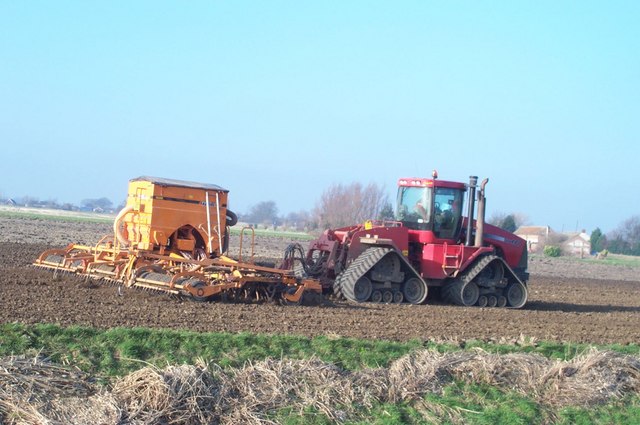 A tractor-towed seed drill in service
Image: Large articulated tractor sowing wheat (joe donovan, CC BY-SA 2.0), Wikimedia Commons. Not a specific metering-mechanism product discussed in the text — a representative example of a tractor-towed seed drill's layout and seed hopper.

30-Second Summary
- A seeder's performance is determined by its "metering" mechanism, which cuts out seed accurately, one seed (or a fixed amount) at a time, at fixed intervals. Broadly, methods split into mechanical (plate/belt) and pneumatic (vacuum/pressure).
- Mechanical types are structurally simple and suited to low-speed work or small-scale, multi-crop operations, but skips and doubles tend to increase as speed rises. Pneumatic types hold seeds one at a time by suction or pressure, aiming for stable seeding even at high speed.
- Seeding depth must be designed together with covering-soil thickness and press-wheel firmness. If depth isn't uniform, germination isn't uniform either, which directly translates into variability in later growth and harvest work.
- Fertilization includes full-field broadcast application spread across the whole field, band application applied along the seeded row, and side-band (side-dress) application applied near the plant base — used differently depending on required amount, fertilizer efficiency, and environmental load.
- Variable-rate application (VRA) is a technology that varies the application amount by position within the field, following a prescription map built from yield maps or soil sensors. It presupposes combination with RTK guidance.
- Precision seeding should be evaluated not just by average hill/plant spacing, but by variability, skip rate, and double rate.
1. Why a "Metering" Machine Rather Than a "Sowing" Machine
Within the history of agricultural mechanization, seeding was one of the operations where variability by hand was greatest. In hand-sowing, the amount of seed in a handful, the interval between sows, and the thickness of covering soil all differed by worker. The evolution of the seeder was the process of replacing this human variability with mechanical repeatability. The drill seeder, put into practical use in the late 19th century, had a mechanism that dropped seed at fixed intervals from a seed box into a hopper, and in the 20th century, mechanisms aimed at handling large-seeded crops like corn and soybeans one seed at a time — "singulation" — developed further.
In Japan, the target crops and cultivation systems are wide-ranging: nursery-tray seeding for paddy rice, drill seeding for wheat and soybeans, and dibble (point) seeding for vegetables. As a result, a diverse range of seeder forms coexist, from hand-push machines like Mukai Kogyo's to tractor-towed seeders combined with tillage, to precision seeders for facility horticulture.
2. Mechanical Metering: Plates and Belts
Figure: Created by Duskcoil. Actual plate shape, cell count, and rotation direction vary by machine and target seed.
Mechanical metering is a method in which recesses (cells) formed in a circular or belt-shaped plate scoop up a fixed amount of seed each time they pass through the bottom of the seed hopper, then rotate around and release the seed by gravity at the position of the drop opening. Designing each cell to hold exactly one seed approaches single-seed sowing; making the cell larger produces multi-seed or fixed-quantity sowing. Mukai Kogyo's hand-push seeder, the "Gonbei," implements this concept via belt feed, using an endless-belt type (EH type) for small vegetable seeds and a link-belt type (LH type) for large seeds such as soybeans and corn. Mukai Kogyo: Gonbei quick-reference lineup
The weak point of mechanical types is that as the plate's rotation speed (i.e., ground speed) increases, "skips" — where a seed fails to fully enter a cell — and "doubles" — where multiple seeds drop at once — tend to increase. The greater the variability in seed shape and size, the harder it is to match the seed to the cell. This suits low-speed, small-scale, multi-crop seeding, but tends to hit limits in high-speed, large-area applications.
3. Pneumatic Metering: Vacuum Suction and Pressure
Many seeders aimed at high speed adopt pneumatic metering, which uses air power to hold seed one at a time. In the vacuum (negative-pressure) type, a vacuum pump applies suction to holes drilled in a rotating disc, drawing in seeds one at a time and carrying them, then stopping suction at the drop position to release them. The pressure type works in reverse, using positive-pressure air to push seed out.
This idea is the same as with the planting claw on a rice transplanter: if the horizontal relative velocity at the instant a seed is dropped can be kept small, it's easier to prevent the seed from rolling or bouncing and disrupting spacing. John Deere's ExactEmerge combines a vacuum meter with BrushBelt conveyance, and its design of placing seeds in the furrow without bouncing is claimed to maintain seed-spacing and depth uniformity even when raising seeding speed from a traditional benchmark of roughly 8 km/h (5 mph) up to roughly 16 km/h (10 mph). John Deere: ExactEmerge Row Unit Kinze's vacuum meter is likewise stated to have consistently achieved singulation rates of 99% or higher at speeds up to roughly 13 km/h (8 mph). Kinze: The Kinze Vacuum Meter European makers such as Väderstad have also adopted vacuum-type metering as their mainstay seeding-unit technology.
These are all examples of precision seeders for large-scale North American and European dryland farming of corn and soybeans, and differ in scale from the mainstream of domestic Japanese paddy rice and dryland farming. Even so, the principle that "handling seeds one by one reliably requires the help of air power" is a concept commonly used in domestic precision seeders for vegetables as well.
4. Seeding Depth, Press-Wheel Firmness, and Covering Soil Are a Continuation of the Seeder's Job
Even if seed can be dropped at the correct interval, germination won't be uniform unless depth is uniform. Many seeding units perform, as an integrated series of steps, cutting a furrow with an opening disc, dropping the seed, covering it with soil via a covering wheel, and pressing the soil and seed together with a press wheel. Just as a rice transplanter's float uses the paddy surface as its reference plane, a seeder's gauge wheel uses the ground surface as the reference for setting furrow depth. Ground undulation, soil moisture and firmness, and the amount of residue are all shared factors that can throw off the set depth.
5. Fertilization Methods: Broadcast, Band, and Side-Band Application
Figure: Created by Duskcoil. Actual placement interval and depth vary by crop and fertilizer mechanism.
Full-field broadcast application uses centrifugal vanes or a spinner to fling fertilizer across a wide area; work speed is fast, suited to quickly covering a large area, as with basal fertilizer. Taisho's broadcaster products publish a spreading width of 4.0–7.5 m for sand-form fertilizer and 6.0–12.0 m for granular compound fertilizer. Taisho: Product catalog That said, variability from wind-driven drift, over- or under-application at field edges, and uneven reach between rows tend to be challenges.
Band application concentrates fertilizer in a band along the seeded row, raising fertilizer-use efficiency by concentrating it near the roots. Side-band application goes further, applying it at a specific position to the side and slightly below the plant — the same idea as a rice transplanter's side-band fertilization mechanism, placing fertilizer ahead of the direction the roots will grow. The rice transplanter's implementation of side-band and variable-rate fertilization is also touched on in the article on rice transplanters.
Generally, full-field broadcast trades fertilizer efficiency and environmental load (surface runoff, volatilization) for work speed, while band and side-band application are advantageous for fertilizer efficiency but make the machine more complex since the mechanism is integrated with seeding/transplanting work. Which method is "correct" isn't the question — it's a design decision balanced against crop, soil, weather conditions, and input cost.
6. Variable-Rate Application (VRA): The Prescription Map as Input
Variable-rate application is a technology that varies the application amount by position within the field, taking as input a prescription map q(x,y) built from yield maps, soil sensors, and growth sensing. Iseki's Smart Top-Dressing System publicly describes the concept of measuring crop growth in real time with a laser optical sensor and coordinating it with a GNSS auto-steer and variable-rate fertilizer applicator in a way that's less affected by environmental conditions such as time of day. Iseki: Smart Top-Dressing System The company also presents a case study of a variable-rate-fertilization rice transplanter equipped with sensors that detect soil-layer depth and soil fertility, introducing a demonstration in which lodging was significantly reduced. Iseki: Lodging significantly reduced when combined with variable-rate fertilization
The effectiveness of variable-rate application is only realized once three things come together: the accuracy of the prescription map, the response lag between GNSS position and the applicator, and the switching speed of the fertilization mechanism. Even with high position accuracy, if the resolution and freshness of the soil diagnostics or yield data underlying the prescription are coarse, finely varying application instructions won't match reality. The design philosophy of combining RTK guidance with variable-rate application is covered in the article on RTK guidance.
7. Metrics for Evaluating Precision Seeding
As with rice transplanters, it's necessary to look not just at average hill spacing but at its variability. Letting the set hill spacing be s_0 and the m measured hill spacings be s_i,
and, in the seeder field, metrics such as skip rate (seed skips), double rate (doubles), and singulation rate (single-seed rate) are commonly used in addition. The target plant population per unit area N_h [plants/ha] can be approximated using row spacing r [m] and hill spacing s [m] as
Confirming how much, and in what way, the actual seeding density varies from this target — as a distribution, not just an average — is what leads to a proper evaluation of seed cost, germination uniformity, and yield stability.
8. Reading Current Product Examples
| Maker / product example | Classification | Key points readable from public information | Official information |
|---|---|---|---|
| Mukai Kogyo Gonbei (EH type / LH type) | Hand-push, mechanical (belt feed) | Belt format differentiated for small vegetable seeds vs. large seeds such as soybean/corn | Gonbei quick-reference lineup |
| Kubota New Kinpa Seeder SR series | Nursery-tray seeder (paddy rice) | A seeding line for nursery trays that continuously processes seeding, covering, and watering | New Kinpa Seeder |
| Iseki Smart Top-Dressing System | Variable-rate application (top-dressing) | Growth measurement via laser optical sensor with GNSS-linked variable-rate top-dressing | Smart Top-Dressing System |
| Taisho Broadcaster / Ground Sower UX | Fertilizer applicator (full-field broadcast) | Spreading-width examples of 4.0–7.5 m for sand-form fertilizer, 6.0–12.0 m for granular compound fertilizer | Product catalog |
| John Deere ExactEmerge | Precision seeding (pneumatic, vacuum + brush belt) | Designed to aim for uniform seed spacing and depth even at high seeding speed | ExactEmerge |
| Kinze Vacuum Meter | Precision seeding (pneumatic, vacuum) | Claims singulation rates of 99%+ up to roughly 13 km/h equivalent | Kinze Vacuum Meter |
Overseas precision seeders for large-scale dryland farming and domestic nursery-tray seeders, hand-push seeders, and fertilizer applicators differ greatly in both target crop and scale. Even so, the engineering question of "how to keep a granular quantity uniform" is shared across them, and there's value in lining them up as a technological lineage.
9. Research and Sensing: "On-the-Spot Verification" of Seeding and Fertilization
Research on seeders and fertilizer applicators covers technologies that directly detect the position and timing of sown seeds using optical or capacitance sensors to detect skips and doubles in real time, technologies that confirm the amount of fertilizer dropped using load cells or flow sensors, and technologies that check post-seeding emergence status via drone camera and feed it back into a model. Combined with position information from RTK guidance, it becomes possible to map "how much skipping or doubling occurred in which block" and feed that back into next season's settings and machine maintenance. That said, all of these sensors are affected by occlusion and fouling from soil and seed, so sensor output shouldn't be treated as ground truth on its own — combining it with on-site verification measurements matters in practice.
Summary
The design of seeders and fertilizer applicators converges on a single point: continuously cutting out an irregular granular material — seed or fertilizer — at a fixed interval and fixed amount. Choices such as mechanical vs. pneumatic, or full-field broadcast vs. band vs. variable-rate application, are settled within the trade-offs of target crop, required precision, work speed, and cost. Position information from RTK guidance is merely an input that gives this metering mechanism the instruction of "where, what, and how much" — without precision and responsiveness in the metering mechanism itself, that positional accuracy goes to waste.
Does constant seed release frequency give constant spacing?
Spacing changes with travel speed. Match release rate to speed and account for drop delay and seed bounce.
References
- Duskcoil: Agricultural Machinery Engineering 101: The Rice Transplanter
- Duskcoil: Agricultural Machinery Engineering 101: RTK Guidance
- Mukai Kogyo: Gonbei quick-reference lineup (confirmed September 4, 2026)
- Kubota: New Kinpa Seeder SR series (confirmed September 4, 2026)
- Iseki: Smart Top-Dressing System (confirmed September 4, 2026)
- Iseki: Lodging significantly reduced when combined with variable-rate fertilization (confirmed September 4, 2026)
- Taisho: Product catalog (confirmed September 4, 2026)
- John Deere: ExactEmerge Row Unit (confirmed September 4, 2026)
- Kinze: The Kinze Vacuum Meter (confirmed September 4, 2026)
Current step · 3 / 7 · Agricultural Machinery Engineering
Comments
Please log in to post a comment
No comments yet.