Contents — find the section you need
Background and reading guide
Background Basic force, motion and energy terminology; use the linked background explanations.
Fundamentals · Explanations of principles, structure and trade-offs.
A rice transplanter is a machine that moves rice seedlings raised in nursery trays into a flooded paddy at a set row spacing, hill spacing, and depth. Visually, what stands out is the rear claws' repeated motion of pushing seedlings into the mud. But in reality, a single planting quality emerges from the feed mechanism that advances the seedling mat sideways by a set amount, the transmission that converts forward travel distance into a planting cycle, the float that reads the unevenness of the paddy surface, the hydraulics that restore body attitude, and the margin that lets the operator restock the next seedling tray.
In transplant-based rice cultivation, nursery raising, puddling, transplanting, water management, fertilization, pest control, and harvest are all connected in time. Looking at the rice transplanter alone as "an automatic machine that plants seedlings" misses why seedling quality, the finish of puddling, paddy-surface hardness, water depth, headlands, and field shape all affect performance. This article is an introduction that reads the rice transplanter by moving back and forth between mechanism, control, and work design. Because product specs, prices, and sales status can change, unless otherwise noted this article uses each maker's public information confirmed as of September 3, 2026.
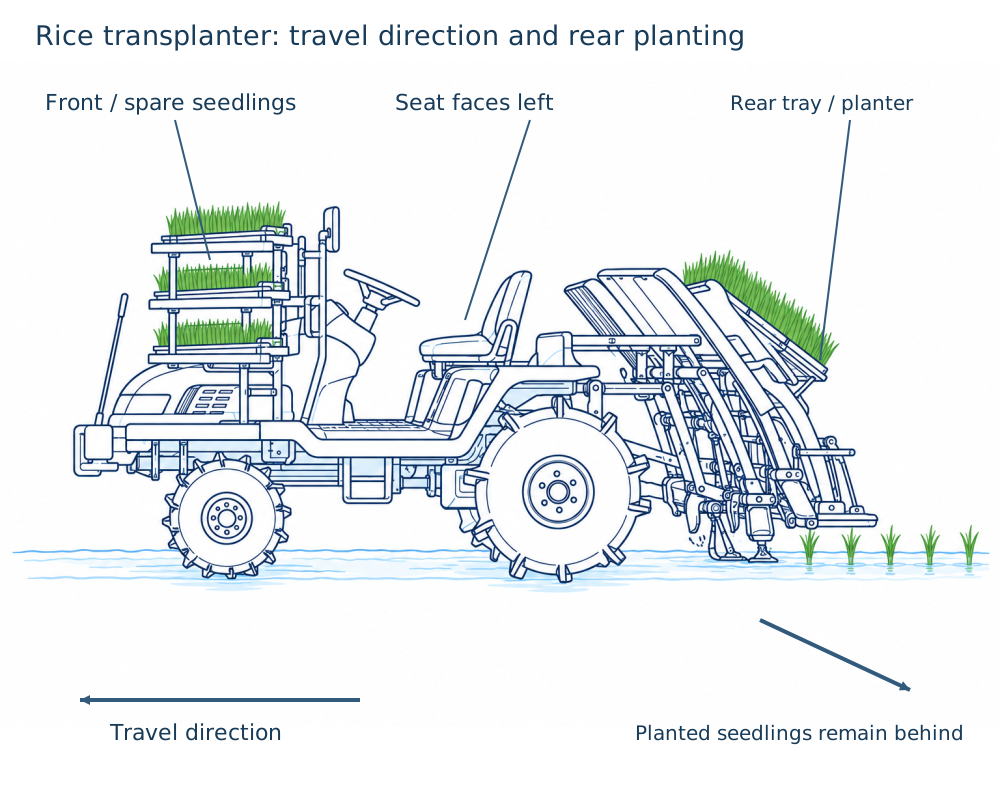
Figure 1 — An educational concept illustration showing the relative positions of the seedling tray, planting unit, and paddy surface. It is not a product photograph or a claim about a particular model.
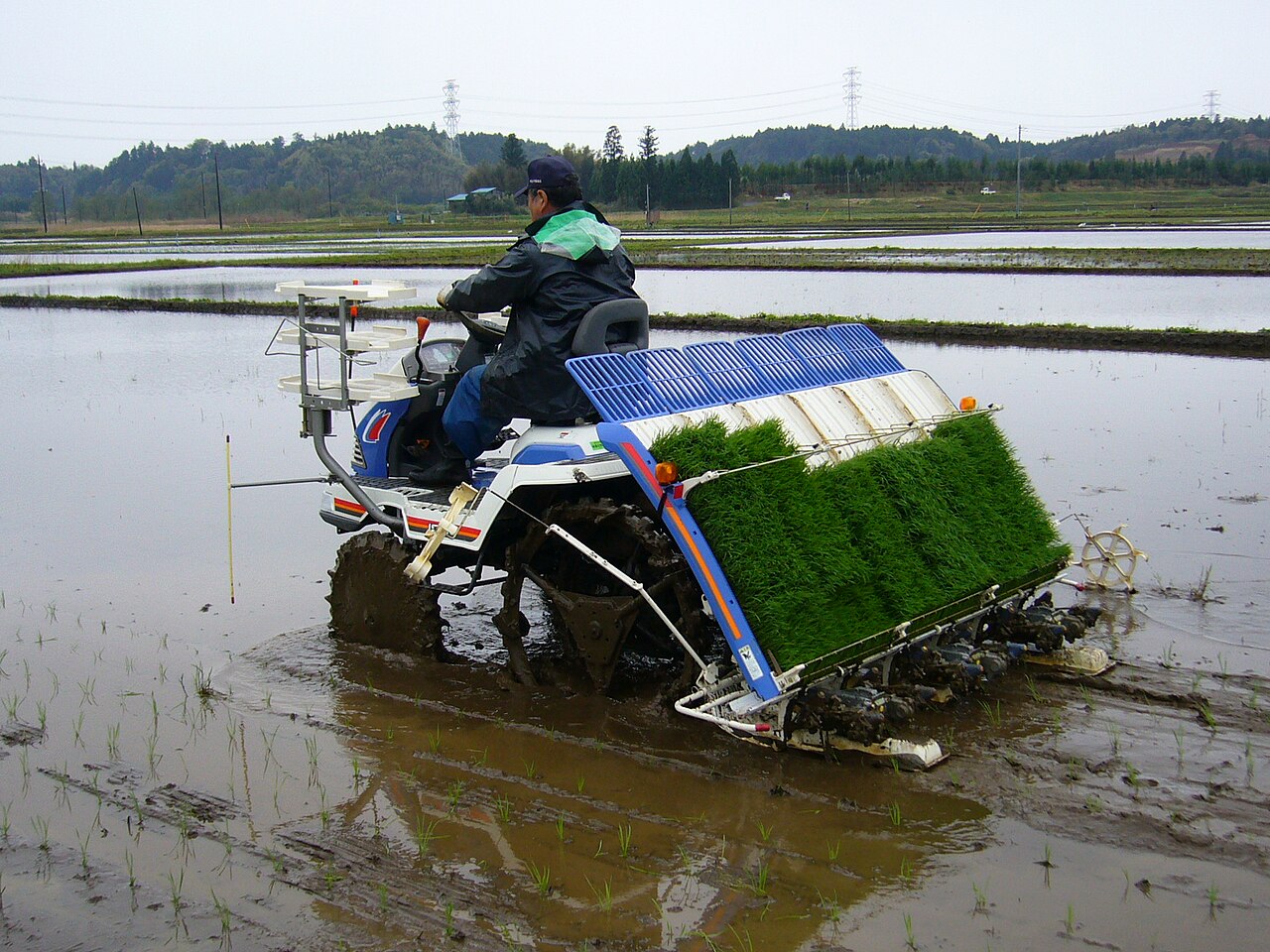 A rice transplanter in service
Image: Rice planting machine 2, katori-city, Japan (katorisi, CC BY-SA 3.0), Wikimedia Commons. This is a smaller machine than the current riding transplanters discussed in the text — a representative example for reading the relative position of the seedling tray and planting unit.

30-Second Summary
- A rice transplanter feeds the seedling mat laterally and longitudinally from the seedling tray, and the planting claw takes a few seedlings at a time on each cycle and places them onto the paddy surface as the machine moves forward. The seedling feed amount, claw cycle, and travel speed determine the hill spacing and the amount of seedling per hill.
- The tip of the planting claw traces a closed trajectory: pull out the seedling, carry it rearward, insert it into the mud, then release and return. Bringing the forward travel speed and the claw tip's horizontal speed close together at the moment of planting keeps the seedling from being dragged and helps it stand upright.
- Planting depth isn't determined by the claw alone. The float glides over the paddy surface, and a sensor float or hydraulics adjusts the height of the planting unit. In overly soft paddies, deep water, or rough puddling, deep planting, floating seedlings, and missing hills all increase even at the same setting.
- Walk-behind machines are easy to maneuver in small plots and hilly/mountainous areas; riding machines raise efficiency through row count, seedling load capacity, and simultaneous turning/fertilization. Kubota's NW series, Iseki's Sanae PJ/PR, and Yanmar's YR/AP are current examples spanning 5–10 rows, walk-behind machines, and straight-line/turn assistance.
- Autonomous steering reduces the burden of planting straight, but seedling restocking, headland turns, levees, people, obstacles, and movement outside the paddy can't be ignored. Evaluation should include RTK/D-GNSS accuracy, satellite reception, field conditions, and the supervision setup.
Rice Transplanting Is Not Just About "Position"
The quality of transplanting isn't determined only by whether the rows look straight. The basics are that each hill sits at its intended position, seedlings don't fall over, roots enter the soil, there's no extreme deep or shallow planting, and there are few missing hills or excessive seedling pickup. Beyond that, it also matters that the resulting row alignment can be passed through by the machinery used for weeding, pest control, top-dressing, and harvest afterward.
Here it's worth distinguishing "the set value" from "the actual planting." Even if the hill-spacing lever is set to 15 cm, actual hill spacing varies due to wheel/crawler slip, travel-speed fluctuation, how the planting clutch engages, and mud flow. Even with a set planting depth, whether the float sinks or floats, and whether the paddy surface undulates, changes the root position of the seedling. A rice transplanter is a machine that makes geometric repetition hold up against the varying targets of soil and seedlings.
The Big Picture: Three Flows — Seedlings, Power, and Information
Figure: Created by Duskcoil. In an actual machine, travel, seedling feed, and the planting mechanism are linked via gears, chains, and hydraulics.
The flow of seedlings begins at the seedling tray where the seedling boxes are placed. With ordinary mat seedlings, the thin root mat that was seeded and raised is placed on the tray box by box, and the tray moves laterally to supply seedlings to each row's pickup opening. In addition, the vertical feed pushes the seedling mat gradually toward the planting claw side. If a claw takes from the same spot repeatedly it creates a hollow and a missing hill; if it feeds too much it disturbs the seedlings and makes pickup amount unstable. The supply system is the origin of quality hidden behind the planting claw.
There's a reason the flow of power for travel and for planting aren't kept identical. Operations such as not planting seedlings while starting, stopping, or turning, holding the set hill spacing, and raising/lowering the planting unit to track the paddy surface all involve clutches, transmission, hydraulics, and electronic control. The flow of information consists of both the long-standing mechanical float and electronic sensors such as angle, vehicle speed, GNSS, and cameras.
Seedling Supply: The Work Before "Cutting Out" One Hill
The Condition of the Seedling Mat Is an Input Condition for the Machine
The mat in a seedling box is a thin, plate-like material in which soil (or growing medium) and roots hold together. Uniform thickness, sufficiently entangled roots, and a state that's neither too wet nor too dry are the conditions for the machine to handle it. A seedling with weak root entanglement collapses when the claw lifts it, and if thickness varies, the amount picked up varies row by row and hill by hill. If leaves grow excessively and tangle between boxes, the tray's feed is also disrupted.
The seedling pickup amount is often not a mechanism that "counts the number of seedlings." Because the claw scoops out a small piece — a given width and depth of the seedling mat including the root mat — the actual number of seedlings varies with seeding density, seedling thickness, and how tightly the roots are bound. Nursery raising and transplanter settings are therefore not separate processes — they're a combination that together produces the same transplanting precision. If the cultivation method changes — dense-seeding transplant, wide-spacing planting, mature-seedling pots — the corresponding tray, feed, claw, and settings are needed.
Lateral Feed and Vertical Feed
Lateral feed moves the tray along the row direction, delivering seedlings in turn to the left and right pickup openings. Vertical feed advances the seedling mat toward the side near the claw, keeping the pickup opening constantly filled with seedlings. If the feed amounts of the two aren't synchronized, seedlings thin out in a particular row, or the claw grabs empty air at the edge of the mat. Tray tilt, poorly seated seedling boxes, dirty feed belts, and root entanglement can all disrupt this synchronization.
When restocking seedlings, it's important not just to consider the time the work is stopped, but to eliminate any step or gap against the existing seedling mat. A gap at the seam causes a run of consecutive missing hills. Large machines increase seedling load capacity not merely for convenience, but to reduce the number of restocking events, work stoppages, and supply defects from rushed restocking. Dense-seeding seedlings can potentially reduce the number of boxes needed, but labor savings don't materialize unless seedling quality and the planting mechanism are properly matched.
The Planting Claw's Trajectory: Geometry That Places a Seedling Without Dragging It
The core of a rice transplanter is the planting claw. The claw tip repeats a closed curve: grip (or scoop) the seedling on the tray side, carry it rearward and downward, release the seedling near the paddy surface, and return empty. With simple circular motion, at the instant it enters the soil, the claw tip's velocity direction points strongly forward or backward, making it easy to knock over or drag the seedling. For this reason, link mechanisms, cams, planetary gears, and rotary mechanisms are used to shape the attitude and speed during the planting interval.
Figure: Created by Duskcoil. The actual trajectory varies by mechanism and setting. What matters is that the speed and attitude required differ between picking up the seedling and planting it.
When the machine travels forward at speed v, let v_c be the claw tip's horizontal speed relative to the ground at the instant of planting. Idealized, the condition for placing the seedling without scraping it forward or backward is
If v_c-v is large, the claw drags the seedling forward or backward. Of course, mud is neither an elastic nor a rigid body — it's a mixture of water and soil particles — and since the seedling also has a root mat, this equation alone can't predict whether it will stand upright. Still, it shows why mechanism design aims to "minimize relative speed at the instant of planting."
Let s be the forward travel distance per cycle; that becomes the base value of the hill spacing. If the planting cycle is f_p [cycle/s], then for travel speed v [m/s]
If the planting transmission isn't changed with travel speed and only the claw cycle stays constant, hill spacing widens the faster the machine travels. Actual rice transplanters link wheel rotation or gear ratio with the planting drive to approach the set hill spacing. But if the drive wheels slip, the distance measured by the wheels and the distance traveled over the ground don't match. Hill-spacing variation in mud isn't simply an operating mistake — it's a problem where the very reference for distance measurement depends on the soil.
Hill Spacing, Row Spacing, and Seedling Count: Designing Planting Density
Let row spacing be r [m], hill spacing be s [m], and the number of seedlings per hill be n. Then the number of hills per unit area N_h [hills/ha] and the approximate seedling count N_s [seedlings/ha] can be expressed as
For example, with 0.30 m row spacing and 0.15 m hill spacing, N_h\simeq222,000 hills/ha. Increasing the number of seedlings per hill, tightening hill spacing, or narrowing row spacing can contribute to securing initial tiller count, but it also changes the relationship with nursery boxes, seedling transport, transplanting time, excessive growth, lodging, and disease. What's appropriate differs by region, variety, transplanting timing, fertilization management, and target yield, so this should be decided from cultivation design rather than fixing the machine's settings first.
Wide-spacing planting is a technique that widens hill spacing to reduce the number of nursery boxes and box-swapping. Iseki's current P43 series publicly states standard support for 37-hill wide-spacing, described as roughly double the hill spacing of standard cultivation. Planting & Fertilization (Iseki) But "fewer boxes" doesn't automatically mean yield and quality stay the same. Varietal tillering capacity, transplanting timing, fertilization, water management, and lodging risk need to be verified against the region's cultivation calendar.
To evaluate hill-spacing precision, look not just at the average error between the set hill spacing s_0 and the measured hill spacing s_i, but at the variability. For m measurements, the root-mean-square error is
Even if the average matches the set value, a row that's twice as wide right after a missing hill and then cramped afterward isn't uniform as a crop stand. Missing-hill rate, floating-seedling rate, deep-planting rate, and the distribution of seedling pickup count should be examined together.
Planting Depth and the Float: Turning the Paddy Surface Into a Reference Plane
However precisely the planting claw's motion is controlled, if the reference paddy surface itself moves up and down relative to the machine, the actual depth changes. That's why a float that glides over the paddy surface is placed beneath the planting unit. The float supports part of the machine's weight over a broad surface, avoiding pushing too hard into the mud, while determining the relative height between the planting unit and the paddy surface. It's not merely a "sled" — it also functions as a mechanical sensor for depth control.
Figure: Created by Duskcoil. Float area, shape, load, and sensor position vary by model.
Let h be the set distance from the planting-unit reference to the float reference plane, e_f the error arising from the float sinking or floating, and z_g the local unevenness of the paddy surface. Then the simplified actual planting depth d can be thought of as
If the paddy surface rises, z_g grows larger and shallow planting becomes more likely; if the float sinks into soft mud, deep planting becomes more likely due to e_f. In practice, water depth, resistance from the seedling's root mat, the timing of the claw's release, and the mud's rebound after planting all add in, so this is a rough map for adjustment rather than an exact model.
NARO's research report on rice transplanters explains an approach that uses a sensor float as a sensor to keep the implement's height above ground constant, controlling implement height to keep the float's tilt in the direction of travel constant, thereby ensuring planting-depth accuracy. Agricultural Machinery Research Institute Report No.36 In the field, letting the float float too much, letting it sink until it's pushing heavy mud, or finishing puddling too roughly, all undermine the premise of this control.
Too shallow, and the roots don't enter the soil, resulting in floating seedlings that move easily with water flow, wind, or weeding work. Too deep, and the growing point may be buried, harming initial growth. Because target depth relates to seedling age, paddy-surface hardness, and water management, it's safer to test-plant on flat ground before entering the field and actually dig up the root base to check. Don't finish depth adjustment on numbers alone — verify it in the center of the paddy, at the headland, and in soft sections.
Comparing Walk-Behind, Riding, and Robotic/Assisted Machines
| Type concept | Main strengths | Constraints / points to check | Currently listed examples |
|---|---|---|---|
| Walk-behind | Lightweight, easy to handle in narrow fields and hilly/mountainous areas. High freedom in transport and turning | Operator's walking burden; seedling load capacity and work width are smaller than riding types | Yanmar AP220A/AP420, Iseki PC25/PC45 |
| Riding (small-to-medium rows) | Sit-down continuous operation; easy to combine with tray, fertilization, and turn assistance | Body dimensions must suit headlands, farm roads, and the field's drainage/bearing capacity | Yanmar YR4C/5C, Iseki PR5/6/7, Kubota NW50/60/80 |
| Large-scale riding | 8–10 rows; seedling load capacity, fertilization, connectivity, and straight-line assist raise work per unit time | The larger the machine, the more turning/transport loss matters in small plots. Seedling supply can become the bottleneck | Iseki PJ8/PJ10, Kubota NW10S/NW10SA, Yanmar YR10 |
| Manned-supervision robot / autonomous steering | Room to reduce the repetitive burden, overlap, and missed spots of straight-line steering | Doesn't mean unsupervised. Boundaries, obstacles, communication, and rescue procedures must be included in work design | Kubota Agri Robo NW80SA, Iseki PRJ8-DR, Yanmar's SMARTPILOT line |
Walk-behind machines aren't a category of "old and small, therefore inferior." In conditions such as sloped land, small plots near terraced paddies, fields with narrow access roads, or carefully managed small areas, a light machine and a person who can quickly change posture becomes an advantage. Iseki's current PC5 series features the 2-row PC25 and 4-row PC45, publicly explaining automatic leveling via a pendulum sensor and a function that lifts the float to turn. Sanae PC5 Series
Riding machines improve efficiency not just by increasing row count, but by bundling together tray loading, side-dress fertilization, automatic raising/lowering of the planting unit, semi-automated turning, and setting changes from the operator's seat. Yanmar's current YR06/YR08 feature straight-line assist, seedling-amount/fertilizer-amount assist, and ICT services. YR06/YR08 However, catalog-level efficiency varies greatly depending on whether the field is rectangular, seedlings and fertilizer don't run out, and turning/restocking/travel go smoothly.
Reading Current Products Beyond the Spec Sheet
Available specs and options differ by maker, region, and dealer. The following are examples showing "which technology options actually exist" — not a purchase recommendation or a side-by-side performance comparison. Prices and equipment should always be reconfirmed via quote and the owner's manual.
| Maker | Examples seen on current pages | Example rows/features | Point of note |
|---|---|---|---|
| Kubota | NAVIWEL NW50N/NW60N/NW80N, NW50S, NW60S/NW80S, NW10S, Agri Robo NW80SA/NW10SA | 5/6/8/10 rows, straight-line keep, variable fertilization, KSAS, examples of manned/unmanned specs | The 2025-launched NW50N/60N/80N are publicly stated as diesel 5/6/8-row machines |
| Iseki | Sanae PR5/PR6/PR7, PRJ8, JAPAN PJ8/PJ10, PC25/PC45 | 2–10 rows, straight-line & turn assist, manned-supervision robot, a mix of gasoline/diesel models | PJ10 is a current 10-row listing; the PR series a current 5–7 row listing |
| Yanmar | AP220A/AP420, YR4C/5C, YR06/YR08, YR10 | Walk-behind, riding, straight-line assist, seedling/fertilizer-amount support, SMARTPILOT | Deploys both model-specific features and retrofittable GNSS assistance |
Kubota's official rice transplanter listing lists the NW50N/NW60N/NW80N as 5/6/8-row, the NW10S and Agri Robo NW10SA as 10-row, and the NW80SA as 8-row, with KSAS, variable fertilization, and hill-spacing/fertilizer-amount keep shown depending on model. Kubota rice transplanter list The new-product announcement states the NW50N/NW60N/NW80N as diesel 5/6/8-row machines. Kubota's announcement
Iseki lines up the JAPAN PJ8 (8 rows) and PJ10 (10 rows), publicly stating a published efficiency figure of as fast as 6.1 minutes per 10a for the PJ10 along with straight-line and turn assist. Sanae Japan PJ10 The PR series lists 5/6/7 rows, with both diesel and gasoline versions. Sanae PR series Rather than "diesel is always better," the choice should be made based on mass in wet paddies, fuel commonality, field scale, and required auxiliary equipment.
Yanmar publicizes a float-lift-on-turn feature on its walk-behind AP series and automated turning with automatic planting-unit raising/lowering on the riding YR10. AP series operability YR10 operability These are designs that standardize not just planting precision while going straight, but the "stop, lift, turn, lower, resume" sequence repeated dozens or hundreds of times during transplanting.
Work Efficiency: Not Determined by Row Count Alone
Let the effective work width be w [m], average work speed be v [km/h], and field work efficiency be \eta_f. Then the actual work rate C [ha/h] is approximately
Here \eta_f includes seedling restocking, fertilizer restocking, headland turning, row alignment, setting checks, travel between fields, and clog removal. For example, even if an 8-row machine has 33% greater theoretical width than a 6-row machine, if it turns more often in a field with many short sides and a single person has to wait for seedling restocking, the time difference per actual area shrinks. Conversely, in a large plot with a well-organized supply system and headlands, the benefit of row count and automatic turning is large.
Model selection should therefore tabulate not just annual area, but each field's long-side length, area distribution, access roads, headland width, water-management constraints, the staff available to carry seedling boxes, and whether simultaneous fertilization is used. Rather than choosing the fastest machine, choose the work system that can finish within the limited days of the optimal transplanting window without sacrificing quality.
Autonomous Steering: Even If Going Straight Is Delegated, Work Responsibility Remains
Autonomous steering comes in stages. First, a method where a person steers following on-monitor guidance; next, a method using a GNSS receiver with a motorized steering wheel or hydraulics to hold a straight line; further, a method that coordinates headland turning and the start/stop of planting; and a manned-supervision robotic method. It's important not to conflate which stage is meant under the single word "autonomous driving."
A simple tracking control with lateral deviation e_y, the difference between machine heading and target path e_\psi, and steering angle \delta can conceptually be written as
In an actual machine, travel speed, steering delay, lateral slip, offset between the antenna and the planting center, ground tilt, and the quality of GNSS correction are all factored in. In a rice transplanter, even if the body center stays on the line, if the planting unit shifts sideways the row bends — so the control target isn't the steering wheel alone.
Yanmar distinguishes, for its retrofittable GNSS guidance and autonomous steering, between guidance that displays positioning on a monitor and a system that automatically controls the steering wheel. GNSS Guidance / Autonomous Steering The company's own materials note that accuracy degradation or unavailability can occur depending on satellite reception conditions, surrounding terrain/buildings, and satellite geometry. SMARTPILOT
Even under autonomous steering, it's necessary to monitor remaining seedling supply, seams between seedling mats, clogging of the planting unit, the edge of the levee, water inlets, workers/third parties, obstacles, and the resumption of planting after a turn. Movement on farm roads or public roads outside the paddy, loading onto a trailer, and deep ditches or soft sections in particular carry different risks. Automation should be evaluated not by "how long you can take your hands off the wheel," but by whether the work can be safely and reproducibly carried out, including monitoring, intervention, and stopping.
Diesel, Gasoline, and Electrification
Riding rice transplanters are predominantly diesel-powered. Diesel offers fast refueling for long work hours, torque at low RPM, power distribution across travel, planting, and hydraulics, and fuel commonality with tractors and combines. Meanwhile, in domains prioritizing small size or light weight, walk-behind machines, gasoline units are also an option. Iseki's current PR series listing both diesel and gasoline shows that the required mass, traversability, and fuel operations aren't uniform. PR series lineup
Electrification isn't only about wholesale replacement of the engine with a battery. There can be stages: using electric actuators to precisely control seedling feed and fertilization, running an electric hydraulic pump only when needed, electrifying auxiliary equipment, and using battery-powered machines in small-scale operations or near facilities. Because motors can readily deliver torque from low speed, they suit speed/position control, giving them an affinity with linking the planting cycle to variable-rate fertilization.
However, a rice transplanter operates amid water, mud, fertilizer dust, high humidity, and vibration. The electrical energy needed for a full day's work, charging time and power availability near the field, sinking from added battery mass, safety around electric shock/insulation/water immersion, and the repair infrastructure all need to be solved simultaneously. The environmental benefit of electrification, too, should be compared including charging electricity, battery life, the amount of diesel reduced, and the work system. At present, appropriate travel speed, reducing excessive wheel spin, organizing seedling restocking logistics, and autonomous steering that reduces overlapping passes also help cut fuel consumption.
Sensors and Research: The Conditions Under Which Measuring Improves Control
The sensors used in, or researched for, rice transplanters differ by purpose. Float/link angle or displacement serves depth control; wheel/motor rotation serves hill-spacing control; an IMU serves roll/pitch correction; GNSS serves straight-line steering and work records; and a camera is a candidate for observing remaining seedling supply, missing hills, and obstacles. Adding more sensors isn't inherently better — what matters is whether they're reliable amid muddy water, sunlight, vibration, and the shade of seedlings, and whether they can fail safely.
| Quantity to observe | Example sensors/methods | Use for control/diagnosis | Representative error |
|---|---|---|---|
| Relative height to the paddy surface | Float angle, link displacement, hydraulic position | Planting-unit raising/lowering, suppressing deep planting | Mistaking float sinking for paddy-surface height |
| Machine attitude | IMU, pendulum, body angle | Roll/pitch correction | Confusing vibration with attitude change |
| Forward distance / travel speed | Wheel encoder, GNSS, IMU fusion | Hill spacing, planting synchronization | Wheel distance drifts due to slip |
| Seedling supply state | Tray position, motor current, camera | Remaining-amount notification, feed-anomaly/missing-hill candidates | Image instability from leaf shadow or mud |
| Position / path | GNSS/RTK, heading, map | Straight-line steering, records, variable fertilization | Correction dropout, multipath, incorrect reference-line setup |
Research topics include direct depth estimation, image-based measurement of seedling pickup amount, post-planting missing-hill detection, mud bearing-capacity estimation, and low-speed position estimation combining GNSS and IMU. As NARO's float research shows, a method using the attitude of a component that contacts the paddy surface, rather than reading the surface directly with a laser, has the advantage of avoiding the effects of water-surface reflection and turbidity. On the other hand, because it involves contact, mud stickiness and adhesion/wear can't be ignored.
Even when a camera counts hills after planting, the job isn't done just because something green and seedling-like appears in the image. Water-surface reflection, mud, overlap, low evening light, parallax from drone or vehicle-mounted cameras, and the tilt right after planting all produce false detections. It's necessary to use manually counted plots as ground truth and verify how far missing-hill rate, excess seedlings, row position, and depth can actually be estimated. AI is best used soundly not as a substitute that erases variation in seedling supply or paddy-surface condition, but as a layer that measures the variation and assists the operator's judgment.
Checks Before, During, and After Work
Before Work
Check seedling thickness, root entanglement, leaf entanglement, and the number of seedling boxes, and inspect the planting claw, seedling-feed belt, and float for mud or damage. Puddling isn't simply an operation to make the surface look flat — it's the process that creates the hardness and levelness needed for the float to glide stably and the seedlings to stand. Walk the field beforehand to identify uneven water depth, deep ruts, rice straw/residue, and soft sections near water inlets.
Over the first few meters, physically check hill spacing, row spacing, seedling pickup count, depth, standing posture, floating seedlings, and mud pushing. If the seedling count is extremely high or low, suspect not just the pickup-amount setting but also seedling quality and feed. If planting is too deep, check float/hydraulic sensitivity/paddy-surface hardness together; if too shallow, check water depth/float lift/claw setting together. Comparing hills at the same spot before and after adjustment reduces the risk of misreading what a setting actually did.
During Work
Don't focus only on row straightness — periodically check remaining seedling supply, seams between boxes, uneven seedling feed, remaining fertilizer, matter adhering to the float, and mud clogging in the planting unit. On turns, confirm that the planting unit reliably rises and that planting resumes properly on the next pass. Autonomous steering shouldn't be a reason to stop watching — it should be used to create the margin needed to watch the seedlings, the planting unit, and surrounding safety.
After Work
Check for missing hills, floating seedlings, and deep planting at multiple points in the field, and record the settings and paddy-surface conditions. Don't dismiss a problem seen right afterward with "it won't matter once it takes root" — reflect it in water management, replanting, and the next puddling. After finishing work, clean the seedling-feed unit, claws, float, and fertilizer unit of any remaining mud, seedlings, or fertilizer following the owner's manual's procedure. This presumes that rotating parts, hydraulics, and electrical systems are stopped and supported before putting hands in.
Summary: A Rice Transplanter Translates Between the Paddy and the Seedling
A rice transplanter divides the mat on the seedling tray into individual root masses per hill, shapes the trajectory of the planting claw atop a moving machine, and converts an uneven paddy surface into a reference plane via the float. When these three come together, hill spacing, depth, and standing posture align. Easy-to-understand specs like row count, horsepower, GNSS, and automation matter, but they only become performance on top of the work system of seedling supply, paddy-surface finish, restocking, and human supervision.
When choosing a model, write out not just area but field shape, softness, seedling-box logistics, simultaneous fertilization, staff headcount, and maintenance setup first. When introducing autonomous steering, decide not just straight-line precision but the behavior when correction information is lost, stopping/intervention, and monitoring of levee edges and obstacles. Understanding a rice transplanter means broadening the view from knowing one cycle of the claw to designing the timing and quality of rice cultivation as a whole.
Official & Primary Sources
- Kubota: Rice transplanter list
- Kubota: 2025 new product announcement (NW50N/NW60N/NW80N)
- Iseki: Sanae Japan PJ10
- Iseki: Sanae PR series
- Iseki: Walk-behind Sanae PC5 series
- Yanmar: YR06/YR08
- Yanmar: Walk-behind rice transplanter AP series
- Yanmar: GNSS guidance / autonomous steering
- NARO: Agricultural Machinery Research Institute Report No.36 (PDF)
Does accurate vehicle travel guarantee good transplanting?
Seedling pickup, finger motion, and planting depth also matter. Navigation accuracy and planting quality require separate checks.
Current step · 4 / 7 · Agricultural Machinery Engineering
Comments
Please log in to post a comment
No comments yet.