Contents — find the section you need
Background and reading guide
Background Basic force, motion and energy terminology; use the linked background explanations.
Fundamentals · Explanations of principles, structure and trade-offs.
The term "agricultural drone" actually lumps together two airframes with very different characters. One is the spray drone, which carries materials such as pesticides, fertilizer, and seed and applies them across the field. The other is the sensing drone, which measures reflectance in visible and near-infrared light to capture crop growth condition and signs of disease over an area. For the former, payload capacity and pump/nozzle system design determine performance; for the latter, sensor spectral characteristics and flight-planning/processing software do. This article treats the two systems separately, and closes by organizing the structure of domestic Japanese flight regulation. Unless otherwise noted, product specs and regulatory information are based on each maker's public information and government materials confirmed as of September 4, 2026.
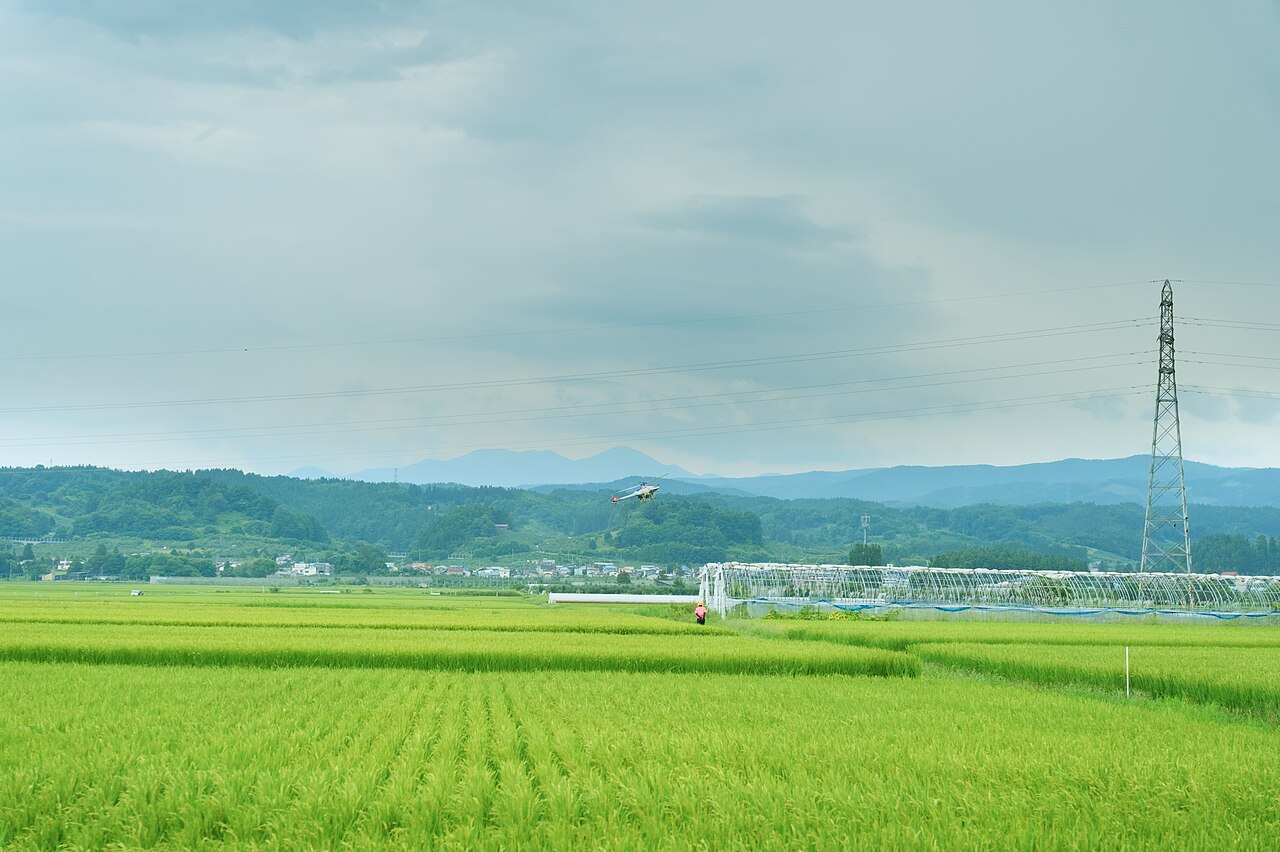 A spray drone in flight
Image: Agricultural drone in use on rice field near Nisoshi, Aomori (Benlisquare, CC BY-SA 4.0), Wikimedia Commons. Not a specific model such as the DJI Agras T50 discussed in the text — a representative example of an agricultural drone spraying over a paddy field.

30-Second Summary
- Agricultural drones should be understood as split between spray drones, which carry materials, and sensing drones, which measure growth condition. Both the required performance and the metrics to evaluate differ.
- A spray drone's capability is evaluated by tank capacity (payload), spray flow rate from the pump/nozzles, and area coverable per unit time (efficiency). The DJI Agras T50 can carry up to 50 kg of granules or 40 L of liquid, and publishes a spraying capacity of up to 21 ha per hour under favorable conditions.
- Sensing drones use the reflectance difference between near-infrared (NIR) and visible red (Red) to calculate NDVI (Normalized Difference Vegetation Index), used to capture growth unevenness and stress over an area.
- Aerial spraying of pesticides in Japan falls under "dropping of objects" under the Civil Aeronautics Act. However, a June 2026 MLIT notice also provides a route under which approval for the method of flight is not required when specified safety conditions are met. Operators must check DIPS2.0 and the current standard manual for the aircraft, location, and flight method, and follow the separate safety guidance for unmanned helicopters and multirotors.
- Drone flight categories include "visual line-of-sight piloted," "visual line-of-sight automatic," "beyond-visual-line-of-sight flight over unpopulated areas" (split into Level 3/3.5 depending on whether an assistant is required), and "beyond-visual-line-of-sight flight over populated areas" (Level 4); pesticide spraying is, in most cases, premised on operation within visual line of sight (Level 2).
- For new Category II permission/approval applications submitted from October 1, 2025, an aircraft with a total weight of 25 kg or more must have third-party liability insurance and state its coverage in the application. This should not be read as a blanket requirement for every flight; check the application category and current review standard.
1. Spray Drone Configuration: Tank, Pump, Nozzles
Figure: Created by Duskcoil. Actual arm count, nozzle placement, and pump type vary by machine.
A spray drone's basic configuration mounts a liquid/granule tank at the center or underside of the airframe, pressurizes with a pump or feeds liquid with an impeller, and sprays from multiple nozzles. The DJI Agras T50 can carry up to 50 kg of granules or a 40 L payload for spraying, and publishes a spray flow rate of up to 24 L per minute with a dual centrifugal nozzle (4-nozzle) configuration, or 16 L per minute with a 2-nozzle configuration. DJI AGRAS T50 handling announcement DJI AGRAS T50 product information A spraying capacity of up to 21 ha per hour at full load is cited, a scale that substantially raises per-machine work efficiency compared with manned radio-controlled helicopters or earlier small drones. DJI announces agricultural drone "Agras T50"
China's XAG P100 Pro, in a configuration weighing about 46 kg including battery with a rated payload of 50 kg, publishes a field work efficiency of 19 ha/h for liquid spraying (max flow rate 22 L/min), and up to 150 kg/min for granule spraying (spreading efficiency 1,300 kg/h). It states hovering accuracy of ±10 cm both horizontally and vertically with RTK enabled, and carries an IPX6K-equivalent dust/water resistance rating. XAG P100 Pro agricultural drone specifications
A spray drone's effective work rate isn't determined by tank capacity alone. Using an actual work efficiency \eta_f that accounts for spray width, flight speed, turning/return losses, and time spent on resupply (liquid, battery), the actual work rate C [ha/h] can be approximated with the same form of equation used for tractors and rice transplanters:
It's worth noting that catalog figures of "up to XX ha/h" are, in many cases, values under conditions that estimate this \eta_f generously.
2. Differences Between Granule Spraying and Liquid Spraying
When spreading fertilizer or granular pesticide, a centrifugal spinner or screw conveyor is used to fling the granules, requiring a different conveyance and metering engineering than liquid spraying. The variability in granule size, specific gravity, and flowability carries the same challenges as a fertilizer applicator's broadcaster, and the thinking about full-field broadcast covered in the article on seeders and fertilizer applicators applies directly to drones as well. In liquid spraying, droplet size can be adjusted via nozzle orifice shape, pressure, and rotation — the finer the droplet, the better the adhesion, but also the greater the risk of drift. This is why management of weather conditions such as wind speed, temperature, and humidity matters even more for drones than for ground-based spraying equipment.
3. Sensing Drones and NDVI
Figure: Created by Duskcoil. Actual NDVI values vary by crop, growth stage, and imaging conditions.
NDVI (Normalized Difference Vegetation Index) is an indicator calculated from near-infrared reflectance \mathrm{NIR} and visible red reflectance \mathrm{Red} as
A healthy plant's leaves strongly absorb the visible red light used in photosynthesis while, owing to cellular structure, strongly reflecting near-infrared light. As poor growth, water stress, or disease progresses, this difference in reflectance pattern narrows and the NDVI value drops. DJI's P4 Multispectral is equipped with a multispectral camera array combining one RGB camera and five narrow-band sensors including red-edge and near-infrared, and is stated to allow real-time NDVI output to be checked in the flight-planning app. DJI announces multispectral-camera-equipped drone "P4 MULTISPECTRAL" enabling growth analysis, etc. NDVI sensor kits that can be retrofitted to existing aerial-imaging drones, such as Sentera's, have also been put into practical use. Sentera NDVI sensor series
NDVI isn't an all-purpose indicator. Even for the same field, values fluctuate with time of capture, solar elevation, cloud cover, and exposed soil area, so it's more realistic to look at time-series change captured under the same conditions, or relative unevenness within the field, rather than simply comparing absolute values against other fields or other days. A sensing drone's value lies in first-pass screening — finding growth abnormalities "quickly and broadly" — and the final diagnosis or response decision needs to be combined with on-the-ground confirmation.
4. Japan's Civil Aeronautics Act and the Regulatory Structure for Aerial Pesticide Spraying
Aerially spraying pesticides or fertilizer with a drone falls under "dropping of objects" under the Civil Aeronautics Act. In June 2026, MLIT published a notice and standard manual that can make approval for the method of flight unnecessary when specified safety conditions are met. Whether an application is required depends on the aircraft, location, flight method, and access-control measures, so operators should check DIPS2.0 and the latest aviation materials. The Ministry of Agriculture, Forestry and Fisheries also publishes separate guidance for aerial application. MLIT flight permission/approval procedure MAFF information on aerial application
Separately, the Ministry of Land, Infrastructure, Transport and Tourism organizes drone flight forms into "flight levels": Level 1, where the pilot directly operates within visual line of sight; Level 2, automatic/autonomous flight within visual line of sight; Level 3, beyond-visual-line-of-sight flight over unpopulated areas; Level 3.5, newly established in December 2023, which under certain conditions removes the need for an assistant, signage, or temporary halts during beyond-visual-line-of-sight flight over unpopulated areas; and Level 4, beyond-visual-line-of-sight flight over populated areas. Relatively short-range spraying work such as pesticide application falls, in most cases, under Level 2. The Ministry of Agriculture, Forestry and Fisheries' public-private council is also advancing efforts to apply beyond-visual-line-of-sight flight over unpopulated areas without an assistant (Level 3) — for example, for field patrol — in the agricultural sector. Ministry of Agriculture, Forestry and Fisheries: Public-private council for expanding the adoption of agricultural drones
Safety rules have also been strengthened. For new Category II permission/approval applications submitted from October 1, 2025, aircraft with a total weight of 25 kg or more must have third-party liability insurance and state its coverage in the application. Operators must also check the Small Unmanned Aircraft Flight Prohibition Act and other applicable rules.
5. Reading Current Product Examples
| Product example | Classification | Public spec examples | Official information |
|---|---|---|---|
| DJI Agras T50 | Spray drone | Up to 50 kg granules / 40 L spray payload; up to 21 ha/h at full load; up to 24 L/min with 4 nozzles | DJI AGRAS T50 |
| XAG P100 Pro | Spray drone | Rated payload 50 kg, liquid-spraying efficiency 19 ha/h, granule-spreading efficiency 1,300 kg/h, RTK hovering accuracy ±10 cm | XAG P100 Pro specs |
| DJI P4 Multispectral | Sensing drone | RGB + 5-band multispectral sensor, real-time NDVI display | P4 Multispectral announcement |
| Sentera NDVI sensor | Sensing (retrofit kit) | Adds on to an existing airframe, enabling simultaneous NDVI capture alongside the optical camera | Sentera sensors |
Spray drones and sensing drones differ not just in role but in the certification and operational structure required. Spray drones handle liquid and heavy payloads, so airframe certification, pilot skill, and management of a spray plan are prerequisites, whereas a lightweight sensing drone can often deliver full value with visual-line-of-sight flight alone. When considering adoption, it's important not to lump the two together as a single "agricultural drone" category for comparison.
6. Accuracy and Pitfalls
A spray drone's application unevenness arises not just from wind-driven drift, but also from nozzle clogging or wear, changes in flight speed from remaining battery level, and shifts in ground altitude caused by terrain undulation. Even with high RTK hovering and path accuracy, if the spray pattern itself is uneven, unevenness in application amount within the field remains. For sensing drones, neglecting reflectance correction using a calibration panel causes NDVI values to fluctuate every time lighting conditions change, degrading the reliability of time-series comparison. For either use case, a machine's "position accuracy" and its "spraying/measurement accuracy" are separate things, and both need to be verified.
Summary
An agricultural drone is a collective term for airframes built around two different design philosophies: a spraying machine that carries materials, and a sensing machine that measures growth. A spray drone's value is determined by tank capacity, pump flow rate, and actual work rate; a sensing drone's value is determined by spectral characteristics and time-series comparison design. Domestic operation in Japan rests on multiple regulatory layers — permission/approval under the Civil Aeronautics Act, the aerial pesticide-spraying guidelines, flight-level classification, and mandatory insurance — and this institutional understanding, not just airframe specs, is a prerequisite for adoption.
What if flight speed doubles at unchanged flow?
With constant swath width, application per unit area halves. Turns, wind, and overlap also affect the actual distribution.
References
- Duskcoil: Agricultural Machinery Engineering 101: Seeders and Fertilizer Applicators
- Ministry of Agriculture, Forestry and Fisheries: Public-private council for expanding the adoption of agricultural drones (confirmed September 4, 2026)
- Ministry of Agriculture, Forestry and Fisheries: Information on aerial spraying of pesticides, etc. by unmanned aircraft (confirmed September 4, 2026)
- MLIT: Flight permission and approval procedures (checked September 7, 2026)
- MLIT: Third-party liability insurance for aircraft of 25 kg or more (checked September 7, 2026)
- DJI AGRAS T50 official specifications (checked September 7, 2026)
- DJI AGRAS T50 handling begins (Sekido) (confirmed September 4, 2026)
- DJI announces agricultural drone "Agras T50" (DroneTribune) (confirmed September 4, 2026)
- XAG P100 Pro agricultural drone specifications (confirmed September 4, 2026)
- DJI announces multispectral-camera-equipped drone "P4 MULTISPECTRAL" (SMART AGRI) (confirmed September 4, 2026)
- Sentera NDVI sensor series (Cybernetech) (confirmed September 4, 2026)
Current step · 6 / 7 · Agricultural Machinery Engineering
Comments
Please log in to post a comment
No comments yet.