Contents — find the section you need
Background and reading guide
Background Basic terminology of the technology; consult the linked fundamentals as needed.
Trends · Read the sources, reporting period and comparison criteria together.
Vision-Language-Action (VLA) models are an architecture that folds camera footage and natural-language instructions into a single system, outputting a robot's actions (motor commands) directly. Against a tradition in robotics that designed perception (recognition) and control (planning and execution) as separate pipelines, the core idea here is a shift in mindset: integrating both into a single transformer model.
 Vision + Language → Action
No license-free official logo could be found for the major VLA companies (Physical Intelligence, etc.), so a simple icon representing the integration of vision, language, and action was created in its place.
VLA at a Glance
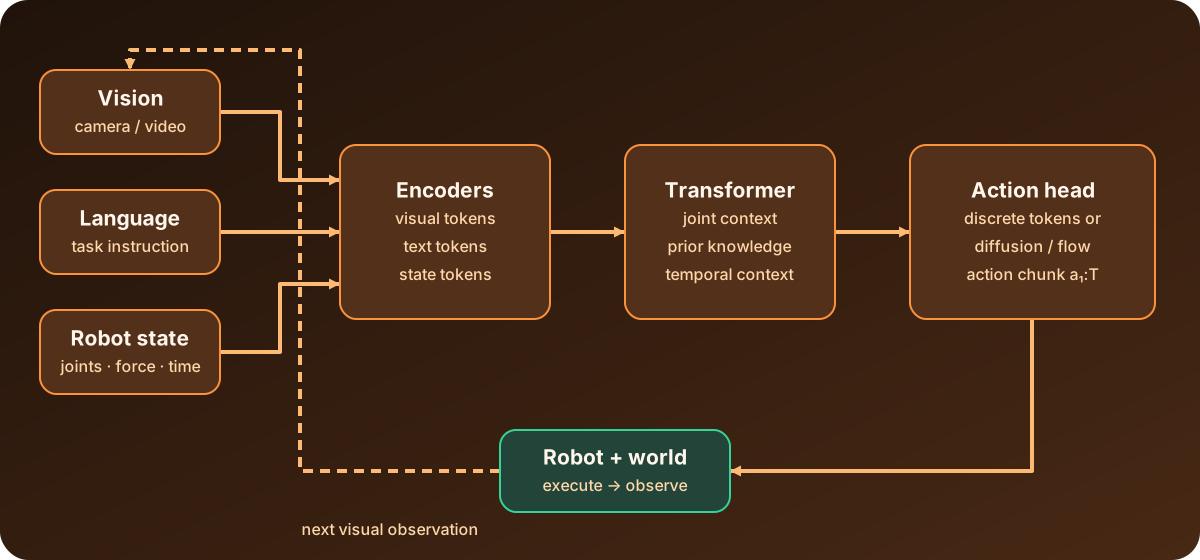
Diagram: Duskcoil. It simplifies a representative relationship between VLA inference and physical-world feedback.
A VLA is not merely a model that can read images and language; it is part of a closed loop whose output is connected to physical action. Images, instructions, and joint state are mapped into a shared representation, a transformer integrates the context, and an action head converts it into an action chunk. Because the observation after execution becomes the next input, practical evaluation must include not only model accuracy but also inference latency, action smoothness, and a mechanism that stops safely when behavior becomes abnormal.
Lineage: From RT-1 to RT-2 to OpenVLA
Google's RT-1 was an early flagship example, and its successor RT-2 developed the idea further, redirecting knowledge from a large model pretrained on web-scale vision and language data toward generating robot actions. On the open-source side, models like Open-VLA, Octo, and CLIP-RT have followed with transformer-based architectures built around cross-modal attention (a mutual attention mechanism spanning vision and language). What all of these share is that "seeing," "understanding," and "acting" aren't split into separate modules — a single network is trained end to end, from input (footage plus instruction) all the way through to output (action).
Internal Structure: Three Subsystems
A VLA model's computational architecture can be understood as roughly three subsystems. First, a vision encoder converts raw pixel data from the camera into a structured feature representation — often a combination of pretrained image encoders like SigLIP or DINOv2. Next comes a projection module (usually a multi-layer perceptron) that maps the extracted visual features into the embedding space the language model works in. Finally, a decoder-only transformer processes the concatenated sequence of visual and language (instruction) tokens and generates the final action.
Generating Action: Two Design Approaches
Once vision and language are integrated, there are broadly two design approaches for how the actual motor command (the action) gets generated.
One uses discrete action tokens: continuous action values (joint angles, velocities, and the like) are discretized into a fixed number of bins (256, say), and token IDs from the language model's vocabulary that see little other use are repurposed to represent actions. The advantage is that vision, language, and action can all be handled uniformly as the same kind of "sequence of tokens," generating the action sequence a_{1:T} autoregressively — conditioned on the observation o, generating each next token based on the ones generated before it.
This formulation has exactly the same shape as next-word prediction in natural-language generation, and it captures the core idea of VLA — handling vision, language, and action within the same probabilistic model.
The other approach uses a diffusion-based action head: the transformer's job is reduced to producing a "readout token" that summarizes the visual and language information, and generating the actual continuous action values is handed off to a diffusion model. Discrete action tokens, being generated in stages, can sometimes fall short on real-time responsiveness and smoothness, whereas a diffusion-based action head tends to produce smoother, continuous action output. Combinations of the two are increasingly common too — Octo, for instance, feeds image and language tokens through a transformer as a single sequence, then passes its output (the readout token) as a condition into a diffusion-based action head.
What This Design Means in Practice
A classical control system can only handle a situation it wasn't designed for by following its script and nothing else. The advantage of a VLA model is the possibility of generalizing to conditions it was never explicitly trained on. Its range of application is expanding fast, from warehouse automation to surgical assistance robots, and it's increasingly being positioned as the core technology behind Embodied AI. At the same time, heavy reliance on large-scale human demonstration data remains a major challenge, both in data collection and training cost.
Physical Intelligence's π0 Lineage
One of the names drawing the most attention in VLA recently is π0 (pi-zero), from Physical Intelligence, a startup that has raised over $400 million. It was announced as a general-purpose robot policy, combining large-scale multi-task, multi-robot data collection with a new network architecture, capable of handling a diverse range of tasks — folding laundry, clearing a table, scooping coffee beans. Physical Intelligence open-sourced π0's code and weights as the openpi repository, and has continued releasing improved versions since — π0.5, π0.6, π0.7. π0 base was pretrained on the Open X-Embodiment (OXE) dataset together with the company's own seven robot platforms, and is designed as a general-purpose model meant for fine-tuning: usable zero-shot for tasks already covered by the pretraining data, but built with fine-tuning as the expected path to a specific use case.
Physical Intelligence's Latest: π0.7 and Beyond
Tracking Physical Intelligence's own official blog, the π0 line has kept adding capability steadily through 2026. March 2026 brought two back-to-back releases: a method that uses an "RL Token" extracted from the VLA model to rapidly refine real-robot manipulation tasks via online reinforcement learning, and "Multi-Scale Embodied Memory," which integrates long- and short-term memory to handle tasks running longer than ten minutes. π0.7, announced in April, is positioned as a steerable model — one that can be guided externally — exhibiting emergent capabilities that amount to a "step-change" in generalization performance. The center of gravity in development appears to be shifting from single-shot demonstration imitation toward capabilities much closer to genuinely autonomous robot operation: memory, online learning, steerability.
LIBERO Saturating, and the Race for Speed
LIBERO, the simulation benchmark that's become standard in VLA research, has seen multiple methods reach task-success rates in the high 90s by the second half of 2026 — accuracy is effectively approaching saturation. Temporal Forcing (August 2026), which strengthens temporal-context understanding by aligning with a 4D scene representation, posts 98.8% on LIBERO while lifting success on a harder "hidden placement" task from 20.0% to 43.3% — a sign that as the standard benchmark saturates, the field's evaluation focus is shifting toward tougher generalization tasks.
With accuracy converging across methods, research focus has also shifted toward optimizing inference speed. DriftingVLA (August 2026), which replaces the conventional multi-step diffusion process with a single forward pass, maintains 98.32% success on LIBERO while reporting a 3.36-fold speedup in action-chunk generation compared to iterative methods. AdaVLA (August 2026, IROS 2026), which accelerates already-trained models without retraining them, introduces a metric that estimates generation confidence from the curvature of the flow-matching trajectory, achieving 1.87x and 2.24x speedups on π0.5 and X-VLA respectively with no additional training. SMILE (August 2026), aimed at smooth motion generation over long-horizon tasks, likewise maintains 98.0% success on LIBERO while reporting a 1.1x speedup through a design that predicts B-spline coefficients — "faster without sacrificing accuracy" has become one of the main axes of VLA research in the latter half of 2026.
The Spread of 2026
Research in the VLA space has continued to appear at a fast pace well into 2026. ABot-M0, which incorporates action-manifold learning; ACE-Brain-0.5, a unified foundation model for embodied agentic AI; Kairos, which integrates a world model with action — research is broadening beyond simple "see and move" toward modeling, remembering, and acting in the physical world in an integrated way. VLA as a concept is itself being repositioned — from a robotics-specific technology into a core element of the broader "Physical AI" framework.
Where Evaluation Ends and Real-Robot Operation Begins
VLA benchmark results are comparative measurements under controlled conditions: the training robot, camera placement, instruction wording, success criterion, and reset procedure are held within the benchmark definition. A benchmark success rate cannot be read directly as a safety claim for another robot or work environment. Before deployment, the action output needs a separate supervisory layer that enforces velocity, acceleration, and joint limits, and stops the robot on communication loss, inference timeout, or sensor failure.
An action chunk generated by a VLA is a prediction based on the observation available at inference time. If a person or object moves during the chunk, executing the whole chunk without another observation leaves commands based on stale perception in the system. Shorter chunks with more frequent replanning improve responsiveness but increase inference and communication load. Longer chunks can be more efficient, while reacting more slowly to occlusion or contact changes. The practical bridge from research to operation is to measure stopping distance, replanning period, and recovery rate in addition to task success.
The distribution of the training data also matters. Lighting, material, joint friction, and camera latency that differ from the training conditions can appear as action errors on the real robot. Evaluation should therefore separate repeated known tasks from tests with moved objects, paraphrased instructions, recovery after occlusion, and deliberately delayed communication. Simply asking a model to retry after a failure does not identify the cause. Store the input image, instruction, generated action, supervisory limits, and stop reason against one shared time base. This makes it easier to distinguish a perception error from a mechanical or communication fault and to repeat the same evaluation after a model update.
Deployment decisions should also be staged. Success in simulation, a stop condition that works in a laboratory, and task completion in a limited environment are different pieces of evidence. Before moving into outdoor or human-shared spaces, test unknown objects, lighting changes, low battery, and network loss, then document the conditions for trusting the model and the conditions for handing control back to a conventional controller. Making that boundary explicit preserves the flexibility of a VLA without giving up the verifiability required by a control system.
The experiment record should include the model and weight version, input resolution, inference time, control period, and action-hold duration. Without these fields, rerunning the same model does not produce a comparable result. Even “success” can mean different things: placing an object at the target, avoiding contact, or completing a task after a limiter intervened. Define success and interruption criteria in advance, and report separately what the model produced and what the supervisory layer allowed. To use research numbers in an operational decision, the measurement conditions and the unmeasured range must be written in the same table.
In routine operation, behavior can change after a camera replacement or lighting change even when the model itself is untouched. To detect distribution shifts, keep recording confidence indicators, action magnitudes, and the number of interventions by the supervisory layer. When abnormal values persist, switching to a slow mode or manual operation is easier to diagnose than repeatedly retrying automatically. Treating a VLA as one component in a system that separates observation, inference, limiting, and stopping supports both reproducibility and safety.
Does apparent instruction understanding establish safe robot action?
Action limits, execution conditions, failure detection, and stopping mechanisms remain necessary. Fluent language is not evidence of physical success.
References
- Vision Language Action Models in Robotic Manipulation: A Systematic Review (arXiv)
- π0: Physical Intelligence Official Blog
- π0.7 Official Announcement
- π0.7 Paper (Physical Intelligence)
- Precise Manipulation with Efficient Online RL (Physical Intelligence)
- VLAs with Long and Short-Term Memory (Physical Intelligence)
- Physical Intelligence openpi GitHub Repository Coverage (The Robot Report)
- Vision-Language-Action (VLA) Models for Robotics (Roboflow Blog)
- A Survey on Vision-Language-Action Models: An Action Tokenization Perspective (arXiv)
- Physical Intelligence Official Blog
- Temporal Forcing Paper (arXiv)
- DriftingVLA Paper (arXiv)
- AdaVLA Paper (IROS 2026, arXiv)
- SMILE Paper (arXiv)
Current step · 9 / 10 · Technology Trends
Comments
Please log in to post a comment
No comments yet.