Humanoid robots are moving, as 2026 unfolds, from "the demo stage" to "actually running in factories, warehouses, and some homes." This piece maps the current landscape, where companies like Tesla, Figure AI, Boston Dynamics, Unitree, Agility Robotics, 1X Technologies, and Sanctuary AI are each competing with a different bet — vertical integration as an automaker, a VLA foundation model, a pivot away from hydraulics, aggressive price-cutting, the home market, a general-purpose enterprise worker.
 Honda
Honda Toyota
Images: Honda / Toyota logos, Wikimedia Commons. Both companies are featured here for their involvement in humanoid research — Honda for its ASIMO lineage, Toyota for the Toyota Research Institute's partnership with Boston Dynamics.


Humanoid Control in One Diagram
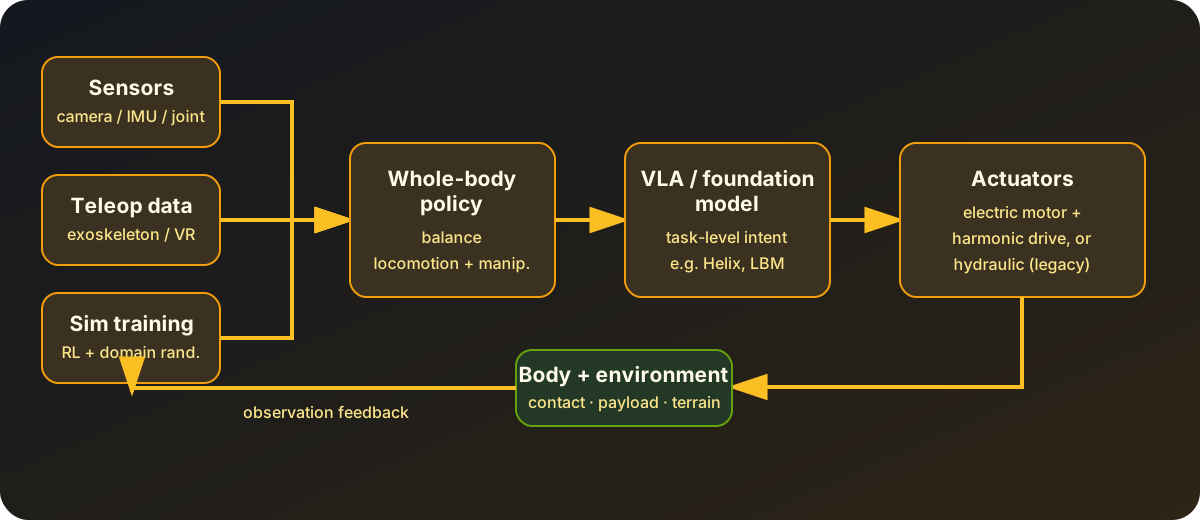
Diagram: created by Duskcoil. A simplified view of the relationship between whole-body control trained via reinforcement learning, learning data derived from teleoperation, and VLA foundation models.
The axis for understanding humanoid robots is to look separately at hardware (actuators and mechanisms) and software (whole-body control and task execution). The hardware problem — where bipedal locomotion alone brings constraints around falling, contact, and power density — and the intelligence problem of executing general-purpose task instructions are separate technical challenges that progress at different speeds. Today's competitive landscape splits largely along which of these two axes a given company is betting on.
Lineage: From ASIMO's Retirement to Today
Honda ended development of ASIMO in 2018, and the program itself was formally shut down in 2022. At the time, Honda signaled a policy of redirecting the technology developed for ASIMO toward more practical applications, such as caregiving and disaster-response support, and no complete humanoid robot has been announced since as a direct successor to ASIMO. In 2026, Honda demonstrated a new robot said to carry on ASIMO's spirit, but this is positioned more as research and technology demonstration than a commercial general-purpose worker. This shift — from ASIMO's embodiment of "highly precise bipedal walking itself" as the goal, to today's leading players targeting "the economics of actually running in factories and warehouses" — reflects where the industry's center of gravity has moved as a whole.
The Actuator Fork in the Road: Electric vs. Hydraulic
One of the biggest design decisions shaping a humanoid's physical performance is how its joints are driven. Hydraulic actuators offer high power density (output per unit weight) and make explosive, powerful motion easy to produce, but they come with challenges around oil leaks, noise, maintenance burden, and general awkwardness in industrial settings. Electric actuators (motor plus reduction gear) are quiet, easy to maintain, and pair well with AI control loops, but matching hydraulic-level explosive force requires high-torque-density motors and a reduction mechanism robust enough to handle them.
Boston Dynamics' Atlas embodies this fork in the road. Developed on hydraulic drive for years, Atlas was relaunched as a fully electric new model immediately after Boston Dynamics announced the retirement of the hydraulic Atlas in 2024. The motivation for this switch is said to have been not simple performance improvement, but a precondition for "scalable practicality" — mass production, maintainability, and deployment on industrial floors. Hydraulic systems are powerful but bulky, noisy, and hard to maintain in a standard factory environment. Going electric brings quieter, more agile motion, better maintainability, and better compatibility with AI control loops, while the challenge that remains is how far motor-and-gear design can catch up to the instantaneous high output hydraulics excelled at. Boston Dynamics unveiled a production version of the electric Atlas at CES 2026, and going electric has already shifted from "a research-stage choice" to "a production-stage premise."
Where the Major Players Stand
Tesla Optimus wields vertical integration, repurposing automotive mass-production lines, as its weapon. The third generation (V3) has 37 joints and a hand with 22 degrees of freedom and 50 actuators, stands 173cm tall and weighs 57kg, and is ramping up mass production in Fremont in the second half of 2026. Early production units are being routed first toward training-data collection, and Musk has offered a cautious outlook on early ramp yield, saying it will be "quite slow." The target price is 20,000 to30,000.
Figure AI wields real-world deployment at BMW's Spartanburg plant as its weapon. The previous-generation Figure 02 was involved in assembling roughly 30,000 BMW vehicles, and its successor Figure 03 uses an AI system called "Helix 02" to coordinate hands, arms, torso, and legs, handling sequencing work — identifying, sorting, and rearranging parts that vary in position and orientation. It's notable for expanding into tasks that combine locomotion and manipulation simultaneously, such as pushing a heavy cart while operating parts at the same time.
Boston Dynamics Atlas wields the integration of a Large Behavior Model (LBM), developed through its partnership with the Toyota Research Institute (TRI), as its weapon. In August 2025, an Atlas equipped with an LBM demonstrated long, continuous sequences of tasks that combine object manipulation and locomotion, with an emphasis on how quickly new motions — previously hand-programmed — can now be added without writing code. With Hyundai, plans are underway to open a Robot Metaplant Application Center (RMAC) in 2026 to train Atlas using data collected at Hyundai factories.
Unitree wields price-cutting as its weapon. The G1 (1.32m tall, about 35kg, 23 degrees of freedom, up to 43 in the EDU version) starts at a direct-sale price of 13,500, and shipped more than 5,500 units in 2025 alone, reportedly capturing about 32% global market share. Its higher-end H2 (1.80m tall, 70kg, 31 degrees of freedom) starts at29,900 domestically in China, and in North America, Toborlife began taking preorders in February 2026. This price range accessible to research institutions is why Unitree is becoming the de facto experimental platform for humanoid research.
Agility Robotics' Digit wields actual runtime hours in logistics operations as its weapon. At GXO's Georgia fulfillment center, Robots-as-a-Service operation has moved from pilot to full deployment, reaching the milestone of 100,000 totes handled at a single site. At Schaeffler's Cheraw plant, it has been deployed on washing-machine loading and unloading work since early 2025, and combined across GXO, Schaeffler, Toyota Motor Manufacturing Canada, and Mercado Libre, it reportedly has more than 65,000 cumulative operating hours. Agility itself is pursuing a public listing via SPAC merger in 2026.
1X Technologies wields the home market as its weapon. NEO stands roughly 168cm tall, is priced at $20,000, and is planned for shipment to ordinary U.S. households in 2026. Since the Series A2 round led by OpenAI, collaboration has continued on both funding and models. The factory it opened in Hayward, California has an annual production capacity of 10,000 units, with a goal of exceeding 100,000 units per year by the end of 2027.
Sanctuary AI wields an AI control system called "Carbon" as its weapon, developing a general-purpose worker robot called Phoenix. The eighth-generation Phoenix is said to handle hundreds of tasks specified by customers spanning more than a dozen industries, and is claimed to learn a new task in roughly 24 hours. That said, third-party verification of commercial shipment volumes and pricing remains limited at this point, and it's worth noting that less real-machine verification information is available for Sanctuary AI than for its competitors.
The Shift to Learning-Based Whole-Body Control
Bipedal locomotion control used to be dominated by walking-pattern generation based on ZMP (Zero Moment Point, a classical indicator derived from center of mass and ground reaction force that determines the conditions for not falling over) or DCM (Divergent Component of Motion), combined with whole-body control (WBC) via quadratic programming (QP). These approaches are model-based and easy to interpret, but adapting to unknown terrain or disturbances requires additional tuning.
The current trend combines reinforcement learning in simulation with domain randomization (a technique that randomizes mass, friction, latency, and other parameters across simulation runs to build a policy robust to the gap with the real machine — see "An Introduction to Model-Based Reinforcement Learning and Sim-to-Real" for details), moving toward acquiring a diverse repertoire of skills — including dynamic motions like parkour and dancing — with less manual work than model-based control. Surveying the research landscape, four trends coexist side by side — model-based gait generation, QP-based whole-body control, sim-to-real transfer via deep reinforcement learning, and hybrid methods that combine these — and the field has not fully converged on a single approach. Recovering from a fall on one's own (getting-up) and robustly adapting to unfamiliar floor surfaces — the "unglamorous but critical" problems that come up constantly in real-world operation — are becoming the yardstick for measuring how practical learning-based methods really are.
The Connection to VLA and Foundation Models
Vision-Language-Action (VLA) model technology is flowing into task-level instruction understanding and action generation (see "Technology Trends in VLA" for details). Figure AI's Helix, Boston Dynamics/TRI's Large Behavior Model, and 1X's NEO World Model all share the design philosophy of integrating "see, understand, and act" into a single model. 1X in particular has adopted a design in which a 14-billion-parameter video generation model is prompted to "imagine a short video of the task being carried out," and that imagined video is then converted into actual joint commands via an Inverse Dynamics Model (a model that turns a generated video into concrete motor commands) — a design that connects a video world model directly to robot control, and links directly to the "World Model" trend covered next (see "Technology Trends in World Models" for details).
Unresolved Challenges
The data-collection bottleneck: Whereas language models can be trained on internet-scale text, robot action data (paired observations and actions) barely exists on the internet. Collection via teleoperation using VR headsets, motion-capture suits, and wearable exoskeletons dominates, but reports suggest that even with dedicated hardware rigs (in the 50,000–150,000 range), a single operator can collect fewer than 200 demonstrations per day — pointing to data collection itself as a bottleneck emerging in the physical AI supply chain.
Cost: As of 2026, prices span a wide range: from the research-oriented Unitree G1 (13,500 and up), to Tesla Optimus and 1X NEO (20,000–30,000) marketed as general-purpose workers, to enterprise EDU units (40,000–$70,000). But use cases where the economics pencil out against labor cost remain limited, and early deployment is concentrated in "simple, repetitive tasks with an especially severe labor shortage."
Safety: Cross-industry safety standards for autonomous machines with roughly human mass and output moving in shared spaces with people are far less mature than those established for industrial robot arms. Behavior on falling, fail-safes on communication loss, and upper bounds on force control are still being designed independently by each company.
Robustness of whole-body control: The performance a policy trained in simulation shows on real hardware tends to degrade under conditions not well covered during training — floor friction coefficient, the center of mass of a carried load, and so on. Flashy demos like parkour and a day-to-day robustness against a small step in a warehouse floor or a slippery surface don't necessarily indicate the same level of achievement.
These challenges are being solved in parallel along three separate axes — hardware (going electric, reducing cost), data (learning from teleoperation, simulation, and video), and software (integrating whole-body control with VLA foundation models) — and as of 2026, that's the reality: no single technical breakthrough is going to resolve all of this at once.
References
- Boston Dynamics Atlas official site
- Boston Dynamics × Toyota Research Institute partnership announcement
- Toyota Research Institute — Atlas demo powered by a Large Behavior Model
- BMW Group official — Figure 03 deployment announcement
- Figure AI official news — F.03 Arrives at BMW
- Agility Robotics — multi-year agreement announcement with GXO
- Agility Robotics — partnership announcement with Schaeffler
- 1X Technologies official — World Model announcement
- Sanctuary AI official — Phoenix announcement
- Honda ASIMO (Wikipedia)
- awesome-humanoid-robot-learning (paper roundup, GitHub)
- For local AI operation on a home server, see also "Technology Trends in Local LLMs"
Comments
Please log in to post a comment
No comments yet.