Contents — find the section you need
An indoor wheeled robot becomes easier to understand when you follow one question: how does a sensor reading become a motor command? This guide connects the site's explanations and project records rather than asking you to memorize algorithm names.
Follow the information flow
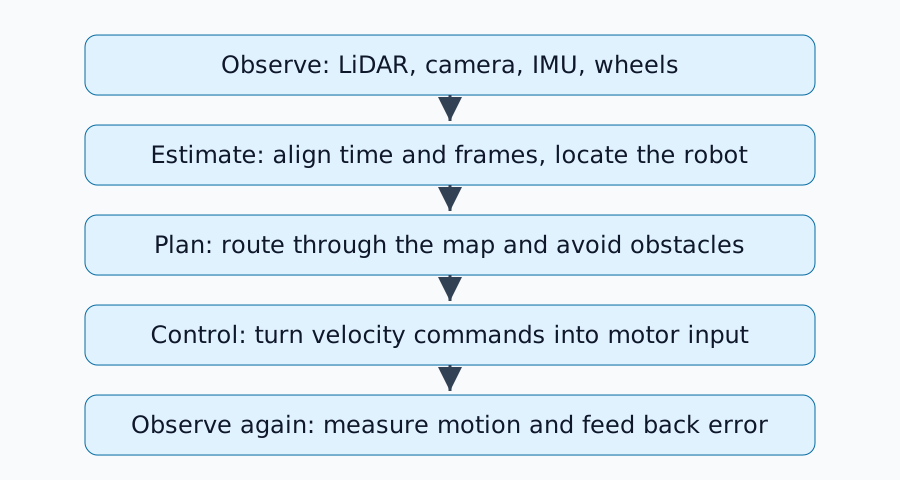
Commanded and actual velocity differ when wheels slip or loads change. Observation therefore repeats throughout motion. A stored map can also disagree with obstacles currently in front of the robot, so local observations must influence planning.
1: Understand what the sensors measure
Begin with LiDAR, IMUs and encoders. The useful milestone is being able to name what each sensor cannot determine alone. Wheel rotation does not directly measure slip against the floor, and integration of IMU measurements accumulates error.
2: Estimate the current pose
Read dead reckoning, LiDAR SLAM and sensor fusion. Separate a smooth short-term motion estimate from a pose corrected relative to a map. This makes the roles of odom and map easier to follow; their semantics are specified in ROS REP-105.
3: Represent free space and choose a route
Use occupancy grids for spatial representation and path planning for route selection. A point can pass through a gap that a wide robot cannot. As an exercise, explain why changing the robot footprint changes which corridors are traversable.
4: Turn the plan into motion
Study PID control and the Python experiment, then move from ROS 2 fundamentals to the minimal Nav2 procedure. The official navigation concepts provide another reference for component responsibilities.
| Goal | First check | Continue with |
|---|---|---|
| Understand principles | Write down every block's inputs and outputs | Detailed explanations |
| Run a simulation | Set the initial pose and a goal on a map | Minimal Nav2 procedure |
| Improve hardware | Record repeated runs under matching conditions | SLAM evaluation and power diagnosis |
Move between tutorials and project records
The newbot mapping and navigation record describes a particular system and its failures. Match its sensors, TF tree, map conversion and velocity-command path to the conceptual blocks; do not assume it uses the tutorial configuration. Consult the Nav2 first-time setup guide for integration dependencies.
Finally, explain which components stop and what command reaches the motors when an observation stream disappears. The boundary you cannot yet explain identifies your next reading topic.
Comments
Please log in to post a comment
No comments yet.