Contents — find the section you need
Background and reading guide
Background Units used in specifications, such as voltage, current, distance and time.
Fundamentals · Explanations of principles, structure and trade-offs.
LiDAR (Light Detection and Ranging) measures the time it takes for emitted laser light to reflect off an object and return (Time of Flight, ToF), then back-calculates distance from the speed of light. Where a camera captures "color and pattern," LiDAR can directly capture an object's actual 3D shape, unaffected by lighting conditions — this is its greatest strength, and it is widely used for surrounding-environment perception in autonomous vehicles and for SLAM (simultaneous localization and mapping) in robotics. This field was pioneered by America's Velodyne, pushed toward lower cost by Livox (a DJI spinoff), and is now seeing China's Hesai and RoboSense elbow into the lead pack at mass-production scale — a market whose balance of power has shifted dramatically in a little over a decade.
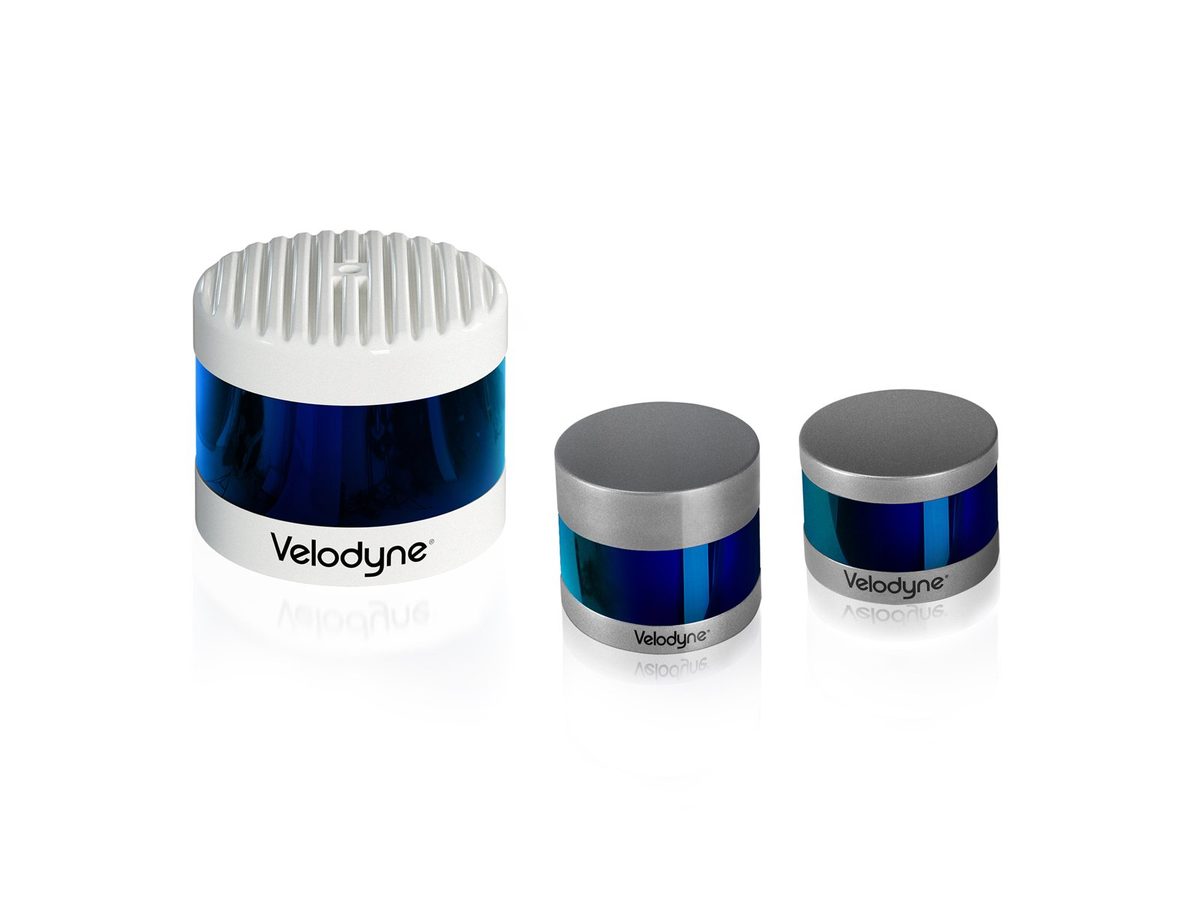 Velodyne Alpha Prime / Ultra Puck / Puck family
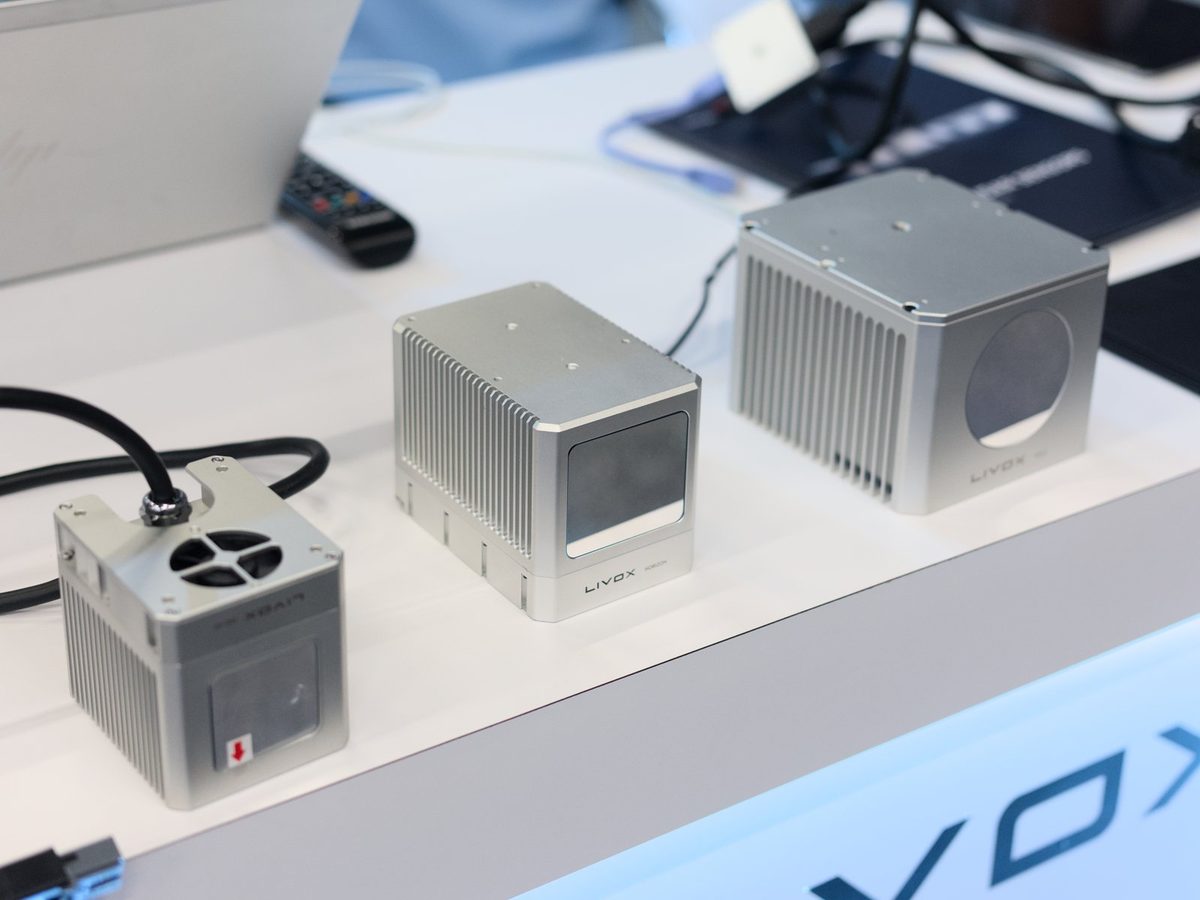 Livox Mid-40 / Horizon / Tele-15
Images: Velodyne Lidar Alpha Prime Ultra Puck Puck Sensor Family (APJarvis, CC BY-SA 4.0) / Livox Mid-40, Livox Horizon, and Livox Tele-15 (Dllu, CC BY-SA 4.0), both Wikimedia Commons. These are not the specific latest models compared in the text (VLP-16, Mid-360S) but representative examples of each company's product line.


Principle: back-calculating distance from the round-trip time of light
LiDAR's basic principle is simple. It fires a laser pulse, measures the time T it takes to reflect off an object and return, and back-calculates distance D from the speed of light c (\approx 3.0 \times 10^8 m/s).
The division by two accounts for the pulse traveling the distance to the target and back. Because the speed of light is so fast, this time difference must be measured on the order of nanoseconds (billionths of a second) — for example, the round-trip time to an object 10m away is only about 67 nanoseconds, and this ultra-high-speed timing is exactly what makes LiDAR technically hard. There are two broad approaches: dToF (direct Time of Flight), which measures a pulse's round-trip time directly, and iToF (indirect Time of Flight, including FMCW), which derives distance from the phase shift of a modulated continuous beam. Most long-range, outdoor-use products adopt dToF.
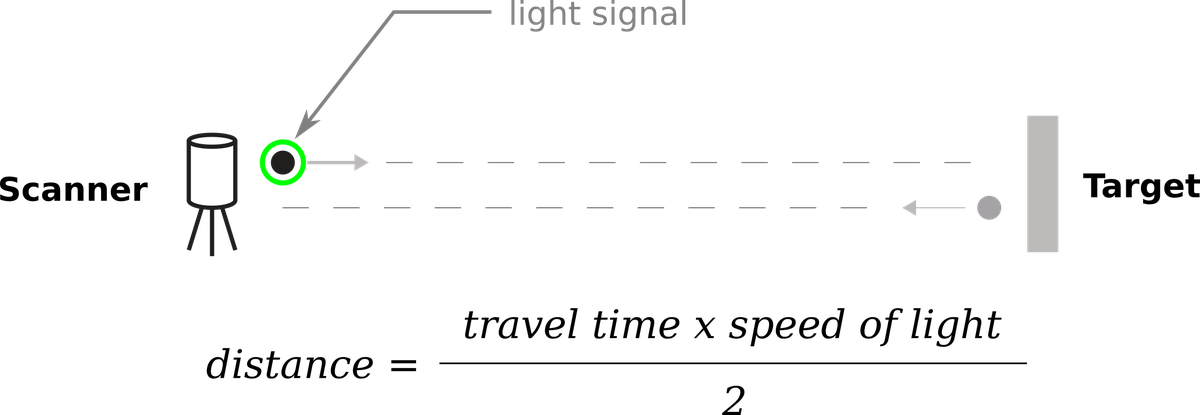 LiDAR ToF principle diagram
Image: Concept of LiDAR (Cartographer3d, CC BY-SA 4.0), Wikimedia Commons.

Scanning methods: from mechanical rotating units to non-rotating (solid-state) designs
LiDAR scanning methods fall broadly into three categories.
Mechanical rotating type stacks laser emitter/receiver units and spins the whole assembly with a motor through 360 degrees — the original approach pioneered by Velodyne. It can cover the full 360-degree surroundings uniformly, but the moving parts tend to put it at a disadvantage on durability and cost.
MEMS type is a semi-solid-state approach that scans the laser by vibrating a tiny mirror (a MEMS mirror) at high speed; its moving parts are small, making it easier to drive down cost. It's one of the mainstream approaches for mass-produced automotive LiDAR, used in RoboSense's M1 series among others.
Non-rotating (Livox's proprietary approach) rotates two prisms (Risley prisms) at different speeds to steer the laser in a non-repetitive, petal-shaped scan pattern (a rhodonea curve). When the rotation-speed ratio between the two prisms is close to an irrational number, the scan trajectory theoretically never retraces the same path, so point-cloud density keeps building the longer it integrates over time. Because the scan pattern crosses the center of the field of view more often than the periphery, it produces a characteristically non-uniform density distribution, denser at the center than at the edges (the line spacing at the center of the FOV is about 0.2 degrees, denser than a conventional 64-line LiDAR). This design keeps moving parts compact while achieving a wide field of view, but its instantaneous point-cloud density lags a rotating design, and performance is constrained on fast-moving platforms that can't afford long integration times.
Key product specification comparison
| Product | Method | Range | Point cloud density | FOV |
|---|---|---|---|---|
| Velodyne (now Ouster) Puck VLP-16 | Mechanical rotating, 16 channels | 100m | Approx. 300,000 points/sec (single return, approx. 600,000 points/sec with dual return) | Horizontal 360°, vertical 30° (±15°) |
| Ouster OS1-128 | Mechanical rotating digital LiDAR, 128 channels | 90m (dark target, 10% reflectivity) | Approx. 2.62 million points/sec | Horizontal 360°, vertical 45° (42.4°) |
| Ouster OS2 | Mechanical rotating digital LiDAR | 240m | — | Horizontal 360° |
| Livox Mid-360 | Non-rotating (prism scanning) | — | 200,000 points/sec | Horizontal 360°, vertical 59° |
| Livox Mid-360S (Mid-360's successor, released June 2026) | Non-rotating (prism scanning) | Minimum detection distance 10cm | Maintains 200,000 points/sec | Horizontal 360°, vertical 59° |
| Hesai AT128 | Hybrid solid-state, 128 channels (905nm VCSEL) | 200m (10% reflectivity), effective ground-detection range approx. 70m | Over 1.5 million points/sec | Horizontal 120° |
| RoboSense RS-LiDAR-M1 | MEMS, automotive mass-production grade | 200m (150m @ 10% reflectivity) | — | — |
| RoboSense E1R | Fully solid-state, 144 channels | 75m | — | Horizontal 120° x vertical 90°, under 10W power consumption |
The Velodyne Puck VLP-16 is defined by its 16 channels (16 vertical laser lines) giving 2-degree vertical resolution, and it has long served as the de facto standard in autonomous driving and robotics proof-of-concept work. Ouster's OS1-128 inherits Velodyne's mechanical rotating structure while adding a proprietary "digital LiDAR" architecture (integrating lasers and detectors on a CMOS process) to achieve high channel count and high point-cloud density. The Livox Mid-360S inherits the Mid-360's IP67 dust/water resistance and built-in IMU (ICM-40609) while revisiting near-range detection performance.
In automotive and industrial applications, China's Hesai and RoboSense are rapidly gaining share with MEMS and solid-state designs. Hesai's AT128 combines 128 high-power multi-junction VCSEL arrays with 128 avalanche photodiode detectors in a hybrid solid-state design; it has been adopted by ADAS programs at multiple major automakers, with cumulative deployment reaching several million units. RoboSense splits its lineup between the MEMS-based M1 series and the fully solid-state E1R, which draws under 10W, covering both automotive-grade reliability and low cost for robotics. As of 2026, the industry's combined annual production capacity for autonomous-driving LiDAR has reached roughly 4 million units.
What's Really Behind the Industry
The DARPA Grand Challenge gave rise to Velodyne — LiDAR's origin story, oddly enough, starts with an audio equipment maker. David Hall, founder of Velodyne Acoustics, originally worked on high-fidelity home speaker technology. Competing in the 2004–2005 DARPA Grand Challenge (a race for autonomous vehicles across 150 miles of desert), he initially tried stereo-camera-based navigation, but after discussing approaches with other teams he turned to LiDAR, and by 2005 had built the world's first real-time 360-degree surround-view LiDAR, the HDL-64, spinning 64 lasers at 900 rpm. At the 2007 DARPA Urban Challenge, nearly every team that finished had a Velodyne unit bolted to the roof — this "desert hack" became the standard equipment of the entire autonomous-driving industry.
Livox, a spinoff from DJI — Livox was founded in 2016 after engineers inside drone giant DJI's internal incubator, the Open Innovation Program, developed a new non-repetitive scanning method. The company set out to deliver high-quality, low-cost, reliable LiDAR across automotive, smart-city, surveying, and mobile-robotics applications, and since launching the Mid series in January 2019 it has served more than 1,500 customers across 26-plus countries and regions. It's also sold through the DJI Store's consumer-facing retail channel — an unusual distribution path for the LiDAR industry.
Waymo's homebrew LiDAR and its "retreat" — In its early autonomous-driving days, Waymo (then Google) was hampered by off-the-shelf LiDAR costing $75,000 per unit. It responded by building its own, starting production in 2011 and reportedly cutting the cost roughly tenfold to about $7,500. In 2019 it began selling a bumper-mounted perimeter LiDAR, the Laser Bear Honeycomb (95° vertical FOV, 360° horizontal), to companies in robotics, security, and agriculture that didn't compete with its robotaxi business. But around 2021, after roughly two and a half years of external sales, it stopped — an example of how hard it is to keep supplying a core piece of your own technology to outsiders.
Hesai's legal battle over being designated a "Chinese military company" — In 2024 the US Department of Defense added Shanghai-based Hesai Technology, along with several other Chinese firms, to its "Chinese military companies" list (the 1260H list). Hesai sued in federal court in Washington the same year, arguing it "is not a military company" and that its products are for civilian use only. In July 2025, the district court upheld Hesai's listing, and Hesai has appealed to the federal court of appeals. It's a live example of a Chinese company with major global share in automotive LiDAR getting caught in geopolitical crossfire.
The Luminar–Volvo collapse — Luminar was one of the few American LiDAR startups to win a real automaker production contract, with standard-fit LiDAR on Volvo's EX90 electric SUV and ES90 sedan. But in late 2025 Volvo ended the relationship, saying Luminar had failed to meet its contractual obligations, and announced it would remove LiDAR from the vehicles starting with model year 2026, paying existing owners compensation of up to 18,000 Norwegian kroner. Luminar filed for Chapter 11 bankruptcy protection on December 15 of that year. It's one of the biggest recent examples of a supplier's financial fragility becoming the bottleneck for the industry's broader goal of making LiDAR standard equipment on autonomous vehicles.
FAST-LIO and LiDAR–IMU fusion — A widely used algorithm that pairs well with non-rotating, high-frequency-output LiDAR like the Livox Mid-360 is FAST-LIO ("A Fast, Robust LiDAR-inertial Odometry Package by Tightly-Coupled Iterated Kalman Filter," arXiv:2010.08196), published in 2020 by Wei Xu, Fu Zhang, and colleagues at the University of Hong Kong. It fuses LiDAR feature points with IMU data through a tightly-coupled iterated Kalman filter, using a new formulation that computes the Kalman gain based on state dimension rather than measurement dimension, achieving substantially faster processing than prior methods at the time. Its 2021 successor, FAST-LIO2 (arXiv:2107.06829), evolved toward registering raw point clouds directly to the map without feature extraction, and is used in many real robotics projects. Research into the scanning characteristics of Livox's own approach continues to appear, too — for instance a paper comparing repetitive vs. non-repetitive scan patterns for roadside-installed LiDAR (arXiv:2511.00060).
Parameters That Determine Performance: Priorities Shift With the Use Case
- Point cloud density: Matters when you need to detect small distant objects (a person, the edge of an obstacle). Lower density means fewer laser points actually land on the target, which leads to missed detections. Products aimed at automotive and high-resolution use are increasingly exceeding a million points per second — Hesai's AT128 (over 1.5 million/sec) and Ouster's OS1-128 (2.62 million/sec) among them
- FOV (field of view): A robot that needs to cover its entire surroundings with one unit requires a full horizontal 360°. Conversely, a vehicle application that only needs forward monitoring can prioritize long-range performance (range) over a limited FOV, as with Hesai's AT128 (120° horizontal) or RoboSense's E1R (120° x 90°)
- Range: Faster-moving vehicles need longer range to secure adequate braking distance. Ouster's OS2 at 240m is designed for highway trucking operation, while for slower-moving robots, near-range detection accuracy tends to matter more
- Minimum detection distance: For a robot arm that works right up close to an obstacle, a "dead zone" where near objects can't be detected is dangerous. This is exactly the point addressed by the Mid-360S's revisited near-range detection
- Vertical resolution: Matters when you need to detect fine surface irregularities like road bumps or curbs. The Velodyne Puck VLP-16's 16-channel, 2-degree-step configuration is a design that balances this resolution against cost
- Power consumption: For battery-powered drones and small robots, power draw translates directly into flight or operating time. RoboSense E1R's sub-10W figure is a design value that clearly targets this use case
- The point-distribution characteristics that come from the scan method itself: A non-rotating design like Livox's has a non-uniform distribution, denser at the center of the FOV than at the edges, so detection accuracy at the periphery can lag behind a rotating design. In practice, whether the platform can afford long integration times (stationary or slow-moving vs. fast-moving) meaningfully affects real-world performance
Reading Point Clouds Numerically: Timing and Angular Resolution
The range number in a datasheet is not enough to predict how a LiDAR will look. A first estimate of range variation comes from converting timing error into distance. If the pulse timing error is \sigma_T, the range standard deviation is
For example, \sigma_T=100\,\mathrm{ps} gives \sigma_D\simeq15\,\mathrm{mm} when c\simeq3.0\times10^8\,\mathrm{m/s}. This is only the sensor's internal timing contribution; reflectivity, incidence angle, raindrops, multipath, and extrinsic-calibration errors add separately.
Angular resolution determines how far apart neighboring points appear at a distance. If adjacent laser rays are separated by \theta at range D, their lateral spacing is, under the small-angle approximation,
At D=10\,\mathrm{m} and \theta=0.2^\circ, s\simeq35\,\mathrm{mm}. To detect a thin pole reliably, check not only points per second but also how many scan lines cross the target and whether the moving platform allows enough integration time.
These two error sources lead to different design decisions. For long-range small-object detection, evaluate receiver sensitivity and timing resolution together with angular resolution, scan period, and vehicle speed. For a slow indoor robot, improving maximum range may matter less than the minimum detection distance, floor reflectance, and timestamp accuracy in the ROS driver.
Do more points guarantee detecting a thin obstacle?
Angular spacing, range, reflectivity, and scan pattern determine hits. Total point count does not specify coverage of a particular target.
References
- Livox Mid-360S product page
- Livox Mid-360 product page
- Mid-360S launch press release (Symphotony)
- Velodyne VLP-16 specs (Ouster)
- Ouster OS1 product page
- Ouster OS2 product page
- Hesai AT128 product page
- RoboSense RS-LiDAR-M1 product page
- RoboSense E1R review (OpenELAB)
- CES 2026 LiDAR trends (Hesai, RoboSense)
- It Began With a Race — 16 Years of Velodyne LiDAR (Velodyne)
- David Hall (Wikipedia)
- DJI spinoff Livox offers new lidar technology (SiliconANGLE)
- Waymo ending lidar sales to other companies (The Robot Report)
- Bringing 3D perimeter lidar to partners (Waymo blog)
- DC Court Upholds Hesai's Designation as 'Chinese Military Company' (Communications Daily)
- Volvo Ends Relationship With Luminar, Drops Lidar For 2026 Models (Jalopnik)
- Volvo drops lidar for good on EX90 and ES90, pays owner compensation (Electrek)
- FAST-LIO paper (arXiv:2010.08196)
- FAST-LIO2 paper (arXiv:2107.06829)
- Which LiDAR scanning pattern is better for roadside perception (arXiv:2511.00060)
Current step · 2 / 21 · Sensors & Hardware
Comments
Please log in to post a comment
No comments yet.