Contents — find the section you need
Background and reading guide
Background Units used in specifications, such as voltage, current, distance and time.
Fundamentals · Explanations of principles, structure and trade-offs.
A monocular camera captures the road ahead with a single lens and a single image sensor, then uses image processing to recognize lane lines, signs, traffic lights, pedestrians, and vehicles. Unlike LiDAR or radar, it doesn't actively emit radio waves or light — it simply receives reflected visible light — so its structure is simple, and it tends to have an advantage in both cost and mounting space. In ADAS (Advanced Driver Assistance Systems) for autonomous vehicles, it's one of the most widely deployed sensors, used for lane-departure warning, lane-keeping assist (LKA), and vision-only adaptive cruise control (ACC).
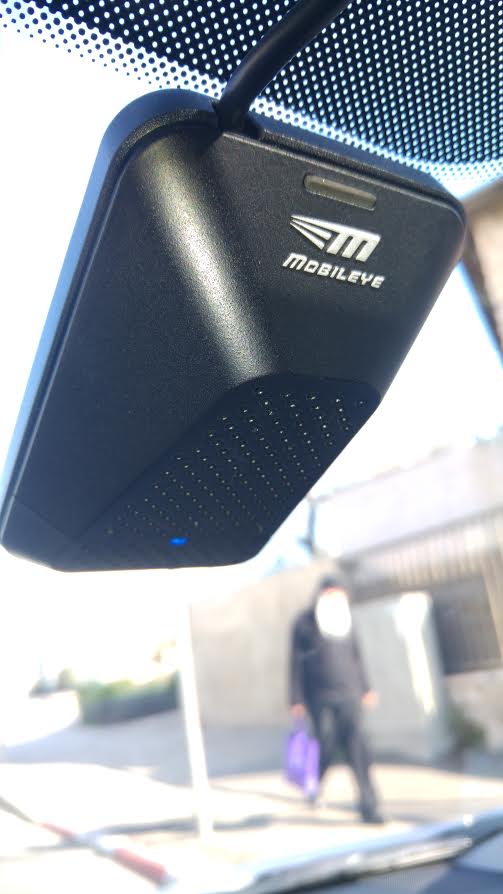 Mobileye's window-mounted camera (photographed 2017)
Image: Car window camera of Mobileye system (Ranbar, CC BY-SA 4.0), Wikimedia Commons. This is not the latest EyeQ6L-based camera discussed in the text, but an example of an earlier model.

Principle: a single image has no "absolute scale"
The biggest weakness of a monocular camera is that a single image alone can't, in principle, fix the absolute distance (real-world scale) to an object. A camera can be approximated with the pinhole camera model: a point (X, Y, Z) in 3D space projects onto a point (x, y) on the image plane, via focal length f, as
As this equation shows, all you can recover from the image coordinates (x, y) is the ratio of the real coordinates (X, Y, Z) normalized by depth Z — the depth Z itself cannot be back-calculated from a single image alone. Two objects that project to the same size in the image could be a small object nearby or a large one far away, and this equation alone can't distinguish them. This is in direct contrast to a stereo camera, which can compute Z directly through triangulation from the disparity between two lenses.
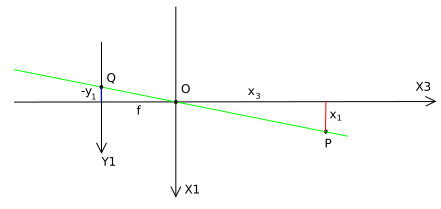 Pinhole camera model projection geometry
Image: Pinhole camera model geometry (KYN, CC0 1.0 public domain), Wikimedia Commons.

To work around this constraint, monocular-camera-based systems estimate distance using some kind of "known reference." A representative technique, used by Mobileye, is single-view geometry via Inverse Perspective Mapping (IPM): it assumes the road surface is planar and uses an object with a known real-world size — lane width, for instance — as a reference, back-calculating actual distance from position in the image (related patent: US8164628B2). Other techniques include estimating distance from an object's apparent size (the typical real-world dimensions of a vehicle or pedestrian) and estimating distance and speed from motion across consecutive frames (optical flow). Because all of these depend on assumptions, error tends to grow when the road surface is sloped or when an object's size deviates from what's assumed.
In recent years, research into "Monocular Depth Estimation" (MDE) — using deep learning to close this gap directly — has advanced rapidly. Where earlier methods could only output relative depth (near-far ordering), a 2025 survey paper focused specifically on "metric" monocular depth estimation, which outputs absolute distance in real-world meters (arXiv:2501.11841), was published in 2025 — a sign that overcoming monocular's fundamental weakness with a neural network is now a primary research battleground.
Key product specification comparison
| Product | Resolution | Field of view (FOV) | Notes |
|---|---|---|---|
| Mobileye EyeQ6L (EyeQ6 Lite) | 8 megapixels | 120 degrees | 20 degrees wider than the camera on EyeQ4M. Roughly 4.5x the processing performance of EyeQ4M, at about half the die area |
| Tesla HW4 camera | 5 megapixels | Substantially wider than HW3 (1.2MP) — exact figure undisclosed | A major upgrade from HW3's 1.2MP to 5MP. The rear camera has a stronger fisheye effect and wider angle |
| Continental MFC500 (MFC525/MFC526) | Up to 8 megapixels | Up to 125 degrees | A modular, scalable camera platform where recognition processing can run either inside the camera or in an external ADCU (integrated control unit) |
| comma.ai openpilot (comma 4) | (aftermarket add-on device, monocular camera + dedicated SoC) | — | A $999 aftermarket kit that adds Level 2 driver assistance to production vehicles. A single end-to-end neural network, "Supercombo," predicts the ego vehicle's future trajectory directly from the monocular image |
| Sony IMX490 image sensor | Approx. 8.8 megapixels | (sensor only, lens-independent) | An automotive-grade CMOS sensor with a wide 150dB dynamic range and LED flicker mitigation, used as a common component in camera modules from Mobileye, Continental, and others |
Mobileye's EyeQ6L is an ADAS SoC (System on Chip) announced in 2024, supplied more as a "camera + processing chip" set than as a standalone monocular camera. Its 8MP resolution and 120-degree wide FOV enable lane-keeping and automatic lane-change features that detect not just the current lane but the lane centers two lanes to either side. Tesla HW4 is the hardware generation rolled out from 2023, a major resolution jump from HW3's 1.2MP to 5MP that improves recognition accuracy for signs and license plates. Continental's MFC500 stands out for its flexibility — the recognition-processing engine can live either inside the camera body or in an external unit — and the family extends up to the truck-oriented MFC526. comma.ai's openpilot is the odd one out, the only product here that's an aftermarket add-on rather than an automaker's factory system, and it uses an end-to-end neural network, "Supercombo," that predicts the vehicle's future trajectory directly from the monocular image.
From a Hebrew University Lab to Mobileye, and Tesla's "Deletion" of Radar
From a Hebrew University lab to a $15 billion-plus Intel acquisition — Mobileye was founded in 1999 by Amnon Shashua, a computer-vision researcher at the Hebrew University of Jerusalem, together with executive Ziv Aviram. Before Mobileye, Shashua had been involved in founding CogniTens (optical measurement systems for automotive and aerospace) and CogniTech (video-analysis technology), and Mobileye was launched as an extension of that work, aiming to bring an affordable vision system to mass-market vehicles. Its first chip, the EyeQ1, shipped in 2004, a decade after the company's initial roadmap. Mobileye went public on Nasdaq in 2014 at roughly a $5.3 billion valuation, and in 2017 Intel acquired it for $15.3 billion — at the time, the largest technology acquisition in Israeli history. It returned to Nasdaq as an independent public company (still under Intel) in late 2022, and has since expanded from ADAS into autonomous driving and "physical AI."
The 2021 moment Tesla Vision "deleted" radar — Starting in May 2021, North American Model 3 and Model Y vehicles switched to a configuration with no radar sensor, beginning the shift to "Tesla Vision" — relying solely on cameras and neural-network processing. Andrej Karpathy, then Tesla's AI lead, gave a keynote at the CVPR 2021 (a leading computer-vision conference) autonomous-driving workshop that June, stating plainly, "We deleted the radar and are driving on vision alone in these cars," and explaining that Tesla's deep-learning vision system had reached a point roughly a hundred times better than the radar it replaced. He also said "everything that happens, happens for the first time, in the car, based on the videos from the eight cameras that surround the car," acknowledging the technical difficulty of a vision-only approach while arguing that once it works, it becomes a general vision system deployable anywhere on Earth. European and Middle Eastern Model 3/Y later also moved to radar-free Tesla Vision — a landmark case of an automaker deliberately choosing a monocular- (and multi-camera-) based approach over sensor fusion.
Aftermarket monocular driver assistance: comma.ai — Separate from any automaker's factory ADAS, comma.ai — founded by George Hotz, known for jailbreaking the iPhone — sells openpilot, which adds Level 2 lane-keeping and adaptive cruise to supported vehicles via a single $999 aftermarket device (the comma 3X/4) mounted on the windshield. Rather than a modular, traditional perception pipeline, it uses an end-to-end neural network called "Supercombo" that predicts the vehicle's future trajectory and road structure directly from the monocular camera feed. Because it's open source, it's widely used within the DIY and research communities.
Parameters That Determine Performance
- Resolution (pixel count): Directly determines recognition accuracy for distant signs, traffic lights, and small obstacles. Tesla HW4's roughly 4x resolution jump from HW3 was primarily aimed at improving visibility of small, distant targets. Automotive monocular camera resolution keeps climbing year over year, as seen with Continental's MFC500 and Sony's IMX490 both reaching the 8-megapixel class
- Field of view (FOV): A wider FOV lets a single camera cover more surrounding context — crossing pedestrians and merging vehicles at intersections, for instance. Mobileye's EyeQ6L securing 120 degrees, 20 wider than EyeQ4M, targets exactly this. Continental's MFC500 goes further, to 125 degrees, aimed at detecting cross-traffic vehicles from the side at intersections
- Dynamic range: Determines whether recognition holds up in scenes with extreme contrast — tunnel entrances/exits, headlight glare and backlight at night — without blowing out highlights or crushing shadows. Sony IMX490's 150dB dynamic range and LED flicker mitigation (which suppresses the flicker of LED traffic signals) address this challenge directly
- Distance-estimation preconditions: Because monocular cameras estimate distance on assumptions — a planar road surface, known lane width, standard object sizes — error tends to grow on rough roads, slopes, or unusually sized obstacles. Applications needing high-precision distance typically assume pairing with a stereo camera, LiDAR, or radar, though approaches like Tesla Vision instead try to push past this constraint purely through the scale of neural-network training
- Cost and mounting space: Needing only a single lens and sensor makes a monocular camera smaller and cheaper to build than a stereo or depth camera — an advantage in a vehicle's cramped windshield-top layout where multiple sensors compete for space. comma.ai's $999 price tag is emblematic of this low-cost advantage
- Processing performance (on the SoC side): A monocular camera's real-world usefulness hinges heavily on how sophisticated the processing behind the captured image can be. EyeQ6L's 4.5x compute performance over EyeQ4M exists specifically to push up recognition accuracy and the number of supported features
Checking Monocular Distance With a Numerical Example
If the road is approximated as a plane, with camera height H, focal length f, and pixel offset y from the horizon to an object's contact point, a simplified inverse-perspective relation is
For H=1.4\,\mathrm{m}, f=1200\,\mathrm{px}, and y=84\,\mathrm{px}, this gives Z\simeq20\,\mathrm{m}. Under the same assumptions, a 2px error in the contact point gives about 0.48\,\mathrm{m} of range error using the differential approximation \sigma_Z\simeq fH\sigma_y/y^2. Road slope, camera attitude, lane height, and an ambiguous contact point add further error.
This calculation does not reject neural monocular-depth estimation. It provides a reference for checking a learned output against road geometry, known object dimensions, stereo, or radar. Report tests by distance band, backlight, slope, rain, night, and object height rather than only one average error.
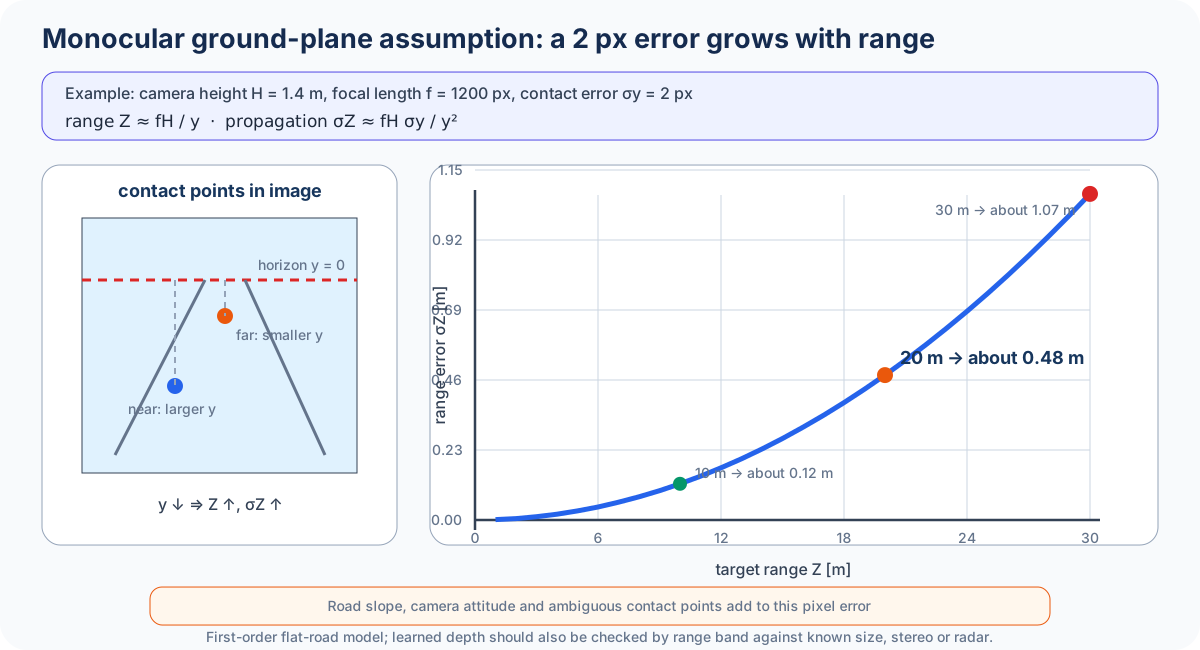
Does one image determine an object's distance?
Scale is ambiguous without extra assumptions. Identify whether the estimate uses known size, multiple views, or learned priors.
References
- Mobileye EyeQ6 Lite launch (Mobileye)
- Mobileye EyeQ6 Lite launch (Business Wire)
- Tesla HW3/HW4 camera comparison (Not a Tesla App)
- Patent on monocular distance estimation: US8164628B2
- Continental MFC500 camera platform announcement
- Continental MFC525 product page (AUMOVIO)
- Sony IMX490 sensor overview (Sony Semiconductor Solutions)
- comma.ai openpilot official site
- openpilot docs
- Level 2 Autonomous Driving on a Single Device (arXiv:2206.08176)
- Mobileye history (Wikipedia)
- Intel's acquisition of Mobileye ($15.3 billion)
- Andrej Karpathy's CVPR 2021 talk (Not a Tesla App)
- Tesla removes radar sensors (The Drive)
- Survey on Monocular Metric Depth Estimation (arXiv:2501.11841)
Current step · 3 / 21 · Sensors & Hardware
Comments
Please log in to post a comment
No comments yet.