Contents — find the section you need
Background and reading guide
Background Units used in specifications, such as voltage, current, distance and time.
Fundamentals · Explanations of principles, structure and trade-offs.
A stereo camera photographs the same scene with two lenses spaced a fixed distance apart (the baseline), then computes distance through triangulation from the shift (disparity) between the resulting left and right images. Where a monocular camera can never fix absolute distance from a single image alone, a stereo camera can compute distance directly from the geometric relationship between its two viewpoints, which makes it easier to secure distance accuracy without relying on extra assumptions (a planar road surface, for instance). It's used widely for forward monitoring in autonomous vehicles, robot navigation, and industrial 3D measurement.
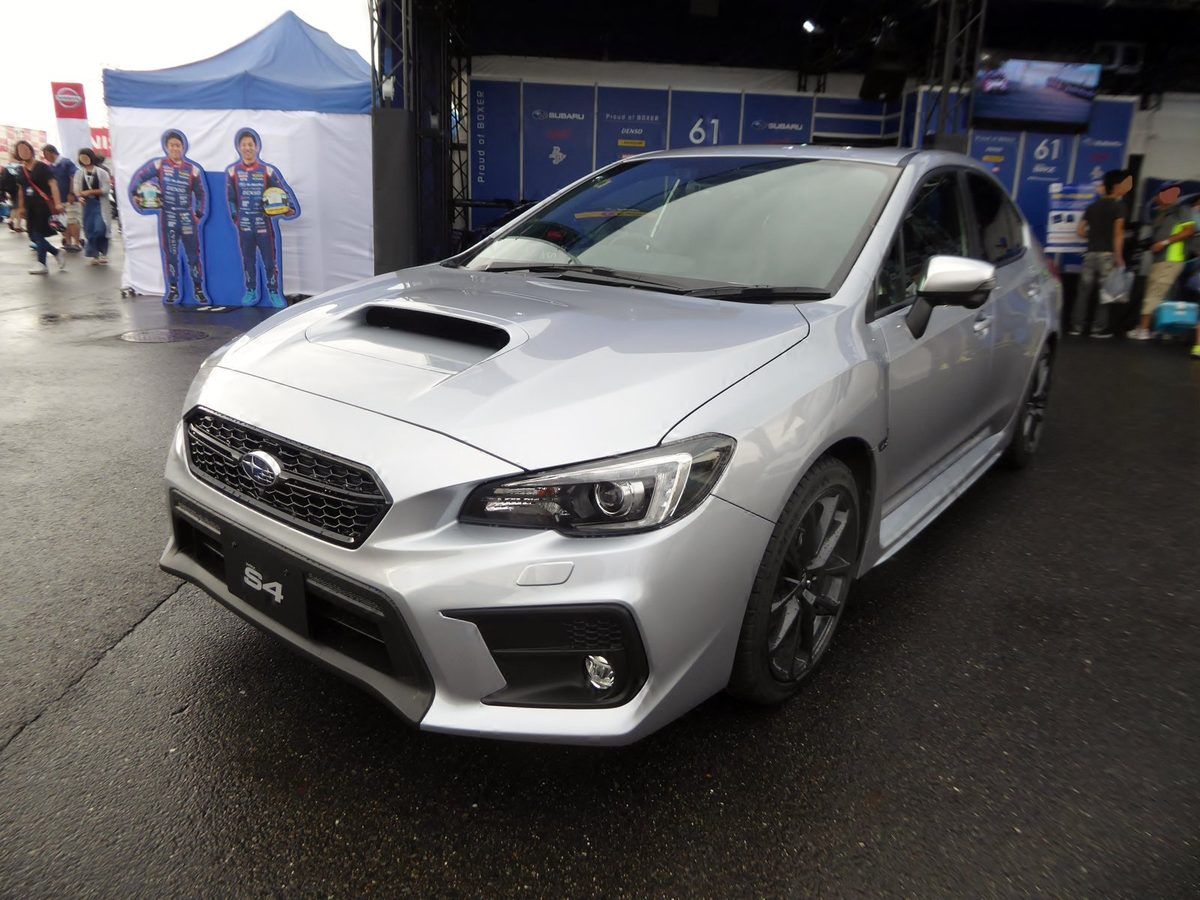 An EyeSight-equipped vehicle (Subaru WRX S4)
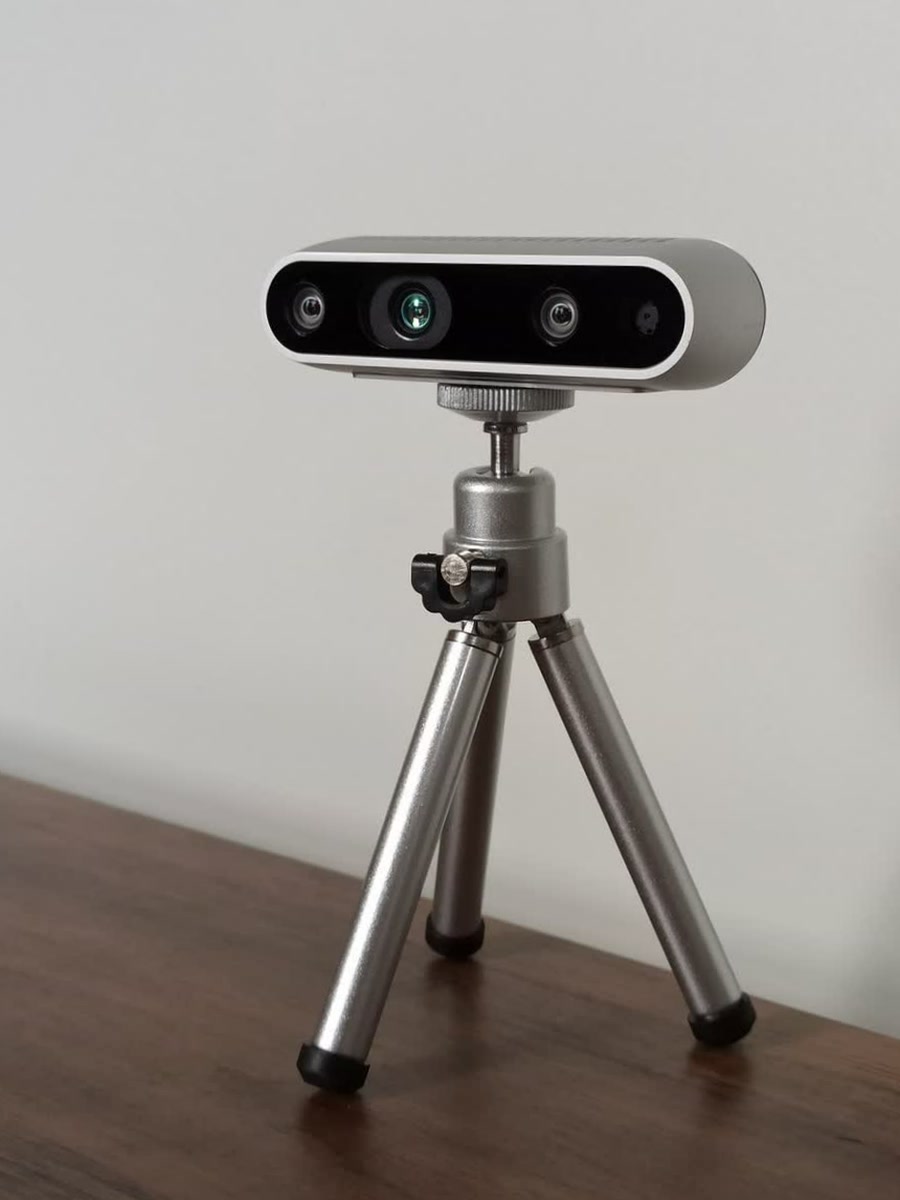 A stereo-camera unit: Intel RealSense D435
Images: Subaru WRX S4 2.0GT-S EyeSight (DBA-VAG) front (Tokumeigakarinoaoshima, CC BY-SA 4.0) / Intel Realsense depth camera D435 (Marc Auledas, CC BY-SA 4.0), Wikimedia Commons. The D435 is not an EyeSight component; it is a physical example of a camera unit with two viewpoints.
_front.jpg)

Principle: baseline length creates a tradeoff
The relationship between disparity d (the pixel shift of the same point between the left and right images), focal length f, and baseline (distance between the two lenses) B is:
Here Z is the distance to the object. As this equation shows, distance Z is inversely proportional to disparity d — nearby objects have large disparity, and distant objects have disparity that shrinks toward zero. A longer baseline B increases the sensitivity (the amount disparity changes for a given change in distance), which pushes long-range measurement accuracy upward. Conversely, a longer baseline means the two lenses' fields of view stop overlapping once an object gets too close, which pushes out the minimum measurable distance (the near-range limit). This means stereo camera design carries an inherent tradeoff, centered on baseline length, between "prioritize long range" and "prioritize short range." Because it's a passive, visible-light-based approach unlike an active depth camera (no infrared projector involved), it tends to work more stably than LiDAR or an active depth camera outdoors under strong sunlight.
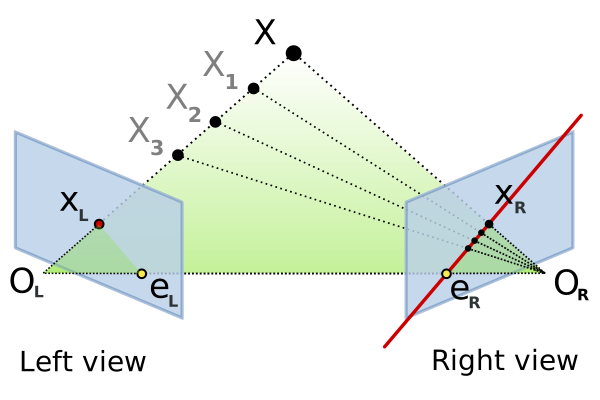 Epipolar geometry, the foundation of stereo vision
Image: Epipolar geometry (Arne Nordmann, CC BY-SA 3.0 / GFDL), Wikimedia Commons.

Many algorithms exist for computing disparity from the left/right images (stereo matching), but a classic method that has remained in wide use is Semi-Global Matching (SGM), published in 2005 by Heiko Hirschmüller at the German Aerospace Center (DLR). It approximates what's fundamentally a 2D optimization problem with roughly eight directions of 1D scanline optimization, achieving accuracy close to a global method at a computational cost close to a local one. It's implemented in many computer-vision libraries including OpenCV, and hardware implementations on FPGAs and GPUs are widespread. Deep-learning-based stereo matching (methods that use a CNN for cost aggregation, for example) increasingly beats SGM on accuracy, but SGM-family algorithms remain in active use for embedded applications where compute is limited.
Key product specification comparison
| Product | Baseline | Depth range | Resolution / frame rate | Notes |
|---|---|---|---|---|
| Stereolabs ZED 2i (2.1mm focal length model) | 12cm | 0.3–20m | 60fps at HD720, up to 2K (2208x1242) | Under 1% error within 3m, under 5% within 15m |
| Stereolabs ZED 2i (4mm focal length model) | 12cm | 1.5–35m | 60fps at HD720, up to 2K (2208x1242) | Under 1% error within 3m, under 5% within 15m |
| Luxonis OAK-D | 7.5cm | (mid-range oriented) | — | Onboard Myriad X VPU handles AI inference and stereo depth together. Funded by a July 2020 Kickstarter that raised about $1.3M from over 650 backers, driving it into mass production |
| Luxonis OAK-D LR (Long Range) | 15cm | Up to approx. 30m | — | A variant with double the baseline of the standard OAK-D, prioritizing long-range accuracy |
| Intel RealSense D435/D435i | Approx. 50mm | Approx. 0.3–10m (condition-dependent) | Up to 1280x720 @ 90fps (depth) | Can use an active infrared pattern projector as an assist, but also works with passive stereo alone. D435i is the 6-axis IMU variant |
| e-con Systems TaraXL | 60mm | Approx. 0.5–3m | WVGA (752x480), up to 60fps | Optimized for the NVIDIA Jetson platform, with a built-in 6-axis IMU. Uses ON Semiconductor MT9V024 sensors on both the left and right |
The ZED 2i (released 2023) is a stereo camera designed for outdoor robotics, offered in two lens models with different focal lengths so it can cover both near-range priority (the 2.1mm model, minimum 0.3m) and far-range priority (the 4mm model, up to 35m) use cases. Both share a 12cm baseline, which forms the basis of the ZED 2i's ranging characteristics. Luxonis's OAK-D is an embedded device that integrates a stereo depth camera with an AI inference chip (an Intel Movidius Myriad X VPU) in one unit, and it has the distinction of having exploded into mass production off the back of a wildly successful 2020 Kickstarter campaign. Its long-range variant, the OAK-D LR, extends the baseline to 15cm — a direct product-design application of the "longer baseline improves long-range accuracy" principle described above. Intel's RealSense D435/D435i and e-con Systems' TaraXL are hybrid designs built around passive stereo but able to add infrared projection or an IMU, suited to close-range robotics and drone applications.
Case study: the evolution of Subaru's EyeSight — from two eyes to three
The longest-running real-world example of a stereo camera is Subaru's "EyeSight." The first-generation EyeSight, launched in 2008, adopted a scheme where two stereo cameras capture the road ahead in 3D, using accurate distance measurement to obstacles — something a monocular camera struggled with — as the foundation for safety features like pre-collision braking. After repeated refinement, cumulative worldwide EyeSight installations passed 5 million units as of August 2022.
The latest generation of EyeSight has evolved into a "three eyes" configuration, adding a wide-angle monocular camera to the traditional pair of stereo cameras. Because a stereo camera pair alone has a limited field of view, the added wide-angle monocular camera reinforces peripheral awareness — cross-traffic at intersections, for instance. "EyeSight X" goes further, combining the stereo cameras' surrounding-environment perception with GPS and high-precision 3D map data to enable conditional hands-off driving (Level 2) on highways. It's a real-world example of fusing a stereo camera's own ranging ability with external information — GNSS and map data — to deliver advanced driver assistance that a camera alone couldn't provide.
EyeSight's Creator Went On to Found His Own Stereo-Vision Company
The engineer who led development of the first-generation EyeSight (the "Stereo Range Imager") was Keiji Saneyoshi, a principal engineer at Subaru. His team was the first in the world to bring to market a driver-assistance system that used stereo cameras alone to detect vehicles, pedestrians, cyclists, and motorcyclists. After leaving Subaru in 1998, Saneyoshi continued his research as a professor at Tokyo Institute of Technology until early 2017, and in May 2016 he founded his own company, ITD Lab, to keep advancing stereo-vision technology. It's an unusual career arc for the industry: a technology born inside an automaker carried forward, by the very person who invented it, into an independent specialist company of his own.
Intel RealSense had its own dramatic turn: in 2021, the announced end-of-life of several product lines (L515, the T26x series, and the F45x series) unsettled the industry, but the D400-series stereo depth cameras themselves stayed in production, and in 2025 the RealSense business itself was spun off from Intel entirely, relaunching as an independent company backed by a $50 million Series A round from a semiconductor-focused private equity firm. It's a case of a stereo depth camera line that started as one division of a major semiconductor company choosing, in response to market demand, to survive on as an independent business.
Parameters That Determine Performance
- Baseline length: The single most important parameter, setting the tradeoff between long-range accuracy and the near-range measurement floor (the dead zone). As the relation Z = fB/d shows, a longer baseline B increases distance sensitivity for a given change in disparity. The OAK-D LR doubling the standard OAK-D's baseline (to 15cm) to reach 30m of range is this exact principle applied directly to product design
- Depth range: As with the ZED 2i's two focal-length models, the optimal range varies dramatically by use case (indoor robot vs. outdoor vehicle)
- Depth accuracy: As the ZED 2i's specs show, error rate grows with distance (under 1% within 3m, growing to under 5% within 15m). Applications needing high-precision close-range measurement, like collision avoidance, demand different accuracy than applications where a rough sense of distant surroundings is enough
- Field-of-view limits: A stereo camera can only measure depth where the two lenses' fields of view overlap, so on its own its field of view tends to be limited. The latest EyeSight adding a wide-angle monocular camera exists precisely to compensate for this, and combining multiple sensors is close to a practical necessity
- Weaknesses inherent to a visible-light basis: Passive stereo can't detect disparity, and loses ranging accuracy, on objects without enough texture (pattern). On a plain wall or a solid-colored floor, an active depth camera using infrared pattern projection can have the advantage
- Computational cost of stereo matching: Searching for corresponding points between the left and right images is computationally expensive, and for embedded devices, hardware acceleration is essentially mandatory. This is why the OAK-D carries a dedicated VPU and the RealSense D400 series carries a dedicated ASIC (the Vision Processor D4) — real-time processing on CPU alone is difficult
- Whether an IMU is integrated: Products with a built-in 6-axis IMU, like the e-con Systems TaraXL and Intel RealSense D435i, can compensate for the camera's own motion while processing depth. For mobile robots and drone-mounted use, this integration is often the practical deciding factor
How a One-Pixel Error Gets Amplified Into Range Error
Stereo depth follows Z=fB/d. Converting disparity uncertainty \sigma_d into range uncertainty gives
For f=700\,\mathrm{px}, B=0.12\,\mathrm{m}, and Z=2\,\mathrm{m}, the disparity is d=42\,\mathrm{px}. A 0.5\,\mathrm{px} disparity error then becomes about 2.4\,\mathrm{cm} of range error. The same 0.5\,\mathrm{px} error grows to about 0.60\,\mathrm{m} at Z=10\,\mathrm{m}, which is why sub-pixel estimation and a longer baseline matter at long range.
This does not mean that a longer baseline is always the answer. At close range the two image fields may stop overlapping, and vibration or temperature-dependent extrinsic changes may matter. In practice, report reprojection error, disparity confidence, and occluded regions separately for each distance band.
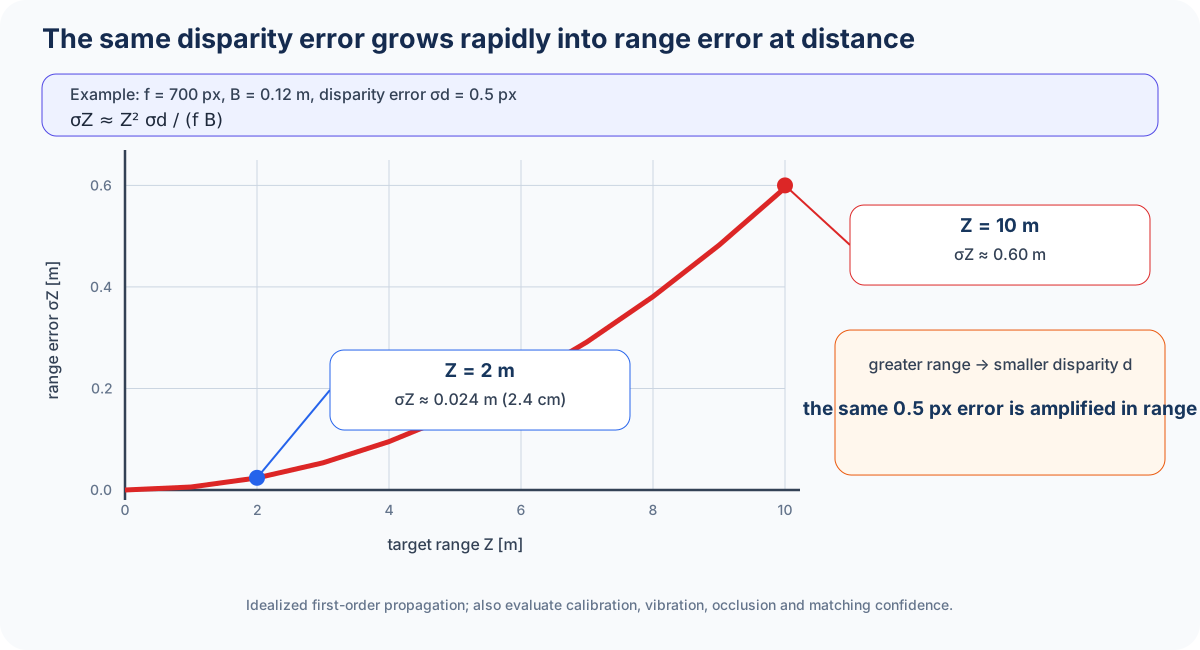
Does one pixel of disparity error matter less at long range?
Disparity shrinks with distance, so the same disparity error produces larger range error. Consider baseline, focal length, and operating range together.
References
- Stereolabs ZED 2i product page
- ZED 2i detailed specs (Stereolabs support)
- The evolution and history of Subaru EyeSight
- EyeSight guide (SUBARU official)
- EyeSight (Wikipedia)
- Subaru EyeSight Father Returns in Stereo Vision (EE Times)
- Luxonis OAK-D Kickstarter campaign
- Introduction to OpenCV AI Kit (PyImageSearch)
- Luxonis OAK-D LR product page
- Intel RealSense D435/D435i product page
- Intel spins off RealSense business (Tom's Hardware)
- e-con Systems TaraXL product page
- Stereo Processing by Semi-Global Matching and Mutual Information (Hirschmüller, 2008, IEEE PAMI)
- Semi-global matching (Wikipedia)
Current step · 4 / 21 · Sensors & Hardware
Comments
Please log in to post a comment
No comments yet.