Contents — find the section you need
Background and reading guide
Background Basic terminology of the technology; consult the linked fundamentals as needed.
Trends · Read the sources, reporting period and comparison criteria together.
Object detection is the task of estimating both an object's location (bounding box) and its category from an image, simultaneously. The YOLO family has long been the go-to choice for production use, but by 2026, transformer-based detectors have reached a point where they're genuinely threatening that position.
This article focuses on research trends and briefly introduces the essential concepts first.
 Object Detection
No license-free official logo for YOLO/Ultralytics could be found, so a simple icon representing bounding-box detection was created in its place.
The Detector Design Split at a Glance
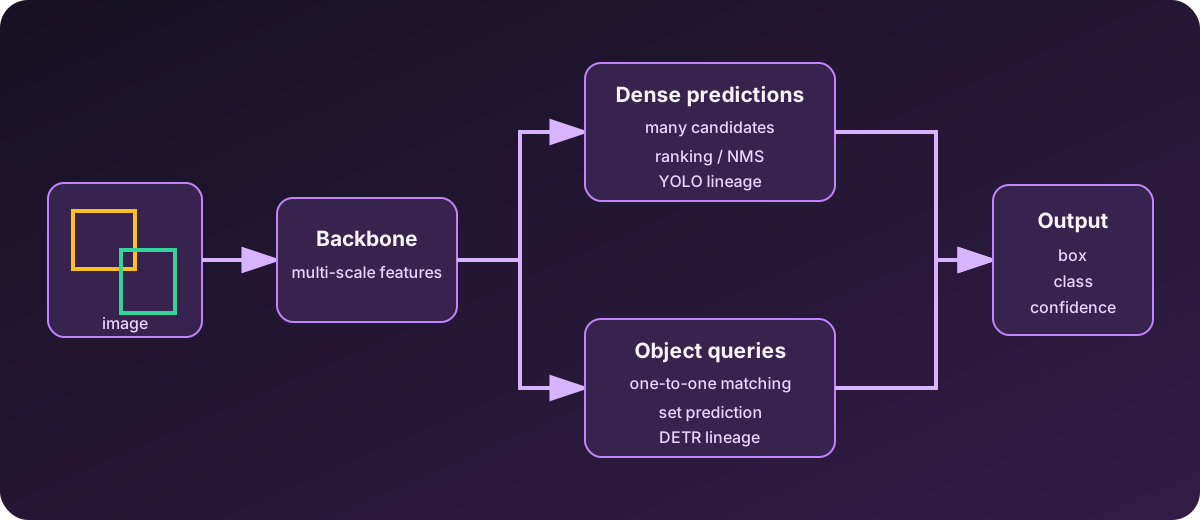
Diagram: Duskcoil. It highlights the representative design split between dense prediction and set prediction.
Every object detector turns an input image into features and ultimately returns location, category, and confidence. The major distinction is whether it creates many candidates and removes duplicates afterward, or matches learned object queries one-to-one with ground truth and directly predicts a low-duplication set. That choice propagates into the need for NMS, the training objective, speed, and behavior in crowded scenes.
Where the YOLO Family Stands: Going NMS-Free
Traditional NMS is a post-processing step that narrows several candidate boxes produced for the same object down to one final detection, by discarding any box whose overlap (IoU: Intersection over Union, the overlap area between two boxes divided by their union area) with another exceeds a threshold.
This post-processing runs as an independent step outside the network, and it comes with baggage: empirical tuning of where to set the threshold, and a tendency to mistakenly discard genuinely distinct, closely packed objects. YOLO26, the latest generation of YOLO, adopts an NMS-free architecture that no longer needs non-maximum suppression, the post-processing step that's been standard for years. NMS tends to be a bottleneck for both compute cost and latency in the inference pipeline, and removing it is aimed at improving both inference speed and implementation simplicity. On the pure-throughput side, the lightweight, high-speed end of the spectrum remains well stocked too — RTMDet, for instance, clears 300 FPS.
The Rise of Transformer-Based Detectors: RF-DETR and RT-DETRv2
Another major current is the DETR (DEtection TRansformer) lineage reaching practical maturity. RT-DETR/RT-DETRv2 combine a CNN with a transformer, and, like the YOLO family, are designed to output final detections directly without NMS.
The big event of 2026 was the arrival of RF-DETR, presented at ICLR 2026. It's described as the first real-time model to break 60 mAP on the COCO benchmark, and it also leads the RF100-VL benchmark, which evaluates domain transfer. Its license is Apache 2.0 — permissive for commercial use — a contrast with the AGPL-licensed YOLO26/YOLOv12.
Open-Vocabulary Detection via Text Prompts
Another important current is "open-vocabulary detection" — detecting categories the model was never trained on. YOLO-World and Grounding DINO can detect an arbitrary category given nothing more than a text prompt, with no additional training data required. It's a shift in mindset away from detection bound to a fixed class list, and it fits well with use cases where the real-world categories can't be fully enumerated ahead of time — object recognition for a general-purpose robot, for instance.
The Technical Mechanism Behind Going NMS-Free
YOLO26's move to NMS-free detection isn't just a matter of skipping a post-processing step — it comes from changing the training method itself. The traditional YOLO design tolerated multiple predicted boxes per object during training (one-to-many assignment), with the assumption that NMS would thin out the duplicates after inference. YOLO26 redesigns the prediction head, switching to one-to-one assignment, where a single, definitive box per object instance is output starting from training itself. It also replaces the distribution-based approach used for bounding-box regression (Distribution Focal Loss) with a lighter, more hardware-friendly parameterization, cutting operations that tend to be unstable across compilers and runtimes. The result is up to 43% faster inference on CPU, alongside a simpler post-processing implementation overall.
RF-DETR is likewise NMS-free, but by a different mechanism than YOLO26. RF-DETR uses a pretrained Vision Transformer, DINOv2, as its backbone, extracts multi-resolution features, and passes them through a decoder that works with learnable queries (abstract representations standing in for candidate objects). Each decoder layer consists of self-attention (capturing relationships between queries), deformable cross-attention (attending only to a small, learned set of sampling points within the image features), and a feed-forward network that refines the prediction. This "look only at a small number of learned points" deformable attention keeps computational cost lower than standard transformer cross-attention, while producing unique, set-based predictions — which is exactly why NMS becomes unnecessary in the first place.
What Cross-Generation Comparisons Actually Show: YOLOv8/v11/v26
Data has also emerged that pushes back on the assumption that "newer generation = uniformly higher accuracy." An August 2026 benchmark spanning three YOLO generations and five model scales — targeting fine-grained structures (branches, fruit, other small objects) in orchard detection and instance segmentation — found that the highest mAP@50:95 wasn't set by YOLOv26 at all, but by YOLOv11s-960 (0.402 mask mAP@50:95, 0.426 box mAP@50:95). YOLOv26s-960, meanwhile, achieved roughly comparable accuracy with only 10.37 million parameters. So the picture that emerges is: raw accuracy gains don't arrive uniformly with each new generation, but parameter efficiency — matching accuracy with far less compute — is advancing steadily.
Small-object detection also remains a real, unresolved challenge. An August 2026 evaluation comparing six YOLO variants and two DETR variants on military vehicle detection found a consistent pattern: larger models perform better, DETR-based approaches show promise, and fine-tuning improves air-to-ground (A2G) performance — but every single model still struggles to detect small objects in the A2G scenario. Neither YOLO26's NMS-free design nor RF-DETR's high mAP has fully solved this "small, distant object" problem.
Open-Vocabulary Detection's Progress: Concrete AP Numbers
The generation of open-vocabulary detectors following YOLO-World/Grounding DINO has also made steady accuracy gains through 2026. FlowOVD (May 2026), which uses a generative rectified flow to transform text-agnostic queries into text-guided ones, reports 49.5 AP on COCO and 31.5 AP on LVIS — improvements of +1.2 AP (a relative +2.5%) and +4.1 AP (a relative +15.0%) over Grounding DINO, respectively. OPUS, published in August 2026, handles multiple prompt types — text, visual (interactive/generic), and mixed — within a single unified framework, and despite a simpler design that avoids heavyweight cross-modal fusion, it posts state-of-the-art-level numbers of 68.1/69.2/54.7 AP across the COCO, LVIS-minival, and ODinW35 benchmarks. Open-vocabulary detection is no longer just a qualitative win — the ability to handle unknown categories — it's starting to become quantitatively competitive with fixed-class detectors too.
The Landscape as of 2026
Object detection today is largely framed along two axes: single-stage, NMS-free transformer architectures, and the YOLO family with its established ecosystem. The transformer side is developing fast, but the YOLO family remains the backbone of real-time production environments, on the strength of its production track record and the sheer depth of its tooling. Broken down by use case:
- Accuracy above all: RF-DETR
- Track record and ecosystem matter most: YOLO26/YOLOv12
- Pure speed: RTMDet
- Need to handle unknown categories: YOLO-World / Grounding DINO
That's the current division of labor.
Can mAP alone select a real-time detector?
Compare latency and quality at matched resolution, data, and hardware. Inference time without pre- and postprocessing is not end-to-end latency.
References
- Demystifying RF-DETR (Towards AI)
- RT-DETRv2 Paper (arXiv)
- DETRs Beat YOLOs on Real-time Object Detection Paper (arXiv)
- Best Object Detection Models 2026 (Roboflow Blog)
- YOLO26: An Analysis of NMS-Free End to End Framework for Real-Time Object Detection (arXiv)
- RF-DETR Paper (ICLR 2026, arXiv)
- RF-DETR GitHub (roboflow)
- Cross-Generation Optimization of YOLOv26, YOLOv11, and YOLOv8 Paper (arXiv)
- Comparative Study of Out-of-the-Box Technology for Automatic Target Detection and Recognition Paper (arXiv)
- FlowOVD Paper (arXiv)
- OPUS Paper (arXiv)
Current step · 5 / 10 · Technology Trends
Comments
Please log in to post a comment
No comments yet.