Contents — find the section you need
Background and reading guide
Background No specialist background required; check the reporting period and scope of financial measures.
Industry research · Read the sources, reporting period and comparison criteria together.
Lunar transport, small SAR satellite constellations, on-orbit servicing (space debris removal) — the three companies leading Japan's "NewSpace" movement are all listed on the Tokyo Stock Exchange Growth Market, yet they are chasing entirely different business territory. ispace hauls cargo to the Moon with lunar landers, a "transport" business; Synspective sells Earth-surface data from its own fleet of small SAR satellites, an "observation" business; Astroscale captures and removes debris and failed satellites in orbit, a "maintenance" business — each is pioneering a business model with almost no precedent anywhere in the world. All three have continued posting massive operating losses since going public, but a structural shift runs through all of them from 2025 into 2026: each has begun folding government demand — the Ministry of Defense, the Space Strategy Fund — into its revenue base.
 ispace
 Astroscale
Image: ispace logo / Astroscale logo (both public domain; trademark rights still apply separately), Wikimedia Commons. No Synspective logo meeting Commons' copyright criteria could be found, so the company is covered in prose only.


Company History: From an XPRIZE Team to Lunar Transport, a Keio-Born SAR Satellite Maker, and a Debris-Removal Startup Founded in Singapore
ispace traces back to September 1, 2010, when it was founded as the operating body for "HAKUTO," Japan's team in the Google Lunar XPRIZE (a private lunar-exploration race). Founder Takeshi Hakamada earned a master's in aerospace engineering at Georgia Tech, worked at a foreign consulting firm, and then led HAKUTO. Even after the XPRIZE ended in 2018 with no winner, ispace continued the effort as its own lunar-exploration program, "HAKUTO-R," and launched its Mission 1 lander from Florida in December 2022. On April 12, 2023, it became the first Japanese space venture to list on the Tokyo Stock Exchange Growth Market, raising roughly ¥6.51 billion.
Synspective was founded on February 22, 2018, by Motoyuki Arai (a Keio University graduate with a doctorate from the University of Tokyo's Graduate School of Engineering) and others, as a startup born out of Keio University. Within under three years of founding it launched its first small SAR (synthetic-aperture radar) satellite, "StriX-α," followed by the technology-demonstration satellite "StriX-β" in 2022 and the first commercial satellite, "StriX-1," which reached orbit in March 2023. It listed on the Tokyo Stock Exchange Growth Market on December 19, 2024 (IPO price ¥480, opening price ¥736, market cap at listing roughly ¥51.96 billion), and put the entire ¥11.76 billion raised toward equipment and working capital.
Astroscale was founded in May 2013 by Mitsunobu Okada in Singapore as ASTROSCALE PTE. LTD. From the outset it was designed for operations across multiple countries — Singapore, Japan, the UK, the US — and it later shifted its head-office functions to Tokyo. In May 2023, marking its 10th anniversary, it relocated to a new headquarters in Kinshicho, Tokyo, equipped with a public tour facility called "Orbitarium" and a cleanroom capable of simultaneously manufacturing up to four satellites the size of the asteroid probe Hayabusa. It listed on the Tokyo Stock Exchange Growth Market on June 5, 2024 (IPO price ¥850, market cap at listing roughly ¥80 billion), raising about ¥11.3 billion. Of the three, it was founded earliest and listed last.
Comparing Company Scale: Results Before and After Listing (Last 4–5 Fiscal Years)
All three are recently listed NewSpace companies that have consistently posted operating losses. Comparing "revenue growth" and "the quality of the loss" (front-loaded investment vs. a structural deficit) captures each company's growth stage better than single-year profitability would.
| Fiscal Year | ispace Revenue | ispace Operating Profit/Loss |
|---|---|---|
| FY2022/3 | ¥674.14 million | -¥4.05666 billion |
| FY2023/3 | ¥989.24 million | -¥11.0239 billion |
| FY2024/3 | ¥2.35705 billion | -¥5.50169 billion |
| FY2025/3 | ¥4.74323 billion | -¥9.79514 billion |
| FY2026/3 | ¥3.30709 billion (down 30.3% YoY) | -¥11.58006 billion |
| Fiscal Year | Synspective Revenue | Synspective Operating Profit/Loss |
|---|---|---|
| FY2023/12 | ¥1.38628 billion | -¥1.79592 billion |
| FY2024/12 | ¥2.31664 billion | -¥3.0702 billion |
| FY2025/12 | ¥2.376 billion | -¥4.137 billion |
| FY2026/12 (company forecast) | ¥6.353 billion | -¥5.467 billion |
| Fiscal Year | Astroscale Revenue | Astroscale Operating Profit/Loss |
|---|---|---|
| FY2023/4 | ¥1.79299 billion | -¥9.66562 billion |
| FY2024/4 | ¥2.85256 billion (up 59.1% YoY) | -¥11.55572 billion |
| FY2025/4 | ¥2.45695 billion (down) | -¥18.755 billion |
| FY2026/4 | ¥5.94061 billion (up 141.8% YoY) | -¥9.975 billion |
| Metric | ispace | Synspective | Astroscale |
|---|---|---|---|
| Listing date | April 12, 2023 (TSE Growth) | December 19, 2024 (TSE Growth) | June 5, 2024 (TSE Growth) |
| Ticker | 9348 | 290A | 186A |
| Employees | ~330 consolidated (end of March 2026; sites in Japan, Luxembourg, and the US) | ~200 (as of 2024; the disclosed figure has been updated only sparingly since) | ~500 (about 70% engineers, about two-thirds based overseas) |
ispace is the only one of the three to record a revenue decline, with FY2026/3 revenue down 30.3% year on year — driven mainly by an engine-development delay on the Mission 3 lander (APEX 1.0) and delayed customer payments, and it illustrates how heavily results swing on a single lunar-transport mission. Synspective has grown revenue for four straight fiscal years; in FY2025/12 gross profit nearly vanished (from ¥214.52 million to ¥7.76 million) as it front-loaded investment into building out its satellite constellation, but for FY2026/12 it is projecting 2.7x revenue growth on the back of a rapidly expanding order backlog (up ¥19.6 billion from the prior year-end, to ¥24.96 billion at the end of FY2025/12). Astroscale slipped into a temporary revenue decline in FY2025/4, but in the third quarter of FY2026/4 it turned gross-profit-positive for the first time since founding, putting it closest to profitability of the three.
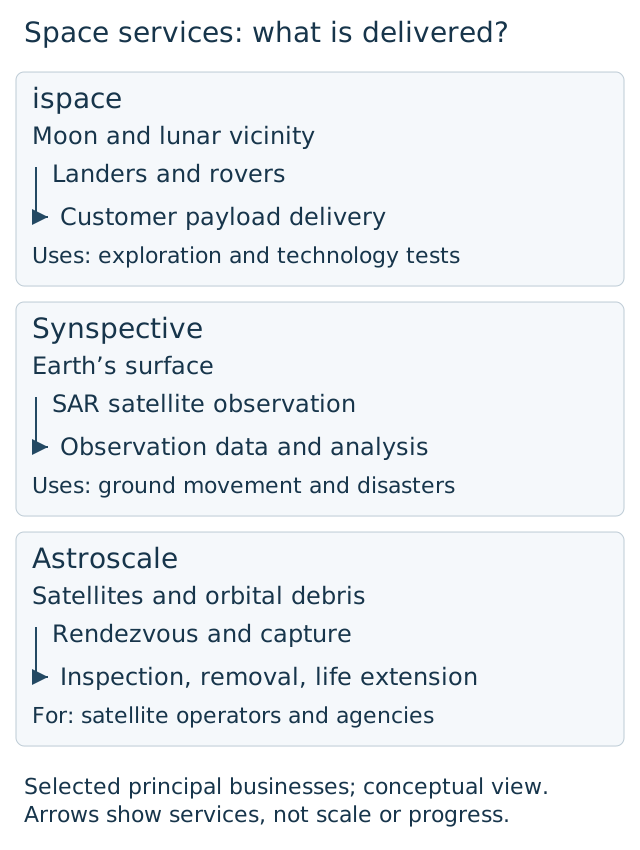
Image: ispace logo / Astroscale logo (both public domain; trademark rights still apply separately), Wikimedia Commons. No Synspective logo meeting Commons' copyright criteria could be found, so the company is covered in prose only.
Comparing Flagship Products and Businesses
The three companies aren't competitors — they occupy different domains: lunar exploration, Earth observation, and on-orbit servicing.
ispace: The Evolution of Its Lunar Landers and Missions
| Item | Mission 1 | Mission 2, "RESILIENCE" | Mission 3, "APEX 1.0" |
|---|---|---|---|
| Launch | December 2022 (SpaceX Falcon 9) | January 15, 2025 | Planned launch in 2026 |
| Outcome | Communication lost just before landing in April 2023, due to an altitude-sensor malfunction (landing failure) | Landing failed on June 6, 2025, at Milestone 9 just before touchdown, due to a laser altimeter fault | Led by ispace-U.S.; aims for high-precision landing with an eye toward contributing to NASA's Artemis program |
| Payload | A small lunar rover (developed in cooperation on SORA-Q, etc.) | ispace EUROPE's micro-rover "TENACIOUS" (26 cm tall, 31.5 cm wide, 54 cm long, ~5 kg, for regolith collection) | Lander design improved from Series 2, renamed APEX |
ispace has failed on both of its landing attempts to date, each time just before touchdown — a testament to how technically demanding lunar landing is. Drawing on lessons from both failures, it is redesigning the lander as APEX 1.0 for its third attempt with Mission 3.
Synspective: The StriX Small SAR Satellites and Data Solutions
| Item | Details |
|---|---|
| Satellite | The "StriX" series, 100 kg class — roughly 1/10 the weight and 1/20 the manufacturing/launch cost of a conventional large SAR satellite |
| Imaging modes | Strip map, sliding spotlight, steering spotlight |
| Resolution | 0.9 m in both ground-range and azimuth in sliding-spotlight mode; 0.46 m × 0.5 m in the high-resolution mode |
| Data solutions | "Flood Damage Assessment" (flood extent, flood depth, road/building damage); "Ground Displacement Monitoring" (millimeter-scale surface displacement plotted over time) |
| Constellation plan | A production/launch plan aiming for roughly 30 satellites by the late 2020s |
SAR (synthetic-aperture radar) uses radar waves, so unlike optical satellites it can observe at night and through cloud cover or rain. Synspective's strategy is to make its satellites small and mass-producible, driving up satellite count to raise revisit frequency (how often it can re-observe the same location).
Astroscale: From On-Orbit Demonstration to Commercial Service
| Item | ELSA-d | ADRAS-J / ADRAS-J2 | ELSA-M |
|---|---|---|---|
| Position | Demonstration (2021) | JAXA's Commercial Removal of Debris Demonstration (CRD2), Phase I/II | Commercial debris-removal service (for OneWeb) |
| Details | Demonstrated a capture mechanism using a magnetic docking plate | Approached a real large piece of debris (a Japanese rocket upper stage, ~11 m long, ~4 m in diameter, ~3 tonnes), closing to within about 15 m — the world's first such demonstration | Deploying technology proven in demonstrations to commercial-satellite debris removal |
| Business stage | Demonstration complete | Demonstration (J) transitioning to removal demonstration (J2) | Moving into commercial operation |
Astroscale is developing several "on-orbit servicing" lines in parallel — debris removal (ADR), life extension (LEX), inspection and observation (ISSA) — a design intended so that the failure of any single mission doesn't cripple overall results. In 2025 it won a satellite prototype contract worth roughly ¥7.27 billion from Japan's Ministry of Defense, marking its full-scale entry into the defense and security sector.
Differences in Technology Strategy
Because the three companies target fundamentally different market structures, a direct comparison is difficult — but each one's path to winning is clear.
ispace's strength lies in its own lunar-lander design and development capability, split across a three-site structure in Japan, Luxembourg, and the US (its US arm, ispace-U.S., leads Mission 3 and serves as the point of contact for NASA-related matters). Its mid-term vision, the "Cislunar Digital Twin 2030" concept, envisions deploying lunar-orbit satellites from 2027 and building at least five of them by 2030 to form "Lunar Connect," a communications and data service — a shift from a one-off lunar-transport mission business toward lunar-orbit infrastructure. That said, as its two landing failures show, the technical validation is still far from complete.
Synspective's strength is its small, mass-producible satellite design. As its roughly 1/10-weight, 1/20-cost figures relative to a conventional large SAR satellite suggest, lightening and standardizing the spacecraft lets it field more satellites and raise revisit frequency at the same location — a strategy of winning through numbers. Its in-house mass-production site, the Yamato Technology Center, which began operating in 2024, is the manufacturing base underpinning that strategy, and its participation in the Ministry of Defense's satellite constellation program (worth roughly ¥283.1 billion over five years, alongside fellow selectees iQPS and Axelspace) is positioned as a second pillar of revenue alongside its civilian data sales.
Astroscale's strength is vertically integrating end-to-end technology (capture, removal, life extension, inspection) in the new market of on-orbit servicing. Its step-by-step progression from ELSA-d to ADRAS-J to ADRAS-J2 to ELSA-M — from demonstration to commercialization — is well underway, and by winning satellite-constellation operators like OneWeb as customers, it is diversifying revenue across both government and commercial missions. Turning gross-profit-positive for the first time since founding in the third quarter of FY2026/4 marks it as the furthest along of the three in proving out its business model.
Development & Manufacturing Facilities
None of the three companies operates the kind of broad production network a large manufacturer would; their domestic presence is concentrated in headquarters functions, though their overseas footprints differ. ispace runs a three-region structure across Japan, Luxembourg, and the US; Synspective has its Tokyo headquarters, the Yamato Technology Center (Yamato, Kanagawa Prefecture), and a Singapore site; Astroscale has the broadest overseas network of the three, with its Tokyo headquarters plus sites in the UK, US, France, Israel, and Singapore. The map below plots the domestic facilities that could be confirmed (overseas facilities are covered in prose only).
Sources: ispace's official announcement of its new headquarters, "Earth Base," opened March 2026 (Nihonbashi-Honcho, Chuo, Tokyo). Synspective's official-site company overview (Koto, Tokyo) and press release on the Yamato Technology Center coming online (Yamato, Kanagawa Prefecture). Astroscale's official announcement of its new headquarters location (Kinshi, Sumida, Tokyo). Coordinates were geocoded to town/block level via OpenStreetMap Nominatim (a building-level primary source could not be obtained for any of the three, so town/block centroids were used). All three companies' domestic sites are concentrated in headquarters functions; overseas facilities (ispace: US, Luxembourg; Synspective: Singapore; Astroscale: US, UK, France, Israel, Singapore) are out of scope for the map.
Strategy & Outlook
ispace pursues its long-term vision, the "Moon Valley 2040" concept (treating the Moon and Earth as a single economic sphere), through its mid-term vision, the "Cislunar Digital Twin 2030" concept. It aims to contribute to NASA's Artemis program with Mission 3 (APEX 1.0), planned for launch in 2026, while also planning to build, from FY2027 onward, a system capable of high-frequency lunar transport — three missions a year — and, by 2030, to deploy at least five lunar-orbit satellites to commercialize "Lunar Connect," a communications and data service. Between October and November 2025 it raised ¥18.2 billion through a public offering and third-party allotment; whether it can overcome its two landing failures is the biggest question for 2026.
Synspective, on the back of its order backlog swelling to ¥24.96 billion (up ¥19.6 billion from the prior year-end) as of its FY2025/12 results, is projecting FY2026/12 revenue at 2.7x the prior year, ¥6.353 billion. Through its participation in the Ministry of Defense's satellite constellation program and support from the Cabinet Office's "Space Strategy Fund" (a disclosed support ceiling of ¥23.79 billion), it has made clear its intent to make government and security demand, alongside civilian data sales, a growth engine. It is also ramping up business activity in the US, aiming to create new revenue opportunities.
Astroscale holds a long-term goal of making on-orbit servicing "an everyday part of space operations" by 2030 and realizing a circular space economy (sustainable space development) by 2035. Having completed the demonstration phase with ELSA-d and ADRAS-J, it is now in transition to commercial operation with ELSA-M and ADRAS-J2, and it is designed to run multiple revenue streams in parallel — including its 2025 Ministry of Defense contract (roughly ¥7.27 billion) — to spread the risk of any single mission's failure. Turning gross-profit-positive for the first time since founding in the third quarter of FY2026/4 shows it is beginning to prove the economic value of on-orbit servicing, a new market, to customers; while it still expects a ninth consecutive fiscal-year net loss for FY2027/4, that loss is on a narrowing trend.
References
- ispace Official Site / Investor Relations
- Synspective Official Site / Company Overview
- Astroscale Official Site / Investor Relations
- Nikkei: ispace lists on TSE Growth Market
- PR TIMES: ispace announces FY2026/3 full-year results
- Nikkei: ispace's FY2026/3 revenue revised down 28%, engine development delayed
- IRBANK: ispace financial results
- Keio Innovation: Synspective lists on TSE Growth Market
- PR TIMES: Synspective's small-SAR-satellite mass-production plant, "Yamato Technology Center," begins full operation
- Logmi Finance: Synspective's order backlog expands rapidly, up ¥19.6 billion from the prior year-end
- PR TIMES: Synspective on the establishment of a special-purpose company for the Ministry of Defense's satellite constellation program
- IRBANK: Synspective financial results
- Nikkei: Astroscale Holdings' TSE Growth Market listing approved
- MONOist: Astroscale opens its new headquarters, including tours of the satellite-manufacturing cleanroom
- PR TIMES: Astroscale's commercial debris-removal demonstration satellite "ADRAS-J" closes to within ~15 m of debris
- IRBANK: Astroscale Holdings financial results
Current step · 21 / 21 · Corporate Research
Comments
Please log in to post a comment
No comments yet.