Contents — find the section you need
Background and reading guide
Background Basic force, motion and energy terminology; use the linked background explanations.
Fundamentals · Explanations of principles, structure and trade-offs.
Bottom line
A gasoline engine ignites an air-fuel charge with a spark plug and converts piston motion into crankshaft torque. It is compact and rev-friendly; throttling creates a part-load penalty. Direct injection, variable valves, turbocharging, and hybrid systems target that penalty. See also agricultural machinery and construction machinery.
Four strokes and thermodynamics
Figure 1 — Conceptual SVG by Duskcoil; two crank revolutions complete one cycle.
For the ideal Otto cycle, with compression ratio r and heat-capacity ratio \gamma,
Real engines add heat transfer, combustion-duration, pumping, and friction losses. Shaft torque is T and speed is \omega; power is P=T\omega; brake-specific fuel consumption is BSFC=\dot m_f/P.
Figure 2 — Conceptual only, not measured data.
Hardware, emissions, products, and safety
The intake, throttle, injectors, cylinders, ignition, exhaust, lubrication, cooling, and ECU form one controlled system. A three-way catalyst requires closed-loop oxygen-sensor control near stoichiometry; direct-injection engines may use a gasoline particulate filter.
Examples current as of 2026-09-03 include the North-American Toyota Corolla 2.0-L Dynamic Force engine and regional Honda 2.0-L e:HEV applications. Specifications, availability, and emissions certification differ by market and model year; confirm local documents. Primary starting points: Toyota, Honda, and EPA.
Research includes lean combustion, pre-chambers, e-fuel compatibility, and model-based controls. BEVs eliminate tailpipe emissions while driving and provide immediate low-speed torque; hybrids use motors and regeneration to keep the engine nearer efficient points. Never operate indoors, open a hot cooling system, or loosen high-pressure fuel hardware before prescribed depressurization. Follow OEM high-voltage isolation procedures on hybrids.
Can compression ratio always be raised for better efficiency?
Separate ideal-cycle trends from knock, heat losses, and combustion constraints. An ideal equation alone cannot set a practical ratio.
References
Load-cycle selection and diagnostic logs
Align speed, requested torque, load, BSFC, temperatures, catalyst state, and fault data by timestamp. Separate steady measurements from transient acceleration and do not treat an OBD code as a replacement instruction.
Component flow
The intake, fuel, ignition, cooling, lubrication, exhaust, and ECU signals must be read together. Crank and cam synchronization, oil pressure, and catalyst temperature are safety-relevant diagnostic context.
Load maps and failure diagnosis
Low-BSFC islands depend on speed, torque, ambient conditions, and accessories. For hard starting or misfire, check voltage, fuel, spark, air leaks, compression, and timing in a documented order.
Agricultural, construction, and electric use
Gasoline engines can suit light equipment and generators; diesel or electric systems may fit sustained heavy work depending on duty cycle. Compare usable battery energy, charging, fuel logistics, emissions, and maintenance.
Map interpretation and failure modes
Use speed-load maps to separate efficient steady operation from transient demand. Misfire, overheating, oil consumption, and catalyst faults require measured data and the manufacturer’s service procedure.
Component flow and safety
The crank and cam signals synchronize injection and ignition; cooling and lubrication protect the hardware; exhaust sensors close the emissions-control loop. Isolate high voltage and depressurize fuel systems as specified before service.
Operation, diagnostics, and equipment use
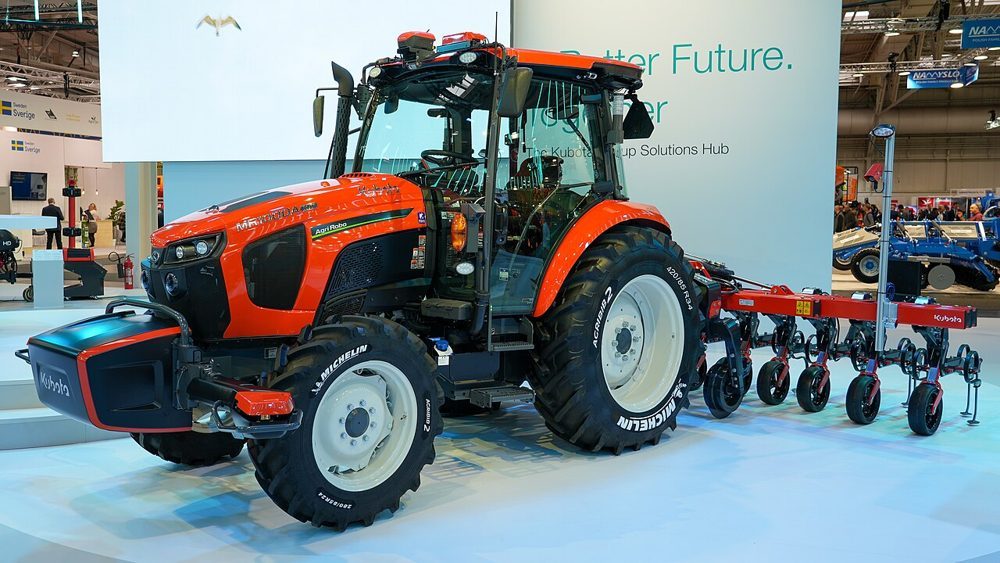 Farm-equipment application
Image: Kubota Agri Robo MR1000A at Agritechnica 2023 (MarcelX42, CC BY-SA 4.0), Wikimedia Commons. It does not depict the engine model discussed here.
.jpg)
Read a speed-load map as operating context, not a single number: low BSFC islands are efficient, but temperature, altitude, accessories, and transient demand matter. Diagnose in order—air, fuel, spark, compression, exhaust, and electrical signals—and use freeze-frame data before replacing parts. Farm PTO work and construction hydraulic peaks differ from road use. For 800 kWh shaft work, a 90% electric path needs roughly 890 kWh at the battery while a 30% engine path needs roughly 2,670 kWh fuel heat; charging, usable SOC, and duty cycle decide the result. Never run indoors or service hot cooling and pressurized fuel systems.
Current step · 1 / 9 · Powertrain & Mechanical Engineering
Comments
Please log in to post a comment
No comments yet.