Contents — find the section you need
Background and reading guide
Background Basic force, motion and energy terminology; use the linked background explanations.
Fundamentals · Explanations of principles, structure and trade-offs.
Bottom line
A diesel engine compresses air until it is hot, then injects fuel for auto-ignition. Strong low-speed torque and efficient sustained operation suit heavy work. Modern hardware combines common rail injection, boosting, EGR, DOC, DPF, and SCR. Context: agricultural machinery and construction machinery.
Four strokes, cycle, and curves
Figure 1 — Conceptual SVG by Duskcoil.
With compression ratio r, heat-capacity ratio \gamma, and cutoff ratio \rho_c, the ideal Diesel-cycle efficiency is
Figure 2 — Conceptual only; it is not measured model data.
Hardware, emissions, products, and safety
Common rail stores pressurized fuel while the ECU controls injection timing, quantity, and events. Turbocharging, EGR, a diesel oxidation catalyst, DPF, and urea-SCR must be calibrated together. DPF regeneration raises exhaust temperature; repeated low-load operation can challenge soot management.
Examples as of 2026-09-03 include the Caterpillar C4.4 used in regional construction applications, John Deere PowerTech applications in 6M tractors, and Cummins X15 commercial engines. Exact model, rating, aftertreatment, and certification differ by market, year, and duty; verify local documentation. Primary sources: Caterpillar, John Deere, Cummins, EPA.
Research covers low-temperature combustion, HVO and hydrogen pathways, boosted efficiency, aftertreatment thermal management, and digital control. Battery-electric machines avoid local exhaust and work well with electric hydraulics, but heavy-duty duty cycles must accommodate charging, energy mass, and site power. Never locate high-pressure leaks by hand; do not operate indoors; keep combustibles clear during regeneration; follow OEM urea and high-voltage procedures.
Does diesel ignite immediately whenever fuel is injected?
Temperature, pressure, atomization, mixing, and ignition delay matter. Injection timing and combustion onset are not identical.
References
Load-cycle selection and diagnostic logs
Compare speed, load, fuel rate, boost, exhaust temperature, and DPF differential pressure on one timeline. A BSFC value is a steady-state indicator, not an instantaneous fuel-rate label.
Hardware flow and map reading
Air, fuel, cooling, lubrication, and aftertreatment form one coupled system. Read a BSFC map with altitude, temperature, PTO or hydraulic demand, and regeneration state; the curves here remain conceptual.
Failure modes and diagnosis
Loss of power can involve air restriction, boost leaks, fuel pressure, injection correction, EGR, or DPF ash. Use measured signals and service procedures; never hand-check a high-pressure leak.
Agricultural, construction, and electric use
Diesel remains useful for long, high-load work, while electric drivetrains can suit short, repeatable cycles with charging access. Compare duty cycle, thermal capacity, refuelling, and site power rather than peak power alone.
Component flow
Air enters through the filter, turbocharger, cooler, and manifold; fuel passes from the pump and rail to the injectors. Cooling, lubrication, sensors, and aftertreatment determine whether the nominal engine rating can be sustained.
Operation, diagnostics, and equipment use
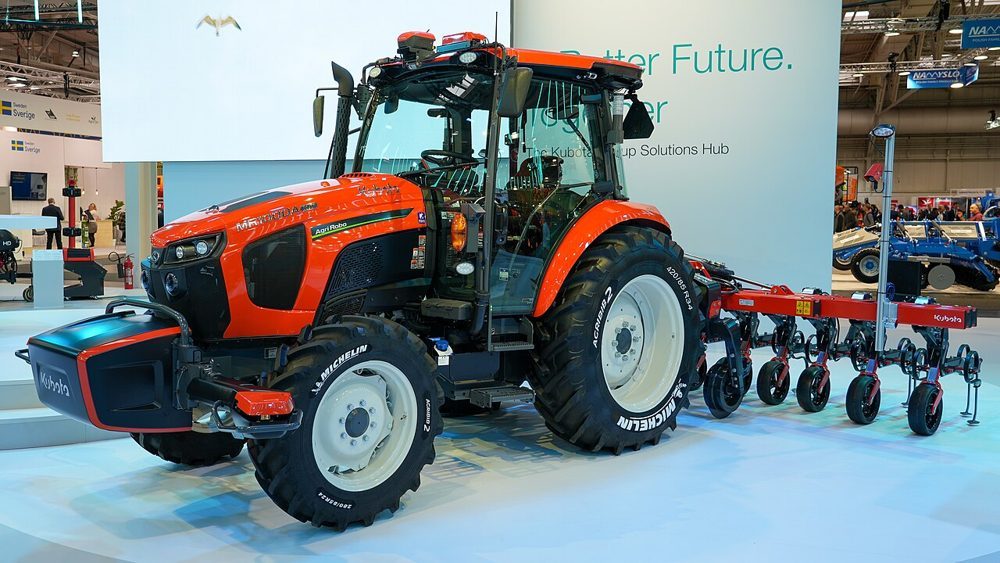 Farm-equipment application
Image: Kubota Agri Robo MR1000A at Agritechnica 2023 (MarcelX42, CC BY-SA 4.0), Wikimedia Commons. It does not depict the engine model discussed here.
.jpg)
Use speed-load maps with ambient temperature, altitude, PTO or hydraulic demand, and aftertreatment state. Diagnose systematically: battery and cranking, fuel supply and rail pressure, air and boost leaks, compression, then DPF differential pressure, EGR, SCR and NOx signals. Do not search high-pressure leaks by hand. Agricultural PTO work and construction duty cycles differ. For 800 kWh shaft work, 90% electric conversion needs about 890 kWh input; a 40% diesel path needs about 2,000 kWh fuel heat, before site charging and refuelling constraints.
Current step · 2 / 9 · Powertrain & Mechanical Engineering
Comments
Please log in to post a comment
No comments yet.