Contents — find the section you need
Change parameters and verify
Open the panel, then press Run to load Python. You can stop execution and reset parameters. Results are computed on this device. No Python installation is required.
Local execution steps below are optional for reproducing the source results; they are not required for the browser experiment.
Try one change at a time
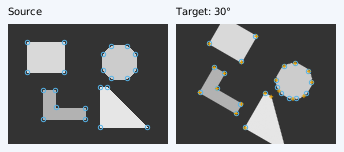
Run the baseline and save it as A. Select the rotation preset and run again; the source and target images for A and B appear at the same display scale. Blue circles are detections, orange crosses are reference positions projected by the known transform. Compare Harris and Shi–Tomasi with the same image settings. Reset restores defaults; sharing reproduces the current controls, not the saved A result.
What the detector computes
Both detectors use a local gradient matrix M. Harris scores det(M) − 0.04 trace(M)²; Shi–Tomasi uses its smaller eigenvalue. The window is 3, 5 or 7 pixels wide. A relative quality threshold, local-maximum suppression, minimum spacing and point limit select the final points. The threshold follows the image's maximum score, so dimming without clipping need not reduce the count. These are single-scale detectors, not descriptors: they select locations but do not identify corresponding points or compute camera motion.
Image transformations
The 160×120 images contain shapes, repeated patterns, a low-texture ramp or an edge. Coordinates increase right and down; positive rotation is clockwise about the image centre. Processing order is bilinear resampling, square box blur, intensity gain, fixed-seed uniform noise, then clipping to [0,1]. Blur is a radius, noise is an amplitude. These encoded grey values are not physical luminance. Downscaling has no antialiasing prefilter. Lightened target areas are excluded so warp boundaries and filter support do not create counted corners.
Read the coverage carefully
Eligible reference points are source detections that project into the valid target detection region. Coverage counts those with any target detection within 3 target pixels and divides by the eligible reference count. An empty denominator is undefined (—). Several reference points may use one detection: this is directional proximity coverage, not matching accuracy or a standard symmetric repeatability benchmark. Repeated patterns can therefore look convincing without identifying the correct object. The JSON download includes actual pixels, masks, points and the transform.
Recorded examples
These values were generated from the shipped model with the default Shi–Tomasi settings, changing only the named preset. The low-texture example demonstrates an undefined ratio rather than a fabricated zero-percent success rate.
| Preset | Source points | Target points | Covered / eligible | Coverage |
|---|---|---|---|---|
| Baseline | 22 | 22 | 22 / 22 | 100.0% |
| Rotation 30° | 22 | 21 | 16 / 20 | 80.0% |
| Low texture | 0 | 0 | 0 / 0 | — |
Continue learning
- Feature detection theory
- Visual SLAM overview
- Source, full model definitions and reference tests
- Recorded metrics JSON
- OpenCV detector reference
Image brightness and luminance Lab — exposure, gamma and clipping
Comments
Please log in to post a comment
No comments yet.