Contents — find the section you need
Background and reading guide
Background Units used in specifications, such as voltage, current, distance and time.
Fundamentals · Explanations of principles, structure and trade-offs.
However precisely a sensor measures a value, that value is meaningless without a way to carry it beyond the microcontroller, out to a gateway or the cloud. Wireless communication modules handle that "carrying" role, and the three representative approaches are Wi-Fi, BLE (Bluetooth Low Energy), and LoRa. All three share the basic idea of putting data onto a radio wave (electromagnetic wave) and propagating it through space, but their modulation schemes, frequency bands, and topology philosophies differ substantially, producing a division of labor: "Wi-Fi — fast but not power-efficient," "BLE — power-efficient but short range," and "LoRa — slow and power-efficient, but reaches kilometers to tens of kilometers." It is not an exaggeration to say that this choice of wireless scheme, even more than the sensor choice itself, dictates an IoT device's overall power budget, communication range, and system architecture.
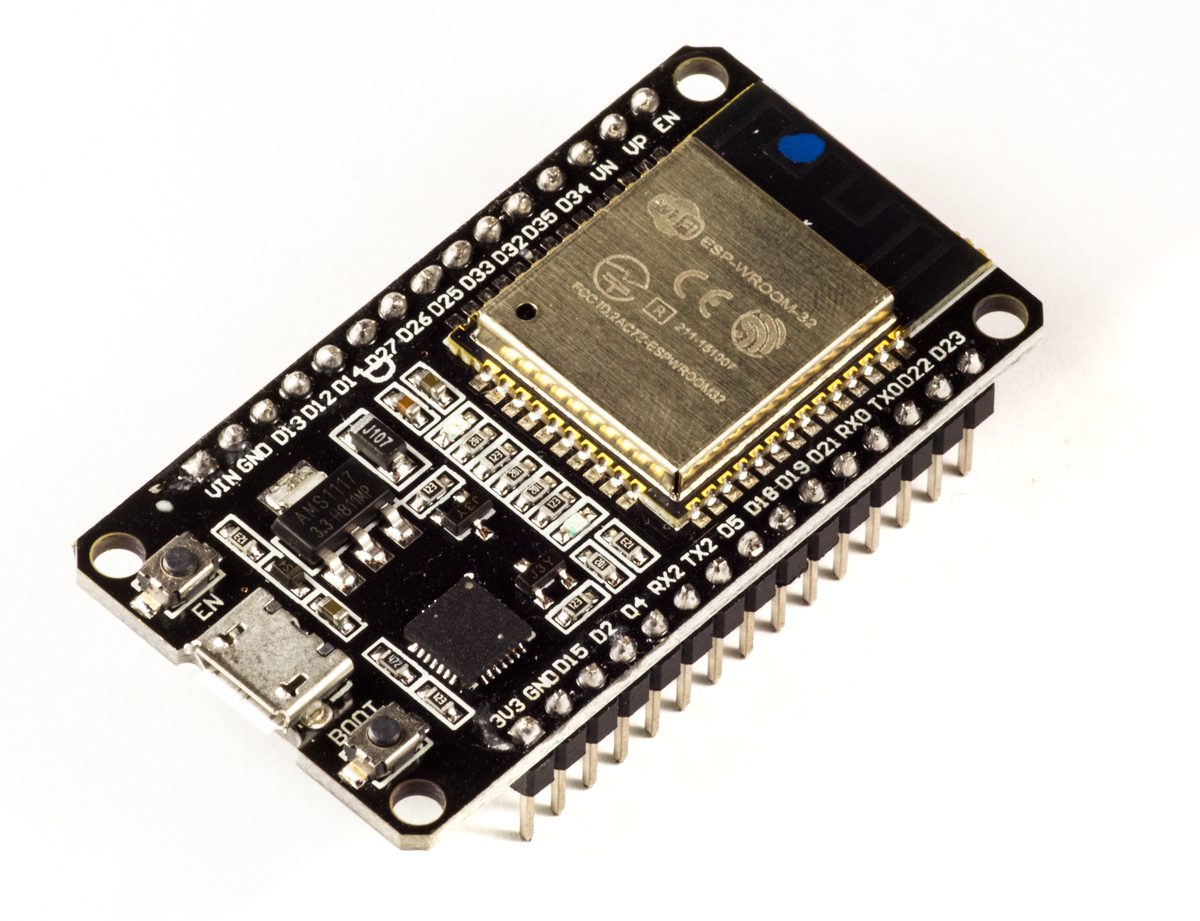 ESP32 development board (an example of a Wi-Fi/Bluetooth-integrated SoC)
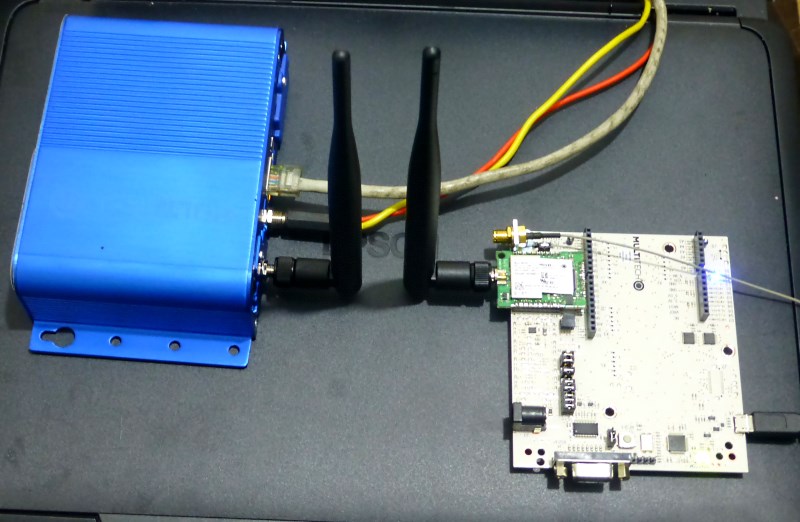 MultiTech Conduit gateway (left) and mDot node (on development board, right)
Images: ESP32 development board (Ubahnverleih, CC0) / MultiTech Conduit gateway and mDot node (IOTpreneur, CC BY-SA 4.0), Wikimedia Commons.


Principle: OFDM — standing up to multipath with orthogonal subcarriers (Wi-Fi)
Instead of putting all its data onto a single carrier wave, Wi-Fi (IEEE 802.11) uses OFDM (Orthogonal Frequency-Division Multiplexing). One wide band is split into many mutually orthogonal narrowband subcarriers, and a slow data stream is carried on each subcarrier separately. Because the symbol rate on each individual subcarrier drops, the duration of a single symbol lengthens, which relatively reduces the impact of delay spread from the reflected waves (multipath) common indoors and in urban areas. Legacy 802.11a/g OFDM places 52 subcarriers (48 for data, 4 for pilot) at a 312.5kHz subcarrier spacing within a 20MHz-wide channel. Being "orthogonal" is the key: each subcarrier's frequency spectrum is arranged so that at the peak of every other subcarrier, its own value is exactly zero, which lets bands be packed tightly together and raises spectral efficiency without incurring inter-symbol interference.
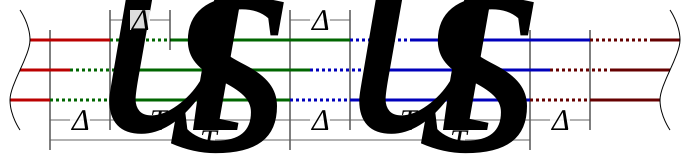
Image: Timing diagram of multipath signals in OFDM reception (Gerben49 / Mliu92, CC BY-SA 4.0), Wikimedia Commons. It illustrates how symbol design with a guard interval absorbs the multiple arrival paths (multipath) created by reflections off walls and furnishings.

Wi-Fi's frequency bands fall broadly into 2.4GHz, 5GHz, and 6GHz (Wi-Fi 6E and later). The 2.4GHz band is favorable for diffraction around obstacles and reach, but because many devices — Bluetooth, microwave ovens, Zigbee — share the same band, it is prone to congestion and interference. The 5GHz and 6GHz bands have relatively fewer devices in use and make it easier to secure wide bandwidth, suiting them for high throughput, but their shorter wavelength gives lower penetration through walls and shorter range. Wi-Fi 6 (802.11ax), now mainstream, introduces OFDMA (Orthogonal Frequency-Division Multiple Access), a further evolution of OFDM that lets a single channel be finely divided and used simultaneously by multiple stations — a design meant to hold down latency and throughput degradation even in environments where many IoT devices are connected at once.
Principle: BLE's GFSK modulation and star topology
BLE (Bluetooth Low Energy) uses the same 2.4GHz ISM band as Wi-Fi, but takes a completely different design philosophy. Rather than a multi-carrier scheme like OFDM, its modulation is GFSK (Gaussian Frequency Shift Keying), a simple single-carrier scheme. Instead of shifting frequency directly with the digital 0/1 as a square wave, GFSK first smooths the waveform through a Gaussian filter before shifting it, which suppresses the sudden widening of occupied bandwidth that accompanies modulation and reduces interference to adjacent channels. From BLE 5 onward, this GFSK base supports selectable modes such as LE 2M PHY, which keeps one bit per symbol and raises the symbol rate to 2 Msym/s, and LE Coded PHY (S=2/S=8), which instead uses error-correction coding and pattern mapping to expand information bits into multiple symbols — letting the application trade off speed against range.
On the topology side, BLE fundamentally takes a star (one-to-many) configuration. A single central device (a smartphone or gateway) holds connections to multiple peripherals (sensor nodes), and each peripheral communicates only directly with the central. In addition, BLE's power efficiency rests on a design of "duty-cycled operation." Rather than staying in a constant receive state, the radio wakes for a short interval only at a predetermined connection event interval (the connection interval) to exchange data, and sleeps its radio circuitry the rest of the time. This duty-cycled operation is the very core of the power efficiency that lets a BLE sensor run for years on a single coin cell, and it is the biggest design-philosophy difference from Wi-Fi, which assumes constant, continuous network connectivity. No suitable public diagram was found for this section, so the explanation of the principle here is limited to equations and prose.
Principle: LoRa's Chirp Spread Spectrum (CSS) and spreading factor
LoRa (Long Range) uses a modulation scheme different from both Wi-Fi and BLE: Chirp Spread Spectrum (CSS). Its base waveform is a "chirp" — a signal whose carrier frequency is swept linearly across the entire band over time — and data is encoded by shifting this chirp's starting frequency symbol by symbol. On the receive side, multiplying by a reference signal whose frequency changes in the opposite direction to the chirp (a "downchirp") makes it easier to detect a peak even from a weak signal. This mechanism gives LoRa high receive sensitivity, able to demodulate even at a very low SNR (a signal weaker than the noise).
LoRa's key parameter is the spreading factor (SF), which ranges from SF7 to SF12. Each step up in SF doubles the number of chirp sweeps per symbol (the effective symbol length), extending the time needed to send the same data (airtime) but improving receive sensitivity by about 2.5dB. In other words, SF12 can greatly extend range compared to SF7, but data rate drops substantially, and the longer transmit time also increases power consumption and airtime occupancy. This trade-off — "raise the spreading factor and you reach farther, but slower" — is the core of LoRa network design.
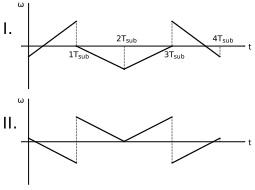
Image: Example sub-chirp combinations in CSS modulation (wdwd, CC BY-SA 3.0), Wikimedia Commons. It shows the principle of representing a symbol through combinations of chirp waveforms whose frequency sweeps linearly over time.

LoRa's physical layer uses sub-GHz ISM bands (which vary by region — the 868MHz band in Europe, the 915MHz band in North America, and so on). The lower the frequency, the more favorable the diffraction and penetration characteristics of the radio wave, so at the same transmit power it reaches farther, and behind obstacles, than the 2.4GHz band. In exchange, many regional regulations impose duty-cycle limits on transmission in the sub-GHz band (for example, some channels in Europe's 868MHz band restrict transmit time to under 1%), making it unsuited to applications that need to send data frequently. On top of this physical layer, "LoRaWAN" is standardized as the MAC-layer specification that manages communication between multiple LoRa end devices and a gateway; the distinction is that LoRa refers to the modulation scheme itself, while LoRaWAN refers to the network-wide protocol.
Spec comparison of key products
| Product | Manufacturer | Scheme | Frequency Band | Key Characteristics |
|---|---|---|---|---|
| ESP32-C6 | Espressif Systems | Wi-Fi 6 + BLE 5 + IEEE 802.15.4 | 2.4GHz | RISC-V core SoC. Integrates Wi-Fi, BLE, and Zigbee/Thread on a single chip; about 80m outdoor line-of-sight range |
| Nordic nRF52840 | Nordic Semiconductor | BLE 5 (Coded PHY support) | 2.4GHz | -95dBm receive sensitivity (at 1Mbps); 16.40mA current draw at +8dBm transmit; 6.26mA at 1Mbps receive |
| Semtech SX1262 | Semtech | LoRa (CSS) | Sub-GHz (868/915MHz, etc.) | +22dBm maximum transmit power, -148dBm receive sensitivity, 4.2mA receive current |
| Texas Instruments CC2652R7 | Texas Instruments | BLE 5.2 + Thread + Zigbee + Matter + IEEE 802.15.4g | 2.4GHz | Multi-protocol wireless MCU with a 48MHz Arm Cortex-M4F; switches among multiple wireless standards on one chip in software |
| MultiTech mDot (MTDOT-915) | MultiTech | LoRa (LoRaWAN 1.0.4 compliant) | 915MHz (North America) | LoRaWAN module claiming up to 16km line-of-sight, up to 2km indoor range, Class A/C support |
The ESP32-C6 stands out for integrating three wireless standards — Wi-Fi, BLE, and IEEE 802.15.4 (Zigbee/Thread) — onto a single RISC-V-based chip. Depending on the application, it can switch between a configuration that sends data directly to the cloud over Wi-Fi, one that pairs with a smartphone over BLE, or one that joins a Zigbee/Thread mesh over 802.15.4 — a flexibility that a single-function chip cannot match. The nRF52840 has a high degree of polish as a BLE-dedicated chip, and its balance of -95dBm receive sensitivity against 16.4mA transmit current reflects numbers optimized for coin-cell-powered wearables and beacons. The SX1262, by contrast, boasts an order-of-magnitude-higher receive sensitivity of -148dBm — a full 53dB gap versus the nRF52840's -95dBm, meaning it can demodulate a signal more than 200,000 times weaker in power terms. This gap in sensitivity is the single biggest factor behind the difference in range: several meters to tens of meters for BLE versus several kilometers to tens of kilometers for LoRa. The CC2652R7 is a multi-protocol design that switches protocols in a software-defined-radio-like manner, suiting devices such as smart-home hubs that want to support multiple wireless standards on one unit. The MultiTech mDot has long been adopted for industrial applications as a LoRaWAN module implementation, and it is one of the few products with a published, measured 16km line-of-sight range figure.
History: the marketing term "Wi-Fi," and the patent lawsuits lurking behind the radio waves
The name Wi-Fi is not, in fact, an abbreviation of a technical standard. It is a marketing term coined in 1999 by the branding firm Interbrand, commissioned by WECA (Wireless Ethernet Compatibility Alliance, later the Wi-Fi Alliance) — the industry body that certifies interoperability of wireless LAN equipment compliant with the IEEE 802.11 standard itself. Coined to evoke the sound of "Hi-Fi (High Fidelity)," it was at times given the retrofitted slogan "Wireless Fidelity," but officially it is not an abbreviation of any specific words. The story of how this technology — which, left as the dry standard number "IEEE 802.11b," likely would never have caught on with ordinary consumers — exploded in popularity once it got a simple name is a case study in the power of naming, not just of the technology itself.
Meanwhile, behind Wi-Fi's core OFDM technology lies a lesser-known history of patent disputes. Australia's national research agency, CSIRO (Commonwealth Scientific and Industrial Research Organisation), had filed a patent in 1992 (U.S. Patent No. 5,487,069) on a technique for correcting multipath-induced distortion, developed in the course of radio-astronomy research. Because this technique overlapped with an element essential to later OFDM implementations in the IEEE 802.11a/g/n generations, CSIRO, starting in 2005, filed a series of lawsuits against major Wi-Fi equipment manufacturers seeking license payments. Settlements and licensing agreements were eventually reached with many manufacturers, and CSIRO is reported to have earned licensing revenue of more than $420 million from this patent portfolio. The fact that a patent born of radio astronomy generated such enormous revenue, behind a technology that has become free and woven into everyday life, is a little-known side of Wi-Fi's technical history.
Real-world example: ZENNER's LoRaWAN smart-meter network — a 10-million-device sensor network
A real-world example of just how far a LoRaWAN network can scale is the LoRaWAN network operated by Germany's Minol-ZENNER Group. In September 2025, the company announced that the number of sensors connected to its LoRaWAN network — mostly smart meters for water, heat, and gas — had surpassed 10 million devices. Considered one of the largest LoRaWAN networks in the world, it is a textbook use case that leverages LoRa's low power consumption and long range: individual meters running on battery power for extended periods, sending meter readings to a gateway at low frequency. The LoRa Alliance (the industry body that manages the LoRaWAN standard) also announced in December 2025 that the total number of LoRaWAN end devices deployed worldwide, aggregated across member operators, had surpassed 125 million, reporting continued growth at an annual rate of 25%. ZENNER's 10 million figure represents an outstanding scale for a single operator even within that global total, standing a full head above other major operators such as Actility (4.6 million), The Things Industries (3.8 million), Birdz (3.6 million), and Netmore (3.4 million).
Behind a network of this scale is a design characteristic in which a single LoRaWAN gateway can accommodate thousands of end devices, and each device's duty cycle is low (a smart meter transmits only a few times a day, at most). Wireless bandwidth constraints are a constant design constraint in robotics too — for example, the newbot project learned from measured Wi-Fi bandwidth that "streaming raw data as-is saturates the bandwidth" — but LoRaWAN instead achieves a different kind of scalability, "accommodating a vast number of devices simultaneously," precisely by extremely restricting the volume and frequency of data sent per device in the first place.
The small French startup that gave birth to LoRa, and research pushing past the limits of a single hop
LoRa's modulation technology itself was not originally born in a large corporate lab. Between 2009 and 2010, Cycleo, a small startup in Grenoble, France, developed a chirp spread spectrum technique for low-power, long-range wireless communication. Semiconductor maker Semtech, taking notice of this technology, acquired Cycleo in 2012 and folded LoRa technology into its own product line, which grew into today's family of LoRa chips including the SX126x/SX127x series, and later into LoRaWAN, the open specification now managed by the nonprofit LoRa Alliance. A modulation scheme developed by a single French startup grew, in a little over a decade, into a global network of more than 125 million devices.
As the flip side of its power efficiency and long range, LoRaWAN fundamentally assumes a single-hop configuration in which end devices communicate directly with a gateway, which gives it an inherent limitation: it struggles to cover areas where a gateway's radio signal cannot directly reach, such as mountainous terrain, underground, or the shadow of a building. Addressing this constraint, a paper published on arXiv in December 2025, "Mesh Augmentation of LoRaWAN-based IoT Networks" (arXiv:2512.00161, Ram Ramanathan et al.), proposes a protocol called "LIMA" that extends effective communication range through multi-hop mesh routing between end devices, without any modification to existing LoRaWAN infrastructure. In simulation, it is reported to have improved delivery success rate by up to 5x and reduced power consumption by up to 12.6x compared to a conventional single-hop configuration — showing that research reexamining the single-hop premise itself, even for a LoRaWAN deployment now grown to 10 million devices, remains active.
A name born from a Danish king's epithet — why "Bluetooth"?
The origin of the Bluetooth wireless technology underlying BLE traces back to research that began within Sweden's Ericsson in 1994. Jaap Haartsen, then an Ericsson engineer, along with colleagues, began research under the direction of Nils Rydbeck into a low-power, short-range wireless link to connect mobile phones with their peripherals — the starting point. In 1996, Ericsson, Intel, and Nokia began discussions toward standardizing this short-range wireless standard, and at the end of the following year, 1997, during casual conversation at a bar in Toronto, Jim Kardach, then an Intel engineer, is said to have floated "Bluetooth" as a provisional name. Kardach had learned of the 10th-century Danish king Harald I (Harald Blåtand, "Harald Bluetooth" in English) from a Viking-themed novel a colleague was reading, and likened this king's feat of unifying Denmark and Norway to the vision of "unifying," through this wireless technology, the then-fragmented PC industry and mobile phone industry. It was meant only as a placeholder until the marketing department settled on an official name, but it stuck internally and externally for its good sound, and it was ultimately adopted as the official name itself. The Bluetooth logo still in use today combines the Younger Futhark runes for "H" (ᚼ) and "B" (ᛒ) — an emblem formed from Harald I's initials. The fact that a Nordic king's epithet still survives, as-is, as a product name behind a single modulation scheme is an episode that, from a different angle than the Wi-Fi naming drama, shows that a technology's name does not necessarily describe the technology itself.
Parameters that shape performance
- Range and receive sensitivity: The SX1262's -148dBm receive sensitivity is 53dB higher than the nRF52840's -95dBm, and this is the root cause of the range gap — "LoRa reaches kilometers to tens of kilometers, BLE reaches meters to tens of meters." This is the starting point for the division of labor: LoRa-family devices for outdoor, wide-area monitoring, and BLE-family devices for indoor, short-range wearables and beacons
- Data rate vs. airtime trade-off: LoRa's SF7-SF12 choice directly becomes a trade-off between range and data rate/power consumption. Because SF12 requires far more airtime than SF7 to send the same data, applications like ZENNER's smart meters — "send a small amount of data a few times a day" — favor a design that prioritizes range even at the cost of raising SF, while applications that exchange data frequently should consider Wi-Fi or BLE rather than LoRa in the first place
- Transmit power and current draw: The nRF52840 draws 16.40mA at +8dBm transmit; the SX1262 draws even more current at +22dBm transmit. In BLE sensors aiming for year-scale operation on a coin cell, a design that limits transmit power to hold down current is the basic approach, while conversely on the gateway side, where power is easier to secure, an asymmetric design that invests high transmit power to hold down the receiving side's battery consumption (strong downlink, weak uplink) is common in LoRaWAN as well
- Frequency band choice: The 2.4GHz band (Wi-Fi, BLE, some Zigbee/Thread) can be used globally but is prone to congestion; the sub-GHz band (LoRa's 868/915MHz) is good at diffracting around obstacles and suits long range, but frequency allocation and duty-cycle regulations differ by region. For products deployed globally, handling this regulatory difference (region-switching the module) becomes a practical design burden
- Topology and scalability: BLE's star topology has an upper limit on how many peripherals a single central can handle, whereas LoRaWAN is designed so that a single gateway can accommodate thousands of end devices — a large-scale deployment like ZENNER's 10-million-device network is not realistic without LoRaWAN. At the same time, as the LIMA paper shows, research into mesh extensions that compensate for the single-hop constraint is also progressing, and topology design is still evolving
- Whether multi-protocol support is needed: SoCs that integrate multiple wireless standards onto a single chip, like the ESP32-C6 or CC2652R7, have the advantage in products whose use case is not yet fixed, or that may switch protocols in the future, while single-protocol-focused chips like the SX1262 or nRF52840 hold the advantage in power/sensitivity optimization when narrowed to that one scheme. Whether to choose multi-protocol support or single-function specialization comes down to a judgment about whether to prioritize development cost or the final product's power budget
Does high data rate make a link suitable for control?
Jitter, loss, congestion, and reconnection matter. Check worst-case latency and outage handling as well as average throughput.
References
- ESP32-C6 Series Datasheet (Espressif official)
- nRF52840 Product Specification (Nordic Semiconductor official)
- SX1261/2 LoRa Connect Datasheet (Semtech official)
- CC2652R7 Datasheet (Texas Instruments official)
- MultiConnect mDot 915MHz LoRa Module (MultiTech official)
- 10 million sensors in the LoRaWAN network of the Minol-ZENNER Group (LoRa Alliance/ZENNER press release)
- LoRa Alliance Reports 125 Million LoRaWAN End Devices Deployed Globally (LoRa Alliance official)
- Mesh Augmentation of LoRaWAN-based IoT Networks (arXiv:2512.00161)
- The origin of the Bluetooth name, Harald I and Jim Kardach (Bluetooth SIG official History)
- OFDM timing.svg (Wikimedia Commons)
- Css subchirp combinations.svg (Wikimedia Commons)
- ESP32 Espressif ESP-WROOM-32 Dev Board.jpg (Wikimedia Commons)
Current step · 20 / 21 · Sensors & Hardware
Comments
Please log in to post a comment
No comments yet.