Contents — find the section you need
Background and reading guide
Background Basic frames, velocity and sensor terminology; use the reading guide for background.
Fundamentals · Explanations of principles, structure and trade-offs.
When hundreds of drones simultaneously rearrange their formation in a drone show, or when a fleet of warehouse robots moves around without colliding, there isn't a single "command center" computing every motion in real time. In most cases, each robot is simply looking at limited information about its own surroundings and following simple rules — and out of that, an orderly, meaningful behavior emerges for the group as a whole. This article works through the idea of swarm control (multi-robot control) — building a complex whole out of simple parts — from three angles: flocking motion, consensus formation, and formation control.
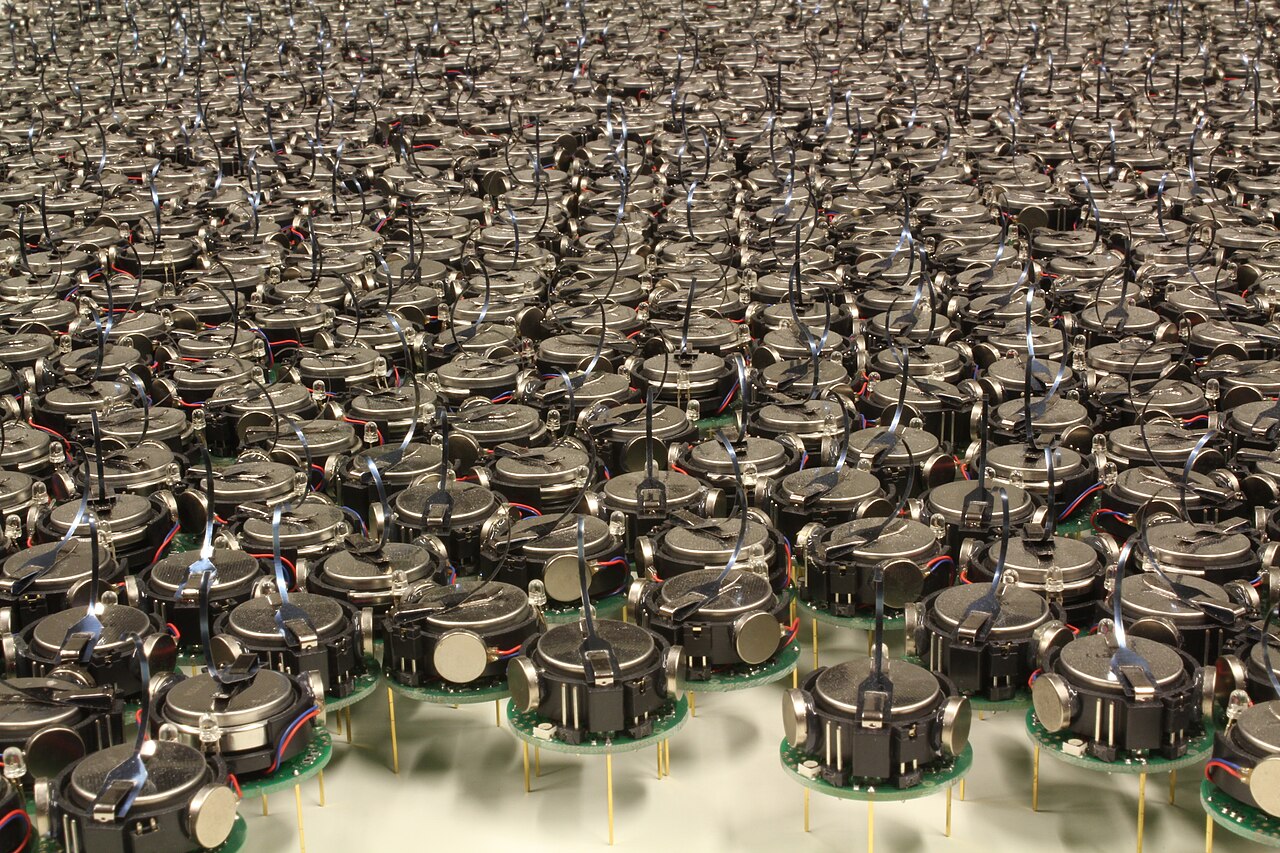 A swarm robot in the field (Kilobot)
Image: Kilobot robot swarm (asuscreative, CC BY-SA 4.0), Wikimedia Commons. A representative example of swarm-robotics research that runs on local rules alone, not the drones or warehouse robots discussed in the text.

0. What This Article Covers
- What problem swarm control is trying to solve, and why a single robot isn't enough
- The relationship between the information each robot can actually obtain (input) and the output (velocity command) built from it
- The architectural difference between centralized and decentralized designs
- How local-rule-based flocking, epitomized by Boids, works
- The mathematics of consensus formation via consensus algorithms
- The differences among three formation-control approaches — leader-follower, virtual structure, and behavior-based
- How communication constraints (latency, dropout, bandwidth) shape swarm-control design
- Which approach to choose for which application — drone shows, warehouse robots, disaster search, and more
1. Bottom Line First: What Swarm Control Is
In one sentence: swarm control is a control framework that produces meaningful collective behavior for the whole group — alignment, formation-keeping, consensus, division of labor — out of the limited information and simple behavioral rules held by each of many robots.
The key point is that "no one necessarily holds the blueprint for the whole." Just as a flock of birds has no conductor, many swarm-control algorithms are designed so that each robot uses only information about the other robots nearby (its neighbors), and even without ever knowing the complete state of the whole group, the swarm as a whole ends up moving as one coherent unit. This idea — "build global order out of local information" — is what fundamentally distinguishes swarm control from single-robot control.
2. Why Is Swarm Control Necessary?
If a problem can be solved by a single high-performance robot, swarm control isn't needed. Swarm control gets chosen in practice in situations where a single unit is, in principle or in practice, at a disadvantage — for example:
- Spatial coverage: a single robot would take too long to search a large disaster site or field from one end to the other. Splitting the work across many robots shortens the search time roughly in proportion to the number of robots.
- Redundancy and fault tolerance: with a single-unit configuration, one failure stops the entire mission; a swarm made of many robots can continue the mission with the remainder even if some drop out.
- Simultaneous work at multiple points: some missions inherently require being in multiple places at once — forming shapes in a drone show, or simultaneously carrying goods to several locations in a warehouse.
- Cost per unit: rather than building one high-performance robot, using many simple, inexpensive robots can be advantageous in total cost and deployment flexibility.
Actually realizing these benefits takes more than simply increasing the number of robots — it requires control laws that keep the robots from colliding while maintaining collective behavior aligned with the goal. That is the role of swarm control.
3. What Are the Inputs?
The information each robot can use for swarm control can be classified as follows, depending on the communication and sensing setup.
- Self-state: the robot's own position, velocity, and orientation. Usually obtained via GPS, odometry, or a self-localization method such as VIO/LIO.
- Relative information about neighboring robots: the relative position and velocity of nearby robots, observed directly with sensors such as cameras, LiDAR, or UWB (ultra-wideband) ranging.
- Messages via communication: position, velocity, and intent (where it's heading next) information explicitly sent from other robots over a wireless link.
- (In centralized designs) commands from a central node: target positions or role assignments distributed to individual robots by a central computer (a ground station, for example) that tracks the state of the whole swarm.
The important point is that many practical swarm-control algorithms do not require "the complete state of the whole swarm" as an input. Algorithms that operate using only relative information from a handful of nearby robots are the mainstream approach, which is precisely what keeps the volume of information each robot must process from exploding as the number of robots grows.
4. What Are We Solving For? What Are the Outputs?
What swarm control ultimately outputs, for each robot, is how it should move in the next instant (a velocity command, or a target position). The "desirable state for the whole" that this output aims to realize splits into the following categories, depending on the goal.
- Consensus: converging some state quantity (position, velocity, or an estimate) across every robot toward a single common value.
- Formation: each robot continually maintains a specified relative positional relationship with the others (triangle, line, circle, etc.).
- Flocking: with no explicit target shape, the swarm moves as a single coherent mass, avoiding collisions while matching velocity with its neighbors.
- Task allocation: deciding which of several discrete tasks — search, transport — each individual robot should take on.
All of these share the structure that "the accumulation of each robot's local outputs satisfies an intended collective property for the whole" — and the next section's basic architecture diagrams out that accumulation loop.
5. Basic Architecture
The processing loop running inside each robot follows roughly the same four stages, regardless of the swarm-control algorithm.
Figure 1 — Each individual robot keeps running a high-frequency loop: gather neighbor information, apply local rules, issue a velocity command, and feed the resulting motion back into the next cycle's sensing.
This loop running concurrently across many robots is what lets the swarm as a whole exhibit orderly behavior, even though no individual robot ever knows the whole blueprint. The design decision of "who holds information about the whole" gives rise to the architectural difference discussed next.
Figure 2 — A centralized architecture is a star structure in which a central node knows every robot's state and sends out commands. A decentralized architecture is a mesh structure in which robots exchange information only with their neighbors, so a failure of the central node doesn't halt the whole system.
6. Representative Algorithms
Boids — Building Flocking Motion From Local Rules
Boids is a model Craig W. Reynolds proposed in his 1987 paper "Flocks, Herds, and Schools: A Distributed Behavioral Model," to reproduce the flocking motion of birds and fish in computer graphics. Each individual (boid) looks only at its neighbors and moves in a direction obtained by weighting and summing three simple rules.
- Separation: steer away from neighbors that are too close
- Alignment: match your own velocity to the average heading of your neighbors
- Cohesion: move toward the average position of your neighbors
In every one of these rules, all an individual knows is the relative position and velocity of a handful of neighbors — no one explicitly tracks the shape or center of the whole flock. And yet, from the superposition of just these three rules alone, natural flocking motion emerges: the group avoids collisions while moving together as a single mass. This phenomenon — "complex global patterns emerging from the superposition of simple local rules" — is the single most fundamental idea running through the whole field of swarm control.
Potential Fields — Building Motion From Attraction and Repulsion
Oussama Khatib's artificial potential field method, proposed in his 1986 paper "Real-Time Obstacle Avoidance for Manipulators and Mobile Robots," was originally devised for a single robot's obstacle avoidance, but by combining an attractive potential toward the goal with a repulsive potential from neighboring robots, it applies naturally to swarm control as well.
Simply moving in the direction that descends the gradient of the attractive potential U_{\text{att}}, which shrinks as you approach the goal, and the repulsive potential U_{\text{rep}}, which grows sharply as you get too close to a neighbor, produces motion that heads toward the goal while avoiding collisions with other individuals. Boids' separation rule is, in essence, the same idea as this repulsive potential.
The Vicsek Model and Consensus Algorithms — the Mathematics of Consensus Formation
Where Boids arose from an engineering and visual motivation — "reproduce how animals move" — physics took a different route, studying flocking motion through a more simplified mathematical model. The Vicsek model, published by Tamás Vicsek and colleagues in Physical Review Letters in 1995, is a simple model — almost like extracting only Boids' alignment rule — in which each particle moves at constant speed while following the average heading of its neighboring particles, plus noise. It showed that, depending on the strength of that noise, the swarm undergoes a phase transition between an ordered phase, where the whole group moves coherently, and a disordered phase, where motion is scattered.
The framework that rigorously formalizes this Vicsek-model idea in control-theoretic terms is the consensus algorithm. In the framework organized by Reza Olfati-Saber and Richard M. Murray's 2004 paper in IEEE Transactions on Automatic Control, among others, each robot's state x_i (which can be anything — position, orientation, an estimate) is continually updated in the direction that shrinks the difference with its neighbors.
Collecting this across all robots gives the form \dot{\mathbf{x}} = -L\mathbf{x}. L is a matrix called the graph Laplacian, and it represents the very structure of the communication network — who can communicate with whom. As long as the communication graph is connected (there's a path, direct or via others, between every pair of robots), this simple update rule alone is proven to converge every robot's state to a single common value. This is the mathematical core of consensus algorithms, applicable to a wide range of problems beyond swarm alignment — time synchronization, distributed averaging of estimates, and more.
Formation Control — Leader-Follower, Virtual Structure, and Behavior-Based
When you want to maintain an explicit geometric formation (triangle, single-file line, etc.), you use formation control, a more concretely-targeted framework. There are three representative design approaches.
- Leader-follower: one robot (or a subset) acts as the leader, and the others follow, maintaining a relative position with respect to it. The framework shown by Jaydev P. Desai, James P. Ostrowski, and Vijay Kumar at ICRA 1998, and subsequently in IEEE Transactions on Robotics and Automation in 2001, is a representative example, using graph theory to explicitly design which robot follows whom. It's intuitive and easy to implement, but has the weakness that the whole formation tends to collapse if the leader fails.
- Virtual structure: an approach M. Anthony Lewis and Kar-Han Tan proposed in their 1997 paper "High Precision Formation Control of Mobile Robots Using Virtual Structures," which treats the entire formation as one virtual rigid structure and has each robot follow a fixed position on that structure. It keeps high accuracy for the formation as a whole, but someone needs to compute the target trajectory for the entire structure, which makes it hard to achieve a fully decentralized design.
- Behavior-based: an approach Tucker Balch and Ronald C. Arkin showed in IEEE Transactions on Robotics and Automation in 1998, in which several reactive behaviors — "maintain formation," "head toward the goal," "avoid obstacles" — are computed in parallel and combined with weights to produce the actual motion. Similar in spirit to Boids, it gives each robot high autonomy and robustness, but the geometric accuracy of the formation tends to be worse than with the other two approaches.
7. How the Algorithms Differ
| Method | Principle | Accuracy (Formation Precision) | Communication/Compute Cost | Robustness (to Partial Failure/Communication Loss) | Implementation Difficulty |
|---|---|---|---|---|---|
| Boids | Superposition of the three rules: separation, alignment, cohesion | No explicit formation (only group cohesion) | Low (only a handful of neighbors) | High (no central element) | Low |
| Potential Field | Gradient descent on attractive/repulsive potentials | Moderate (depends on local balance) | Low | High | Low |
| Consensus (Vicsek/Olfati-Saber family) | Update rule that shrinks the difference with neighbors; convergence guaranteed via the graph Laplacian | Converges exactly, depending on the quantity being agreed on | Low (neighbor communication only) | High if the communication graph is connected | Moderate (requires mathematical understanding of convergence) |
| Leader-Follower | Maintains relative position to the leader | High (accurate relative to the leader) | Moderate (leader information must be propagated) | Low (vulnerable to losing the leader) | Low |
| Virtual Structure | Treats the whole formation as one rigid body | Very high | High (requires computing the trajectory for the whole structure) | Moderate (recomputing the structure is costly) | High |
| Behavior-Based | Weighted composition of several reactive behaviors | Moderate (depends on the tradeoff among behaviors) | Low | High | Moderate (requires behavior design and tuning) |
As a general trend, the more you prioritize geometric accuracy of the formation (virtual structure), the more information sharing and compute cost is required; the more you prioritize decentralization and robustness (Boids, behavior-based), the more the formation's own accuracy is sacrificed. Consensus algorithms sit as a theoretically tractable middle ground between these two extremes, achieving both "a rigorous mathematical convergence guarantee" and "decentralization requiring only neighbor communication."
8. Where It Struggles / Difficult Environments
Many of the difficulties swarm control faces in implementation and operation are collective-specific problems that don't exist in single-robot control.
- Communication latency and disconnection: most convergence guarantees for consensus algorithms assume the communication graph is connected. In real environments, communication can be cut off or delayed by radio range or obstructions, and once this assumption breaks down, problems arise — consensus fails to converge, or converges to the wrong value.
- Scalability: in a centralized architecture, the central node's computational load and communication bandwidth requirements grow sharply as the number of robots increases, and beyond a certain count, real-time performance can no longer be maintained. Even in decentralized architectures, sensing and communication load increases in dense environments with many neighbors.
- Local minima and deadlock: potential-field methods can leave a robot stuck at a "local minimum" where multiple repulsive and attractive forces balance out, unable to reach the goal (a typical example is a gridlock situation where several robots try to enter a narrow passage at the same time).
- Insufficient fault-tolerance design: decentralized designs are theoretically said to be robust to partial failure, but in practice, designs with some inherent asymmetry — like leader-follower — can retain failure modes more fragile than expected.
- Mixed heterogeneous robots and sensors: in real-world deployments where robot models and onboard sensors aren't uniform, the precision and frequency of information each robot obtains differs, and algorithms premised on a single idealized model tend not to function well as-is.
9. Practical Choices
How to choose a swarm-control algorithm largely depends on whether the application prioritizes "formation accuracy" or "robustness/decentralization."
- Drone shows: predetermined trajectories and formations need to be expressed with extremely high precision, and many production systems adopt a design close to centralized/virtual-structure, distributing pre-computed trajectories to each vehicle (accuracy and reproducibility are prioritized over autonomous in-flight decision-making).
- Warehouse/logistics robot fleets: many transport robots need to divide up dynamically changing tasks (which shelf to which destination), and a hybrid centralized/decentralized design is common — a central management system handles task allocation, while individual robots' path generation and collision avoidance are processed in a decentralized way. See the Path Planning Primer for the fundamentals of path planning.
- Disaster search, agricultural monitoring, and other wide-area coverage: since communication tends to be unstable in these environments, decentralized approaches with little reliance on a center (Boids-like flocking, or consensus-based coverage) are preferred. Individual robots' behavior decisions are often combined with a behavior planning framework.
- Small-scale research and educational swarm robots: since these are experimental setups with few robots and stable communication, virtual structure or leader-follower — which pursue formation accuracy — tend to be adopted.
Whatever the application, answering three questions — "how many robots will be operated," "how stable is the communication environment," and "which is the failure-intolerant requirement, formation accuracy or robustness" — is the starting point for choosing a swarm-control architecture.
10. Summary (Three-Line Recap)
- Swarm control is a framework that produces orderly behavior for the group as a whole from local rules that use only each robot's limited information about its neighbors.
- Boids and potential-field methods realize decentralized flocking motion, while consensus algorithms realize consensus formation with a convergence guarantee mathematically established via the graph Laplacian.
- Leader-follower, virtual structure, and behavior-based formation control occupy different positions in the tradeoff between formation accuracy and robustness/decentralization, and must be chosen according to the application.
Does local collision avoidance guarantee the swarm's global task?
Local safety and global arrival or coverage differ. Evaluate communication range, deadlocks, and fragmentation.
References
Current step · 18 / 18 · Robotics Primer
Comments
Please log in to post a comment
No comments yet.