Contents — find the section you need
Background and reading guide
Background Voltage, current, power, energy and unit conversion.
Fundamentals · Explanations of principles, structure and trade-offs.
The traditional distribution network was designed on the assumption that electricity flows one way, from power plant to consumer. The pole-mounted transformer's job was simply to step high voltage down to the low voltage used in homes; it was never designed for current to flow the other way. But once rooftop solar panels, home batteries, and EVs hang off the distribution line, sections appear where, on a sunny afternoon, electricity flows backward from the consumer into the grid. A smart grid is a distribution network that can safely handle this two-way power flow by layering on an "information layer" of metering, communication, and control. How the substations and transmission lines that carry power — the "skeleton" of the system — work was covered in the Substation and Transmission Line Primer. This article looks at what changes beyond that, at the distribution level, through four pillars: smart meters, communication protocols, demand response, and self-healing distribution automation.
The Bottom Line in 30 Seconds
- The traditional distribution network was a one-way, top-down design. As distributed energy resources (solar, batteries, EVs) increase, sections appear where electricity flows backward from the consumer into the grid, creating problems — such as voltage rise — that the old design never anticipated.
- The smart meter (AMI: Advanced Metering Infrastructure) isn't just a device that automates meter reading. It's a two-way communication terminal that handles fine-grained usage data such as 30-minute readings, remote connect/disconnect, and outage detection, and in Japan the rollout for the low-voltage segment (households, etc.) is said to have been essentially completed by the end of FY2024.
- There are three communication routes: the B route, which connects the smart meter to the HEMS (home energy management system); the A route, used by the utility; and the C route, which passes data to retailers and third parties — each with a different communication method and purpose. ECHONET Lite and OpenADR are international standard protocols that cover different layers: in-home control and business-to-business demand response, respectively.
- Demand response (DR) is a mechanism that remotely controls demand-side equipment to adjust supply and demand as if a power plant's output had been raised or lowered. It's less a single technology than an umbrella term for an operation that combines communication, contracts, and market design.
- Self-healing distribution automation, which automatically isolates a faulted section and restores power to healthy sections via an alternate route, is already widely in commercial use at Japanese utilities. What's new about the smart grid isn't automated restoration itself, so much as the granularity and speed of the data now available to make that decision.
1. Why the Grid Had to Get "Smart"
The transmission network is a world of hundreds of kV, high voltage and high capacity, where power flow has long been centrally managed by substation protection relays and grid operators. The distribution network, by contrast, is a low-voltage world at the far end of the system, originally designed on the premise that "electricity flows from upstream to downstream." What broke that premise was the rapid rise of small-scale distributed energy resources (DER) — rooftop solar, home batteries, and EVs.
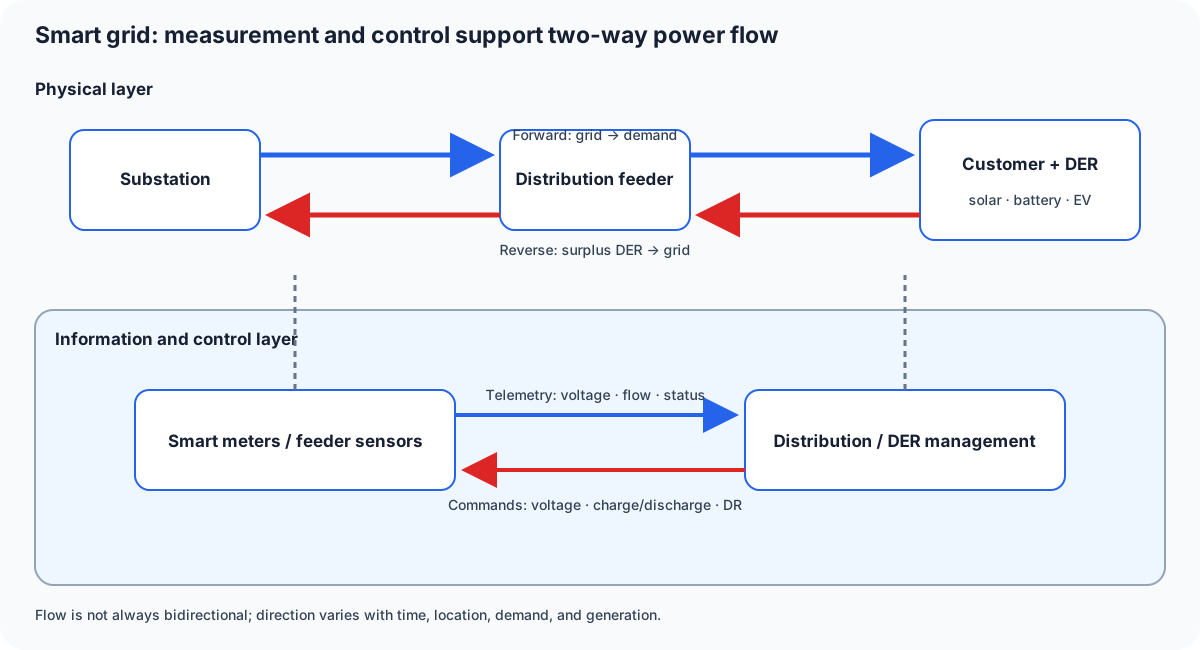
Figure 1 — Power-flow direction varies by section as the balance of demand and DER generation changes. Smart meters and feeder sensors send telemetry to distribution and DER management, which returns voltage, charging, and demand-response commands.
As reverse power flow increases, voltage along the distribution line can rise, raising concern about violating the voltage-maintenance obligations under Japan's Electricity Business Act (101±6V at low voltage, 202±20V, etc.). Voltage was traditionally managed by a substation's on-load tap changer (OLTC) or by section-level automatic voltage regulators (SVR), but these are control schemes premised on electricity flowing from upstream to downstream. When solar output variation and demand variation happen simultaneously on the same distribution line, simple tap control alone can no longer keep up. The smart grid is the umbrella term for the effort to layer metering, communication, and distributed control onto the distribution network in response to this physical shift.
2. The Smart Meter (AMI) — From Meter Reading to a Two-Way Data Platform
A smart meter isn't just a device that measures electricity usage in place of a meter reader. It functions as the endpoint of an entire communication network called AMI (Advanced Metering Infrastructure), with roles that include the following.
- Fine-interval metering: it records usage data at intervals such as 30 minutes and sends it to the utility, forming the basic data behind time-of-use pricing and measuring the effect of demand response.
- Remote connect/disconnect: it can control the supply or cutoff of electricity remotely, without a site visit, for reasons ranging from contract changes to unpaid bills to safety during a disaster.
- Outage detection: by having the meter send a final "last gasp" signal, the utility can grasp the extent of an outage without waiting for phone calls from customers.
In Japan, following policy set by the Ministry of Economy, Trade and Industry, utilities have advanced the switchover to smart meters, and the rollout is said to have been essentially completed for the high-voltage segment (factories, etc.) by 2016 and for the low-voltage segment (households, etc.) by the end of FY2024. This has completed a massive nationwide metering network. The Agency for Natural Resources and Energy is also studying the next stage — a "next-generation smart meter" scheme — positioned as the infrastructure for new services (power-sector DX) built on power data.
Smart meter data is routed through three separate communication paths, used for different purposes.
| Route | Direction of data | Main use | Example communication method |
|---|---|---|---|
| A route | Meter ⇔ utility (transmission and distribution operator) | Meter reading, remote connect/disconnect, grid operation | Wireless multi-hop, 1:N wireless, PLC |
| B route | Meter ⇔ consumer (HEMS, etc.) | Visualization, appliance control, DR | Mainly 920 MHz band wireless (Wi-SUN), secondarily G3-PLC |
| C route | Meter ⇔ retail electricity provider/third party (via A route) | Rate plans, data-utilization services | Business-to-business coordination via the A route |
With usage data passed to the HEMS through the B route, services become possible that manage a home's solar, battery, and air conditioner as a single unit, "visualizing" power use and controlling it automatically.
3. The Layers of Communication Protocols — In-Home Control and Business-to-Business Coordination Are Separate Layers
Smart-grid communication doesn't run on a single protocol. In-home device control and communication between utilities/aggregators call for different properties.
- ECHONET Lite: a protocol for controlling equipment inside a smart house, established by the ECHONET Consortium. Built on UDP/IP, it defines more than 90 device classes, including air conditioners, water heaters, batteries, and EV chargers. Standardized internationally as an ISO/IEC standard, it handles the "last mile" between the HEMS and in-home devices.
- OpenADR (Open Automated Demand Response): an international standard protocol for automatically exchanging demand-response signals between utilities/aggregators and consumers (or their gateways). OpenADR 2.0b is a representative specification used for automating business-to-business DR.
- Grid- and substation-side protocols: protection and control inside a substation use IEC 61850 (see the Substation and Transmission Line Primer for details). Distribution-system monitoring and control sometimes use communication standards such as IEC 60870-5-104 or DNP3, used in SCADA.
In short, ECHONET Lite handles in-home communication, OpenADR handles business-to-business DR signals, and IEC 61850-family protocols handle the transmission/distribution backbone — the smart grid is a system where multiple protocols with different purposes are stacked in layers. It's often misunderstood that there's a single "smart-grid protocol"; there isn't.
4. Demand Response (DR) — Using the Demand Side as a "Power Plant"
Demand response (DR) is a mechanism that controls consumer equipment to give the grid the same effect as raising or lowering a power plant's output. There's "downward DR," which reduces demand when power tends to be scarce, and "upward DR," which increases demand when power tends to be in surplus, such as during midday solar peaks.
Institutionally, it splits broadly into two categories.
- Incentive-based DR: a utility or aggregator directly and remotely controls the equipment of contracted consumers, paying compensation in proportion to the response.
- Rate-based DR: electricity rates change by time of day or during periods of tight supply-demand, letting consumers decide themselves how to change their usage.
Bundling DR so it can be traded on the market as if it were a single power plant is what VPP (Virtual Power Plant) — covered in the next article — does. How DR is traded as a market product is covered in detail in the VPP (Virtual Power Plant) Primer.
5. Self-Healing Distribution Networks
The mechanism that quickly isolates only the faulted section during a transmission-line fault is the very role of protection relays covered in the Substation and Transmission Line Primer. A similar concept exists at the distribution level, called distribution automation. It's already in wide commercial use at Japanese utilities — for example, Kyushu Electric Power Transmission and Distribution's automatic distribution-line control system automatically detects the faulted section and restores power quickly to healthy sections via an alternate route.
One representative scheme is time-delayed sequential restoration. When a fault occurs, the substation breaker first cuts power entirely, then automatic switches installed at each section close in sequence from the substation side, one after another with a set time delay. If a fault current is detected again at a given section, the switch just before it stays open, isolating only the faulted section — power to healthy sections downstream is then routed from an alternate route (an adjacent, interconnected distribution line).
Figure 2 — Distribution automation automatically opens the switches on either side of a faulted section to isolate it, then reroutes power from an adjacent healthy distribution line (a different substation's system), minimizing outage time outside the faulted section itself. The mechanism that makes this decision and switchover happen quickly without human intervention is what's called "self-healing."
This kind of automation existed before the smart grid, but the addition of smart-meter outage detection and real-time sensor data has improved both the accuracy of estimating the faulted section and the speed of restoration. What's new about the term "self-healing grid" isn't automated restoration itself, so much as the fact that the data informing that judgment now extends to data obtained from the consumer side.
6. Voltage Rise and Inverter Voltage Regulation
The first technical challenge that shows up as distributed energy resources increase is voltage rise on the distribution line. Writing the distribution line's impedance as R+jX, the active power sent out as P, and the reactive power as Q, the voltage difference between the sending and receiving ends can be approximated as
When solar generation exceeds demand, P points from the consumer side toward the grid side (the sign flips), which tends to raise voltage at the far end of the distribution line. To suppress this, a combination of measures is used: automatic voltage-regulation functions that let the power conditioner (PCS) automatically adjust reactive power Q, revisions to the control logic of SVRs and automatic voltage regulators, and output curtailment via batteries. Maintaining voltage is "the most unglamorous but most fundamental challenge of the smart grid," and how finely this control can be performed depends on the granularity of AMI data.
7. Current Technology and Research Focus
- Next-generation smart meters: study is underway to revisit the current AMI's communication standards and functionality, aiming for higher-frequency data acquisition and stronger security.
- Digital twins of distribution systems: simulating power flow and voltage on distribution lines to evaluate, in advance, how much distributed generation can be interconnected.
- More sophisticated distribution-level markets and control: examining a Distribution System Operator (DSO)-type function that factors in voltage and power-flow constraints.
- Cybersecurity: with tens of millions of smart meters and their communication networks, the attack surface is large, and authentication, encryption, and anomaly-detection design are now a precondition for operation.
- DERMS (Distributed Energy Resource Management System): a software platform that coordinates and controls large numbers of solar installations, batteries, and EVs within the constraints of the distribution system.
Summary: The Smart Grid Is "a Distribution Network With a Layered Information System"
The smart grid isn't a single technology; it's a system made up of several layered mechanisms — metering via smart meters, multiple layers of communication protocol, demand-side utilization through demand response, and self-healing distribution automation. What they have in common is an attempt to manage, through two-way information flow, a power flow that distributed energy resources have already made physically two-way.
When looking into a region's smart-grid efforts, it's worth checking the following:
- Which communication route and protocol is exchanging what data?
- Who is handling voltage management (PCS, SVR, battery), and on what timescale?
- Is demand response incentive-based or rate-based, and which market or contract does it connect to?
- How much of automatic restoration during a fault completes without human intervention?
Keeping these four points in mind lets you read past a headline like "smart meters are increasing" to the design philosophy of the distribution network behind it.
Does faster communication solve supply–demand balance?
Moving information is different from changing physical power. Check controllable equipment, response times, and communication-loss behavior.
References
- Agency for Natural Resources and Energy — Summary of the Next-Generation Smart Meter System Study Group
- Agency for Natural Resources and Energy — On Smart Meter Opt-Out
- ECHONET Lite Specification/Overview
- Kyushu Electric Power Transmission and Distribution — Automatic Distribution-Line Control System
- Agency for Natural Resources and Energy — Modernizing the Power Network
- Organization for Cross-regional Coordination of Transmission Operators, Japan (OCCTO)
- IEC 61850 — Communication networks and systems for power utility automation
- NREL — Grid Modernization
Current step · 14 / 15 · Power Engineering Primer
Comments
Please log in to post a comment
No comments yet.